DPreview First impression review 5D IV

rishi_sanyal said:
...Which also doesn't detract from the point that with certain competitors, we don't even need to change from AF-C to AF-S for a portrait, because AF-C simply isn't as jumpy as AI Servo is on a Canon...

You must be doing something wrong, because I kept my 5DIII and 1DX, and keep my 1DXII constant in AI Servo, also for portraits. Nothing jumpy happening AF-wise.

Mario
 
Upvote 0
davidhfe said:
romanr74 said:
i start to really dislike the climate/tone in this forum...

Especially since rishi's been pretty patient the last few posts. Chalk it up to just there being a higher s:n than normal bleeding over.

I honestly don't know why he feeds the trolls. And yes, the responses that any mildly critical statement from DPReview generates among otherwise rational people on this site is trolling.

Reviewers are supposed to offer their opinions based on their impressions and experience. I don't understand what is so hard for people to understand about that. Nor, do I understand why anyone who likes and uses Canon products would object to criticisms that might actually lead to better products.
 
Upvote 0
Mario said:
rishi_sanyal said:
...Which also doesn't detract from the point that with certain competitors, we don't even need to change from AF-C to AF-S for a portrait, because AF-C simply isn't as jumpy as AI Servo is on a Canon...

You must be doing something wrong, because I kept my 5DIII and 1DX, and keep my 1DXII constant in AI Servo, also for portraits. Nothing jumpy happening AF-wise.

Mario
I agree. I only swap to one shot when I have to keep something far out in the periphery in focus. I have programmed the back focus button to swap between Servo and One shot. For everything else, I keep Servo. Very often I also have all focus points active, but always keep track of the initial focusing point. However, if you´re using the wrong AF mode, you can run into trouble. So to learn which mode works for what is time well spent.
 
Upvote 0
rishi_sanyal said:
You're once again misunderstanding my entire point. I've loved and used the back wheel many-a-time. But when you can't predict the exact exposure needed in a fraction of a second, you simply can't predict it. Neither can a computer that works far faster than your brain, as exemplified by the hundreds of exposures where the camera's metering system got it wrong. Without the immediate feedback of an EVF, you're telling me you can always overcome your own camera's metering system's shortcomings, predicting exactly the EV your camera will underexpose due to a backlight (especially since spot-metering isn't linked to AF point?), at that moment, on the spot, in a fraction of a second, without even checking your shot?

If you're going to say 'yes' to that, then, yes, I challenge you and claim you're lying, if you're claiming you can do that all the time, on the spot, in the moment. And if you're going to then tell me 'well maybe I'll miss a few shots but I'll eventually catch up', then I'll say: 'but you've missed the moment you wouldn't have missed if your camera hadn't gotten in the way'. And isn't that the entire point - to choose the best tool for the job? I'm literally pointing out the upgrade will help you in this manner. What is your chief complaint? That the old one was always just fine for everyone and that progress isn't actually progress?

Or even if spot-metering were linked to AF point, you're telling me you can get the exact exposure needed to balance the highlights from blowing while keeping the exposure good enough for the faces you're exposing? Even if the difference between those two (the dark faces and the bright backlight) approaches near the dynamic range of your camera?

This makes me wonder - have you even shot fast-paced weddings/events?

It's not a matter of being defensive - I'm beginning to feel you just haven't used these cameras under the stressful situations I have, yet are comfortable commenting on how 'because it's fine for me, it's good enough for everyone'.

When did that ever help those who are actually running up against the limitations of their cameras and working around them - which I know for a fact many, many photographers do (focus and recompose, anyone? Don't tell me you use it because it's literally the best way you could ever think of using AF on a camera...)?

Yes, I have shot weddings... and the bride in her white dress and the groom in his dark suit come walking up the aisle past the row of windows where the sun is streaming in and we flash from dark shade to bright sun to dark shade to bright sun. I doubt that there is a photographer alive who can handle that in full manual mode..... and even if we had the exposure properly coupled to the focus point, do I choose the light bride or the dark groom? There are ALWAYS going to be cases where you are going to have to step in and set it yourself because no automatic mode can cover all possibilities and read your mind.

I will go on record as saying that I love Av and Tv, that I twirl the exposure compensation wheel, and when sufficiently confused (or panicked due to no time) that I have even used the dreaded "green box" mode. When time is a bit more relaxed, I shoot manual. I don't think it matters if I shoot Canon, Nikon, Sony, or whatever.... once you get to a particular level it is the nut holding the camera that is far more important than the camera. Yes, a better camera is a better tool, but only if the person holding it is capable of using that capacity!

As far as AF systems go, I don't believe anything said about them until the person has had a couple of months to play with them.... it takes a long time to get proficient with such a complex system. Of course, in a case where the user is familiar with (for example) the 1DX AF system and they put it into another model, then the learning curve is a lot shorter, but it still takes time.... but this much I am confident to state: Canon did not spend a lot of time and money to make the AF system worse..... of course it is better! Yet somehow, we have people on this forum who have never seen or touched the camera, and are experts on it!

Overall, I thought the review was good. It could have been better in a few places, but it also could have been considerably worse. Given that the title of the review was "first impressions", something which many of the readers here seem to have missed, I expect that at some time in the future you will come out with a far more comprehensive article. In the meantime, please remember that internet criticism is worth the paper it is written on.......
 
Upvote 0
neuroanatomist said:
[quote author=Canon DLC]
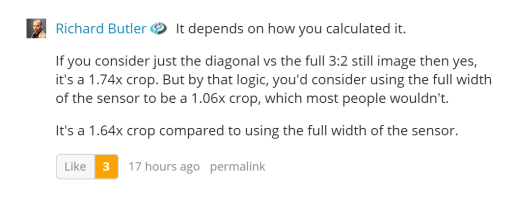
Because of the pixel density on the 5D Mark IV’s 30.4MP sensor, which results in a smaller pixel, its 4K ‘crop factor’ is equivalent to that of a lens with approximately 1.74X the indicated focal length.

[quote author=Rishi et al. @ DPR]
The 5D Mark IV uses a native crop of the sensor for 4K capture, using a 4096 x 2160 pixel region of the sensor. This works out to a 1.64x crop relative to full frame...
[/quote]

[quote author=Rishi @ DPR]
But if you've been reading us for some time, you might know that we don't just read other sites and regurgitate claims. We're make really, really darn sure we're right about something before we say it, and that's usually after exhaustive vetting and testing ourselves.
[/quote]

Hey Rishi - well done with your usual great job of making really, really darn sure you're right about something before saying it!!

Here's a hint: the aspect ratio of Canon's 4K video crop is not the same as the aspect ratio of the entire sensor, so you can't just take the long-side measure of the 6720 x 4480 FF image and divide it by the long-side measure of the 4096 x 2160 4K video output to come up with the crop factor. I suggest that you do the math properly...or if that's too exhausting, you can read what Canon – and the rest of the Internet – say about the 5DIV's 4K crop factor and simply regurgitate that.
[/quote]

You conveniently left out the response of the author (of that section), attached below. This is how we've consistently evaluated video crops in our reviews, so we stuck with it for consistency. If there are enough complaints against it, we'll consider re-evaluating our methodology. As far as I know, no one's complained about this method before, but I'll keep an eye out for it.

Furthermore, saying 'we try very hard to be right' is not the same as saying 'infallible'. We've certainly been wrong before - and transparently stated so in the form of Editor's Notes when we are. It'd be silly to suggest one is never wrong. I see you continue to put words in my mouth and misconstrue what I'm saying to feed your agenda - and that it's simply the nature of some to do so - but I do feel the need to call out what you're doing for what it is.

By the way, I see you've gone silent on your claims that it was us who hadn't 'RTFM' when it came to Auto Area AF with iTR. Since it appears you misunderstood how this mode actually worked, I just wanted to make sure you had a better understanding now, so that you don't continue to erroneously claim that our claims were unfounded and misguided.

-Rishi
 

Attachments

  • Screenshot (1).png
    Screenshot (1).png
    61.9 KB · Views: 157
Upvote 0
Don Haines said:
rishi_sanyal said:
You're once again misunderstanding my entire point. I've loved and used the back wheel many-a-time. But when you can't predict the exact exposure needed in a fraction of a second, you simply can't predict it. Neither can a computer that works far faster than your brain, as exemplified by the hundreds of exposures where the camera's metering system got it wrong. Without the immediate feedback of an EVF, you're telling me you can always overcome your own camera's metering system's shortcomings, predicting exactly the EV your camera will underexpose due to a backlight (especially since spot-metering isn't linked to AF point?), at that moment, on the spot, in a fraction of a second, without even checking your shot?

If you're going to say 'yes' to that, then, yes, I challenge you and claim you're lying, if you're claiming you can do that all the time, on the spot, in the moment. And if you're going to then tell me 'well maybe I'll miss a few shots but I'll eventually catch up', then I'll say: 'but you've missed the moment you wouldn't have missed if your camera hadn't gotten in the way'. And isn't that the entire point - to choose the best tool for the job? I'm literally pointing out the upgrade will help you in this manner. What is your chief complaint? That the old one was always just fine for everyone and that progress isn't actually progress?

Or even if spot-metering were linked to AF point, you're telling me you can get the exact exposure needed to balance the highlights from blowing while keeping the exposure good enough for the faces you're exposing? Even if the difference between those two (the dark faces and the bright backlight) approaches near the dynamic range of your camera?

This makes me wonder - have you even shot fast-paced weddings/events?

It's not a matter of being defensive - I'm beginning to feel you just haven't used these cameras under the stressful situations I have, yet are comfortable commenting on how 'because it's fine for me, it's good enough for everyone'.

When did that ever help those who are actually running up against the limitations of their cameras and working around them - which I know for a fact many, many photographers do (focus and recompose, anyone? Don't tell me you use it because it's literally the best way you could ever think of using AF on a camera...)?

Yes, I have shot weddings... and the bride in her white dress and the groom in his dark suit come walking up the aisle past the row of windows where the sun is streaming in and we flash from dark shade to bright sun to dark shade to bright sun. I doubt that there is a photographer alive who can handle that in full manual mode..... and even if we had the exposure properly coupled to the focus point, do I choose the light bride or the dark groom? There are ALWAYS going to be cases where you are going to have to step in and set it yourself because no automatic mode can cover all possibilities and read your mind.

Yes, exactly. But when you don't have the luxury of chimping, and you don't have a live preview, many will not react, or even know to react, fast enough - and even if he/she did, the question goes back to 'what do you then optimize for - the backlight, or the couple?' And the whole 'but just bracket' argument has been beaten to death, so I won't repeat it here but to simply state that bracketing doesn't come without its costs, especially for fast-paced shooting.

A camera that gives you latitude to not have to worry about this is a better tool in that regard than a camera that doesn't. The 5D IV is a better camera in this regard. Period.

Remember Canon's own market research said Dynamic Range was the #1 request of 5D-series owners. I think that says something over all this forum chatter claiming it doesn't matter... and as I said, as a client I've received files from multiple internationally-recognized wedding photographers that would've benefited from increased exposure latitude. Any technology that ups your keeper rate is progress that allows you to focus on photography, not technical limitations.
 
Upvote 0
rrcphoto said:
I find page 7 incredibly misleading.

What other first impressions review goes on and whines about the prior camera.

Reading it quickly or looking at the photo examples you'd think it was the mark iv

Really? Even though the captions of those very photos state things like 'the Mark IV will make this comically easy'.

And if people thought those photo examples were of the Mark IV - how would that be a bad thing? Considering they're photos a number of commentators have indicated they like, and most of them are used to state some positive aspect of the Canon system - like flash, out-of-box colors, and excellent L glass?

There's an embargo on images shot with the Mark IV we're not willing to break. And 26 consecutive paragraphs of text with no images is - in our opinion - not how you write engaging content.

-Rishi
 
Upvote 0
Orangutan said:
rishi_sanyal said:
Orangutan said:
Not having read any of your reviews, and having read many of Neuroanatomist's posts, I was initially inclined to believe he was being a just a bit snarky and hyperbolic. However, your responses to his posts are not helping your credibility.

For example, this is unprofessional, unscientific rhetoric.
I'm sorry you feel that our merely pointing out shortcomings constitutes bias against an entire brand

Does 'I'm sorry' mean something different here on CR? I'm genuinely confused.

You're making the false assumption that all criticism here is fanboi whining; while some clearly is, there's also some that clearly is not. I'm trying to help you understand that, and you don't seem to care.

Your quote above came across as sarcastic, not as sincere. You start with a straw-man argument, "you feel our merely pointing out shortcomings constitutes bias..." and then add a sarcastic "I'm sorry." Again, I haven't read your reviews, so they may be gems for all I know. I'm merely telling you that you're not defending them very well.

The point Neuroanatomist has made (the truth of which I can't currently judge), is that you're not "merely pointing out shortcomings," as if you had done so in a purely objective way, or as if it could be done in a purely objective way. All reviews and tests have unintentional bias, we get that. As I read the criticism, they are accusing you of two major errors: (1) failing to learn the Canon product well enough to use it as described in the manual; i.e. trying to apply Nikon-centric principles to the Canon product, instead of learning it for what it is; (2) choosing which features and qualities should be emphasized based on which brand wins that particular battle. You need to engage with these complaints professionally, not emotionally. When you lash out emotionally at critique, whether that critique is valid or not, it makes me wonder if your other work is also emotionally tainted or biased.

To reiterate once again: I'm criticizing your defense of your reviews, not the reviews themselves,which I have not read.

(1) It was neuroanatomist that failed to comprehend the manual. See my earlier post.
(2) 'trying to apply Nikon-centric principles to the Canon product' --> the piece he referred to was explicitly titled "Shooting motocross with the Nikon D5 and Canon 1D X II". It was a shootout between the two. We didn't apply any camera's principles to another. The piece concluded that the Canon had a noticeably higher burst rate and better tracking than previous cameras, but that the Nikon had noticeably better subject tracking, as well as a more practically useful Auto Area mode.

The piece simply stated findings, it didn't 'choose which features should be emphasized'. The conclusion literally stated the advantages of each.

As for 'lashing out emotionally at critique', I fail to see how 'I'm sorry you feel this way but... we level criticisms at all cameras... for example here's what we said about the D810... etc.' is constituted as 'unprofessional unscientific rhetoric' that is 'emotionally tainted and biased'.

Perhaps you're misconstruing tone over written internet responses (I believe there's some precedent for this), or I could do a better job in my wording, or some combination thereof?

-Rishi
 
Upvote 0
Interesting postings. Sometimes the "sound" of the postings is a little bit rude.

In my opinion every magazine and author is biased and has its favourite product. Favourite, because he thinks the product is really good, or his company earns money for writing positive reviews.
If I read DPreview reviews, they are sometimes not Canon friendly. And that for, they are critizised here in this forum - as it is a Canon fan-forum.
And sometimes, such reviews miss some details that are the reason for someone to buy it. (e.g.: I personally will use an Canon 80D or 5DIV, because I like to use the f8-AF with my 600mm & 2x extender. But where in most reviews is this mentioned?)
Other suboptimal things are not reported or not underrated. Like AF at sports in sony A7 or the heat problem, also the crowded menu. Or the extraordinary price of the battery grip or the 5DIV body.
So, you are forced to read other reviews too and look for the succus of the given information.

However, you have to credit that Mr. Sanyal writes in this formum, despite all this critizm.

Maybe all canon fanboys and scientists in this forum show him our/your - I hope objective - view of things and pro´s of the product. So Mr. Sanyal gets better insight and is able to review the Canon product more "properly" in his next article.
 
Upvote 0
rishi_sanyal said:
Yes, exactly. But when you don't have the luxury of chimping, and you don't have a live preview, many will not react, or even know to react, fast enough - and even if he/she did, the question goes back to 'what do you then optimize for - the backlight, or the couple?' And the whole 'but just bracket' argument has been beaten to death, so I won't repeat it here but to simply state that bracketing doesn't come without its costs, especially for fast-paced shooting.

A camera that gives you latitude to not have to worry about this is a better tool in that regard than a camera that doesn't. The 5D IV is a better camera in this regard. Period.

Remember Canon's own market research said Dynamic Range was the #1 request of 5D-series owners. I think that says something over all this forum chatter claiming it doesn't matter... and as I said, as a client I've received files from multiple internationally-recognized wedding photographers that would've benefited from increased exposure latitude. Any technology that ups your keeper rate is progress that allows you to focus on photography, not technical limitations.
My first DSLR had about 8 stops of DR and that was all the DR that anyone would ever need :) . Then my new Oly improved to 10 stops and there was no going back..... Then 11 stops with canon.... and now I am at 12 stops with Canon.... my next one will probably by 13 stops, but the more the merrier!

For a while, there were a number of people on this forum jumping up and down and screaming DR DR DR as if it were the only feature that mattered and that made the subject a rather sore point here. Many of us saw it as only one of the factors that were important. I doubt that there was anyone who would not appreciate more DR, but to reiterate the point, it is only one factor!

That said, I'd love to see the 6D2 come out with 14+ stops of DR...... I'd be on that one like a fat boy on a wedding cake!
 
Upvote 0
I never worry about one reviewer at this level. What I like is that I can come here and see counter arguments to whatever is argued on DR. I could critique every style here but overall, the debate is what helps me to get a sense of what really matters and what doesnt because bias turns up in a variety of ways.
 
Upvote 0
rishi_sanyal said:
rrcphoto said:
I find page 7 incredibly misleading.

What other first impressions review goes on and whines about the prior camera.

Reading it quickly or looking at the photo examples you'd think it was the mark iv

Really? Even though the captions of those very photos state things like 'the Mark IV will make this comically easy'.

And if people thought those photo examples were of the Mark IV - how would that be a bad thing? Considering they're photos a number of commentators have indicated they like, and most of them are used to state some positive aspect of the Canon system - like flash, out-of-box colors, and excellent L glass?

There's an embargo on images shot with the Mark IV we're not willing to break. And 26 consecutive paragraphs of text with no images is - in our opinion - not how you write engaging content.

-Rishi

But you have added to the captions, why did you feel the need to do that if you were comfortable with the way you presented your piece previously.

As for your issues with metering; composition and exposure are the two key aspects of any image. Stand two photographers next to each other and their images look different because of the composition and exposure. Anybody using any camera with selective exposure control should understand how and what a meter is doing and how it will represent a scene in front of them. And lets be honest, all digital cameras will meter practically the same in any situation.

It is your skill as a photographer to interpret that reading and make the adjustments you need to get the image to look how you envision, but you know that. I think the general public would assume that people testing any gear for review, especially on the more popular review sites, would not only fully understand all that but be able to use any one of a number of techniques to correctly expose their subjects in any situation they might run into with any regularity. The logical extension of your argument is the low DR slide film was unusable, yet clearly it wasn't.

I am all in favor of simplifying our lives, but for exposure we are talking about iso shutter speed and aperture, nothing more. There are ever more complex ways of prioritizing and automating our exposure which can enable faster selection in some situations given enough practice and skill. But we are still only dealing with three variables and any camera meter is only ever going to register 12.7%, half stop below mid tone. I don't know about you but I rarely want my subject to be 1/2 stop below mid tone so use EC or M mode almost all the time.

You do not have to be some godlike speed demon super hero to use EC, you just need to use cameras regularly and be deliberate about what tonal values you actually want. It takes time, familiarity, application and a certain amount of skill to get your exposures where you want them. It seems to me your argument is 'I don't need skill with other cameras so why should I need that with this one, which isn't the camera we are actually talking about which we think might be a bit better anyway.'

I have no doubt that a lot of what goes on with regards dissecting the tech from all these various manufacturers takes a skill set and understanding not common amongst working photographers, but to get realistic and unbiased user experiences you have to put them in the hands of those working photographers and let them use them in the kinds of situations we will encounter.
 
Upvote 0
xps said:
Interesting postings. Sometimes the "sound" of the postings is a little bit rude.

In my opinion every magazine and author is biased and has its favourite product. Favourite, because he thinks the product is really good, or his company earns money for writing positive reviews.
If I read DPreview reviews, they are sometimes not Canon friendly. And that for, they are critizised here in this forum - as it is a Canon fan-forum.
And sometimes, such reviews miss some details that are the reason for someone to buy it. (e.g.: I personally will use an Canon 80D or 5DIV, because I like to use the f8-AF with my 600mm & 2x extender. But where in most reviews is this mentioned?)
First paragraph of my 'AF' section in my First Impressions:

"The 24% greater vertical frame coverage of the peripheral points will benefit non-central compositions, and F8 autofocus at all points — with the right lens/teleconverter combinations — will be an asset to birding and wildlife photographers."

xps said:
Other suboptimal things are not reported or not underrated. Like AF at sports in sony A7 or the heat problem, also the crowded menu.

Our a7R II review and dedicated piece on shooting football with the a7R II essentially said that sports shooters should simply ignore this camera. I don't think it gets more damning than that.

The overheating was listed as a con until it was addressed, at which point we removed it. Re the menu and ergonomics, here's what I wrote directly in the cons of our a7R II review:

  • Buttons and dials are either too small, recessed, or mushy
  • Inane interactions between menu items lead to poor experience and too many greyed out items
  • Buffer is sluggish to clear, making quick image review and focus check difficult

Some more text of what I wrote about Sony menus, again in our full review:

"Sony's full menu system, accessed by pressing the 'Menu' button on the back of the camera, is frankly a disorganized mess. For example, 22 AF options are split across 11 different submenu pages under 2 different main menu headers. The lack of organization is inexplicable, but what makes it even worse is the lack of a customizable 'My Menu', which would at least have allowed user to collate all frequently used menu options under customizable tabs. It's silly that I have to go to the second line of the fifth page of the sixth tab simply to format my memory card, something you might (and should) often do."

I believe that addresses all your points?

-Rishi
 
Upvote 0
privatebydesign said:
It is your skill as a photographer to interpret that reading and make the adjustments you need to get the image to look how you envision, but you know that. I think the general public would assume that people testing any gear for review, especially on the more popular review sites, would not only fully understand all that but be able to use any one of a number of techniques to correctly expose their subjects in any situation they might run into with any regularity. The logical extension of your argument is the low DR slide film was unusable, yet clearly it wasn't.

It is funny how timing works..... I am scanning some old Kodachrome slides from the early 1950's..... slide film was usable....... but the greatly improved DR on new cameras makes things way better....

To reiterate earlier comments, yes, DR is just ONE factor out of many..... Yes, I want more!..... and yes, I want all the other factors to improve as well......
 

Attachments

  • img014.jpg
    img014.jpg
    2.2 MB · Views: 135
Upvote 0
privatebydesign said:
But you have added to the captions, why did you feel the need to do that if you were comfortable with the way you presented your piece previously.

No, I only added 'Canon 5D Mark III' to one rollover, an oversight due to the fact that that rollover was copied from another article on read noise where we purposefully left brands/cameras out of the discussion. After someone pointed it out here (in a very rude manner, no less), I agreed it best to clarify right in the caption (since I guess some weren't reading the text around it that clearly indicated the 5D IV's improvements addressed such issues).

No other captions were changed. I am very comfortable with the way the piece was originally presented, which is pretty much the same way it's presented now.

privatebydesign said:
As for your issues with metering; composition and exposure are the two key aspects of any image. Stand two photographers next to each other and their images look different because of the composition and exposure. Anybody using any camera with selective exposure control should understand how and what a meter is doing and how it will represent a scene in front of them. And lets be honest, all digital cameras will meter practically the same in any situation.
Well, except for ones that won't spot meter off the chosen AF point.

Also, this was kind of my point: that you have to work around the fact that camera meters aren't perfect always for your creative intent, so technologies like EC and latitude both help you, with the latter particularly helping you when you don't have the time to chimp.
privatebydesign said:
It is your skill as a photographer to interpret that reading and make the adjustments you need to get the image to look how you envision, but you know that.

Yes, agreed. But what you're arguing is, if I may, bit of snobbery: that a 'real photographer' will adjust exposure on the spot, while a (poser?) will try and adjust the exposure after-the-fact. The latter is to be looked down upon, even when the former may not be possible because of the speed of the shooting scenario?

privatebydesign said:
I think the general public would assume that people testing any gear for review, especially on the more popular review sites, would not only fully understand all that but be able to use any one of a number of techniques to correctly expose their subjects in any situation they might run into with any regularity. The logical extension of your argument is the low DR slide film was unusable, yet clearly it wasn't.

The logical extension of your counterargument is that the low DR of slide film was good enough, which I suppose is why most wedding photographers shot negative film that had far more latitude? :)

I'm sure you see my point: most event photographers shot/shoot neg, landscape shooters that had all the time in the world shot slides (I did, anyway). This is precisely why at DPR I keep stating that, if anything, dynamic range is possibly more important for fast-paced shooting scenarios than landscapes; at least you have the time for bracketing and good technique with the latter.

privatebydesign said:
You do not have to be some godlike speed demon super hero to use EC, you just need to use cameras regularly and be deliberate about what tonal values you actually want. It takes time, familiarity, application and a certain amount of skill to get your exposures where you want them. It seems to me your argument is 'I don't need skill with other cameras so why should I need that with this one, which isn't the camera we are actually talking about which we think might be a bit better anyway.'

I use EC all the time. You've misunderstood me. 'It takes time... and a certain amount of skill to get your exposures where you want them' --> exactly. And what I'm saying is this:

... that even some of the best photographers in the world don't have the skill to always predict exactly how much EC would be needed without chimping, and some scenarios don't allow time for chimping (encountered in weddings all the time as a moment is happening). In those scenarios, latitude is beneficial.

Or, times where you actually *want* to dial in negative EC or allow for underexposure to retain highlights. In which case a camera that has more latitude allows you to do so with less of a noise cost.

Is that so very unreasonable?

-Rishi

 
Upvote 0
Eldar said:
neuroanatomist said:
Wesley said:
I'm a single point AF-C, back button focus user. Sometimes 3D tracking.

Seems like I should stick with Nikon for continuous AF.

Definitely, because if you believe DPR, Nikon's AF-C has the uncanny ability to find and lock onto a subject and never ever let go even if the subject is moving at warp speed, and you can underexpose by 5 stops for a faster shutter speed and push the images in post with no penalty*, whereas Canon has AI Servo tracking and sometimes you might get lucky if you're using the right kind of lens.

*Does not apply to Nikon's flagship D5, but that's okay because using fast shutter speeds isn't really important to that camera's user base, so shhhhhh, don't mention the banding!
Eehhh ... I must be doing something wrong ... Because on both the 5DSR and 1DX-II, the tracking seems to be working quite well ... Maybe I should check if some calibration thing is off ::)

I think Eldar makes a very strong point here. I just dont care about DPR opinions anymore, as I dont agree with what they emphasize as important, and not. A major problem, is that they criticize features that work perfectly well in the hands of those who knows their camera. If the "old fashion" AF system delivers the results you want, why should the photographer care if other camera manufacturers has alternative AF-solutions that work better than the similar one, but that you dont use in the Canon camera? It is the results that the photographer can produce that matter.

I have no issues with pointing out that Nikon 3D-tracking is superior to Canon iTR tracking, but the importance of this feature seems very overrated, as the none iTR-tracking works very well for a large crowd of happy 5DIII/1DX users.

Further, I really think DPR fail in order to grasp, and bring out the essence of Canon; their DSLRs does everything very well without much compromise, is very user friendly, and reliable. Canons dont have silly issues such as overheating, hang ups and other bugs. When I read DPR reviews of Sony, they point out many weak points, which Rishi can refer to when claiming his unbiasedness. In my opinion, many of the weak points would be deal breakers, but not for DPR; despite those issues, they still end up praising it like the lord himself, and rate the cameras accordingly. It seems like the Sonys in particular, are rated for what they do better than Canon, but are not punished in the overall score for the MANY things they do worse.

With regards to the summary of the 5DIV, I think it is absurd to illustrate shadow noise in a pushed 5DIII file. It brings an unfair negative angle to the summary, that probably has nothing to do with the 5DIV. I just dont see the point in it.
 
Upvote 0
Larsskv said:
Eldar said:
neuroanatomist said:
Wesley said:
I'm a single point AF-C, back button focus user. Sometimes 3D tracking.

Seems like I should stick with Nikon for continuous AF.

Definitely, because if you believe DPR, Nikon's AF-C has the uncanny ability to find and lock onto a subject and never ever let go even if the subject is moving at warp speed, and you can underexpose by 5 stops for a faster shutter speed and push the images in post with no penalty*, whereas Canon has AI Servo tracking and sometimes you might get lucky if you're using the right kind of lens.

*Does not apply to Nikon's flagship D5, but that's okay because using fast shutter speeds isn't really important to that camera's user base, so shhhhhh, don't mention the banding!
Eehhh ... I must be doing something wrong ... Because on both the 5DSR and 1DX-II, the tracking seems to be working quite well ... Maybe I should check if some calibration thing is off ::)

I think Eldar makes a very strong point here. I just dont care about DPR opinions anymore, as I dont agree with what they emphasize as important, and not. A major problem, is that they criticize features that work perfectly well in the hands of those who knows their camera. If the "old fashion" AF system delivers the results you want, why should the photographer care if other camera manufacturers has alternative AF-solutions that work better than the similar one, but that you dont use in the Canon camera? It is the results that the photographer can produce that matter.

I have no issues with pointing out that Nikon 3D-tracking is superior to Canon iTR tracking, but the importance of this feature seems very overrated, as the none iTR-tracking works very well for a large crowd of happy 5DIII/1DX users.

Further, I really think DPR fail in order to grasp, and bring out the essence of Canon; their DSLRs does everything very well without much compromise, is very user friendly, and reliable. Canons dont have silly issues such as overheating, hang ups and other bugs. When I read DPR reviews of Sony, they point out many weak points, which Rishi can refer to when claiming his unbiasedness. In my opinion, many of the weak points would be deal breakers, but not for DPR; despite those issues, they still end up praising it like the lord himself, and rate the cameras accordingly. It seems like the Sonys in particular, are rated for what they do better than Canon, but are not punished in the overall score for the MANY things they do worse.

To address this very problem, we are trying to build personalized scoring.

Furthermore, I'd point out that the 1D X II's failed predictive algorithms and worse subject tracking for a camera that revolves around AF could've cost it a lot of points, and yet it ended up scoring exactly the same as the D5. So you may be exaggerating exactly how much weight we do place on (certain aspects of) AF overall, since it seems that that's your chief complaint. Canons do *not* do everything well as you suggest. No camera does.

We also don't have a made-up scoring system. It's rigid. You just may not agree with its weightings, and you may also not agree with what aspects of AF are important. I suppose you think AF is 'good enough' the way you use it, but we can't use the same standard, because our audience is not just Canon users. Meanwhile, three ISPWP wedding photographers I interviewed recently that shoot Canon said their top complaint, shooting 5D Mark IIIs, is AF, and that many of their fellow wedding photographers have been switching to Nikon. Would they switch to Nikon though? No, too much inertia, and Canon colors are gorgeous (I agree).

We have to capture all that. It's not easy, but at some point we have to make a choice, and 'good enough for those who aren't aware of other methods that could aid their photography' happens to not be our standard.

The same debates happened for years (and still continue) around DR. It's the same exact thing with AF. Except at least here, a predictive algorithm tripping up and front-focusing on nothing is at least universally considered bad...

Just try and remember that your perspective isn't always the only perspective (and I know you know this). We try our best to synthesize multiple perspective across multiple brands in our assessment, and I'm aware of the philosophical differences here, but please try and understand why we choose our philosophy.

Larsskv said:
With regards to the summary of the 5DIV, I think it is absurd to illustrate shadow noise in a pushed 5DIII file. It brings an unfair negative angle to the summary, that probably has nothing to do with the 5DIV. I just dont see the point in it.

Nothing to do with the 5D IV? It has everything to do with the 5D IV, because the 5D IV addresses the issue head on. Remember, it was Canon that stated it was one of their top concerns because it was the #1 request of 5D-series owners. Meanwhile, I remember very well the sentiment here on CR of 'if Canon actually thought DR were a limitation, they'd have done something about it, but they haven't, so clearly they don't think it's a problem.'

Why are we just trying to tuck that one under the rug?

Also - negative angle? It brings a positive angle to the discussion about the 5D IV.

-Rishi
 
Upvote 0