DPreview First impression review 5D IV

privatebydesign said:
dilbert said:
privatebydesign said:
...
But if it is factually correct it isn''t "name calling" is it? His posts are so weak I feel sorry for him, ergo, he is pathetic. ...

If a girl sleeps with a different guy every night, some might argue that she is a "sl*t" and some might argue that the facts support that however to call said girl a "sl*t" is still an insult. If you see an an African-American in the streets of new york and call him a "black fella" because he has very dark skin (so it is factually true), you're insulting him and quite possibly being racist. In this case, Rishi is the professional journalist, not you, and has been at dpreview for some time. If Rishi was pathetic as you claim then likely dpreview would have let RIshi go. But most importantly, your claim to RIshi being pathetic is based on your opinion of Rishi as a result of articles on dpreview and messages written here - you have no insight as to who Rishi is as a person. Being factual or correct based on the facts you choose is not an excuse for being rude and disrespectful.

I have explained my position and I have provided evidence of complex thought. That your sensibilities are upset by the word I used to describe my feelings isn't my fault. I believe it was a fair and accurate use of the word and is not overtly derogatory but an accurate descriptor in this case.

As for DPReview's opinion of Rishi, I wouldn't claim to have any knowledge of that whatsoever. However as DPReview are owned by "the worlds leading online retailer" I suspect entertainment that leads to sales would be prioritized over objective and honest journalism that doesn't. Read DPReview and you be the judge.

Frankly I don't care who pays my paycheck. My first and foremost objective every morning I wake up is to provide meaningful and correct information to my audience. That is: to my fellow photographers.

Your posts are nothing but juvenile, rude, inhumane, uncalled for and unjustified ad hominem attacks with no actual justification. Therefore, I give up, and reserve the right to relinquish any and all bridges *I* (notably: not you) tried to build in the process.

I'm sorry (and I'm sorry that some will interpret 'I'm sorry' as some unprofessional emotional lashing out as well) a better resolution couldn't be reached.

Kind regards,
Rishi
 
Upvote 0
neuroanatomist said:
Oh, and incidentally I ran across another of Rudy's articles describing how to use iTR:

[quote author=Canon DLC]
Using it is simple:
[list type=decimal]
[*]Set the EOS-1D X to the AI Servo AF mode.
[*]Be sure the camera is set to Automatic AF point selection mode (in the viewfinder, you’ll see a thin border surrounding the AF point array).
[*]Manually select any single point as the starting point for focus tracking, whether centered or off-center.
[*]Activate AF using color information in the Menu: 4th AF menu > Auto AF pt. select criteria > EOS iTR AF
[/list]
That’s it! Now, you begin to initially track a subject at the AF point you dialed in as the starting point. Press whatever button you’re using to activate AF and the camera starts to focus-track your subject. If the subject moves away from that AF point, its shape, size and color are monitored by the RGB metering system and tells the AF system which points to continuously update to keep it in sharp focus.

Tell me, was that the method that DPR's reviewer used when testing out the 1D X II for motocross? Let's see...

[quote author=Dan Bracaglia @ DPR]
I started off the day shooting with the 70-200mm with the camera set to Auto Point Selection, which utilizes iTR. By default it is set to auto area select, in which the camera automatically tries to identify the subject. Unfortunately, I quickly found the camera was easily confused and very much like to focus on nearest patch of dirt in the foreground of my shots.

Thankfully there is an option buried within the dedicated AF menu to switch the camera from auto to manual area select. Once I made the switch, I instantly had success locking and maintaining focus.
[/quote]

Yes, he did...eventually. Amazingly, after that personal revelation where he figured out the proper way to use a camera with which he was manifestly unfamiliar, it magically worked well. Like you, he failed to understand one of the basic functional aspects of Canon's AF systems – as Canon states in their manuals regarding automatic AF point selection, "This mode tends to focus on the nearest subject." Like I said...RTFM.

[/quote]

In my opinion, neuro brings up a very important aspect of how to use iTR tracking, which really wasnt addressed by Rishi in his response.

I found iTR tracking to be a much more useful feature after realizing what neuroanatomist is referring to. This AF mode works much better, and much better to my liking, when you can enable a single af point in order decide where the camera should start its iTR tracking (instead of the nearest subject).

I haven´t ever had the impression that this is understood by DPR reviewers, apart from the above quote made from Dan Bracaglia.
 
Upvote 0
dilbert said:
privatebydesign said:
...
Why should I thank him because he made a correction to a portion of his work that made him look bad?

He isn't accommodating me, I just pointed out he was misleading his readers. A situation he has decided to revert to. Yet you think I should thank him?
...

Let me answer this in another way.

Whenever I see something on the web or elsewhere that is misleading or confusion and I suggest that it could be better expressed, if someone makes a change in response to my feedback I always say "Thanks for doing that" (or words to that effect.) Why do I say "thanks"? Because there is no need for them to make a change and they're essentially making a change because of me.

For all the thousands, hundreds of thousands or millions that have read that article, only one person has thought it needs to be changed.

I disagree. If somebody points out an error of mine I am duty bound to thank them, they don't have to point out I am wrong, they are taking the time and trouble to help me correct my mistakes. Sure it might sting and my pride might take a tiny hit, but I need to see through that and take the enhanced knowledge forwards thanking that person that I am no longer misinforming or misleading anybody else.

Of course there is a need for them to make a change, it is misleading and they are supposed to be journalists!
:CORRECTION: No there is no need for them to change it, they are entertainers.

You have no idea how many people read the article and thought the caption needed changing, I have no idea how many people read the article and mistakenly thought the image shown was from the camera being pre reviewed. I am fairly sure I wasn't the only one of the former and I am equally sure there are more than one of the later.
 
Upvote 0
Larsskv said:
Please dont twist my words, I didn´t claim best or class leading. The point is, you can bring a Canon DSLR to almost every situation and get good results, in both stills or video, action or dim light, birds in flight with teleconverters, and so on. And that is even before talking about the broad lens collection. You cannot make that claim with many of its competitors.

Wrong. Far more nuanced, as any actual seasoned Sony shooter knows (not you, and not me either, but I do need to understand both of you to do my job)

Larsskv said:
To me, DPR scoring system is as mystical as DXO´s. Please tell me how heating up in intended use, or sudden 20 second hang ups when using a Sony camera affects the score...

Hyperbole. Doesn't happen on any even remotely consistent basis.

Larsskv said:
So, what is the choice you make? You prefer mirrorless focusing and eye af, and trusting the camera to choose where to focus. I prefer manual control, so that I decide where to focus.

Absolutely incorrect. I can't stand auto area AF. I always specify what I want to focus on, a staple of candid portraiture and wedding photography.

But please, feel free to misrepresent the position of your opponent to try and make yourself look better.
 
Upvote 0
rishi_sanyal said:
privatebydesign said:
dilbert said:
privatebydesign said:
...
But if it is factually correct it isn''t "name calling" is it? His posts are so weak I feel sorry for him, ergo, he is pathetic. ...

If a girl sleeps with a different guy every night, some might argue that she is a "sl*t" and some might argue that the facts support that however to call said girl a "sl*t" is still an insult. If you see an an African-American in the streets of new york and call him a "black fella" because he has very dark skin (so it is factually true), you're insulting him and quite possibly being racist. In this case, Rishi is the professional journalist, not you, and has been at dpreview for some time. If Rishi was pathetic as you claim then likely dpreview would have let RIshi go. But most importantly, your claim to RIshi being pathetic is based on your opinion of Rishi as a result of articles on dpreview and messages written here - you have no insight as to who Rishi is as a person. Being factual or correct based on the facts you choose is not an excuse for being rude and disrespectful.

I have explained my position and I have provided evidence of complex thought. That your sensibilities are upset by the word I used to describe my feelings isn't my fault. I believe it was a fair and accurate use of the word and is not overtly derogatory but an accurate descriptor in this case.

As for DPReview's opinion of Rishi, I wouldn't claim to have any knowledge of that whatsoever. However as DPReview are owned by "the worlds leading online retailer" I suspect entertainment that leads to sales would be prioritized over objective and honest journalism that doesn't. Read DPReview and you be the judge.

Frankly I don't care who pays my paycheck. My first and foremost objective every morning I wake up is to provide meaningful and correct information to my audience. That is: to my fellow photographers.

Your posts are nothing but juvenile, rude, inhumane, uncalled for and unjustified ad hominem attacks with no actual justification. Therefore, I give up, and reserve the right to relinquish any and all bridges *I* (notably: not you) tried to build in the process.

I'm sorry (and I'm sorry that some will interpret 'I'm sorry' as some unprofessional emotional lashing out as well) a better resolution couldn't be reached.

Kind regards,
Rishi

Oh get over yourself, stop avoiding the facts that are presented to you as evidence of your bias and admit your first paragraph is bullshit, you are an entertainer working an agenda first and foremost, not some noble knight fighting for truth and justice for all photographers.

I have backed up everything I have written, I have not changed my position and those positions have not been shown to be false.

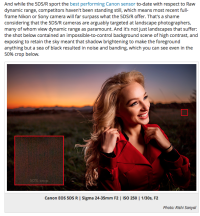
But anytime you want to post the RAW file from your 5DSR comedy skit to illustrate how severely underexposed the background truthfully is you might change my mind about becoming an entertainer, maybe, "impossible-to-control background scene of high contrast" my arse.
 

Attachments

  • Screen Shot 2016-08-27 at 3.45.24 AM.png
    Screen Shot 2016-08-27 at 3.45.24 AM.png
    424 KB · Views: 518
Upvote 0
Larsskv said:
neuroanatomist said:
Oh, and incidentally I ran across another of Rudy's articles describing how to use iTR:

[quote author=Canon DLC]
Using it is simple:
[list type=decimal]
[*]Set the EOS-1D X to the AI Servo AF mode.
[*]Be sure the camera is set to Automatic AF point selection mode (in the viewfinder, you’ll see a thin border surrounding the AF point array).
[*]Manually select any single point as the starting point for focus tracking, whether centered or off-center.
[*]Activate AF using color information in the Menu: 4th AF menu > Auto AF pt. select criteria > EOS iTR AF
[/list]
That’s it! Now, you begin to initially track a subject at the AF point you dialed in as the starting point. Press whatever button you’re using to activate AF and the camera starts to focus-track your subject. If the subject moves away from that AF point, its shape, size and color are monitored by the RGB metering system and tells the AF system which points to continuously update to keep it in sharp focus.

Tell me, was that the method that DPR's reviewer used when testing out the 1D X II for motocross? Let's see...

[quote author=Dan Bracaglia @ DPR]
I started off the day shooting with the 70-200mm with the camera set to Auto Point Selection, which utilizes iTR. By default it is set to auto area select, in which the camera automatically tries to identify the subject. Unfortunately, I quickly found the camera was easily confused and very much like to focus on nearest patch of dirt in the foreground of my shots.

Thankfully there is an option buried within the dedicated AF menu to switch the camera from auto to manual area select. Once I made the switch, I instantly had success locking and maintaining focus.

Yes, he did...eventually. Amazingly, after that personal revelation where he figured out the proper way to use a camera with which he was manifestly unfamiliar, it magically worked well. Like you, he failed to understand one of the basic functional aspects of Canon's AF systems – as Canon states in their manuals regarding automatic AF point selection, "This mode tends to focus on the nearest subject." Like I said...RTFM.

[/quote]

In my opinion, neuro brings up a very important aspect of how to use iTR tracking, which really wasnt addressed by Rishi in his response.

I found iTR tracking to be a much more useful feature after realizing what neuroanatomist is referring to. This AF mode works much better, and much better to my liking, when you can enable a single af point in order decide where the camera should start its iTR tracking (instead of the nearest subject).

I haven´t ever had the impression that this is understood by DPR reviewers, apart from the above quote made from Dan Bracaglia.
[/quote]

And yet, that's exactly how we use iTR when comparing to 3D Tracking. With a manually selected AF point (save for when Dan tried 'auto' in the motocross piece).

Perhaps you should try reading the text in our reviews?

Maybe then PVD wouldn't think I am 'wrong' in not clarifying ALL my points in EVERY image caption, because naturally we're not supposed to assume people read the actual text of our reviews...
 
Upvote 0
neuroanatomist said:
rishi_sanyal said:
You continue to argue with yourself in circles. The metering sensor is absolutely used to initially detect faces, and yet you sit here trying to argue only the PDAF system is first used to detect and track the original subject.

Well, I was going to suggest that you demand your money back from the two Ivy League schools that awarded you degrees in spite of an apparent lack of reading comprehension ability...but then I thought about what you wrote, and it's apparent that you comprehend quite well, but you are unable to admit that you're wrong.

It's actually quite clever, your first statement above is technically correct, but adroitly side-steps the main point under discussion, superficially appearing to respond to a specific point while actually being completely tangential. Seems you're a master of the red herring...not a skill one should be proud of, I think, unless you're the villain in one of Arthur Conan Doyle's novels. But then, your second statement blatantly misrepresents what I've said...again, almost certainly intentional on your part.

"The metering sensor is absolutely used to initially detect faces," yes that's true. Of course, I never claimed otherwise...that's you, dragging a red herring across the trail. At issue is not the initial detection of faces, but rather the initial automatic selection of an AF point when focusing is initiated. That function is performed by the PDAF system alone, and it generally selects the AF point covering the nearest subject. After the AF point is selected by the PDAF system, that location is handed off to the metering system, which detects faces. So, while you're correct that the metering system initially detects faces, it does so only after the PDAF system alone selects an AF point to localize the face detection.

"...yet you sit here trying to argue only the PDAF system is first used to detect and track the original subject," no, that's not what I argued; 'detect' yes, but 'track' is you blatantly misrepresenting my statements. I stated that in automatic AF point selection, the PDAF system is first used to select the AF point – or if you prefer, to detect location of the subject. The metering system is not involved in that step. Once the AF point is selected, the metering system identifies faces/shapes/colors and performs tracking, guiding the AF system in which points to activate to track the moving subject.


rishi_sanyal said:
You have no clue how the actual system works, yet you try to convince unsuspecting bystanders here that you know what you're talking about.

Rishi, where in all of this is your evidence that you have any clue how the actual system works? Throughout my posts, I am quoting direct statements by Canon, which they published for the purpose of educating their users. You seem to be relying on your own (mis)understanding of how the iTR system works, whereas I am relying on public statements by the company which developed the system. Are you saying that Rudy Winston, a technical representative for Canon, is wrong about how iTR works? Why should anyone – me or 'unsuspecting bystanders' – believe that you know more than Canon about how iTR works?


rishi_sanyal said:
I see that I don't even need to refute you when your own community recognizes you for you who you are.

What is apparent is that you are unable to refute my arguments from a techincal standpoint, because they're not my arguments per se, but rather my restatement (and direct quotation) of information from Canon themselves on how the iTR system functions.

So, because you cannot refute my arguments, and you are unable to simply admit your mistake, you're planning to take your marbles and go home.

Ah, so first an initial subject is chosen and focused on *and only then* is a face attempted to be detected and then WHOOPS OMG JUST KIDDING I SHOULD PROBABLY FOCUS ON THAT RIGHT?!

Makes perfect sense.

Keep digging.
 
Upvote 0
rishi_sanyal said:
Maybe then PVD wouldn't think I am 'wrong' in not clarifying ALL my points in EVERY image caption, because naturally we're not supposed to assume people read the actual text of our reviews...

Seriously? Including the camera and lens in the CAPTION, especially when they are not the camera being previewed, is onerous? It doesn't have any informational value? It doesn't prevent any misunderstanding? It doesn't give you unimpeachable claims to fairness and accuracy?
 
Upvote 0
privatebydesign said:
But anytime you want to post the RAW file from your 5DSR comedy skit to illustrate how severely underexposed the background truthfully is you might change my mind about becoming an entertainer, maybe, "impossible-to-control background scene of high contrast" my arse.

Aargh ! That picture again. It drives me nuts. If you're answer to every situation is to severely under expose for God's sake get a Nikon.
 
Upvote 0
rishi_sanyal said:
Larsskv said:
neuroanatomist said:
Oh, and incidentally I ran across another of Rudy's articles describing how to use iTR:

[quote author=Canon DLC]
Using it is simple:
[list type=decimal]
[*]Set the EOS-1D X to the AI Servo AF mode.
[*]Be sure the camera is set to Automatic AF point selection mode (in the viewfinder, you’ll see a thin border surrounding the AF point array).
[*]Manually select any single point as the starting point for focus tracking, whether centered or off-center.
[*]Activate AF using color information in the Menu: 4th AF menu > Auto AF pt. select criteria > EOS iTR AF
[/list]
That’s it! Now, you begin to initially track a subject at the AF point you dialed in as the starting point. Press whatever button you’re using to activate AF and the camera starts to focus-track your subject. If the subject moves away from that AF point, its shape, size and color are monitored by the RGB metering system and tells the AF system which points to continuously update to keep it in sharp focus.

Tell me, was that the method that DPR's reviewer used when testing out the 1D X II for motocross? Let's see...

[quote author=Dan Bracaglia @ DPR]
I started off the day shooting with the 70-200mm with the camera set to Auto Point Selection, which utilizes iTR. By default it is set to auto area select, in which the camera automatically tries to identify the subject. Unfortunately, I quickly found the camera was easily confused and very much like to focus on nearest patch of dirt in the foreground of my shots.

Thankfully there is an option buried within the dedicated AF menu to switch the camera from auto to manual area select. Once I made the switch, I instantly had success locking and maintaining focus.

Yes, he did...eventually. Amazingly, after that personal revelation where he figured out the proper way to use a camera with which he was manifestly unfamiliar, it magically worked well. Like you, he failed to understand one of the basic functional aspects of Canon's AF systems – as Canon states in their manuals regarding automatic AF point selection, "This mode tends to focus on the nearest subject." Like I said...RTFM.

In my opinion, neuro brings up a very important aspect of how to use iTR tracking, which really wasnt addressed by Rishi in his response.

I found iTR tracking to be a much more useful feature after realizing what neuroanatomist is referring to. This AF mode works much better, and much better to my liking, when you can enable a single af point in order decide where the camera should start its iTR tracking (instead of the nearest subject).

I haven´t ever had the impression that this is understood by DPR reviewers, apart from the above quote made from Dan Bracaglia.
[/quote]

And yet, that's exactly how we use iTR when comparing to 3D Tracking. With a manually selected AF point (save for when Dan tried 'auto' in the motocross piece).

Perhaps you should try reading the text in our reviews?

Maybe then PVD wouldn't think I am 'wrong' in not clarifying ALL my points in EVERY image caption, because naturally we're not supposed to assume people read the actual text of our reviews...
[/quote]

Excuse me, but I have read over and over again, that you find that Canons iTR focusing doesn't focus where you wish it would, but some foreground element, which proves that you dont use a selected AF-point to start the iTR focusing.
 
Upvote 0
Sporgon said:
privatebydesign said:
But anytime you want to post the RAW file from your 5DSR comedy skit to illustrate how severely underexposed the background truthfully is you might change my mind about becoming an entertainer, maybe, "impossible-to-control background scene of high contrast" my arse.

Aargh ! That picture again. It drives me nuts. If you're answer to every situation is to severely under expose for God's sake get a Nikon.

The ironic thing is that even if you put a 5Ds image with banding beside a squeaky clean D810 image, most people would probably prefer the 5Ds, because it's totally unnatural to comb through dark patches looking for banding, and the 5Ds will capture the subject better.
 
Upvote 0
dilbert said:
Sporgon said:
privatebydesign said:
But anytime you want to post the RAW file from your 5DSR comedy skit to illustrate how severely underexposed the background truthfully is you might change my mind about becoming an entertainer, maybe, "impossible-to-control background scene of high contrast" my arse.

Aargh ! That picture again. It drives me nuts. If you're answer to every situation is to severely under expose for God's sake get a Nikon.

So using the picture of the woman in the foreground of a sunset as an example, how would you have exposed the image so that highlights in neither the woman or sky were blown? How would you have composed and exposed the picture?

The highlights in neither the woman or the sky ? They are independent, the girl in filled with flash ???

I actually reconstructed this situation because I was intrigued as to how Rishi had made the 5Ds look so bad, and posted it on CR, but that was ages back, perhaps six months, and I'm not going looking for it now. I estimated (correctly as it turned out) that he had shot this half an hour after the sun had gone down, and I demonstrated that he had under exposed the highlights in the evening sky by about 1.5 stops. I also gave my e mail address and told Rishi that if I was wrong he could send me the raw file for me to analyse. He didn't.

Also the girl clearly thinks its a huge joke that Rishi is attempting this shot with a Canon rather than a Sony ;)

9VIII said:
The ironic thing is that even if you put a 5Ds image with banding beside a squeaky clean D810 image, most people would probably prefer the 5Ds, because it's totally unnatural to comb through dark patches looking for banding, and the 5Ds will capture the subject better.

I agree. I've tried various makes of camera using the Sony sensor, and I can honestly say I prefer the characteristics of the Canon. So do others, which is probably why on the latest Canons they are "still behind Sony and Nikon". But when I was using these other cameras I did find myself beginning to under expose in relation to how I shoot with Canon. I suppose it's just human nature; we get away with as little effort as we can when the opportunity presents.
 
Upvote 0
dilbert said:
Sporgon said:
dilbert said:
...
So using the picture of the woman in the foreground of a sunset as an example, how would you have exposed the image so that highlights in neither the woman or sky were blown? How would you have composed and exposed the picture?

The highlights in neither the woman or the sky ? They are independent, the girl in filled with flash ???

I actually reconstructed this situation because I was intrigued as to how Rishi had made the 5Ds look so bad, and posted it on CR, but that was ages back, perhaps six months, and I'm not going looking for it now.
...

That's a pity as it would be interesting to see how you shot the same type of composition and to see if there is any shadow noise in your shot.

When I copied what Rishi had done the shadow noise in my shot was horrendous !

(But remember I copied: I was trying to see what he had done, not do it properly).
 
Upvote 0
dilbert said:
Sporgon said:
...

When I copied what Rishi had done the shadow noise in my shot was horrendous !

(But remember I copied: I was trying to see what he had done, not do it properly).

If only you'd done it properly, you'd have been able to show us how it should be done.

Yes I agree. At the time I was just fixated on replicating what he had done to cripple the 5Ds for my own interest rather than do it properly.
 
Upvote 0
rishi_sanyal said:
neuroanatomist said:
rishi_sanyal said:
You have no clue how the actual system works, yet you try to convince unsuspecting bystanders here that you know what you're talking about.

Rishi, where in all of this is your evidence that you have any clue how the actual system works? Throughout my posts, I am quoting direct statements by Canon, which they published for the purpose of educating their users. You seem to be relying on your own (mis)understanding of how the iTR system works, whereas I am relying on public statements by the company which developed the system. Are you saying that Rudy Winston, a technical representative for Canon, is wrong about how iTR works? Why should anyone – me or 'unsuspecting bystanders' – believe that you know more than Canon about how iTR works?

Ah, so first an initial subject is chosen and focused on *and only then* is a face attempted to be detected and then WHOOPS OMG JUST KIDDING I SHOULD PROBABLY FOCUS ON THAT RIGHT?!

Makes perfect sense.

Keep digging.

Ah, so you have no evidence to suggest that you understand how iTR works, but you believe it works differently than Canon says it does...and you think that sarcastically shouting your incorrect belief will make it true. News flash: it doesn't.

If you'd like to present some factual evidence to back up your claims that iTR functions differently than Canon describes, I'd be happy to listen and learn. In the meantime, continuing to demonstrate your lack of understanding merely makes you look foolish and petulant.


rishi_sanyal said:
My first and foremost objective every morning I wake up is to provide meaningful and correct information to my audience.

Fail.
 
Upvote 0
Otara said:
Well one thing this thread has encouraged me to do is try ITR again, after DPR put me off it in reviews.

So thanks for that, regardless of outcome, at least I have some new ideas on how to try using it.

I'm glad that some meaningful and correct information here on CR helped you out. :)
 
Upvote 0
ok people, step back from the keyboard, go outside, take some pictures.....

It doesn't matter which camera it is, what mode it is in, or who is using it.... If the scene has too much DR for the camera, you can't capture it all in one shot. You can expose for highlights, expose for shadows, or somewhere in the middle, but whatever you choose something is either going to be noise or washed out... You have three options: wait for technology to give you more DR, shoot HDR and hope that it works, or you can admit the limitations of today's technology and deal with it.

As to AF usage: Everyone - Admit that Canon AF and Nikon AF work differently and that a test that is good for one system may be a poor test for the other system. Rishi - take some of the suggestions here and integrate them into a proper review of the 5D IV. Everyone else - It was "FIRST IMPRESSIONS", not a comprehensive review.... wait for the proper review..... modern AF systems are complex and it is going to take a reviewer (or a camera buyer) time to get used to the system and start to get decent results. Of course Rishi is not using it perfectly; but to be fair, none of us would pick up a new body and be instant experts either. <EDIT> except Neuro.... he knows too much and types too fast to be human...there is a distinct possibility that he is a cyborg sent back from the future with a secondary mission to kill Sarah Conners and a primary mission to annoy Dilbert </EDIT>
 
Upvote 0
Don Haines said:
It was "FIRST IMPRESSIONS", not a comprehensive review.... wait for the proper review..... modern AF systems are complex and it is going to take a reviewer (or a camera buyer) time to get used to the system and start to get decent results. Of course Rishi is not using it perfectly; but to be fair, none of us would pick up a new body and be instant experts either.

Fair point. But, if subsequent time and knowledge reveal that some of your 'first impressions' were incorrect, you have two options:

[list type=decimal]
[*]Acknowledge your mistake and correct the misinformation you previously posted
[*]Stubbornly defend the original, incorrect information you initially presented
[/list]

The first one is called "integrity," and I have seen DPR choose that approach on occasion. The second is called "dishonesty," and that's the approach Rishi is taking here.
 
Upvote 0
dilbert said:
Sporgon said:
dilbert said:
...
So using the picture of the woman in the foreground of a sunset as an example, how would you have exposed the image so that highlights in neither the woman or sky were blown? How would you have composed and exposed the picture?

The highlights in neither the woman or the sky ? They are independent, the girl in filled with flash ???

I actually reconstructed this situation because I was intrigued as to how Rishi had made the 5Ds look so bad, and posted it on CR, but that was ages back, perhaps six months, and I'm not going looking for it now.
...

That's a pity as it would be interesting to see how you shot the same type of composition and to see if there is any shadow noise in your shot.

http://www.canonrumors.com/forum/index.php?topic=29255.msg582690#msg582690

It's important to remember that the subject is entirely illuminated by the flash so her exposure is irrelevant to the discussion.
 
Upvote 0