DSLR ? - thinking out loud ....

Lee Jay said:
The problem is, you can never beat some aspects of an OVF with an EVF. How are you going to improve on zero lag, zero power use, virtually infinite dynamic range and color gamut?
The human visual system already has lag, and some EVFs are getting quite close to human lag. I think lag may be one of the first impediments to fall.

As for the DR and color, that's precisely why I want an EVF: I want to compose using what the sensor can see, so I have a better idea of the final image. This is another plus for EVF.

EVFs suck power like crazy. You're going to need a battery breakthrough to replace OVFs as well, or an enormous battery that more than makes up for the size difference of removing the prism and mirror.
Yup, this one is still a real problem for event/action photographers. For landscape/studio not so much.
 
Upvote 0
Orangutan said:
Lee Jay said:
The problem is, you can never beat some aspects of an OVF with an EVF. How are you going to improve on zero lag, zero power use, virtually infinite dynamic range and color gamut?
The human visual system already has lag, and some EVFs are getting quite close to human lag. I think lag may be one of the first impediments to fall.

As for the DR and color, that's precisely why I want an EVF: I want to compose using what the sensor can see, so I have a better idea of the final image. This is another plus for EVF.

EVFs suck power like crazy. You're going to need a battery breakthrough to replace OVFs as well, or an enormous battery that more than makes up for the size difference of removing the prism and mirror.
Yup, this one is still a real problem for event/action photographers. For landscape/studio not so much.

Until you take that evf into very low light. Then It shutters and flops around like a fish out of water. (With the a7 anyway.)
 
Upvote 0
RLPhoto said:
Orangutan said:
Lee Jay said:
The problem is, you can never beat some aspects of an OVF with an EVF. How are you going to improve on zero lag, zero power use, virtually infinite dynamic range and color gamut?
The human visual system already has lag, and some EVFs are getting quite close to human lag. I think lag may be one of the first impediments to fall.

As for the DR and color, that's precisely why I want an EVF: I want to compose using what the sensor can see, so I have a better idea of the final image. This is another plus for EVF.

EVFs suck power like crazy. You're going to need a battery breakthrough to replace OVFs as well, or an enormous battery that more than makes up for the size difference of removing the prism and mirror.
Yup, this one is still a real problem for event/action photographers. For landscape/studio not so much.

Until you take that evf into very low light. Then It shutters and flops around like a fish out of water. (With the a7 anyway.)

For now, but it's not an intractable problem. I'm not saying mirrorless replaces OVF completely right now, but it's definitely heading that way.
 
Upvote 0
Vossie said:
Many may think that OVF will always be superior to EVFs because they are today, but a decade ago, many also thought that film would always be superior to digital.

Nobody with a clue thought that.


Orangutan said:
As for the DR and color, that's precisely why I want an EVF: I want to compose using what the sensor can see, so I have a better idea of the final image. This is another plus for EVF.

Not really. The dynamic range and color gamut of any display technology is very limited compared with the range of the sensor and your eye. The difference becomes readily apparent when shooting at night. Maybe in twenty years, EVFs will be able to replace OVFs, but I thought that twenty years ago, and they just haven't gotten much better in all that time, except in resolution, so I'm not holding my breath.
 
Upvote 0
Orangutan said:
As for the DR and color, that's precisely why I want an EVF: I want to compose using what the sensor can see, so I have a better idea of the final image. This is another plus for EVF.

So you want a better idea of what the in-camera JPG conversion will look like, if displayed on an uncalibrated monitor with low resolution and a poor color gamut? Sounds like a big minus for EVF to me, particularly for anyone who shoots RAW...
 
Upvote 0
neuroanatomist said:
Orangutan said:
As for the DR and color, that's precisely why I want an EVF: I want to compose using what the sensor can see, so I have a better idea of the final image. This is another plus for EVF.

So you want a better idea of what the in-camera JPG conversion will look like, if displayed on an uncalibrated monitor with low resolution and a poor color gamut? Sounds like a big minus for EVF to me, particularly for anyone who shoots RAW...

mmm exactly my feel on this too - I can visualize my postprocessing without the camera showing it's default constrast and color of the scene.
 
Upvote 0
These are all good points. The wild card is the one that may be hard (even by Canon) to track.
The 5DMII created a whole new customer base that did not exist before…. the video people. Spread across both the Rebel line and above. After that the large sensor video camera market exploded across the whole spectrum and its proving to be both big and profitable. My guess is that whatever marketing numbers are floating around don’t differentiate between the customers who use their DSLR for video primarily and those who are legitimate still photographers and those in between. The cash-flow from new video customers has not been insignificant. The Canon Cinema line is a good one but it prices users at the T5i-70D price point out of that market.

For still photo guys the following wont matter much so you can skip this part …. but, speaking of video now, the Panasonic GH4 and SONY A7s and Black Magic will eat into Canons market share for sure. How far Canon can respond without compromising their high end C-line will also be a challenge for them. In the end perhaps it’s ok for them to get back more to their still picture roots but as I may have already said, its a vastly more complicated and competitive market now that it was back in the day.
 
Upvote 0
Orangutan said:
Lee Jay said:
The problem is, you can never beat some aspects of an OVF with an EVF. How are you going to improve on zero lag, zero power use, virtually infinite dynamic range and color gamut?
The human visual system already has lag, and some EVFs are getting quite close to human lag.

If they are the same, then the EVF is doubling the system lag.

As for the DR and color, that's precisely why I want an EVF: I want to compose using what the sensor can see, so I have a better idea of the final image. This is another plus for EVF.

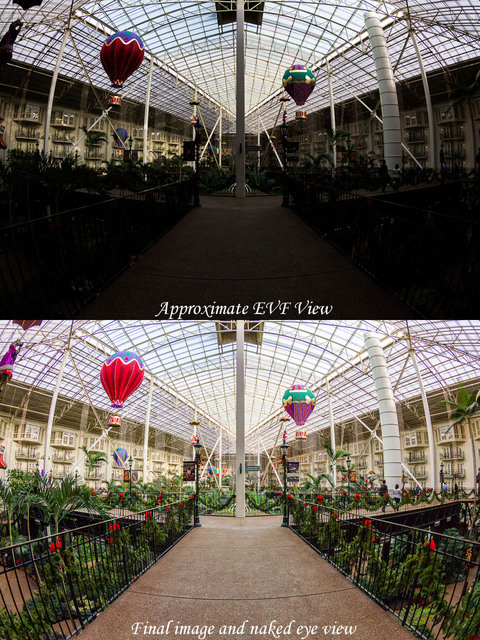
Sorry, EVFs don't show that, they show the in-camera JPEG conversion, which is way, way smaller than what the sensor can see. I post this example often:

EVF%20OVF%20View%20comparison.jpg
 
Upvote 0
neuroanatomist said:
Orangutan said:
As for the DR and color, that's precisely why I want an EVF: I want to compose using what the sensor can see, so I have a better idea of the final image. This is another plus for EVF.

So you want a better idea of what the in-camera JPG conversion will look like, if displayed on an uncalibrated monitor with low resolution and a poor color gamut? Sounds like a big minus for EVF to me, particularly for anyone who shoots RAW...

I'm surprised, you don't usually make bad arguments. You have invoked the "it is thus and ever shall be" argument. I'm saying I want an improved Live View through the viewfinder, and I believe it's achievable in the next few years. I'm not saying current EVF is adequate.
 
Upvote 0
Lee Jay said:
Orangutan said:
Lee Jay said:
The problem is, you can never beat some aspects of an OVF with an EVF. How are you going to improve on zero lag, zero power use, virtually infinite dynamic range and color gamut?
The human visual system already has lag, and some EVFs are getting quite close to human lag.

If they are the same, then the EVF is doubling the system lag.
Human vision lag is, if I remember correctly, about 100ms. Current best EVF lag is, if I recall correctly, about 30ms. That could easily come down to 10ms in the next few years, and I doubt you could distinguish a 10% increase from OVF.

As for the DR and color, that's precisely why I want an EVF: I want to compose using what the sensor can see, so I have a better idea of the final image. This is another plus for EVF.

Sorry, EVFs don't show that, they show the in-camera JPEG conversion, which is way, way smaller than what the sensor can see. I post this example often:
The fact that they don't currently doesn't mean they can't very soon. Do you ever use Live View? I'm still unpersuaded that, aside from battery life, there are any serious problems with EVF that can't be overcome in a very few years. And, when that happens, EVF will be indisputably superior to OVF.
 
Upvote 0
Orangutan said:
Lee Jay said:
Sorry, EVFs don't show that, they show the in-camera JPEG conversion, which is way, way smaller than what the sensor can see. I post this example often:
The fact that they don't currently doesn't mean they can't very soon. Do you ever use Live View? I'm still unpersuaded that, aside from battery life, there are any serious problems with EVF that can't be overcome in a very few years. And, when that happens, EVF will be indisputably superior to OVF.
I have a pair of the Olympus "tough" waterproof cameras... One is about 4 years old and the other is last years model. A friend just bought the latest version. On the 4 year old one, lag is very noticeable and the viewfinder sucks in poor light. On the one year old one, lag is not noticeable and the viewfinder is noisy in poor light. On the new one, there is no noticeable lag and the viewfinder is close to what the eye sees in poor light.

This is the march of progress. Just using this as an example, four years ago I would have said that EVFs are a long way off, but today I would say that they are close..... and this is with a cheap P/S camera. The viewfinder in the OMD EM-1 is superior to this EVF... and what is coming down the pipes? What do Canon/Nikon/Sony have planned for the future?

Ever use liveview on your DSLR? Ever zoom in 10X to check the focus? This is a trivial problem for an EVF, yet impossible for an OVF.... you have the option to switch between what the sensor sees and processed views....

And now lets travel back in time to the origins of the SLR camera... it was an ingenious design that allowed the eye to see the light that would be presented to the film. A DSLR with an OVF is the same, it allows your eye to see the light that is presented to the sensor. An EVF goes one step further and allows you to see the light as viewed by the sensor.

New cameras have ten times or more computing power than those of just a couple years ago... they can do complex noise correction on the fly.... the on-the-screen jpg of four years ago is not the same as it is today. You can not use the inadequacies of the past to justify the future.

 
Upvote 0
Orangutan said:
Lee Jay said:
Orangutan said:
Lee Jay said:
The problem is, you can never beat some aspects of an OVF with an EVF. How are you going to improve on zero lag, zero power use, virtually infinite dynamic range and color gamut?
The human visual system already has lag, and some EVFs are getting quite close to human lag.

If they are the same, then the EVF is doubling the system lag.
Human vision lag is, if I remember correctly, about 100ms. Current best EVF lag is, if I recall correctly, about 30ms. That could easily come down to 10ms in the next few years, and I doubt you could distinguish a 10% increase from OVF.

As for the DR and color, that's precisely why I want an EVF: I want to compose using what the sensor can see, so I have a better idea of the final image. This is another plus for EVF.

Sorry, EVFs don't show that, they show the in-camera JPEG conversion, which is way, way smaller than what the sensor can see. I post this example often:
The fact that they don't currently doesn't mean they can't very soon. Do you ever use Live View? I'm still unpersuaded that, aside from battery life, there are any serious problems with EVF that can't be overcome in a very few years. And, when that happens, EVF will be indisputably superior to OVF.

Human visual lag cannot be characterized by a single number, and recent experiments have shown that it is at least faster than 16ms.

No, I never use live view.
 
Upvote 0
Orangutan said:
I'm surprised, you don't usually make bad arguments. You have invoked the "it is thus and ever shall be" argument. I'm saying I want an improved Live View through the viewfinder, and I believe it's achievable in the next few years. I'm not saying current EVF is adequate.

It might get there eventually, but IMO we'll need much better display tech than currently is available. The real problem is that the needs of cameras go way beyond the needs of TV sets, where overly bright blacks and compromised color accuracy are acceptable compromises in the name of increased dynamic range. Unfortunately, the market for EVFs is also miniscule compared with the market for TVs, so most of the research is going towards improving TVs, rather than improving niche products like EVFs. This means we're likely to have to wait until TVs exceed the requirements for EVFs so the technology can bubble down. I could be wrong, but I'd expect a very long wait. :)
 
Upvote 0
Lee Jay said:
Orangutan said:
Lee Jay said:
The problem is, you can never beat some aspects of an OVF with an EVF. How are you going to improve on zero lag, zero power use, virtually infinite dynamic range and color gamut?
The human visual system already has lag, and some EVFs are getting quite close to human lag.

If they are the same, then the EVF is doubling the system lag.

As for the DR and color, that's precisely why I want an EVF: I want to compose using what the sensor can see, so I have a better idea of the final image. This is another plus for EVF.

Sorry, EVFs don't show that, they show the in-camera JPEG conversion, which is way, way smaller than what the sensor can see. I post this example often:

EVF%20OVF%20View%20comparison.jpg

All this example shows is that you don't know how to use a camera.

In one of the A7R launch interviews the photographer was giving examples of low light pictures where the camera was picking up details he couldn't see (people in the background).
 
Upvote 0
Don Haines said:
Orangutan said:
Lee Jay said:
Sorry, EVFs don't show that, they show the in-camera JPEG conversion, which is way, way smaller than what the sensor can see. I post this example often:
The fact that they don't currently doesn't mean they can't very soon. Do you ever use Live View? I'm still unpersuaded that, aside from battery life, there are any serious problems with EVF that can't be overcome in a very few years. And, when that happens, EVF will be indisputably superior to OVF.
I have a pair of the Olympus "tough" waterproof cameras... One is about 4 years old and the other is last years model. A friend just bought the latest version. On the 4 year old one, lag is very noticeable and the viewfinder sucks in poor light. On the one year old one, lag is not noticeable and the viewfinder is noisy in poor light. On the new one, there is no noticeable lag and the viewfinder is close to what the eye sees in poor light.

This is the march of progress. Just using this as an example, four years ago I would have said that EVFs are a long way off, but today I would say that they are close..... and this is with a cheap P/S camera. The viewfinder in the OMD EM-1 is superior to this EVF... and what is coming down the pipes? What do Canon/Nikon/Sony have planned for the future?

Ever use liveview on your DSLR? Ever zoom in 10X to check the focus? This is a trivial problem for an EVF, yet impossible for an OVF.... you have the option to switch between what the sensor sees and processed views....

And now lets travel back in time to the origins of the SLR camera... it was an ingenious design that allowed the eye to see the light that would be presented to the film. A DSLR with an OVF is the same, it allows your eye to see the light that is presented to the sensor. An EVF goes one step further and allows you to see the light as viewed by the sensor.

New cameras have ten times or more computing power than those of just a couple years ago... they can do complex noise correction on the fly.... the on-the-screen jpg of four years ago is not the same as it is today. You can not use the inadequacies of the past to justify the future.

Excellent comments. It really comes down to technology in the end. Just because a thing does not exist now does not mean it won't exist soon enough. What is an EVF? Its a name for a feature on a camera. A feature which can be comprised of any technology with any specifications. The problems people here have with current EVFs only have relevance to existing technology but not to what they'll be shipping in a few years.
 
Upvote 0
Lee Jay said:
As for the DR and color, that's precisely why I want an EVF: I want to compose using what the sensor can see, so I have a better idea of the final image. This is another plus for EVF.

Sorry, EVFs don't show that, they show the in-camera JPEG conversion, which is way, way smaller than what the sensor can see. I post this example often:

EVF%20OVF%20View%20comparison.jpg

Here is a tip for you, if you got an A7 type of camera what you do is turn on DRO and then what you see through the EVF is pretty much comparable to your final image, and the raw's are unaffected by this setting.
 
Upvote 0
Clayton said:
Excellent comments. It really comes down to technology in the end. Just because a thing does not exist now does not mean it won't exist soon enough. What is an EVF? Its a name for a feature on a camera. A feature which can be comprised of any technology with any specifications. The problems people here have with current EVFs only have relevance to existing technology but not to what they'll be shipping in a few years.

Wise words. It seems that Canon are holding back until the technology is to their satisfaction. That's an approach also taken by Apple.

The current Eos M is just a toe in the water. The increasing range of lenses show that they are serious about the format, the current M is a valuable part of their development, and there is now an EVF for the G1 X, which could conceivably be built into a future model to eventually replace the Rebel series cameras. The SL1 is impressive, but will be outclassed by EF-M cameras as the march of electronic EVF (and sensor) progress surges forward in accordance with Moore's law.

I'm looking forward to it, but sticking with my full frame and pentaprism 6D for now. I would like to also own a smaller alternative for everyday - an Eos M with built in grip and EVF could win Canon my money.
 
Upvote 0
It seems some comments are coming from people who haven't used a MILC with a decent EVF.

Higher end mirrorless and EVFs are at the point NOW where they are comparable to many consumer/prosumer DSLRs in performance in most conditions, including low light. Give them another year or 2 and they will likely be on par with their mirror-flapping counterparts. .. And then they'll exceed them.

The EVFs in current Olympus and Fuji cameras are impressive and I'm sure Sony's are comparable as well.
They're OLED, so have very good dynamic range and color gamut. Lag exists but in some of them, like the Fuji XT1, it's quite minimal in decent light and not bad in low light either.

I attended an event last nite, turned out to be a dim and poorly lit club. I wanted a compact but reasonably capable camera with me. So I grabbed an old Fuji XE1 over a Pentax Q because I wanted an EVF. Unfortunately, I grabbed one I'd just bought used so I had not yet set it up the way I liked. As it is, I barely use the XE1 enough to be partly atuned to it so there were plenty of shots I could have done better using more familiar gear. It didn't matter, this was not a job.
I used the 27mm f/2.8 pancake prime on it; very light, small and discreet compared to any sort of DSLR.

The XE1 is slightly older tech already, and it still performed better than I expected and certainly was no worse to use than a small pentamirror OVF in a consumer DSLR. Actually, it was no problem framing and composing images in low light where I had to use iso 3200 or 6400 at 1/15s and f/4.

AF performance was not great but it was still possible to do a good manual focus using the magnified live view in the EVF fairly quickly when needed. I don't think many consumer grade DSLRs would have had much better AF performance on the dark and low contrast targets I shot anyway but they may have been a bit quicker for focus and recompose or some of the moving targets.
 
Upvote 0
Orangutan said:
neuroanatomist said:
Orangutan said:
As for the DR and color, that's precisely why I want an EVF: I want to compose using what the sensor can see, so I have a better idea of the final image. This is another plus for EVF.

So you want a better idea of what the in-camera JPG conversion will look like, if displayed on an uncalibrated monitor with low resolution and a poor color gamut? Sounds like a big minus for EVF to me, particularly for anyone who shoots RAW...

I'm surprised, you don't usually make bad arguments. You have invoked the "it is thus and ever shall be" argument. I'm saying I want an improved Live View through the viewfinder, and I believe it's achievable in the next few years. I'm not saying current EVF is adequate.

You said more than merely 'improved live view', you said you want the EVF to allow you to, "...compose using what the sensor can see," in terms of color and DR.

RAW data is 14-bit, displays and EVFs are generally 8-bit - that's a significant gap in color and DR. The highest-end professional video editing displays and EVFs support 10-bit color, and I suppose you are suggesting that displays will catch up...but high-end cameras (I have some in the lab) use 16-bit ADCs, and those will also show up in mainstream consumer imaging down the line.

You are apparently assuming display technology will improve while image capture technology remains stagnant...sorry, but that's the bad argument here. Both are improving (and will likely continue to) in parallel, and given the already large lead that image capture has in terms of bit depth, it's highly unlikely that you'll ever be able to look through an EVF and 'see what the sensor sees'.
 
Upvote 0
neuroanatomist said:
Orangutan said:
neuroanatomist said:
Orangutan said:
As for the DR and color, that's precisely why I want an EVF: I want to compose using what the sensor can see, so I have a better idea of the final image. This is another plus for EVF.

So you want a better idea of what the in-camera JPG conversion will look like, if displayed on an uncalibrated monitor with low resolution and a poor color gamut? Sounds like a big minus for EVF to me, particularly for anyone who shoots RAW...

I'm surprised, you don't usually make bad arguments. You have invoked the "it is thus and ever shall be" argument. I'm saying I want an improved Live View through the viewfinder, and I believe it's achievable in the next few years. I'm not saying current EVF is adequate.

You said more than merely 'improved live view', you said you want the EVF to allow you to, "...compose using what the sensor can see," in terms of color and DR.

RAW data is 14-bit, displays and EVFs are generally 8-bit - that's a significant gap in color and DR. The highest-end professional video editing displays and EVFs support 10-bit color, and I suppose you are suggesting that displays will catch up...but high-end cameras (I have some in the lab) use 16-bit ADCs, and those will also show up in mainstream consumer imaging down the line.

You are apparently assuming display technology will improve while image capture technology remains stagnant...sorry, but that's the bad argument here. Both are improving (and will likely continue to) in parallel, and given the already large lead that image capture has in terms of bit depth, it's highly unlikely that you'll ever be able to look through an EVF and 'see what the sensor sees'.
I thought it was obvious what Orangutan meant.... guess I was wrong....
 
Upvote 0