Dynamic Range vs. Exposure Range, and why the difference matters

Status
Not open for further replies.

jrista

EOL
Dec 3, 2011
5,348
37
33,651
jonrista.com
I just came across some articles written by ctein at The Online Photographer. He brought to light a term that I think would be very useful when it comes to discussing dynamic range of modern cameras. Frequently, the debate arises about what DXOMark's Print DR statistic means, usually in conjunction with the D800's whopping and hard-to-swallow rating of 14.4 stops. Some people have come up with the term "Photographic Dynamic Range" to refer to the thing most photographers think of when they hear "dynamic range", but the meaning of PDR is not super clear all the time. I think ctein's explanation in the two articles below is an excellent one, and I like the differentiation the term "Exposure Range" allows relative to "Dynamic Range". I think Exposure Range (apparently an existing term used in the film days) appropriately and accurately describes what most photographers think of when they hear "dynamic range". Dynamic Range, the way DXO describes it, is quite appropriately called Dynamic Range as it has to do with the "signal", not necessarily the usable range of tones in an "image", nor the characteristics or quality of the noise that may affect the exposure range of the image.

http://theonlinephotographer.typepad.com/the_online_photographer/2012/09/dynamic-range-is-not-exposure-range-part-i.html
http://theonlinephotographer.typepad.com/the_online_photographer/2012/09/dynamic-range-is-not-exposure-range-part-ii.html

Ctein also puts forward the notion that as many pixels comprise an image, it is theoretically possible for the exposure range to be higher than the dynamic range. He explains it in the second article. Interesting concepts. I am not sure how well it applies with RAW and raw editors these days...the expandibility of exposure range via dithering (which is effectively what Part II covers) is theoretically possible, but in my experience noise in the lower tonal range of a RAW image tends to have too high of a standard deviation to be effective as a medium for dithering. I've never used a top-end camera like the 1D X, however...perhaps its superior noise characteristics would.
 
This strikes me as a rather pointless (and ultimately futile) attempt to argue against using the commonly understood term ("dynamic range") for the quantity that really matters (saturation to noise floor).

He's not even correct -- DxO's usage is correct (the term "dynamic range" is quite often used both in digital photography and other domains to mean "saturation point to noise floor").

I don't really see the point of trying to diminish the importance of the dynamic range as measured by DxO by assigning to it a term that no-one is familiar with (aside from "advocating" for a particular brand whose sensors have weak dynamic range, that is)
 
Upvote 0
elflord said:
I don't really see the point of trying to diminish the importance of the dynamic range as measured by DxO by assigning to it a term that no-one is familiar with (aside from "advocating" for a particular brand whose sensors have weak dynamic range, that is)

He says he's using a D800, so I doubt that is his intention.
 
Upvote 0
elflord said:
This strikes me as a rather pointless (and ultimately futile) attempt to argue against using the commonly understood term ("dynamic range") for the quantity that really matters (saturation to noise floor).

He's not even correct -- DxO's usage is correct (the term "dynamic range" is quite often used both in digital photography and other domains to mean "saturation point to noise floor").

I don't really see the point of trying to diminish the importance of the dynamic range as measured by DxO by assigning to it a term that no-one is familiar with (aside from "advocating" for a particular brand whose sensors have weak dynamic range, that is)

Your missing the point. But, then again, you always have, so there isn't any surprise there.
 
Upvote 0
jrista said:
Your missing the point.
Maybe it's because he doesn't have one.

He seems to be insisting that everyone use "dynamic range" to mean what he wants it to mean (which happens to be a useless definition as far as photography is concerned) as opposed to the useful (and correct) definition that DxO use.

What is the point of assigning as useless definition to the term "dynamic range" ? Or is there some deep significance to his definition of DR that I'm missing ?

But, then again, you always have, so there isn't any surprise there.

Well, if you have any deep insight into this, please do share it with us. Simply asserting that you are more insightful (but aren't able to share your insights) might make you feel better, but it is not terribly persuasive.
 
Upvote 0
"Dynamic range is the range of signal that a sensor can record" is an odd duck. Introducing sensors with different capabilities doesn't change the luminance DR of the room in which I'm sitting. Introducing microphones with different capabilities doesn't change the acoustic DR of my guitar.

From a sensor's perspective, sure: DR is the range of signal it can record.

I'm not a sensor (even if maybe my eyes and ears and nerves are).

It seems to me the most appropriate use for the term from a photographer's perspective is the widest range of useful brightness values I can expect to reproduce with my cameras. I don't care about ideal sensors in the real world, and it serves me little purpose to introduce one term to use in the ideal and a different term to use in the actual.
 
Upvote 0
I for one am very thankful for the advances in dynamic range in the current crop of bodies. I find that the transition from primarily using a 5dMKII to a new 6D has been striking in the ability to gather more detail, particularly from the shadow areas. I find that my use of HDR (which I have used in the past, particularly to expand dynamic range) is drastically reduced now as I find that I can frequently pull the detail I need out of a single RAW exposure.

I find the greatest expansion has been in the shadow area - I still see room for advancement in the highlights. A slightly underexposed image is easier to recover than an overexposed one.

I haven't used a D800, but it is the first recent Nikon product that made me wish that I wasn't so invested in Canon architecture. I have seen some pretty special images made with it. That being said, it has been my observation that Nikons frequently look better on paper than they execute in practice.
 
Upvote 0
RLPhoto said:
DR is over-rated.

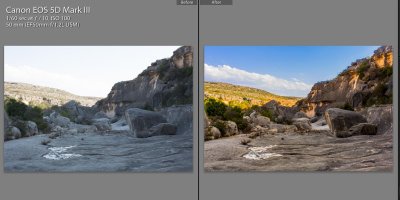
Why would you say that? It's thanks to what is still GOOD DR that you were able to recover that sky! :P It's not the best of the best right now, but one of my points all along is that Canon sensors don't have "bad" DR either.

Having good dynamic range, or I guess Exposure Range as Ctein would call it, is what allowed you to do what you did with that photo.
 
Upvote 0
jrista said:
RLPhoto said:
DR is over-rated.

Why would you say that? It's thanks to what is still GOOD DR that you were able to recover that sky! :P It's not the best of the best right now, but one of my points all along is that Canon sensors don't have "bad" DR either.

Having good dynamic range, or I guess Exposure Range as Ctein would call it, is what allowed you to do what you did with that photo.

I know, but it's still overrated. I did this on a supposed "outdated" sensor tech from a camera everyone loves to bash for DR. Heck, with alittle more time I could do this same shot on a d30. :P

The quest for DR has been around and argued for decades. I just believe it's an issue of technique rather than technology.
 
Upvote 0
RLPhoto said:
jrista said:
RLPhoto said:
DR is over-rated.

Why would you say that? It's thanks to what is still GOOD DR that you were able to recover that sky! :P It's not the best of the best right now, but one of my points all along is that Canon sensors don't have "bad" DR either.

Having good dynamic range, or I guess Exposure Range as Ctein would call it, is what allowed you to do what you did with that photo.

I know, but it's still overrated. I did this on a supposed "outdated" sensor tech from a camera everyone loves to bash for DR. Heck, with alittle more time I could do this same shot on a d30. :P

The quest for DR has been around and argued for decades. I just believe it's an issue of technique rather than technology.

I would say it is an issue of both. I mean, there is no question that the D800 and D600 have better DR and Exposure Range than the 5D III. They would perform just as well as your 5D III did in WORSE situations than that, where the 5D III would eventually fail due to the high read noise. Technique can help you maximize the potential of what you have, but better technology combined with great technique can do even better still. That's not really the point though.

The point I keep trying to make, which I think you will appreciate, is that the 5D III DOES HAVE GOOD DR! I totally agree that people fuss too much over the 5D III's DR, and a lot of people make it sound as though it is a horrid, nasty piece of crap...when it clearly is not. (I mean, go back to the generation of cameras before the 5D II, and all too frequently they couldn't do any better than 6-7 stops, maybe 9 at the most, with only the absolute top of the line cameras offering 10-11 stops.)

I've tried to make other points as well, but I won't bring those up as it'll probably start a huge war, and I don't really want that.
 
Upvote 0
3kramd5 said:
RLPhoto said:
I know, but it's still overrated. I did this on a supposed "outdated" sensor tech from a camera everyone loves to bash for DR. Heck, with alittle more time I could do this same shot on a d30. :P

... provided the scene doesn't exceed the capabilities of the D30.

No, provided that I understand how to get as many stops of DR I need.
 
Upvote 0
Status
Not open for further replies.