EOS 7D Mark II & Photokina

Re: EOS 7D Mark II & Photokina

I bet it will be the same sensor as seen in the 70D. This would make sense, if Canon wanted to keep the price reasonable ( < $2k ). I would not be surprised if they price it at the same level of the previous 7D ( ~$1699).

As far as much better high ISO performance, why would they do that? It would sabotage the sales of the flagship 1Dx. Lets get real...a crop sensor will never perform like a full frame. This should be the go-to camera for fair weather wildlife and sports photographers.

Just my two cents.
 
Upvote 0
Re: EOS 7D Mark II & Photokina

My thoughts are that it will have wifi if the rumor is correct that it can sync time between 7dii cameras. Otherwise how could that be achieved and maintained? Also many of the gps chips now are combined with wifi..or vice versa...so from a capability standpoint this would not require much additional tech other than firmware.
 
Upvote 0
Re: EOS 7D Mark II & Photokina

neuroanatomist said:
I do believe in Santa Claus. I do I do I do. And flying reindeer. And rainbow-pooping unicorns. Any of those are more likely to be real than an APS-C sensor that's as good or better than the 5DIII at high ISO.

In a fight between physics and fantasy, my money is on physics. 8)

I don't disagree with you about sensors, but still, be careful betting all your money on it :)...

"Heavier than air flying machines are impossible."
-- Lord Kelvin, president, Royal Society, 1895

"The resistance of air increases as the square of the speed and works as the cube [of speed].... It is clear that with our present devices there is no hope of aircraft competing for racing speed with either our locomotives or automobiles."
-- William H. Pickering, Director, Harvard College Observatory, 1910

"Even considering the improvements possible...the gas turbine could hardly be considered a feasible application to airplanes because of the difficulties of complying with the stringent weight requirements."
-- U. S. National Academy Of Science, 1940

"Professor Goddard...does not know the relation of action to re-action, and the need to have something better than a vacuum against which to react....he only seems to lack the knowledge ladled out daily in high schools."
-- 1920 New York Times editorial on Robert Goddard's rocket work.

"The energy produced by the breaking down of the atom is a very poor kind of thing. Anyone who expects a source of power from the transformations of these atoms is talking moonshine."
-- Ernest Rutherford, 1930

"This foolish idea of shooting at the moon is an example of the absurd length to which vicious specialization will carry scientists. To escape the Earth's gravitation a projectile needs a velocity of 7 miles per second. The thermal energy at this speed is 15,180 calories [per gram]. Hence the proposition appears to be basically impossible"
-- A. W. Bickerton, 1926

"Fooling around with alternating currents is just a waste of time. Nobody will use it, ever."
-- Thomas Edison
 
Upvote 0
Re: EOS 7D Mark II & Photokina

I'm sure this is posted every so often, but it bears repeating. For everyone hoping for a full stop improvement in noise performance in the next model of a camera, it is NEVER going to happen. Today's sensors capture very roughly 50% of the incoming photons. So if a sensor was theoretically perfect, sensors could be one stop better. That's the best they will EVER be, without switching from a bayer color pattern to a foveon-like sensor. ( In that case you could theoretically get over another stop of improvement IF you were still able to maintain the same efficiency. ) So even in another 2000 years with insane technological advances there is no way that cameras could ever be 3 stops better in raw noise performance.

So even if a sensor manufacturer could get close to 100% efficiency now, they would be insane to sell it from a business standpoint. They could release a sensor with 60% efficiency and still be the best, and give customers small improvements for years to come.

Quantum effeciencies:
http://www.dpreview.com/forums/post/53054826

We have been spoiled over the past decade - there was a full stop of improvement between the 5D to the 5Diii, but it just can't continue on that pace without breaking the laws of physics.
 
Upvote 0
Re: EOS 7D Mark II & Photokina

digitalride said:
I'm sure this is posted every so often, but it bears repeating. For everyone hoping for a full stop improvement in noise performance in the next model of a camera, it is NEVER going to happen. Today's sensors capture very roughly 50% of the incoming photons. So if a sensor was theoretically perfect, sensors could be one stop better. That's the best they will EVER be, without switching from a bayer color pattern to a foveon-like sensor. ( In that case you could theoretically get over another stop of improvement IF you were still able to maintain the same efficiency. ) So even in another 2000 years with insane technological advances there is no way that cameras could ever be 3 stops better in raw noise performance.

So even if a sensor manufacturer could get close to 100% efficiency now, they would be insane to sell it from a business standpoint. They could release a sensor with 60% efficiency and still be the best, and give customers small improvements for years to come.

Quantum effeciencies:
http://www.dpreview.com/forums/post/53054826

We have been spoiled over the past decade - there was a full stop of improvement between the 5D to the 5Diii, but it just can't continue on that pace without breaking the laws of physics.

Quantum efficiency isn't the only driver. Read noise can be a major factor as well. In some cases (some sensors, some ISO settings) driving read noise to zero could provide better than a 1-stop improvement. While QE at 100% is not possible, read noise at essentially zero is possible.
 
Upvote 0
Re: EOS 7D Mark II & Photokina

Thank you, Lee Jay. An image results from the whole train of electronics, not just the raw electrons-per-well (pixel) count.

Now, I am off on the tylenol hunt, and I will definitely need high ISO for this - in case it lurks under the bed or at the back of the cabinet.
 
Upvote 0
Re: EOS 7D Mark II & Photokina

Right now, in this moment in time, the biggest feature I'm looking for in the 7DX would be the ability to put an stop to this endless waffle about who knows what better when it comes to sensors, DR and noise.

I respect everybody and their level of knowledge but damn!

Sabaki's #1 7DX Feature?
A (full) stop to all this one uppance!
 
Upvote 0
Re: EOS 7D Mark II & Photokina

FWIW ... I have to say I agree with the current CR 7D replacement specs - I've not seen any convincing info of late, indicating otherwise.

First time in a while that I'd be happy putting a [modest] bet on some specs ;-)

I guess we'll get further versions of that 20.2 MP sensor appear in the next crop DSLRs next year... but without the souped up AF of the 7D replacement (but I suppose that they will have touch screens and WiFi)
 
Upvote 0
Re: EOS 7D Mark II & Photokina

Lee Jay said:
Quantum efficiency isn't the only driver. Read noise can be a major factor as well. In some cases (some sensors, some ISO settings) driving read noise to zero could provide better than a 1-stop improvement. While QE at 100% is not possible, read noise at essentially zero is possible.

Yes, I hadn't considered lowering the read noise. Anyone know how many stops of noise improvement is practically and theoretically possible there? I don't know enough to make sense of the info at http://www.sensorgen.info . I want to get a number so I can spout off and say "noise performance cannot ever improve more than X stops from what we have today" every time someone expects a 2x improvement in the next model.
 
Upvote 0
Re: EOS 7D Mark II & Photokina

24MP at 10fps could be a reality with dual DIGIC 6 processors. And I can see them doing it for sports and wildlife photographers who regularly crop their images. I got a feeling it's going to set the standard for APS-C cameras if most of the rumors specs are true. I think Canon has to make it great to replace the still amazing 7D...
 
Upvote 0
Re: EOS 7D Mark II & Photokina

roguewave said:
neuroanatomist said:
I do believe in Santa Claus. I do I do I do. And flying reindeer. And rainbow-pooping unicorns. Any of those are more likely to be real than an APS-C sensor that's as good or better than the 5DIII at high ISO.

In a fight between physics and fantasy, my money is on physics. 8)

I don't disagree with you about sensors, but still, be careful betting all your money on it :)...

Fair enough. But to clarify, my meaning was an APS-C sensor announced by Canon at Photokina this year that's as good or better than the 5DIII at high ISO.
 
Upvote 0
Re: EOS 7D Mark II & Photokina

Keith_Reeder said:
neuroanatomist said:
In a fight between physics and fantasy, my money is on physics. 8)

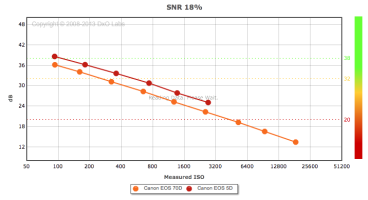
Which ignores the fact that newer crop sensors are waaay better in the high ISO noise stakes than old FF cameras.

There's more to this than "just" physics...

Keith_Reeder said:
even DxO gets this:

Yes, even DxO gets how far we've come, that a new APS-C sensor like that in the 70D is waaay better in terms of high ISO noise than an old FF sensor like that in the original 5D.

::) ::) ::)
 

Attachments

  • We've come a long waaaay baby!.png
    We've come a long waaaay baby!.png
    34.3 KB · Views: 188
Upvote 0
Re: EOS 7D Mark II & Photokina

digitalride said:
Lee Jay said:
Quantum efficiency isn't the only driver. Read noise can be a major factor as well. In some cases (some sensors, some ISO settings) driving read noise to zero could provide better than a 1-stop improvement. While QE at 100% is not possible, read noise at essentially zero is possible.

Yes, I hadn't considered lowering the read noise. Anyone know how many stops of noise improvement is practically and theoretically possible there? I don't know enough to make sense of the info at http://www.sensorgen.info . I want to get a number so I can spout off and say "noise performance cannot ever improve more than X stops from what we have today" every time someone expects a 2x improvement in the next model.

Unlike shot noise, read noise's impact can't be quantified this way. At some ISOs and portions of the tone curve, it's negligible, at others, it's crucial.
 
Upvote 0
Re: EOS 7D Mark II & Photokina

Lee Jay said:
ekt8750 said:
ajfotofilmagem said:
Canon1 said:
The good news is that if it is a totally new sensor, it may be much better than the 70d and it will have better high ISO noise at 20.2 than 24 mp. Im all for a smaller sensor in aps-c. Truthfully, I wish it was closer to 12 or 16. We'd have a killer crop camera!
I'd be happier with a 16 megapixel sensor without dual pixel AF. Do not get me wrong. For the intended use of 7D Mark II (mini 1DX) the most important thing is a big improvement in noise above ISO 1600.

Same here if it means larger pixels that let more light in. Just look at Canon's prosumer camcorders which work on that very concept.

Saying bigger pixels let more light in is like saying cutting a 15 inch pizza into 6 slices instead of 8 gets you more pizza.

HAHA! That's a PERFECT analogy! :D Sweet. Gotta use that one in the future.
 
Upvote 0
Re: EOS 7D Mark II & Photokina

NancyP said:
Hey, I am going on a unicorn photo expedition in January, I need that slightly-better-than-70D high-ISO noise performance. 8)

Bigger pixels give more electron capacity per pixel (say, 4 micron pixel has 30,000 maximum capacity, 7 micro pixel has 100,000 maximum capacity). So, say you have 14-bit ADC, that's roughly 16,000 levels of electrons, or about 2 electrons per level for the 4 micron pixel and 6 electrons per level for the 7 micron pixel. Say you have 30 electrons worth of noise. Noise takes up the first 15 levels for the 4 micron pixel and the first 5 levels for the 7 micron pixel. That's why bigger pixels, all other things being equal, result in less perceptible noise.

This is still wrong. Bigger pixels mean more charge per pixel...but it's still the same TOTAL CHARGE for the WHOLE SENSOR! :P As Lee Jay said, slicing up a pizza into smaller slices doesn't mean you have more pizza, or more pepperoni on that pizza. It's still the same amount of food.

Same for sensors. You can have two APS-C sensors with 10µm and 5µm pixels. One has four times as many pixels as the other. The sensors are 22.3x14.9mm in size. The big pixel sensor is 2230x1490 pixels, the small pixel sensor is 4460x2980 pixels. One has pixels with four times the area as the other. The 10µm pixels gather 100ke- charge FWC, the 5µm pixels gather 25ke- charge FWC. The bigger pixels are better, right? They gather more light than smaller pixels. They mean less noise, right? Nope. Let's calculate the total charge in the sensor for a fully saturated sensor

(2230*1490) * 100000 = 332,270,000,000e-
(4460*2980) * 25000 = 332,270,000,000e-

Hmm. Something MUST be wrong, because these two sensors gathered the same amount of light! If your subject fills the same absolute area of the sensor, then either sensor is going to gather the same total amount of light. The only difference is that one divides the subject into smaller buckets. Each bucket gets less light, but the subject as a whole is resolved at the sensor with the exact same amount of light in total.

Oh, but I purposely used pixels that had a nice, neat little ratio between them. It doesn't work that way in real life, right? Let's prove the point. Let's take the 5D III and 6D, both full frame sensors. Their total charge capacities are:

5D III: (5760px*3840px) * 67531e-/px = 1,493,677,670,400e-
6D: (5472px*3648px) * 76606e-/px = 1,529,197,940,736e-

The 5D III has 49% Q.E., the 6D has 50% Q.E. Dividing the above by 49% and 50% respectively gives us:

1,493,677,670,400/49 = 30,483,217,763.27
1,529,197,940,736/50 = 30,583,958,814.72

Dividing those numbers gives us:

30,483,217,763.27/30,583,958,814.72 = 0.99670608203273169699921873489352

The 5D III and 6D are within 99.7% of each other as far as total charge goes. That means the difference in light gathering capacity is 0.3%...well within margin of error. Differences in technology, cherry picking the best sensors (as in the 1D X/D4 lines), using better companion electronics (again as in 1D X/D4), etc. can create larger discrepancies, but in general, differences in pixel size, until were talking about very small pixels where fill factor becomes an issue, are largely meaningless. It's sensor area that matters first and foremost, then quantum efficiency...then pixel size/fill factor.

The 7D II could employ some new technology to improve Q.E. They could use better materials (i.e. black silicon), control current better, maybe even switch from using a standard RGGB CFA to using something like color splitting, etc. and maybe double Q.E. That would allow them to realize a REAL one-stop improvement in noise performance at high ISO. I think it's doubtful that's happened...if the 20.2mp sensor rumor is true. In all likelihood, Canon has made some minor evolutionary improvements, maybe improved Q.E. a few percent, maybe found a way to recover some die area for photodiodes, improved the efficiency of their circuitry, etc. I don't expect the differences to be huge.

The 70D has 45% Q.E. The 7D II might have around 49% Q.E., and they may better utilize the sensor die area for photodiodes. We might see a boost from ~26ke- FWC to maybe ~30ke- FWC. That is not going to change things much...and accounting for the differences in quantum efficiency, the two sensors are still going to come within a fraction of a percent of each other as far as total light gathering capacity goes.

 
Upvote 0
Re: EOS 7D Mark II & Photokina

digitalride said:
I'm sure this is posted every so often, but it bears repeating. For everyone hoping for a full stop improvement in noise performance in the next model of a camera, it is NEVER going to happen. Today's sensors capture very roughly 50% of the incoming photons. So if a sensor was theoretically perfect, sensors could be one stop better. That's the best they will EVER be, without switching from a bayer color pattern to a foveon-like sensor. ( In that case you could theoretically get over another stop of improvement IF you were still able to maintain the same efficiency. ) So even in another 2000 years with insane technological advances there is no way that cameras could ever be 3 stops better in raw noise performance.

So even if a sensor manufacturer could get close to 100% efficiency now, they would be insane to sell it from a business standpoint. They could release a sensor with 60% efficiency and still be the best, and give customers small improvements for years to come.

Quantum effeciencies:
http://www.dpreview.com/forums/post/53054826

We have been spoiled over the past decade - there was a full stop of improvement between the 5D to the 5Diii, but it just can't continue on that pace without breaking the laws of physics.

Agreed. There are limits to how much we can improve high ISO performance....so long as we keep doing things the same way.

There have been some intriguing innovations for video, where you might be able to use prior frame data to augment subsequent frame data (especially in high speed video), multi-bucket pixels, etc. I'm not sure how many of those innovations could be used for still photography. High ISO is physics limited, and for still frames at high ISO, the most common use case is to support a faster shutter speed. The use of technology like Aptina's multi-bucket high DR pixels probably wouldn't do much to improve total light gathered at high ISO (although it might be able to improve DR and eliminate signal clipping.)
 
Upvote 0
Re: EOS 7D Mark II & Photokina

jrista said:
Lee Jay said:
ekt8750 said:
ajfotofilmagem said:
Canon1 said:
The good news is that if it is a totally new sensor, it may be much better than the 70d and it will have better high ISO noise at 20.2 than 24 mp. Im all for a smaller sensor in aps-c. Truthfully, I wish it was closer to 12 or 16. We'd have a killer crop camera!
I'd be happier with a 16 megapixel sensor without dual pixel AF. Do not get me wrong. For the intended use of 7D Mark II (mini 1DX) the most important thing is a big improvement in noise above ISO 1600.

Same here if it means larger pixels that let more light in. Just look at Canon's prosumer camcorders which work on that very concept.

Saying bigger pixels let more light in is like saying cutting a 15 inch pizza into 6 slices instead of 8 gets you more pizza.

HAHA! That's a PERFECT analogy! :D Sweet. Gotta use that one in the future.

By logically 15" pizza are larger by 6 slices, but the 15" pizza thicker pizza into 8 slices will be different...
In another word, weight per pizza of 1/8 is heavier than 1/6... hrmmm it mean a possible for crop 24mp excel FF 21mp in term of more fine pixel? Sorry i'm no too good into pixel stuffs
 
Upvote 0