EOS 7D Mark II & Photokina

Re: EOS 7D Mark II & Photokina

LetTheRightLensIn said:
you really should compare using the normalized chart:
http://www.dxomark.com/Cameras/Compare/Side-by-side/Canon-EOS-70D-versus-Canon-EOS-5D___895_176

that said it still doesn't quite match the 5D, much less outdo it

* Open Comparometer.
* Compare old 5D and modern 70D.
* DxO is wrong again. ::)

Serious question: does anyone at DxO even own a camera?

That said, I wouldn't expect crop sensors to match today's FF sensors on noise for another few years, at which point FF will be that much better. For a given level of tech the larger sensor simply gathers more light. I seriously doubt that the 7D2 sensor will make some kind of leap to FF high ISO, and if it does then the 5D4 won't be far behind with the same tech and even better high ISO.

That doesn't mean crop is a slouch at high ISO though. Its gotten pretty good.
 
Upvote 0
Re: EOS 7D Mark II & Photokina

LetTheRightLensIn said:
Canon1 said:
The good news is that if it is a totally new sensor, it may be much better than the 70d and it will have better high ISO noise at 20.2 than 24 mp. Im all for a smaller sensor in aps-c. Truthfully, I wish it was closer to 12 or 16. We'd have a killer crop camera!

How? If it is 12MP then it's getting to be not the ton more reach than a 5D3 is. It's not the crop factor that matters, it's the photosite density. All teh crop factor does is limit your FOV with each lens.

A 12mp sensor would have better high ISO performance, utilize the center of lens elements, pair that with 10fps and I think that would be a great crop camera package. Better in the field then a 5d3 or a 1div. Of which I have both.

And also, a 12 mp crop sensor is 150% of the "reach" and 16mp is 200% of the "reach"... As you put it.

Just my ideal wildlife camera.
 
Upvote 0
Re: EOS 7D Mark II & Photokina

Canon1 said:
A 12mp sensor would have better high ISO performance,

No, it wouldn't. This myth just won't go away.

utilize the center of lens elements,

Which is wrong on two levels - every pixel uses all of the lens elements. You may have meant "image circle" instead of lens elements. Secondly, using the "sweet spot" is nearly always detrimental compared to using the entire image circle because of increased enlargement.

And also, a 12 mp crop sensor is 150% of the "reach" and 16mp is 200% of the "reach"... As you put it.

"Reach" means "resolving power" and it goes with the square of pixel count. You want to double resolving power? You need four times as many pixels.
 
Upvote 0
Re: EOS 7D Mark II & Photokina

Lee Jay said:
Canon1 said:
A 12mp sensor would have better high ISO performance,

No, it wouldn't. This myth just won't go away.

utilize the center of lens elements,

Which is wrong on two levels - every pixel uses all of the lens elements. You may have meant "image circle" instead of lens elements. Secondly, using the "sweet spot" is nearly always detrimental compared to using the entire image circle because of increased enlargement.

And also, a 12 mp crop sensor is 150% of the "reach" and 16mp is 200% of the "reach"... As you put it.

"Reach" means "resolving power" and it goes with the square of pixel count. You want to double resolving power? You need four times as many pixels.

Whatever... my opinions are derived from "field" observation... and interestingly I have found that most things being equal, larger pixels translate to higher ISO noise usability.... and that the center of images are always sharper and have less distortion than the edges. But who needs field observations when we have all of these "theoretical" photographers here on the forum to prove us all wrong??
 
Upvote 0
Re: EOS 7D Mark II & Photokina

Canon1 said:
Lee Jay said:
Canon1 said:
A 12mp sensor would have better high ISO performance,

No, it wouldn't. This myth just won't go away.

utilize the center of lens elements,

Which is wrong on two levels - every pixel uses all of the lens elements. You may have meant "image circle" instead of lens elements. Secondly, using the "sweet spot" is nearly always detrimental compared to using the entire image circle because of increased enlargement.

And also, a 12 mp crop sensor is 150% of the "reach" and 16mp is 200% of the "reach"... As you put it.

"Reach" means "resolving power" and it goes with the square of pixel count. You want to double resolving power? You need four times as many pixels.

Whatever... my opinions are derived from "field" observation... and interestingly I have found that most things being equal, larger pixels translate to higher ISO noise usability.... and that the center of images are always sharper and have less distortion than the edges. But who needs field observations when we have all of these "theoretical" photographers here on the forum to prove us all wrong??

I've got a quarter million shots under management in LR. I wouldn't call that theoretical.

You're noise observation is wrong because you are comparing at different enlargement ratios (1:1 with all pixel counts).

Your center image circle is wrong because you aren't comparing crops and full image circle images at constant final size.

And what I said about "reach" (resolving power) is correct.
 
Upvote 0
Re: EOS 7D Mark II & Photokina

Canon1 said:
Lee Jay said:
Canon1 said:
A 12mp sensor would have better high ISO performance,

No, it wouldn't. This myth just won't go away.

utilize the center of lens elements,

Which is wrong on two levels - every pixel uses all of the lens elements. You may have meant "image circle" instead of lens elements. Secondly, using the "sweet spot" is nearly always detrimental compared to using the entire image circle because of increased enlargement.

And also, a 12 mp crop sensor is 150% of the "reach" and 16mp is 200% of the "reach"... As you put it.

"Reach" means "resolving power" and it goes with the square of pixel count. You want to double resolving power? You need four times as many pixels.

Whatever... my opinions are derived from "field" observation... and interestingly I have found that most things being equal, larger pixels translate to higher ISO noise usability.... and that the center of images are always sharper and have less distortion than the edges. But who needs field observations when we have all of these "theoretical" photographers here on the forum to prove us all wrong??

"whatever"! Really? Some facts thrown your way and you disregard it….
 
Upvote 0
Re: EOS 7D Mark II & Photokina

Jaydeep said:
When was the last time that we had two sensors having the exact same MP resolution but were "different " ?
I'm afraid it looks like the 7D II will have the 70D sensor . The 70D sensor is pretty good though, its just that we are expecting two sensor revolutions in two years ..which is incredibly rare.

Agreed. I know everyone (including me) hopes that the 7DX will have some jaw-dropping sensor tech, but the 7D and 60D shared the same 18MP sensor. The differentiation that justified the price difference was AF system, FPS, buffer depth, weather sealing and build quality.

Why should we expect the next generation of each camera to have a different relationship to one another? It would be unusual for Canon to make a "successor" to the 7D that was positioned differently in the market. Not saying it can't happen -- just saying it seems most likely that the positioning of the two products in relation to one another continues.

The 7DX uses the same sensor as the 70D and continues the differentiation with beefy AF system, FPS, buffer depth and even more solid build. Seems predictable to me. Of course, it's the predictability that gets so many shorts in a twist on this forum... :-X
 
Upvote 0
Re: EOS 7D Mark II & Photokina

Dare I wade into the pizza war? :P

Perhaps I can translate it into a wooden pizza to fit one of my other hobbies: If I have a 15" maple disc, cutting it into 6 pieces WOULD give me more maple surface area than cutting it into 8 pieces. Why? because there is waste from blade kerf. If I have a 1/8" kerf, I lose an approximately 1/8" slice of material with each cut. Let's say now that we fill in each cut with a 1/8" slice of ebony so we don't lose overall surface area when we glue it all up. The disc maintains its original surface area, but there is still less maple surface area with 8 slices than with 6. Using a 1/16" kerf blade will increase the ratio of maple surface area to ebony, but there will still be less maple surface area with 8 slices than with 6.

Now imagine the disc is actually a rectangle, and the pieces are squares instead of pizza slices. The maple is the photo-sensitive portion of the sensor, and the ebony is the border around each pixel. If sensor size and transistor size are constant, doesn't increasing the number of pixels increase the number of borders and transistors, and doesn't that reduce the portion of the overall sensor that receives light? Is moving from a 500nm process to a 180nm process like going from a 1/8" kerf to 9/200" kerf?

I'm obviously not a sensor geek, so I might be completely misunderstanding pixels, borders, et cetera. What am I missing in this analogy? :P
 
Upvote 0
Re: EOS 7D Mark II & Photokina

Famateur said:
Jaydeep said:
When was the last time that we had two sensors having the exact same MP resolution but were "different " ?
I'm afraid it looks like the 7D II will have the 70D sensor . The 70D sensor is pretty good though, its just that we are expecting two sensor revolutions in two years ..which is incredibly rare.

Agreed. I know everyone (including me) hopes that the 7DX will have some jaw-dropping sensor tech, but the 7D and 60D shared the same 18MP sensor. The differentiation that justified the price difference was AF system, FPS, buffer depth, weather sealing and build quality.

Why should we expect the next generation of each camera to have a different relationship to one another? It would be unusual for Canon to make a "successor" to the 7D that was positioned differently in the market. Not saying it can't happen -- just saying it seems most likely that the positioning of the two products in relation to one another continues.

The 7DX uses the same sensor as the 70D and continues the differentiation with beefy AF system, FPS, buffer depth and even more solid build. Seems predictable to me. Of course, it's the predictability that gets so many shorts in a twist on this forum... :-X


Your logic might be correct just maybe the relationship is wrong. What is to say the 7DII will not have the same sensor as the 80D
 
Upvote 0
Re: EOS 7D Mark II & Photokina

Famateur said:
Jaydeep said:
When was the last time that we had two sensors having the exact same MP resolution but were "different " ?
I'm afraid it looks like the 7D II will have the 70D sensor . The 70D sensor is pretty good though, its just that we are expecting two sensor revolutions in two years ..which is incredibly rare.

Agreed. I know everyone (including me) hopes that the 7DX will have some jaw-dropping sensor tech, but the 7D and 60D shared the same 18MP sensor. The differentiation that justified the price difference was AF system, FPS, buffer depth, weather sealing and build quality.

Why should we expect the next generation of each camera to have a different relationship to one another? It would be unusual for Canon to make a "successor" to the 7D that was positioned differently in the market. Not saying it can't happen -- just saying it seems most likely that the positioning of the two products in relation to one another continues.

The 7DX uses the same sensor as the 70D and continues the differentiation with beefy AF system, FPS, buffer depth and even more solid build. Seems predictable to me. Of course, it's the predictability that gets so many shorts in a twist on this forum... :-X

Well, for one, the 7D came out before the 60D, and the sensor that was in the 7D trickled down the line. Not up to the 7D from the 60D. So, the real question is about the relationship between the 7D2 and the 80D, not the 70D.
 
Upvote 0
Re: EOS 7D Mark II & Photokina

sanj said:
"whatever"! Really? Some facts thrown your way and you disregard it….

Oh... my bad. My observations in the field have been proven wrong (Thanks LeeJay!), and I have revised my "wish list" for a new 7D.

Sanj... I appreciate all the facts that are thrown around here. Just look at the 50+ page thread on the 7D started a few days ago. There are so many facts in there that prove every other fact wrong that nothing could possibly be true.

I'm not disregarding the facts, I'm just stating that my opinions for a great APS-C camera are based on my own field operation. Truthfully, I don't care about the physics. What I care about is generating high quality images and through my own experience, I believe that my "wish list" for a great APS-C camera help create cleaner more usable files at high ISO. I'm not about to debate what makes a pixel produce better noise. If canon can make a 24mp APS-C camera that produces excellent quality, low ISO noise at ISO 3200... I don't care what goes into it. In my experience, this would be a more realistic achievement if that crop sensor was 12 or 16MP.
 
Upvote 0
Re: EOS 7D Mark II & Photokina

nebugeater said:
Famateur said:
Jaydeep said:
When was the last time that we had two sensors having the exact same MP resolution but were "different " ?
I'm afraid it looks like the 7D II will have the 70D sensor . The 70D sensor is pretty good though, its just that we are expecting two sensor revolutions in two years ..which is incredibly rare.

Agreed. I know everyone (including me) hopes that the 7DX will have some jaw-dropping sensor tech, but the 7D and 60D shared the same 18MP sensor. The differentiation that justified the price difference was AF system, FPS, buffer depth, weather sealing and build quality.

Why should we expect the next generation of each camera to have a different relationship to one another? It would be unusual for Canon to make a "successor" to the 7D that was positioned differently in the market. Not saying it can't happen -- just saying it seems most likely that the positioning of the two products in relation to one another continues.

The 7DX uses the same sensor as the 70D and continues the differentiation with beefy AF system, FPS, buffer depth and even more solid build. Seems predictable to me. Of course, it's the predictability that gets so many shorts in a twist on this forum... :-X


Your logic might be correct just maybe the relationship is wrong. What is to say the 7DII will not have the same sensor as the 80D

Good point! Let's hope so!!! :D
 
Upvote 0
Re: EOS 7D Mark II & Photokina

Famateur said:
Dare I wade into the pizza war? :P

Perhaps I can translate it into a wooden pizza to fit one of my other hobbies: If I have a 15" maple disc, cutting it into 6 pieces WOULD give me more maple surface area than cutting it into 8 pieces. Why? because there is waste from blade kerf. If I have a 1/8" kerf, I lose an approximately 1/8" slice of material with each cut. Let's say now that we fill in each cut with a 1/8" slice of ebony so we don't lose overall surface area when we glue it all up. The disc maintains its original surface area, but there is still less maple surface area with 8 slices than with 6. Using a 1/16" kerf blade will increase the ratio of maple surface area to ebony, but there will still be less maple surface area with 8 slices than with 6.

Now imagine the disc is actually a rectangle, and the pieces are squares instead of pizza slices. The maple is the photo-sensitive portion of the sensor, and the ebony is the border around each pixel. If sensor size and transistor size are constant, doesn't increasing the number of pixels increase the number of borders and transistors, and doesn't that reduce the portion of the overall sensor that receives light? Is moving from a 500nm process to a 180nm process like going from a 1/8" kerf to 9/200" kerf?

I'm obviously not a sensor geek, so I might be completely misunderstanding pixels, borders, et cetera. What am I missing in this analogy? :P
I would say that you have it correct and that your analogy is cutting edge :)
 
Upvote 0
Re: EOS 7D Mark II & Photokina

Don Haines said:
Famateur said:
Dare I wade into the pizza war? :P

Perhaps I can translate it into a wooden pizza to fit one of my other hobbies: If I have a 15" maple disc, cutting it into 6 pieces WOULD give me more maple surface area than cutting it into 8 pieces. Why? because there is waste from blade kerf. If I have a 1/8" kerf, I lose an approximately 1/8" slice of material with each cut. Let's say now that we fill in each cut with a 1/8" slice of ebony so we don't lose overall surface area when we glue it all up. The disc maintains its original surface area, but there is still less maple surface area with 8 slices than with 6. Using a 1/16" kerf blade will increase the ratio of maple surface area to ebony, but there will still be less maple surface area with 8 slices than with 6.

Now imagine the disc is actually a rectangle, and the pieces are squares instead of pizza slices. The maple is the photo-sensitive portion of the sensor, and the ebony is the border around each pixel. If sensor size and transistor size are constant, doesn't increasing the number of pixels increase the number of borders and transistors, and doesn't that reduce the portion of the overall sensor that receives light? Is moving from a 500nm process to a 180nm process like going from a 1/8" kerf to 9/200" kerf?

I'm obviously not a sensor geek, so I might be completely misunderstanding pixels, borders, et cetera. What am I missing in this analogy? :P
I would say that you have it correct and that your analogy is cutting edge :)

I saw what you did there. ;D

By the way, for your birthday next weekend, maybe the "big white" socks you get will have an "L" series red stripe and weather sealing for long canoe trips. 8)
 
Upvote 0
Re: EOS 7D Mark II & Photokina

Famateur said:
Dare I wade into the pizza war? :P

Perhaps I can translate it into a wooden pizza to fit one of my other hobbies: If I have a 15" maple disc, cutting it into 6 pieces WOULD give me more maple surface area than cutting it into 8 pieces. Why? because there is waste from blade kerf. If I have a 1/8" kerf, I lose an approximately 1/8" slice of material with each cut. Let's say now that we fill in each cut with a 1/8" slice of ebony so we don't lose overall surface area when we glue it all up. The disc maintains its original surface area, but there is still less maple surface area with 8 slices than with 6. Using a 1/16" kerf blade will increase the ratio of maple surface area to ebony, but there will still be less maple surface area with 8 slices than with 6.

Now imagine the disc is actually a rectangle, and the pieces are squares instead of pizza slices. The maple is the photo-sensitive portion of the sensor, and the ebony is the border around each pixel. If sensor size and transistor size are constant, doesn't increasing the number of pixels increase the number of borders and transistors, and doesn't that reduce the portion of the overall sensor that receives light? Is moving from a 500nm process to a 180nm process like going from a 1/8" kerf to 9/200" kerf?

I'm obviously not a sensor geek, so I might be completely misunderstanding pixels, borders, et cetera. What am I missing in this analogy? :P

What you're missing is gapless microlenses, which essentially render the "blade kerf" largely moot by concentrating the light into the light-sensitive area between the "kerf lines".
 
Upvote 0
Re: EOS 7D Mark II & Photokina

Sorry, it's a long post, maybe too long.

In physics, the Carnot cycle is an ideal representation of a perfect engine having 100% efficency. It is a useful thermodynamic representation to explain energy conversion. In the real world, such a system does not exist.

Too many of you claim that a higher MP sensor does not have more noise than a lower MP one, all conditions being equal, and support this claim with mathematics, but that's not true in the real world. Some even claim that smaller photosites have less noise than bigger ones: now, that's the kind of claim that should make all of us invoke Santa, bigfoot and rainbow-pooping unicorns going on vacation together with a flying saucer. The real world behaves differently.

Lee Jay said:
Saying bigger pixels let more light in is like saying cutting a 15 inch pizza into 6 slices instead of 8 gets you more pizza.

No. Your logic is flawed.

If the pizza represents the sensor, the number of slices correspond to the number of the pizza eaters, represented by the sensels, i.e. photosites, i.e. pixels. An eater who eats 1/6 of the pizza eats more than one eating 1/8 of it. An ideal 24 x 36 mm sensor being a single light sensitive unit is a one pixel sensor which, let's say, collects 1 billion photons at a given time unit and luminous intensity; it has the lowest resolution possible, but it would be capable of letting you know if even a bunch of photons have hit it or not with 100% certainty, i.e. with zero noise. Ideally, if you divide that single huge photosite into 1 million smaller photosites (1 MP sensor), each photosite receives IDEALLY 1000 photons under the same conditions; in the practice it's less than 1000 because of the wiring and the spacing between photosites which equally absorb the photons, but do not convert them into a useful signal, instead convert them into heat, which is detrimental. This 1 MP sensor has sufficient resolution to resolve enough detail for a very small print, and with today's tech you could probably use it at 204,800 ISO or more with very low noise (and before any of you reply that you can reduce the size of the image and therefore reduce noise and equally obtain the print, try exposing a 36 MP sensor at 204,800 ISO or higher if you can...).

Again, the same sensor with 20 MP exposed in the same conditions does not collect 50 photons per photosite, but MUCH LESS this time due to massive wiring and lots of wasted space between photosites, so you have a high resolution image, but with a lot of noise.

Actually, in my example with 1,000,000,000 total photons hitting a 24 x 36 mm sensor I think you'd have only random noise at 20 MP, but it was for the sake of explaining. I'm not talking quantum efficency at all here, it's just the number of photons you can effectively use I'm talking about. Moreover, we don't have a linear relationship between number of photons and noise, so it's not as if you have half of the photons per photosite you double the noise, the situation is worse in the real world.

The Canon 1Dx is 18 MP; in the Nikon D800, being 36 MP, each photosite collects LESS than one half of each of the Canon's photosites, that's why the 1Dx is much better in low light. And the D800 holds because of its superior sensor tech (let's face it, fortunately Canon's system is better as a whole), otherwise they wouldn't have made it 36 MP in the first place.

In the pizza analogy, the more you cut the pizza, the more breadcrumbs, morsels, atomies you produce, leaving the eaters with less and less pizza to eat to the point that, putting together all the slim slices of pizza eaten by all, they add up to not even a quarter of the original one. And, actually, a pie should be a better fitting analogy.

It's like having a 100 x 100 ft room all for yourself, 10,000 square feet is plenty of space. But if you want to accomodate 100 people inside it and offer them a bit of privacy, you have to build walls which eat space, not to mention furniture, so you end up with much less than 100 sq. ft for each dweller.

Still not convinced? OK, you may say "who are you to stand up and make such claims against my maths?", so let's look at what Canon's engineers have done, I bet they know more than me or anyone else on CR about silicon performance and noise. This is what I wrote in a previous post:

"There's a reason the 1Dx has the best (to my eye) IQ of all the DSLRs available to date (yes, better than any Nikon I think): its 18 MP FF sensor. And there's a reason why Canon developed a prototype sensor with photosites 7.5 times larger than the 1Dx: to capture quality video in candlelight (candledrkness sounds better, though). Don't know if you remember, but check these:

http://www.canon.com/news/2013/mar04e.html

http://petapixel.com/2013/09/13/canon-debuts-exciting-prototype-sensor-exceptional-low-light-capability/

And Sony? Compare the the 36 MP Alpha A7r(esolution) and the 12 MP A7s(ensitivity), then say again that more MP does not mean more noise if you dare. At base ISO maybe, but try going at 800 and beyond...

And should somebody dare claim again that smaller photosites means less noise as I've read too many times, remember Santa & Co. are watching us from their flying saucer... And again, at base ISO maybe, but what's the point of shooting 36 MP and then reduce resolution in post to lower the noise and make small prints or web sized images?

I'm going to spend the weekend with my son, so I'll be having a look at CR every now and then, but I'm not going to post, sorry. Have a nice weekend you all, too!

Peace!

 
Upvote 0
Re: EOS 7D Mark II & Photokina

pierlux said:
Too many of you claim that a higher MP sensor does not have more noise than a lower MP one, all conditions being equal, and support this claim with mathematics, but that's not true in the real world. Some even claim that smaller photosites have less noise than bigger ones: now, that's the kind of claim that should make all of us invoke Santa, bigfoot and rainbow-pooping unicorns going on vacation together with a flying saucer. The real world behaves differently.

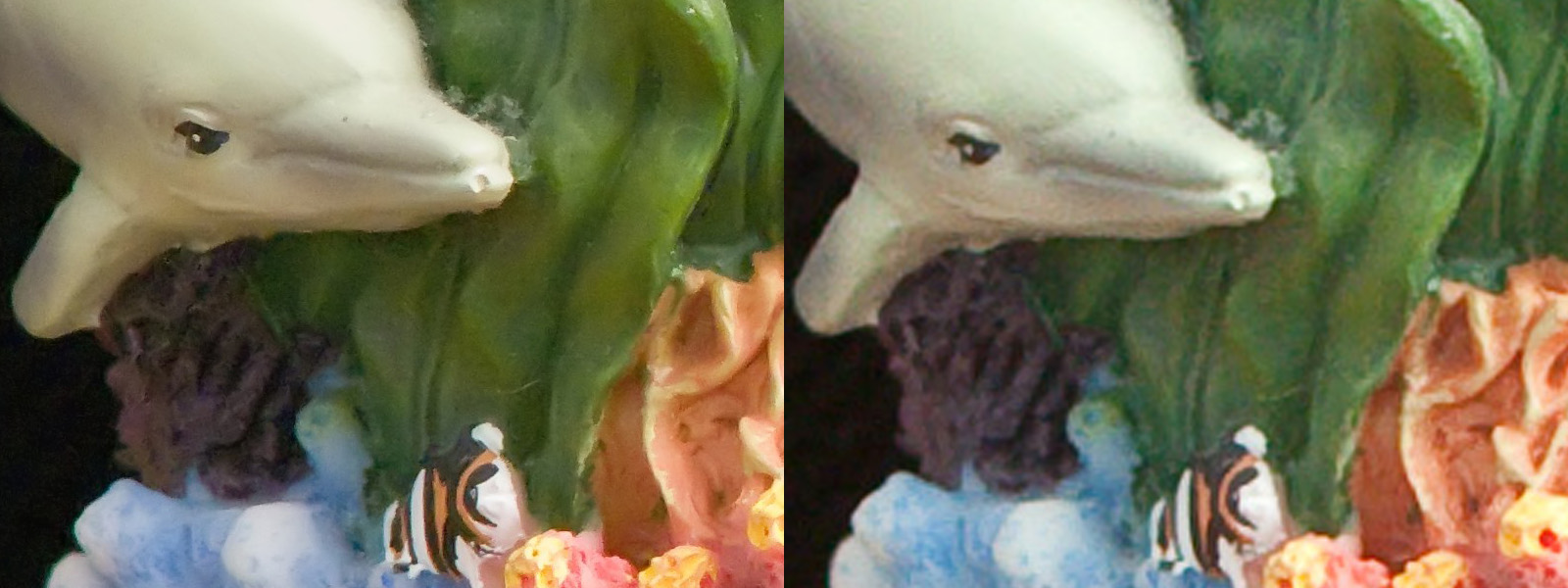
Oh, really. Same ISO, same f-stop, same shutter speed, same focal length, same subject, same lighting, shot in raw, same raw processing tool. The pixels on the left are 1/16th as big (in area) as the pixels on the right.

Pixel%20density%20test%202%20detail%20filtered.jpg
 
Upvote 0
Re: EOS 7D Mark II & Photokina

Lee Jay said:
pierlux said:
Too many of you claim that a higher MP sensor does not have more noise than a lower MP one, all conditions being equal, and support this claim with mathematics, but that's not true in the real world. Some even claim that smaller photosites have less noise than bigger ones: now, that's the kind of claim that should make all of us invoke Santa, bigfoot and rainbow-pooping unicorns going on vacation together with a flying saucer. The real world behaves differently.

Oh, really. Same ISO, same f-stop, same shutter speed, same focal length, same subject, same lighting, shot in raw, same raw processing tool. The pixels on the left are 1/16th as big (in area) as the pixels on the right.

Pixel%20density%20test%202%20detail%20filtered.jpg

Which ISO? Which f-stop? Which sensors? Could you provide a link, please? I've found this

http://photos.imageevent.com/sipphoto/samplepictures/Pixel%20density%20test%202%20detail%20filtered.jpg

but I can't find the exif, nor a caption. Sorry, I'm not particularly smart with computers... help me. Thanks!
 
Upvote 0
Re: EOS 7D Mark II & Photokina

pierlux said:
Lee Jay said:
pierlux said:
Too many of you claim that a higher MP sensor does not have more noise than a lower MP one, all conditions being equal, and support this claim with mathematics, but that's not true in the real world. Some even claim that smaller photosites have less noise than bigger ones: now, that's the kind of claim that should make all of us invoke Santa, bigfoot and rainbow-pooping unicorns going on vacation together with a flying saucer. The real world behaves differently.

Oh, really. Same ISO, same f-stop, same shutter speed, same focal length, same subject, same lighting, shot in raw, same raw processing tool. The pixels on the left are 1/16th as big (in area) as the pixels on the right.

Pixel%20density%20test%202%20detail%20filtered.jpg

Which ISO? Which f-stop? Which sensors? Could you provide a link, please? I've found this

ISO 800 (the highest setting available at the time on the small pixels. The cameras as the Canon S3IS and the Canon 5D.
 
Upvote 0
Re: EOS 7D Mark II & Photokina

Lee Jay said:
pierlux said:
Lee Jay said:
pierlux said:
Too many of you claim that a higher MP sensor does not have more noise than a lower MP one, all conditions being equal, and support this claim with mathematics, but that's not true in the real world. Some even claim that smaller photosites have less noise than bigger ones: now, that's the kind of claim that should make all of us invoke Santa, bigfoot and rainbow-pooping unicorns going on vacation together with a flying saucer. The real world behaves differently.

Oh, really. Same ISO, same f-stop, same shutter speed, same focal length, same subject, same lighting, shot in raw, same raw processing tool. The pixels on the left are 1/16th as big (in area) as the pixels on the right.

Pixel%20density%20test%202%20detail%20filtered.jpg

Which ISO? Which f-stop? Which sensors? Could you provide a link, please? I've found this

ISO 800 (the highest setting available at the time on the small pixels. The cameras as the Canon S3IS and the Canon 5D.

So the 6 MP p&s S3IS has better IQ of the 13 MP full frame 5D? Could you provide a link please so that I can see all by myself without asking you more detail? Thanks. Sorry, but I'm going to board my car in 5 min, as I said I have to pick my son to spend the weekend with him. I promise you I'll publicly apologize if you convince me, but please Lee Jay, read all my post and tell me where my logic is flawed. See you tomorrow (or tonight, I'm on the other side of the world...)
Cheers!
 
Upvote 0