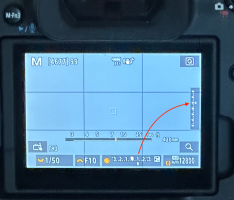
This is interesting. I agree that I find M just fine, but I tend to not use it in auto ISO mode. For that I have Fv.
I use M with Auto ISO very frequently. Typically at performances where I need to independently vary from a wide aperture for a single subject to a narrower aperture for several subjects and faster shutter speed when people are moving vs. a slower one when they are still. M with Auto ISO lets me quickly vary one or both of those settings while letting the camera set the ISO. Fv mode would allow that, also, but I find it easier and faster to have each setting on a separate control dial. Most of these are in relatively poorly lit venues, so the idea is to select the widest aperture and slowest shutter speed feasible based on the subject(s) and movement to minimize the auto-selected ISO.
What I would expect (my camera is packed for a trip or I'd test) is that in auto ISO mode M would target a balanced image -- i.e., an exposure of +/- 0, to put it in a crude way. Which is probably why Canon doesn't bother in M mode — either the image is balanced, or you're being "creative."
Yes, in M mode with Auto ISO you set the aperture and shutter speed and the camera sets the ISO based on the metered exposure.
The point is that Canon does enable use of EC in M mode. I have no idea why
@Noise seems to think it doesn't work.
In some scenarios, applying EC in the above use cases is helpful. For example, if a performer is spot-lit then I can dial in a bit of negative EC to avoid blowing out the highlights on the subject, where the exposure would otherwise be weighted to include some of the dark background.
On my 1D X, there was the option for spot metering linked to the AF point, which meant much less need for EC in that scenario. I have no idea why that feature was dropped with Canon's MILCs. They kept it restricted to 1-series DSLRs, and I presumed —incorrectly— that even though the R3 lacked the feature, the R1 would have it. I can't see a technical reason for it, if anything it would be easier to implement with both AF and metering coming from the image sensor, rather than two other independent non-image sensors as was the case on a DSLR.
Let's assume that's how it works for a second — the balanced image of 0 is the target.
No need to assume, that's how it works with all Auto exposure settings. The aim is to achieve the metered (what you call balanced or 0) exposure.
If I had auto ISO on but the shutter and aperture were set in such a way that auto ISO cannot achieve a balanced image (e.g., my lens cap is on because it's a really slow coffee morning) would the idea be that an EC metric showed that 0 could not be achieved? i.e., -3 or worse.
No, the EC setting just shows where it's set...0, or however much positive or negative compensation you've applied. The metered exposure is shown by the exposure meter, and if the camera cannot achieve the metered exposure with the available ISO settings, then the exposure meter shows that. If it's beyond the range of the meter such as if you left the lens cap on, then the meter shows an arrow at the end of the range.
For example, here's my R1 with the 100-500 + 1.4x mounted, M mode with EC set to +1, but the lens cap is on so the max allowed ISO of 51200 is still >3 stops underexposed, indicated by the little down-arrow at the bottom of the exposure meter on the right side of the LCD.
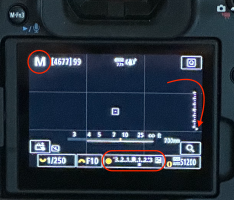
Here, with the lens cap off (and the shutter speed lowered a bit to get the ISO into the usable range), you can see with the +1 EC setting applied the exposure meter reflects an exposure that's one stop over the metered exposure (which would be ISO 6400).