
EOS R6 vs Sony A7V noise

Can somebody explain how Sony always get these low read noise ratings from PhotonstoPhotos when their images look like that?
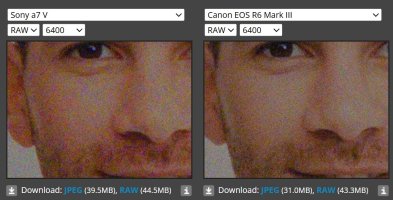
Screenshot 2026-01-07 200701.jpg

I don't get it, digital looking noise, color blotches all over the image and yet the numbers say that Sony allegedly has ~15.5 DN read noise and Canon has ~25.3 DN.
Does Sony somehow deceive the algorithms that measure the noise? Or am I the only one who thinks that Canon's noise looks finer and more film-like?
 
Can somebody explain how Sony always get these low read noise ratings from PhotonstoPhotos when their images look like that?

View attachment 227412

I don't get it, digital looking noise, color blotches all over the image and yet the numbers say that Sony allegedly has ~15.5 DN read noise and Canon has ~25.3 DN.
Does Sony somehow deceive the algorithms that measure the noise? Or am I the only one who thinks that Canon's noise looks finer and more film-like?
This is the third time I have posted this in the past few days. Read the the first line of the footnote under the photonstophotos chart:

Screenshot 2026-01-08 at 16.31.50.png
 
Upvote 0
Can somebody explain how Sony always get these low read noise ratings from PhotonstoPhotos when their images look like that?
Alan's point notwithstanding, there is a difference between quality and quantity. Sounds intensity is measured in decibels (dB), but consider the difference between 40 dB of a stream babbling past you as you sit in quiet contemplation for a couple of hours, versus 40 dB of an infant whimpering for a couple of hours as you sit next to the crib. Same quantity of sound, very different quality. In the latter case, I might be inclined to take a break, perhaps letting Samuel L Jackson read the bedtime story).

P2P is quantifying the total read noise, regardless of whether it shows up in the image as luminance noise or chroma noise. The latter is much more visually distracting, and in your example the Sony clearly has a larger, coarser component of it in the image.

 
  • Like
Reactions: 2 users
Upvote 0
Alan's point notwithstanding, there is a difference between quality and quantity. Sounds intensity is measured in decibels (dB), but consider the difference between 40 dB of a stream babbling past you as you sit in quiet contemplation for a couple of hours, versus 40 dB of an infant whimpering for a couple of hours as you sit next to the crib. Same quantity of sound, very different quality. In the latter case, I might be inclined to take a break, perhaps letting Samuel L Jackson read the bedtime story).

P2P is quantifying the total read noise, regardless of whether it shows up in the image as luminance noise or chroma noise. The latter is much more visually distracting, and in your example the Sony clearly has a larger, coarser component of it in the image.

Cambridge in colour is simply the best. The author has some superb local photos on the web too: https://pbase.com/compuminus/cambridge
 
  • Like
Reactions: 1 user
Upvote 0