For our DR peepers: Sony A7000 - rumored 15,5 stops DR

interesting trick but seeing how nikon manages to pull DR from sony sensor better than sony and how the two year old sony sensors were already in mid 14's, I think the world's first full frame 15 stop DR capable sensor will be a nikon/sony and not resort to any tricks.

but time will tell.
 
Upvote 0
neuroanatomist said:
Yes, it's quite a good trick to have DR "in mid 14's" when your camera has a 14-bit ADC. Hail to the almighty DxO Biased Scores, and kudos to those that revel in that BS. ::)

isn't their margin of error about that much (half a stop)? You're also assuming their ADC quantization scale is a uniform power of two. It doesn't have to be. You can quantize a larger DR than 14 stops in 14 bits by simply deciding how your conversion curve maps the signal to a bit value. This is not that different from how tone mapping works in HDR software. It is off course not as preferable as a true 15 bit value, but given precision at the lower bits are just measuring noise, and how a 1 stop is not going to push your tone curve excessively, it could be easily done.

But it may very well be the world's first full frame 15 bit camera is coming. It was only a matter of time and if anybody has a reason to do this is the sony sensors. They are after all the only ones with this problem...which is actually a good problem :)
 
Upvote 0
Except that the data don't suggest that's the case....but people just go on quoting 14.whatever-stops of DR, maybe some people just like the stench of bovine scat.

You're correct that we'll see true 15-bit or higher DR in consumer cameras at some point. It's already in use in some scientific imaging applications.
 
Upvote 0
neuroanatomist said:
Except that the data don't suggest that's the case....but people just go on quoting 14.whatever-stops of DR, maybe some people just like the stench of bovine scat.

You're correct that we'll see true 15-bit or higher DR in consumer cameras at some point. It's already in use in some scientific imaging applications.

What data is that you're referring to? If you mean to say the RAW DOX data I have never seen it but I have no problem seeing the two stop advantage on the sony sensor and neither have basically every reviewer that has scrutinized it. Probably the most extensive set of DR analysis that is not numeric, but visual is here
http://diglloyd.com/search-ajax.html?q=dynamic+range

So we have quite a few years worth of images that show a clear advantage to sony's sensors and all but those in denial accept it. It is a dead horse and time to move on buddy. To dwell on how that is quantized in the 14 bit raw file and how DXO measures it is ultimately focusing on the wrong number. You can argue that given photons are random, there isn't 14 stops in a 14 bit file anyway. But the various measurements are still useful to compare differences: it may be that the 14 bit file contains only 12 stops of USABLE DR. Still the camera that gets you 12 usable stops will have a higher DR than the one that yields 10. Again the absolute value isn't what you're comparing: it is the difference between the absolute values. That is what the images will show.

I agree it is unfortunate some people focus on the absolute value, but it is ultimately the value that must be given because how else are we to extract the useful value: the difference. So while you can disagree all you want with absolute numbers in relation to actual DR, the difference and evidence of the difference already settled this topic.

Back to speculation:
noise control via sensor tech should make better use of the 14 bit file to maybe get one more stop of usable range. So if the current baseline they are using scores it at 14.5, they will score it at 15.5. If the ADC has a non power of two curve, then probably can fit more. Point being it will be a 3 stop usable difference over a lesser sensor even if there isn't actually 15 stops of usable range.
 
Upvote 0
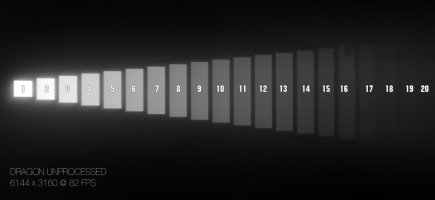
This was digitized with a 16-bit ADC. I see 17-18 different tones (19 & 20 appear indistinguishable on this display).

I have no reason to believe the a7000 won't be nearly as capable with a tone curve similar to what they have now plus multi-exposure blending.
 

Attachments

  • image.jpg
    image.jpg
    47.5 KB · Views: 294
Upvote 0
Interesting that I have not, here or elsewhere, denied that SoNikon sensors have 2+ more stops of low ISO DR...yet you feel compelled to argue the point anyway. Nicely done.

2 + 2 = 5. Don't focus on the fact that the absolute answer of 5 is wrong, what matters is that the sum is greater than the addends...that's all that really matters.
 
Upvote 0
neuroanatomist said:
Interesting that I have not, here or elsewhere, denied that SoNikon sensors have 2+ more stops of low ISO DR...yet you feel compelled to argue the point anyway. Nicely done.

2 + 2 = 5. Don't focus on the fact that the absolute answer of 5 is wrong, what matters is that the sum is greater than the addends...that's all that really matters.

buddy, if you feel compelled enough to whine about people claiming 14.4 stops and 14 bit DAC conversion curves, are you really going to complain when somebody answered? here is a question: if you didn't want to hear it, why did you bring it up?

Also I'm not saying 2+2=5. I think you've gone mad. What I'm saying is that if you quantize DR the same from a set of 14 bit values, the absolute value DR you calculate to be there doesn't mean anything if you cannot compare it to something else. DXO is in the business of comparison. Plenty of field testing (see Diglloyd link) supports the findings. You can spin around the actual DR being 14 stops or not. Given the conversion curve is never stated to be a power of two, it really doesn't matter as long as they use the same curve on all cameras, which they do (or their comparison would be meaningless).

What the takeaway from DXO should be is that some cameras have better DR than others as measured by them in terms of relative stops to each other. And that is the key part: stops apart from each other. Sony/Nikon: 2-3 stops ahead whatever the actual DR of their curve is. That is it. Just get over it.
 
Upvote 0
Still arguing the point I never disputed. At the outset, you wrongly stated that SoNikon sensors have >14-stops of DR, and I agreed that SoNikon delivers 2+ more stops of low ISO DR than Canon. You've posted a few hundred words, and I still agree that SoNikon delivers 2+ more stops of low ISO DR than Canon, and you were still wrong to state that SoNikon sensors have >14-stops of DR. Again, well done.
 
Upvote 0
A question for all you technical experts...
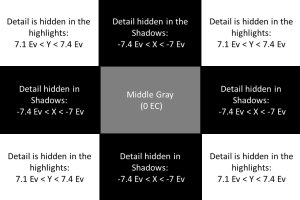
Lets say I have an image properly exposed for my middle gray subject but I've lost detail in the highlight and shadows because the dynamic range of the scene was very high. For argument sake lets say my camera is a D810 which has 13.7 stops of dynamic range at pixel level and it has 36MP. How much would I need to downsize my image to regain detail that is hidden in the highlights areas and shadow areas, both of which are important to properly convey the meaning of the image? (see attached image)
 

Attachments

  • DS-or-BS.jpg
    DS-or-BS.jpg
    84 KB · Views: 279
Upvote 0
As I understand it, you are not going to gain highlight detail by downsampling. Downsampling affects DR because noise is averaged and becomes lower relative to signal. It's only advantageous where SNR is low (ie not in the highlights).
 
Upvote 0
Moreover, you don't gain DR beyond what can be captured by the sensor's actual (pixel level) DR. If your scene contains more than 13-14 stops of DR, you're going to lose highlights, shadows, or both...and no amount of downsampling will recover what you lose.
 
Upvote 0
neuroanatomist said:
Moreover, you don't gain DR beyond what can be captured by the sensor's actual (pixel level) DR. If your scene contains more than 13-14 stops of DR, you're going to lose highlights, shadows, or both...and no amount of downsampling will recover what you lose.

Right. You aren't going to suddenly see details on the surface of the sun, or that dastardly black cat who haunts the neighborhood coal mine, if they weren't digitized from the onset. You're going to see less noise.
 
Upvote 0
3kramd5 said:
neuroanatomist said:
Moreover, you don't gain DR beyond what can be captured by the sensor's actual (pixel level) DR. If your scene contains more than 13-14 stops of DR, you're going to lose highlights, shadows, or both...and no amount of downsampling will recover what you lose.

Right. You aren't going to suddenly see details on the surface of the sun, or that dastardly black cat who haunts the neighborhood coal mine, if they weren't digitized from the onset. You're going to see less noise.

And yet...some people will keep bleating on about how SoNikon sensors deliver 14.whatever stops of DR. ::)
 
Upvote 0
neuroanatomist said:
3kramd5 said:
neuroanatomist said:
Moreover, you don't gain DR beyond what can be captured by the sensor's actual (pixel level) DR. If your scene contains more than 13-14 stops of DR, you're going to lose highlights, shadows, or both...and no amount of downsampling will recover what you lose.

Right. You aren't going to suddenly see details on the surface of the sun, or that dastardly black cat who haunts the neighborhood coal mine, if they weren't digitized from the onset. You're going to see less noise.

And yet...some people will keep bleating on about how SoNikon sensors deliver 14.whatever stops of DR. ::)

I wonder how long it will be before we start to see some larger photon wells and 16 bit a/d converters in cameras..... right now, the full well size takes 15 bits to digitize and Sony/Nikon throws away 1.3 bits for noise and Canon throws away about 3 bits for noise..... A bit deeper well and a bit cleaner circuitry and 14 bits will no longer cut it...

My bet is within two years....
 
Upvote 0
Don Haines said:
neuroanatomist said:
3kramd5 said:
neuroanatomist said:
Moreover, you don't gain DR beyond what can be captured by the sensor's actual (pixel level) DR. If your scene contains more than 13-14 stops of DR, you're going to lose highlights, shadows, or both...and no amount of downsampling will recover what you lose.

Right. You aren't going to suddenly see details on the surface of the sun, or that dastardly black cat who haunts the neighborhood coal mine, if they weren't digitized from the onset. You're going to see less noise.

And yet...some people will keep bleating on about how SoNikon sensors deliver 14.whatever stops of DR. ::)

I wonder how long it will be before we start to see some larger photon wells and 16 bit a/d converters in cameras..... right now, the full well size takes 15 bits to digitize and Sony/Nikon throws away 1.3 bits for noise and Canon throws away about 3 bits for noise..... A bit deeper well and a bit cleaner circuitry and 14 bits will no longer cut it...

My bet is within two years....

You think consumer cameras will be able to make significant use of 16-bit ADCs in two years? I'll be surprised, but I guess it's possible.
 
Upvote 0
3kramd5 said:
Don Haines said:
neuroanatomist said:
3kramd5 said:
neuroanatomist said:
Moreover, you don't gain DR beyond what can be captured by the sensor's actual (pixel level) DR. If your scene contains more than 13-14 stops of DR, you're going to lose highlights, shadows, or both...and no amount of downsampling will recover what you lose.

Right. You aren't going to suddenly see details on the surface of the sun, or that dastardly black cat who haunts the neighborhood coal mine, if they weren't digitized from the onset. You're going to see less noise.

And yet...some people will keep bleating on about how SoNikon sensors deliver 14.whatever stops of DR. ::)

I wonder how long it will be before we start to see some larger photon wells and 16 bit a/d converters in cameras..... right now, the full well size takes 15 bits to digitize and Sony/Nikon throws away 1.3 bits for noise and Canon throws away about 3 bits for noise..... A bit deeper well and a bit cleaner circuitry and 14 bits will no longer cut it...

My bet is within two years....

You think consumer cameras will be able to make significant use of 16-bit ADCs in two years? I'll be surprised, but I guess it's possible.
I should have written my thoughts a bit clearer....

I think that in 2 years it will happen on one or two very high end cameras... 1DX II ???? but most cameras will not have it or even need it.

Also 16 bit A/D is easy to do... in the electronics world 16 bit A/D is low-res.... 24 bit is considered normal and 32 bit (and above) is considered high res.... and in some very specialized instruments ( think $100,000 + ) you can even find 64 bit A/D...
 
Upvote 0
Don Haines said:
3kramd5 said:
Don Haines said:
neuroanatomist said:
3kramd5 said:
neuroanatomist said:
Moreover, you don't gain DR beyond what can be captured by the sensor's actual (pixel level) DR. If your scene contains more than 13-14 stops of DR, you're going to lose highlights, shadows, or both...and no amount of downsampling will recover what you lose.

Right. You aren't going to suddenly see details on the surface of the sun, or that dastardly black cat who haunts the neighborhood coal mine, if they weren't digitized from the onset. You're going to see less noise.

And yet...some people will keep bleating on about how SoNikon sensors deliver 14.whatever stops of DR. ::)

I wonder how long it will be before we start to see some larger photon wells and 16 bit a/d converters in cameras..... right now, the full well size takes 15 bits to digitize and Sony/Nikon throws away 1.3 bits for noise and Canon throws away about 3 bits for noise..... A bit deeper well and a bit cleaner circuitry and 14 bits will no longer cut it...

My bet is within two years....

You think consumer cameras will be able to make significant use of 16-bit ADCs in two years? I'll be surprised, but I guess it's possible.
I should have written my thoughts a bit clearer....

I think that in 2 years it will happen on one or two very high end cameras... 1DX II ???? but most cameras will not have it or even need it.

Also 16 bit A/D is easy to do... in the electronics world 16 bit A/D is low-res.... 24 bit is considered normal and 32 bit (and above) is considered high res.... and in some very specialized instruments ( think $100,000 + ) you can even find 64 bit A/D...

Going to a 16-bit ADC is certainly easy to do, but I don't think sensors will be such that two additional bits would be useful to anyone outside the marketing department. ;)
 
Upvote 0
neuroanatomist said:
Yes, it's quite a good trick to have DR "in mid 14's" when your camera has a 14-bit ADC. Hail to the almighty DxO Biased Scores, and kudos to those that revel in that BS. ::)

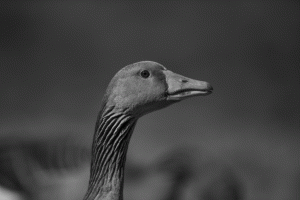
Yes clearly, here is a 1bit image 8192 pixels wide, then the same 1bit image again downsampled to 1024 pixels. As you clearly can see there can't possibly be more than 1stop DR in this image ::)
 

Attachments

  • _1D_7739.gif
    _1D_7739.gif
    4.8 MB · Views: 299
  • _1D_7739_downsampled.gif
    _1D_7739_downsampled.gif
    320.2 KB · Views: 272
Upvote 0