For our DR peepers: Sony A7000 - rumored 15,5 stops DR

msm said:
neuroanatomist said:
Yes, it's quite a good trick to have DR "in mid 14's" when your camera has a 14-bit ADC. Hail to the almighty DxO Biased Scores, and kudos to those that revel in that BS. ::)

Yes clearly, here is a 1bit image 8192 pixels wide, then the same 1bit image again downsampled to 1024 pixels. As you clearly can see there can't possibly be more than 1stop DR in this image ::)

Certainly, there are ways to digitally increase the DR in an already-captured image. I bet your grandmother knows how to suck eggs without you having to teach her.

Which camera did you use that converted the original >1 stop analog signal to digital using a 1-bit ADC?

At issue is the scene DR vs. the system DR at image capture. Are you suggesting that signal above the full well capacity or below the noise floor can be included in the dynamic range of an image? That a sensor with a 13.5-stop difference between noise floor and full well capacity can capture the full DR of a scene with 14.4-stops of DR, in a single image?

But lots of people like BS, and seem to eat it up with a giant spoon. For example, in this post on Digital Camera World that purports to explain, "...what you need to know about capturing all the tones in a scene," the author states that:

[quote author=Markus Hawkins on Digital Camera World]
For instance, the Nikon D610’s dynamic range has been measured at between 13 and 14.4 EV at ISO 100.
[/quote]

The D610's DR has been measured at 14.4 EV. Do you believe that statement to be true? Is the D610 capturing all the tones in a scene when that scene has 14.4 stops of DR? Personally, I think Markus has eaten a big helping of DxO and his breath reeks of BS.

DxO aside, it's true that 14-bit ADCs are commonly used because that's more than required to fully represent the captured range of current sensors. As sensors exceed than 14-bit limit, camera makers could clip or map that >14-bit signal into the smaller range. It would be transformed data still called RAW, but that's already common (Nikon applied NR to RAW, Sony applies lossy compression, and Canon's mRAW and sRAW aren't really RAW). More likely they'll just move to 16-bit ADCs (just like they went from 12- to 14-bits a while back). The step after that (18-bits) will be the tricky one.
 
Upvote 0
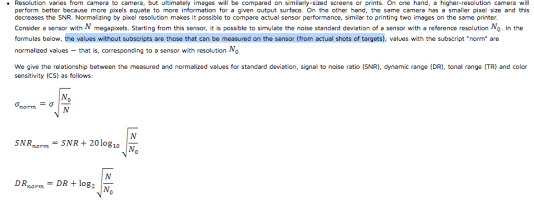
Neuro, I am gonna ignore your usual irrelevant BS. I will just point out that there are multiple definitions of dynamic range. You got the traditional per pixel ones (ie engineering DR and DXO screen) and you got the more modern ones which takes resolution into account (ie DXO print and Bill Claff's photographic dynamic range). Both Bill Claff and DXO disclose their DR definitions at their websites. When the resolution of the sensor is sufficiently high it is perfectly possible for the dynamic range measured in stops to exceed the number of bits of the DAC when using the DR measures which take resolution into account.

In a per pixel measure of DR, a sensor with 1 pixel and 11stops of DR has better dynamic range than a 50megapixel sensor with 10.9stops DR. For a photographer, this is a obviously a completely useless piece of information, thats why we have the more modern measures. A 50 megapixel sensor with per pixel DR of 13.5stops captures way more information than a 12mpixel sensor with per pixel DR of 13.5, in fact it captures more than a stop more per pixel DR after you downscale to 12mpix than the 12mpix sensor does.

Unless you have some information to share with us that points out that DXO's D750 test has not been performed in accordance with their definition, then you may as well consider the following statement to be a fact: "The D750 sensor has been measured at 14.5EV dynamic range at base iso using the DXO print definition".
 
Upvote 0
msm said:
50 megapixel sensor with per pixel DR of 13.5stops captures way more information than a 12mpixel sensor with per pixel DR of 13.5, in fact it captures more than a stop more per pixel DR after you downscale to 12mpix than the 12mpix sensor does.

By what magic does downsampling an image change what the sensor already captured?

You'll never capture more by downsampling - what gets digitized initially is the most of anything you get. downsampling will reduce noise and therefore increase DR of an image, but it doesn't affect the capture.

[quote author=msm]
Unless you have some information to share with us that points out that DXO's D750 test has not been performed in accordance with their definition, then you may as well consider the following statement to be a fact: "The D750 sensor has been measured at 14.5EV dynamic range at base iso using the DXO print definition".[/quote]

It is not fact. Had DXO down sampled a d750 image and run analysis on it it would be fair to say "an image from the d750 has been measured at 14.5," but that isn't what they do. They analyze RAW (dxoone notwithstanding) and use a math model to predict downsampled "print" DR; it isn't measured.
 
Upvote 0
msm said:
Neuro, I am gonna ignore the main point you made and the specific question you asked me.

Fixed that for ya. I'll try once more, and I'll keep it simple. You're holding a D750 and have framed a scene with 14.5 stops of DR from deepest shadow detail to brightest highlight detail. Yes or no: can you capture in a single image all that detail from the deepest shadow to the brightest highlight? Feel free to use whichever definition of DR that you prefer.


msm said:
Unless you have some information to share with us that points out that DXO's D750 test has not been performed in accordance with their definition, then you may as well consider the following statement to be a fact: "The D750 sensor has been measured at 14.5EV dynamic range at base iso using the DXO print definition".

"Measured,"...in the context of science and engineering, the word has a specific meaning. I understand it, DxO understands it, but it seems that you do not. DxO's understanding is described in the attached screenshot (from here). In terms of their plots, Screen DR is measured and Print DR (the one that's >14-stops) is mathematically determined from that measured value. If you were able to answer the above question correctly, you should understand why the distinction is important.
 

Attachments

  • Measured vs Calculated.png
    Measured vs Calculated.png
    73.3 KB · Views: 251
Upvote 0
3kramd5 said:
msm said:
50 megapixel sensor with per pixel DR of 13.5stops captures way more information than a 12mpixel sensor with per pixel DR of 13.5, in fact it captures more than a stop more per pixel DR after you downscale to 12mpix than the 12mpix sensor does.

By what magic does downsampling an image change what the sensor already captured?

You'll never capture more by downsampling - what gets digitized initially is the most of anything you get. downsampling will reduce noise and therefore increase DR of an image, but it doesn't affect the capture.

Downsampling does not create more information. But for instance a 50megapixel sensor captures more information than a 16 megapixel one with identical per pixel DR, which results in less noise and higher dynamic range from the 50megapixel sensor when the images are viewed at identical magnification (or downsampled to identical resolutions). This is why looking at per pixel DR without considering resolution is meaningless from a photography perspective.

It is not fact. Had DXO down sampled a d750 image and run analysis on it it would be fair to say "an image from the d750 has been measured at 14.5," but that isn't what they do. They analyze RAW (dxoone notwithstanding) and use a math model to predict downsampled "print" DR; it isn't measured.

In practice it doesn't matter if they downsample first then calculate or if they use a formula, the difference will be negligable. Or are you implying the statistics is wrong? But if you know for a fact they calculate it from the formula you can substitute the word "measured" with "estimated" in my statement above, but unless DXO mess it up it will be a good estimate however.
 
Upvote 0
neuroanatomist said:
msm said:
Neuro, I am gonna ignore the main point you made and the specific question you asked me.

Fixed that for ya. I'll try once more, and I'll keep it simple. You're holding a D750 and have framed a scene with 14.5 stops of DR from deepest shadow detail to brightest highlight detail. Yes or no: can you capture in a single image all that detail from the deepest shadow to the brightest highlight? Feel free to use whichever definition of DR that you prefer.

Uninteresting question, but if you absolutely want to then yeah you can come up with a scene and a definition of DR where the answer in practice is yes. In general however a DSLR can never capture all detail of a scene.
 
Upvote 0
msm said:
In practice it doesn't matter if they downsample first then calculate or if they use a formula, the difference will be negligable.

I guess what bothers me, as a bit of a purist, is that they make every effort to discuss how their scorings are based on RAW, for example:

All sensor scores reflect only the RAW sensor performance of a camera body. All measurements are performed on the RAW image file BEFORE demosaicing or other processing prior to final image delivery. DxOMark does not address such other important criteria as image signal processing, mechanical robustness, ease of use, flexibility, optics quality, value for money, etc. While RAW sensor performance is critically important, it is not the only factor that should be taken into consideration when choosing a digital camera.

and

Since users can choose their RAW converter and tune the settings to a very fine degree, and since we want to evaluate the intrinsic quality of the sensor and the lens, it is only logical to perform measurements on RAW images.

and

Only RAW-based measurements report on the image quality of the photographic hardware irrespective of the RAW converter. ,

and yet by default what they display in their sensor scoring is not RAW but rather one which has been noise-reduced via the averaging of pixels involved in down-sampling. Seems a little strange. It also negates a common use (if internet posts are to be believed) for high-resolution sensors: cropping.

That which is based on downsampling a demosaiced RGB image shouldn't be referred to as a sensor property, or score, etc., any more than one which has been run through DXO Prime. It's a reasonable way to compare potential SNR between different cameras with different resolutions, but that's about it.

msm said:
But if you know for a fact they calculate it from the formula you can substitute the word "measured" with "estimated" in my statement above, but unless DXO mess it up it will be a good estimate however.

I'd probably still take issue with it since it says "the sensor has been..."

I'd have no problem with the statement "Prints which have been averaged down to roughly 1/3 the native sensor resolution have been estimated as potentially representing 14.5EV DR" ;D

Personally, I work on my images at full resolution, and what happens when they get down sampled to another format are a bonus. I would much prefer if I DXO gave prominence to "screen DR," but it isn't my website and I'm not about to start a competing one, so I'll deal with a few additional clicks. Unfortunately, given how the internet works, each step away from DXO makes it a little less likely the caveats are understood by the end reader.
 
Upvote 0
To have 15.5 (call it 16) stops of DR, then the sensor needs to output atleast 15 bits of data + a few extra for the darkest dark. Let's say 4 bit is sufficient. That means 20 stops of data.

Normally LR, ... save 16 bits of data (actually there are only 15 bits, the high order bit is a sign bit so data is recorded from 0 ... 32767 which is 2^15-1.

For 20 bits of data (required to support 15.5 stops of DR), the sensor and processing would need to use 32 bit data which means files would be twice the size.

Sounds like DxO is measuring something that is not actually used.
 
Upvote 0
3kramd5 said:
That which is based on downsampling a demosaiced RGB image shouldn't be referred to as a sensor property, or score, etc., any more than one which has been run through DXO Prime. It's a reasonable way to compare potential SNR between different cameras with different resolutions, but that's about it.

Where is it stated that it is based on a demosaiced image?

3kramd5 said:
I'd probably still take issue with it since it says "the sensor has been..."

I'd have no problem with the statement "Prints which have been averaged down to roughly 1/3 the native sensor resolution have been estimated as potentially representing 14.5EV DR" ;D

Personally, I work on my images at full resolution, and what happens when they get down sampled to another format are a bonus. I would much prefer if I DXO gave prominence to "screen DR," but it isn't my website and I'm not about to start a competing one, so I'll deal with a few additional clicks. Unfortunately, given how the internet works, each step away from DXO makes it a little less likely the caveats are understood by the end reader.

Ok so you only care about pixel peeping 100% crops and don't care about how the entire image look from a reasonable viewing distance? In that case I would recommend you get a low resolution camera with good per pixel DR measures.

Measures like DXO print DR and Bill Claff's photographic dynamic range is based on the image in its entirety, for instance Bill Claff states "PDR is the dynamic range you would expect in an 8x10” print viewed at a distance of about arms length."
 
Upvote 0
msm said:
Ok so you only care about pixel peeping 100% crops and don't care about how the entire image look from a reasonable viewing distance?

Incorrect on both. I said I work on full res and that if noise is reduced when I change format it's a bonus. However I wouldn't purchase a high resolution camera (eg the 42.4 ish or 50.1 ish MP bodies I have on order) with the intent to shed the vast majority of the resolution.

I mostly use a 5D3 which isn't high res by current standards and doesn't have huge per pixel DR by current SOTA. Doesn't matter, it works for me. I sometimes use a 36MP camera, and when I do, it's because I intend to use the resolution, by which I mean print a whole heck of a lot bigger than 8X10.

msm said:
3kramd5 said:
That which is based on downsampling a demosaiced RGB image shouldn't be referred to as a sensor property, or score, etc., any more than one which has been run through DXO Prime. It's a reasonable way to compare potential SNR between different cameras with different resolutions, but that's about it.

Where is it stated that it is based on a demosaiced image?

Fair 'nuff. Substitute "that which is based on an estimate of what could result were you to downsample a demosaiced RGB image..." :)
Regardless, it's signal processing and is no longer RAW by any stretch of DXO's verbiage.
 
Upvote 0
msm said:
neuroanatomist said:
msm said:
Neuro, I am gonna ignore the main point you made and the specific question you asked me.

Fixed that for ya. I'll try once more, and I'll keep it simple. You're holding a D750 and have framed a scene with 14.5 stops of DR from deepest shadow detail to brightest highlight detail. Yes or no: can you capture in a single image all that detail from the deepest shadow to the brightest highlight? Feel free to use whichever definition of DR that you prefer.

Uninteresting question, but if you absolutely want to then yeah you can come up with a scene and a definition of DR where the answer in practice is yes.

Uninteresting to you...perhaps because you don't like the answer. What it means is that,the D750 does not deliver 14.5-stops of DR. Furthermore, no current SoNikon sensor delivers >14-stops of DR.

Yet...there are claims like that all over the place, including the one by psolberg which started this discussion. All thanks to the BS plopping to the ground behind DxO.
 
Upvote 0
neuroanatomist said:
msm said:
neuroanatomist said:
msm said:
Neuro, I am gonna ignore the main point you made and the specific question you asked me.

Fixed that for ya. I'll try once more, and I'll keep it simple. You're holding a D750 and have framed a scene with 14.5 stops of DR from deepest shadow detail to brightest highlight detail. Yes or no: can you capture in a single image all that detail from the deepest shadow to the brightest highlight? Feel free to use whichever definition of DR that you prefer.

Uninteresting question, but if you absolutely want to then yeah you can come up with a scene and a definition of DR where the answer in practice is yes.

Uninteresting to you...perhaps because you don't like the answer. What it means is that,the D750 does not deliver 14.5-stops of DR. Furthermore, no current SoNikon sensor delivers >14-stops of DR.

Yet...there are claims like that all over the place, including the one by psolberg which started this discussion. All thanks to the BS plopping to the ground behind DxO.

Uninteresting because it is a stupid question. No sensor can capture all detail in any scene period. Then if you ignore that point then the question is not well defined:

"a scene with 14.5 stops of DR from deepest shadow detail to brightest highlight detail": How do you define this precisely?
" can you capture in a single image all that detail from the deepest shadow to the brightest highlight?": Again defined how?
 
Upvote 0
msm said:
neuroanatomist said:
msm said:
neuroanatomist said:
msm said:
Neuro, I am gonna ignore the main point you made and the specific question you asked me.

Fixed that for ya. I'll try once more, and I'll keep it simple. You're holding a D750 and have framed a scene with 14.5 stops of DR from deepest shadow detail to brightest highlight detail. Yes or no: can you capture in a single image all that detail from the deepest shadow to the brightest highlight? Feel free to use whichever definition of DR that you prefer.

Uninteresting question, but if you absolutely want to then yeah you can come up with a scene and a definition of DR where the answer in practice is yes.

Uninteresting to you...perhaps because you don't like the answer. What it means is that,the D750 does not deliver 14.5-stops of DR. Furthermore, no current SoNikon sensor delivers >14-stops of DR.

Yet...there are claims like that all over the place, including the one by psolberg which started this discussion. All thanks to the BS plopping to the ground behind DxO.

Uninteresting because it is a stupid question. No sensor can capture all detail in any scene period. Then if you ignore that point then the question is not well defined:

"a scene with 14.5 stops of DR from deepest shadow detail to brightest highlight detail": How do you define this precisely?
" can you capture in a single image all that detail from the deepest shadow to the brightest highlight?": Again defined how?

14.5 stops of DR in the scene. Can the D750 capture that full 14.5 stops of DR without clipping a highlight or blocking up a shadow? Oh, wait – you've already answered and the answer is, "No." Now, it's both uninteresting and stupid because you don't like the answer. Weaseling around interpretations doesn't alter the facts. No current Sony/Nikon/etc. sensor used in a dSLR or MILC can capture more than 14-stops of DR. Can you grasp that simple fact, or do you need more basic terminology and concepts defined for you?
 
Upvote 0
msm said:
"a scene with 14.5 stops of DR from deepest shadow detail to brightest highlight detail": How do you define this precisely?

How about a scene of a constant texture lit at one end by a spot. If you meter in the spot light, it gives f/128, and if you meter the opposite end it gives f/1 with an extra half stop from a longer exposure time.

The question then would be can you see the same constant texture across the entire scene?
 
Upvote 0
3kramd5 said:
msm said:
"a scene with 14.5 stops of DR from deepest shadow detail to brightest highlight detail": How do you define this precisely?

How about a scene of a constant texture lit at one end by a spot. If you meter in the spot light, it gives f/128, and if you meter the opposite end it gives f/1 with an extra half stop from a longer exposure time.

The question then would be can you see the same constant texture across the entire scene?

I don't have a lens that opens up to f/1 or stops down to f/128, so your question is impractical and irrelevant. See...I can weasel around on interpretation, too. ;)
 
Upvote 0
neuroanatomist said:
msm said:
neuroanatomist said:
msm said:
neuroanatomist said:
msm said:
Neuro, I am gonna ignore the main point you made and the specific question you asked me.

Fixed that for ya. I'll try once more, and I'll keep it simple. You're holding a D750 and have framed a scene with 14.5 stops of DR from deepest shadow detail to brightest highlight detail. Yes or no: can you capture in a single image all that detail from the deepest shadow to the brightest highlight? Feel free to use whichever definition of DR that you prefer.

Uninteresting question, but if you absolutely want to then yeah you can come up with a scene and a definition of DR where the answer in practice is yes.

Uninteresting to you...perhaps because you don't like the answer. What it means is that,the D750 does not deliver 14.5-stops of DR. Furthermore, no current SoNikon sensor delivers >14-stops of DR.

Yet...there are claims like that all over the place, including the one by psolberg which started this discussion. All thanks to the BS plopping to the ground behind DxO.

Uninteresting because it is a stupid question. No sensor can capture all detail in any scene period. Then if you ignore that point then the question is not well defined:

"a scene with 14.5 stops of DR from deepest shadow detail to brightest highlight detail": How do you define this precisely?
" can you capture in a single image all that detail from the deepest shadow to the brightest highlight?": Again defined how?

14.5 stops of DR in the scene. Can the D750 capture that full 14.5 stops of DR without clipping a highlight or blocking up a shadow? Oh, wait – you've already answered and the answer is, "No." Now, it's both uninteresting and stupid because you don't like the answer. Weaseling around interpretations doesn't alter the facts. No current Sony/Nikon/etc. sensor used in a dSLR or MILC can capture more than 14-stops of DR. Can you grasp that simple fact, or do you need more basic terminology and concepts defined for you?

Wrong, the problem here is that you can't formulate a meaningful question. You can "capture" more than 14stops DR (as in you can separate signals of more than 14 stops below white point), just downsample sufficently and you are left with pixels which are way past 14. I have already demonstrated that in the goose picture above. And as a consequence by some definitions of dynamic range you can have more than 14stops of DR from a 14bit ADC (because the measured signal is supersampled by definition). Why is this so hard to accept for you? It is just a definition you know.
 
Upvote 0
msm said:
Wrong, the problem here is that you can't formulate a meaningful question. You can "capture" more than 14stops DR (as in you can separate signals of more than 14 stops below white point), just downsample sufficently and you are left with pixels which are way past 14. I have already demonstrated that in the goose picture above. And as a consequence by some definitions of dynamic range you can have more than 14stops of DR from a 14bit ADC (because the measured signal is supersampled by definition). Why is this so hard to accept for you? It is just a definition you know.

Well, it looks like we've run up against the wall of your inability to accept facts. As I already stated, you can digitally introduce over 14-stops if data into a 14-bit digital file. But current sensors cannot capture the complete dynamic range of a scene with >14-stops of DR. It must be nice for you – you are able to have as much DR as you want in your files – you can capture the detail of a white rocks face in full sun and the detail inside the unlit cave, all in one shot...all you have to do is downsample. The rest of us live in the real world, where detail in the highlights will be lost to clipping, detail in the shadows will be lost and unrecoverable, or both. Your handwaving around "by some definitions" is ignoring the central point that information lost at capture cannot be recreated later, and your unwillingness or inability to admit that fact is rather sad.

Your intransigence has apparently reached the point of a mental handicap regarding this issue, so I see no point in continuing this discussion.
 
Upvote 0
neuroanatomist said:
msm said:
Wrong, the problem here is that you can't formulate a meaningful question. You can "capture" more than 14stops DR (as in you can separate signals of more than 14 stops below white point), just downsample sufficently and you are left with pixels which are way past 14. I have already demonstrated that in the goose picture above. And as a consequence by some definitions of dynamic range you can have more than 14stops of DR from a 14bit ADC (because the measured signal is supersampled by definition). Why is this so hard to accept for you? It is just a definition you know.

Well, it looks like we've run up against the wall of your inability to accept facts. As I already stated, you can digitally introduce over 14-stops if data into a 14-bit digital file. But current sensors cannot capture the complete dynamic range of a scene with >14-stops of DR. It must be nice for you – you are able to have as much DR as you want in your files – you can capture the detail of a white rocks face in full sun and the detail inside the unlit cave, all in one shot...all you have to do is downsample. The rest of us live in the real world, where detail in the highlights will be lost to clipping, detail in the shadows will be lost and unrecoverable, or both. Your handwaving around "by some definitions" is ignoring the central point that information lost at capture cannot be recreated later, and your unwillingness or inability to admit that fact is rather sad.

Your intransigence has apparently reached the point of a mental handicap regarding this issue, so I see no point in continuing this discussion.

This is getting funny. I do not have a problem with accepting facts. However I do have a problem with facts from Neuroland.

Let's instead consider some facts from reality:

- A single pixel in a modern image sensor can at most create 14bits of information per scan by a 14bit DAC.
- Modern image sensors however consist of many pixels, in fact millions of pixels. In fact a 5DS sensor creates more than 700megabits of information per scan.
- In digital imaging some parties have started to measure dynamic range as a property of the sensor, not as the property of the individual pixels. In these measures, dynamic ranges in stops can exceed the number of bits in the DAC.

I have tried to explain why several times now and even demonstrated the principle practically but it is obviously a waste of time. You should read your last post again and reflect on whether it maybe applies to yourself, but it seems self reflection is not one of your strenghts. ::)
 
Upvote 0
3kramd5 said:
How about a scene of a constant texture lit at one end by a spot. If you meter in the spot light, it gives f/128, and if you meter the opposite end it gives f/1 with an extra half stop from a longer exposure time.

The question then would be can you see the same constant texture across the entire scene?

Apparently the answer is yes. Just downsample and the detail in the texture lost to highlight clipping and/or shadow blocking will magically be created.

Physics – it's only a suggestion. . ;)
 
Upvote 0