For our DR peepers: Sony A7000 - rumored 15,5 stops DR

neuroanatomist said:
3kramd5 said:
How about a scene of a constant texture lit at one end by a spot. If you meter in the spot light, it gives f/128, and if you meter the opposite end it gives f/1 with an extra half stop from a longer exposure time.

The question then would be can you see the same constant texture across the entire scene?

Apparently the answer is yes. Just downsample and the detail in the texture lost to highlight clipping and/or shadow blocking will magically be created.

Physics – it's only a suggestion. . ;)

Oh is this another wonderful insight from Neuroland or is it an attempt of trying to ridicule someone based on arguments they never made? My guess is on the latter but from what I have seen above I can't be 100% sure ::)
 
Upvote 0
msm said:
- A single pixel in a modern image sensor can at most create 14bits of information per scan by a 14bit DAC.
Using a 14-bit Analog-to-Digital-Converter (ADC), a pixel's quantized value can be anything from 0 to 16383. When you combine multiple pixels you can average their values. So if you combine an input pixel array (0;0;0;1) you can have an output pixel value of 0.25. Log2(16383/0.25)>14. I believe this is your argument msm, please correct me if I'm wrong.

For the Nikon D610, if your noise floor (average read noise) is 0.32 EV then that corresponds to a 14-bit pixel value of 1.25. If you combine an input pixel array (1.25;1.25;1.25;1.25) you get an output pixel value of 1.25. Log2(16383/1.25)=13.7. I believe this is Neuro's argument, please correct me if I'm wrong.
 
Upvote 0
StudentOfLight said:
msm said:
- A single pixel in a modern image sensor can at most create 14bits of information per scan by a 14bit DAC.
Using a 14-bit Analog-to-Digital-Converter (ADC), a pixel's quantized value can be anything from 0 to 16383. When you combine multiple pixels you can average their values. So if you combine an input pixel array (0;0;0;1) you can have an output pixel value of 0.25. Log2(16383/0.25)>14. I believe this is your argument msm, please correct me if I'm wrong.

For the Nikon D610, if your noise floor (average read noise) is 0.32 EV then that corresponds to a 14-bit pixel value of 1.25. If you combine an input pixel array (1.25;1.25;1.25;1.25) you get an output pixel value of 1.25. Log2(16383/1.25)=13.7. I believe this is Neuro's argument, please correct me if I'm wrong.

I don't have time nor motivation to try to write up a fully detailed and correct explanation but I'll try to sum up some of it.

One important aspect here is that when you read pixel values the result is subject to noise which means we need to turn to statistics. The important part here is that when you average measurements from multiple pixels the result will have less noise than the noise of the individual measurements, the more measurements you average the less noise you get. If you want to understand the details I recommend reading about the concepts in basic statistics like stochastic variables, expected values, variance and standard deviation.

Also important are the definitions of DR which you can read about on DXO's site or at http://home.comcast.net/~NikonD70/GeneralTopics/Sensors_&_Raw/Sensor_Analysis_Primer/Sensor_Analysis_Primer.htm

The sensor based DR definitions either downsample to a specific resolution by bilinear filtering or adjusting for a circle of confusion. This is done by calculating weighted averages for multiple pixels. So obviously the more measurements you have (ie more pixels) the lower the noise is in the downsampled pixels or in the CoC. Since modern sensors based on same technology in practice typically have identical per pixel noise at base ISO regardless of resolution, this means that in practice a high resolution sensor typically produces less noisy images (when viewed at identical distance or at identical resolution) than a low resolution sensor based on same technology. This is why I argue that per pixel measurements of dynamic range alone is of limited value in photography.

When DXO says that the landscape DR is above 14 stops it simply means that the ratio between the noise floor (probably defined as the signal where signal to noise ratio is 1, check the DXO site to be sure) and the clipping or white point is above 14 stops at base ISO per pixel after the image has been downsampled to 8mpixels. It doesn't mean anything other than this, so it is important not to misinterpret this number. A signal to noise ratio of 1 also means a very noisy signal so that does not mean that you can "capture details 14 stops below white point" or anything like that. The real answer to a question like that would also depend on things like how detailed the detail is (ie how many pixels would be needed to reproduce it of sufficient quality) and how large area of the sensor it covers.

The actual values from dynamic range measurements can vary significantly depending on whichever criterions are used, the important thing are usually not the values themselves but the differences in measured values for different sensors measured by the same definition.
 
Upvote 0
This thread discusses per pixel and per sensor dynamic range. What about whole system dynamic range?
I thought that flare inside the lens and camera defined an upper limit for dynamic range, although I don't know what that is.
 
Upvote 0
>:(
Frodo said:
This thread discusses per pixel and per sensor dynamic range. What about whole system dynamic range?
I thought that flare inside the lens and camera defined an upper limit for dynamic range, although I don't know what that is.

I've got a feeling that some lenses do allow the sensor to capture slightly more dynamic range, specifically modern, 'made for digital' ones when compared with some of the last film era lenses that were designed to boost contrast with film.
 
Upvote 0
Frodo said:
This thread discusses per pixel and per sensor dynamic range. What about whole system dynamic range?
I thought that flare inside the lens and camera defined an upper limit for dynamic range, although I don't know what that is.

That's a very complex issue to try to quantify. It depends on where the bright and dark areas are positioned in the frame. Some lenses can maintain very high contrast ratios in one portion of the frame where bright light is shining and then very low contrast in other parts of the frame. There is also the question of how far apart the brightest and darkest areas are from each other in the frame. If you have a sharp edge transition from super dark to super bright, all lenses will be struggling to maintain any decent level of DR. If the darkest area is in one corner and the brightest area in the opposite corner, then most lenses will perform far beyond what any current sensor can do in terms of DR.
 
Upvote 0
StudentOfLight said:
A question for all you technical experts...
Lets say I have an image properly exposed for my middle gray subject but I've lost detail in the highlight and shadows because the dynamic range of the scene was very high. For argument sake lets say my camera is a D810 which has 13.7 stops of dynamic range at pixel level and it has 36MP. How much would I need to downsize my image to regain detail that is hidden in the highlights areas and shadow areas, both of which are important to properly convey the meaning of the image? (see attached image)


You don't expose for mid tones, you expose for hilights. it's called Expose To The Right: ETTR.. so long as you don't clip any pixels then you can recover shadows by downsampling, you get one stop improvement in the shadows by halving both vertical and horizontal resolution, do the same again and get another stop.

You can also gain one stop in the shadows by averaging 4 images, or 2 stops with 16 images.. this is what is often done in astro imaging.

additionally you get the same performance in the real world with either the sony or Nikon implementation of the same sensor despite what DxO would have you believe. Nikon clip the noise so makeing the zero point look less noisy, if you have extremely low but not zero signal level the noise is raised so that it is fully sampled and you lose the "benefit" of clipping, so whilst areas at 14EV below clipping might appear marginally better, those at -13EV below clipping and brighter should appear identical.
 
Upvote 0
It's been a long day and I'm tired and the silly bickering here ceases to be amusing any more.

Y'all might need to pause your arguments for a moment and think about a particular aspect of DxO's downsampled DR, which I'm sure you're all aware of and understand how it's calculated but either don't think is real-world relevant or just enjoy arguing over semantics.

Remember that for any maximum number representing a full quantized count of a signal, the MINIMUM quantifiable amount is ZERO.
Anything over zero = infinity. Infinity would be a lot of DR!

What DXO's downsampling does is merely to average out the black level data provided by the sensor.
The closer to zero you can get, the higher the DR, no matter whether its 14 bits, 12 or 8 or less.

Since Canon's sensor systems don't produce many zeros due to prodigous read noise, their DR is gonna be limited.
ABC cameras produce more zero data for black levels so simply have a better black level when averaged and that makes for a better DR number the way DxO calculates it.

Theoretically, it's possible to use a really high resolution sensor, digitized at only 1 bit but, for sake of argument, using some sort of diffusion and dithering method, to produce an infinite DR measurement because it's black levels would always be represented by only zero and not some slightly greater than zero noise number. (because the diffusion and dithering algorithms it uses are perfect)


So, IMO, the print DR number is carp!
The screen DR number is somewhat useful but is also misleading as we're not really sure how they're averaging all the black pixels. (simple mean, RMS, mean + RMSvar)

The full SNR measurements are slightly more useful as you can see how clean the entire signal is at any tonal level (in %) for any major ISO.
By looking at where the plot intersects the bottom axis, the farther to the left, the better. The higher the plot intersects the vertical right axis, the better.
Log2 (latter / former) is your DR when using 1:1 signal to noise ratio as the base limit for the measurement as they've chosen to depict it.

ALL OF THESE MEASUREMENTS ARE STILL ALMOST USELESS IF YOU DON'T HAVE A FIGURE FOR PATTERN NOISE which is what really limits useful DR.
But if you KNOW a particular body does not exhibit pattern noise, then DxOmark's numbers are very useful and directly comparable.
Have a look at the SNR graph for a Pentax K5ii if you want to see an impressively clean camera which is also devoid of any significant pattern noise.

http://www.dxomark.com/Cameras/Pentax/K-5-II---Measurements#measuretabs-6


So, perhaps to surprise Neuro, I don't fit into his DRone group.
I'm in the smaller anti-pattern-noise group.
Maybe someone can come up with a catchy acronym for that. :)
 
Upvote 0
dilbert said:
3kramd5 said:
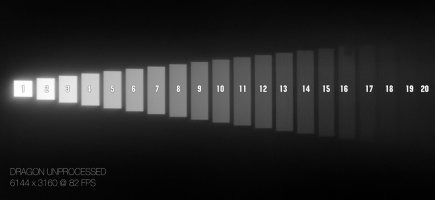
This was digitized with a 16-bit ADC. I see 17-18 different tones (19 & 20 appear indistinguishable on this display).

To me, all 20 are distinguishable on my laptop...

Yes, I see them all on my desktop (originally posted from an iphone6), and 19 on my laptop (2015 macbook pro). Note that DXO's "print DR" score is 14.8, so presumably 15-and-on are where the math model predicts SNR of less than 1 after downsampling from 6k.
 
Upvote 0
msm said:
Measures like DXO print DR and Bill Claff's photographic dynamic range is based on the image in its entirety, for instance Bill Claff states "PDR is the dynamic range you would expect in an 8x10” print viewed at a distance of about arms length."

I think I missed this before. What papers and inks are you using to see 14.5 stops of DR on a print? Maybe with neat backlighting you could get there, by in my experience the final format, be it web-based or printed, has a far narrower DR than any modern DSLR musters. Gotta map tones down.

Print DR from DXO doesn't tell me anything about what I could expect in a printed 8X10, it tells me what I could expect a downsampled digital file to contain.
 
Upvote 0
3kramd5 said:
msm said:
Measures like DXO print DR and Bill Claff's photographic dynamic range is based on the image in its entirety, for instance Bill Claff states "PDR is the dynamic range you would expect in an 8x10” print viewed at a distance of about arms length."

I think I missed this before. What papers and inks are you using to see 14.5 stops of DR on a print? Maybe with neat backlighting you could get there, by in my experience the final format, be it web-based or printed, has a far narrower DR than any modern DSLR musters. Gotta map tones down.

Print DR from DXO doesn't tell me anything about what I could expect in a printed 8X10, it tells me what I could expect a downsampled digital file to contain.

Well yes of course, that statement is maybe a bit simplistic. It is a measure of the quality of the data off the sensor not the quality of some actual print. So you could see it as what you could expect to see in some theoretical perfect print, or you can just see it as a measure of how many stops of information you got available to tone map into your print.
 
Upvote 0
msm said:
3kramd5 said:
msm said:
Measures like DXO print DR and Bill Claff's photographic dynamic range is based on the image in its entirety, for instance Bill Claff states "PDR is the dynamic range you would expect in an 8x10” print viewed at a distance of about arms length."
I think I missed this before. What papers and inks are you using to see 14.5 stops of DR on a print? Maybe with neat backlighting you could get there, by in my experience the final format, be it web-based or printed, has a far narrower DR than any modern DSLR musters. Gotta map tones down.

Print DR from DXO doesn't tell me anything about what I could expect in a printed 8X10, it tells me what I could expect a downsampled digital file to contain.
Well yes of course, that statement is maybe a bit simplistic. It is a measure of the quality of the data off the sensor not the quality of some actual print. So you could see it as what you could expect to see in some theoretical perfect print, or you can just see it as a measure of how many stops of information you got available to tone map into your print.

You continue to perpetuate that fallacy.

"Print DR" is not a measurement of any property of the sensor. "Print DR" does not indicate the amount of scene DR – light information in the real world – that can be captured by the sensor. Information/image detail in the real-world subject at luminance levels which fall outside of the directly measured DR of a sensor (what DxO reports as "screen DR") is lost, and downsampling or other post-capture manipulation of the digital file will not recover those data.

As 3kramd5 states, "print DR" tells you what DR you can expect in a downsampled digital file, and that's a pretty useless piece of information for practical purposes. "Print DR" is a contrived value that facilitates comparison of DR among sensors of different MP count – in other words, the primary practical utility of "print DR" is as a comparison shopping tool.
 
Upvote 0
Sensor DR, though, i.e. what DXO calls "screenDR," is an entirely reasonable and appropriate measure for a digital I/O signal chain. I don't think anyone could successfully argue (and note I am not claiming Neuro is attempting to) that the Sony signal chain doesn't produce lower noise, and thus make possible larger DR, than the canon signal chain, given the usual caveats (at or near base ISO, practicality, etc).
 
Upvote 0
neuroanatomist said:
"Print DR" is not a measurement of any property of the sensor. "Print DR" does not indicate the amount of scene DR – light information in the real world – that can be captured by the sensor. Information/image detail in the real-world subject at luminance levels which fall outside of the directly measured DR of a sensor (what DxO reports as "screen DR") is lost, and downsampling or other post-capture manipulation of the digital file will not recover those data.

As 3kramd5 states, "print DR" tells you what DR you can expect in a downsampled digital file, and that's a pretty useless piece of information for practical purposes. "Print DR" is a contrived value that facilitates comparison of DR among sensors of different MP count – in other words, the primary practical utility of "print DR" is as a comparison shopping tool.

Oh ok so when you fall below "Screen DR" or a SNR of 1 all of a sudden all information dissapears in Neuro land? ::)

This is not how things work in statistics. It is not how sensors work in the real world either. And fortunately it is easy to test, here is a couple of pictures for you, one is ETTR'ed (not a single pixel clipped according to rawdigger) and the other is underexposed 16 stops (where all information would be lost according to you) and then pushed.

If it wasn't for pattern noise the 16 stops pushed image would look much better and that is the one thing DXO DR doesn't account for.

Amusing how you prefer to keep making a fool out of yourself rather than admitting you are wrong ::)
 

Attachments

  • DSC02271.jpg
    DSC02271.jpg
    33.9 KB · Views: 2,100
  • 15stop push.jpg
    15stop push.jpg
    22.4 KB · Views: 525
Upvote 0
msm said:
neuroanatomist said:
"Print DR" is not a measurement of any property of the sensor. "Print DR" does not indicate the amount of scene DR – light information in the real world – that can be captured by the sensor. Information/image detail in the real-world subject at luminance levels which fall outside of the directly measured DR of a sensor (what DxO reports as "screen DR") is lost, and downsampling or other post-capture manipulation of the digital file will not recover those data.

As 3kramd5 states, "print DR" tells you what DR you can expect in a downsampled digital file, and that's a pretty useless piece of information for practical purposes. "Print DR" is a contrived value that facilitates comparison of DR among sensors of different MP count – in other words, the primary practical utility of "print DR" is as a comparison shopping tool.

Oh ok so when you fall below "Screen DR" or a SNR of 1 all of a sudden all information dissapears in Neuro land? ::)

Of course not, hence [re-attached from the first page].

Print DR is a somewhat dubious (since for sensors with resolutions larger than 8MP, it involves a noise-reducing process) way to compare sensors, and it's arbitrary. So is a SNR>=1, but at least that's somewhat common.
 

Attachments

  • image.jpg
    image.jpg
    47.8 KB · Views: 244
Upvote 0
msm said:
Oh ok so when you fall below "Screen DR" or a SNR of 1 all of a sudden all information dissapears in Neuro land? ::)

This is not how things work in statistics. It is not how sensors work in the real world either. And fortunately it is easy to test, here is a couple of pictures for you, one is ETTR'ed (not a single pixel clipped according to rawdigger) and the other is underexposed 16 stops (where all information would be lost according to you) and then pushed.

Apparently you don't understand the meaning of the word "range". It seems you think dynamic range represents a static set of values distributed around metered 'middle gray'.

At least you have succeeded in proving one thing...your lack of comprehension and knowledge regarding this topic. Great job!
 
Upvote 0
rfdesigner said:
StudentOfLight said:
A question for all you technical experts...
Lets say I have an image properly exposed for my middle gray subject but I've lost detail in the highlight and shadows because the dynamic range of the scene was very high. For argument sake lets say my camera is a D810 which has 13.7 stops of dynamic range at pixel level and it has 36MP. How much would I need to downsize my image to regain detail that is hidden in the highlights areas and shadow areas, both of which are important to properly convey the meaning of the image? (see attached image)


You don't expose for mid tones, you expose for hilights. it's called Expose To The Right: ETTR.. so long as you don't clip any pixels then you can recover shadows by downsampling, you get one stop improvement in the shadows by halving both vertical and horizontal resolution, do the same again and get another stop.

You can also gain one stop in the shadows by averaging 4 images, or 2 stops with 16 images.. this is what is often done in astro imaging.

additionally you get the same performance in the real world with either the sony or Nikon implementation of the same sensor despite what DxO would have you believe. Nikon clip the noise so makeing the zero point look less noisy, if you have extremely low but not zero signal level the noise is raised so that it is fully sampled and you lose the "benefit" of clipping, so whilst areas at 14EV below clipping might appear marginally better, those at -13EV below clipping and brighter should appear identical.
By downscaling you average pixels essentially sacrificing fine detail to gain a cleaner rendition of larger-scale detail, but if the darks are being amputed then does that not affect the efficacy of downscaling? If the ((dark detail)+(read noise)) pixels are being deleted will averaging of those pixels not result in lost dark details?
 
Upvote 0
neuroanatomist said:
Yes, it's quite a good trick to have DR "in mid 14's" when your camera has a 14-bit ADC. Hail to the almighty DxO Biased Scores, and kudos to those that revel in that BS. ::)

It's actually the compression algorithm. Also technically speaking, it isn't actually RAW. However, cRAW applies a tone curve to the data coming off the sensor before it black clips and compresses. It's actually the same thing they do with the A7s, and will probably do with future cameras. They take a greater dynamic range than their bit depth and use a mathematical curve to compress it into a smaller space. Same thing we do with our RAW editors.

The thing with Sony cameras is they have the data fidelity to actually do that. The data precision in their RAW files may only be 12 bit, however in terms of usable information they still deliver stops more than any Canon camera. You can hate DXO all you want (I don't like most of what they do either), but the real world results are all you should need to understand that bit depth and usable information are not synonymous.

The thing I don't get is why Sony doesn't just go strait to 16-bit RAW. In digging around with their SDK lately, I think Sony has some strange data bottlenecks somewhere in their readout pipeline. They have a number of cases where they restrict the sensor readout to 12 bits even, and it always seems to be throughput related. If at some point they resolve those issues, I'd be willing to bet Sony puts the first 16-bit RAW consumer camera on the market.
 
Upvote 0