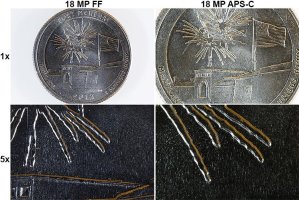
As a general rule, the FF sensor will deliver a sharper image than an APS-C sensor. The reason is simple - for a given output size, the APS-C image needs to be enlarged more, and that extra enlargement leads to a loss of resolution. The larger sensor also gives you the capability to have a shallower DoF if you want it (the crop factor applies to aperture, too, in terms of DoF for the same framing), but if you need the additional DoF or the faster shutter speed, there's no penalty for using FF.
Fundamentally, in
most use cases, the only meaningful benefit of an APS-C camera is the lower cost.
Sabaki said:
The more I read, it seems that crop bodies have a singular advantage over full frame and that is the increase in focal length.
You're not getting an increase in FL, you're just cropping away part of the image relative to a FF sensor. They're called
crop sensors, not 'magnifying' sensors, for a reason. What you are getting is more pixels on target, but that's solely due to the usually higher pixel density of the smaller sensors (and as a counter example, the FF Nikon D800 puts more pixels on target than the APS-C Canon T3/1100D).
If you're focal length limited (you're using your longest lens and it's not long enough),
and you're shooting at fairly low ISO,
and your desired output requires more resolution than the image cropped from a FF sensor provides, then you're in one of those use cases where APS-C has an advantage other than cost. In practice, what that means is that if you're focal length limited, printing at sizes larger than 16x24"/A2, and shooting at ~ISO 800 or lower, then APS-C is a better choice. For 'regular' size prints and/or at higher ISOs, cropping the FF image to the FoV of the APS-C sensor will yield results that are as good or better (and increasingly better as ISO goes up).
Sabaki said:
My favourite photography genre is macro and I do a lot of it! Shooting with a MR-14 EX and extension tubes, I absolutely love the IQ of my subjects but equally hate the noise and banding in the shadow areas.
Macro is potentially another one of those 'exception' use cases. I say potentially, becuase it really depends on what you mean by macro. Formally, 'macro' generally means 1:1 magnification (or higher), and anything less than that (0.1x - 1x mag) is considered 'close-up' photography. If you're at 1:1 with a macro lens, you're at the MFD (or closer if you go higher with tubes) - that means there's no DoF 'advantage' (i.e. more of it) with APS-C. The APS-C sensor (e.g. 18-20 MP) is going to give you more pixels on target at a given magnification compared to a FF sensor (e.g. 20-22 MP), whereas the FF sensor will give you a wider AoV at that magnification.
Below is an example of that (shot with the MP-E 65mm on a 1D X and EOS M, both at the same distance from the coin for equivalent
optical magnification, and since both use 18 MP sensors, no down- or up-scaling is required for the comparison). At 1x mag with FF you can frame nearly the whole quarter while APS-C crops much of the coin away but gives you higher resolution at the pixel level.
Personally, I usually choose FF for macro (and have done so since having both the 7D and 5DII).