Full Frame Vs Crop Sensor

AcutancePhotography said:
Marsu42 said:
Oh no, I'm too late to the thread, it's already page 3 and the mudslinging has already started :-p

I actually surprised it took that long. Photographers tend to be rabidly opinionated. :)

People just need to learn to do what they want. If they want to shoot JPEG, shoot JPEG. If they want to shoot RAW, shoot Raw. Same applies to FF vs CS. There are people shooting with either system and shooting fantastic pictures. There others shooting either system and shooting crap.

Pick what you can afford and get out there and start honing your skill.

This is why I snicker when some people claim that it is the photographer and not the gear, but then spend time arguing about gear. LoL

Well said.
 
Upvote 0
koolman said:
Larry said:
mkabi said:
If you can take amazing pictures, then that makes you a photographer. Post-processing makes you an editor, and although thats what it takes to be photographer nowadays i.e. be both photographer & editor... It wasn't like that back in the day. And you have to agree...

Nope. Don't have to agree.

A photograph is a thing. The person who makes the thing is a photograph-er. The thing is not made until the image captured by the camera is made visible on the paper or other viewing surface. This "making" consists of the entire process from choosing/arranging/lighting the subject, adjusting/aiming/operating the camera and doing what one will to get it onto the paper. Ansel has already been mentioned as an example of a "back in the day" photograph-er who certainly made use of his dark room, his enlarger, and whatever other tools he chose, to create his "art". The photographs thusly made have been greatly admired by many, and few of the admirers fail to call him a "photographer", rather than an "editor". (Ansel the dodger/burner?)

Adams and the numerous other "photographers" one could mention as widely recognized and acclaimed, used the tools available to them in their time, just as we do today. I don't doubt that they would envy us our new tools.

It hardly seems appropriate to try to differentiate a carpenter from a measurer, a sawer or a hammerer. Perhaps we should further distinguish him as a laser level technician, an adhesives applier, or a plumb(vs. apple)-bobber.

Are we having fun yet? :-)

Larry - I need to totally disagree with you. Photography is the skill of producing photographs. There is a big difference between a photograph and digital picture. "digital art" produces stunning pictures - which more often then not do NOT reflect anything real.

Photography as I understand it - is about recording a real moment or object in the most accurate way.

Yes I understand that some tweaks can be allowed - but these should be minor and unnoticeable. The "photo" should remain something real that the photographer saw. Photography is about VISION - NOT about enhanced photoshop / lightroom skills.

My 2 cents

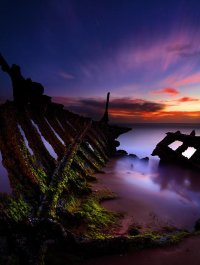
Your understanding, as per my understanding, is totally wrong. Will find a photo I saw yesterday on this forum on a TS lens which was beautiful and far from accurate. Will find it and post next so you can see better.
 

Attachments

  • Wreck Dawn.jpg
    Wreck Dawn.jpg
    44.7 KB · Views: 903
Upvote 0
I don't want to muddy the waters here, but it sounds like this conversation is heading towards artistic expression versus technical know how... and I would just like to say... high dynamic range.

I see so many boring photos that have been hdr'd with crazy color saturation and extreme contact that in no way shape or form Lloyds normal.

I played with it for a while and I'll use it periodically if I need the added dynamic range because the lighting circumstance is difficult to contend with... but I stopped making the mundane psychedelic.

First and foremost should be the subject being interesting... then maybe being enhanced.. but just like boobs... going from an a cup to a c cup is good.... a to a double f... just kinda weird.

sanj said:
koolman said:
Larry said:
mkabi said:
If you can take amazing pictures, then that makes you a photographer. Post-processing makes you an editor, and although thats what it takes to be photographer nowadays i.e. be both photographer & editor... It wasn't like that back in the day. And you have to agree...

Nope. Don't have to agree.

A photograph is a thing. The person who makes the thing is a photograph-er. The thing is not made until the image captured by the camera is made visible on the paper or other viewing surface. This "making" consists of the entire process from choosing/arranging/lighting the subject, adjusting/aiming/operating the camera and doing what one will to get it onto the paper. Ansel has already been mentioned as an example of a "back in the day" photograph-er who certainly made use of his dark room, his enlarger, and whatever other tools he chose, to create his "art". The photographs thusly made have been greatly admired by many, and few of the admirers fail to call him a "photographer", rather than an "editor". (Ansel the dodger/burner?)

Adams and the numerous other "photographers" one could mention as widely recognized and acclaimed, used the tools available to them in their time, just as we do today. I don't doubt that they would envy us our new tools.

It hardly seems appropriate to try to differentiate a carpenter from a measurer, a sawer or a hammerer. Perhaps we should further distinguish him as a laser level technician, an adhesives applier, or a plumb(vs. apple)-bobber.

Are we having fun yet? :-)

Larry - I need to totally disagree with you. Photography is the skill of producing photographs. There is a big difference between a photograph and digital picture. "digital art" produces stunning pictures - which more often then not do NOT reflect anything real.

Photography as I understand it - is about recording a real moment or object in the most accurate way.

Yes I understand that some tweaks can be allowed - but these should be minor and unnoticeable. The "photo" should remain something real that the photographer saw. Photography is about VISION - NOT about enhanced photoshop / lightroom skills.

My 2 cents

Your understanding, as per my understanding, is totally wrong. Will find a photo I saw yesterday on this forum on a TS lens which was beautiful and far from accurate. Will find it and post next so you can see better.
 
Upvote 0
jdramirez said:
mackguyver said:
jdramirez said:
First and foremost should be the subject being interesting... then maybe being enhanced.. but just like boobs... going from an a cup to a c cup is good.... a to a double f... just kinda weird.
Nice analogy - LOL - and I feel the same way about HDR and over saturation.

Can we start a thread called: double f stops or bigger.
Definitely, and just to keep this post relevant to the OP - another one called: Bigger sensors and the women who love them
 
Upvote 0
Re: Full Frame Vs Crop Sensor ( somewhat adrift)

koolman said:
Larry - I need to totally disagree with you. Photography is the skill of producing photographs. There is a big difference between a photograph and digital picture. "digital art" produces stunning pictures - which more often then not do NOT reflect anything real.

Photography as I understand it - is about recording a real moment or object in the most accurate way.

Yes I understand that some tweaks can be allowed - but these should be minor and unnoticeable. The "photo" should remain something real that the photographer saw. Photography is about VISION - NOT about enhanced photoshop / lightroom skills.

My 2 cents

Hi Koolman,

"totally" disagree?

You have broadened the subject from the definition of a photographer to what his subject should be, i.e., what he chooses to present, and how he chooses to present it, to the viewer. Now we are in subjectivity-land.

I'll go back to my carpenter analogy - the carpenter may be a good or poor craftsman. He may choose to make a fine home (by YOUR standards), or some piece of woodworking "art" to take to the Burning Man Festival. Or the very same carpenter may do both on different occasions. What he chooses to "carpent", makes him no less a carpenter. ;-)

In any case, he will likely make use of the best tools available to him to do his type of creating.

I made no mention of "digital art", and my comments about what defines a photographer, I believe, hold while discussing your preferred "realism" style.

I personally think that your preference that the photograph represent "something that the photographer saw" is reasonable, considering that digital art may readily be created on a computer alone, with no camera involved at all..

I believe that the usual expectation is that a photographer would use a camera. With that understood, I would then expect him to point the lens at something of his choosing, operate the camera as he chooses or as his ability allows, and then, using the image presented to his recording medium by the lens, complete the photograph per his personal "vision", using his "completing" tools, …the same as A. Adams and the host of acknowledged-to-be-great-photographers have (usually) done. "Usually", because there is always, among any numerous group of creators, some few "purists" who have decided that less is more. These same few might declare that the artistic fine woodworker is not a carpenter, because he decided to add some particular finish or stain, to, in his opinion' "enhance" the piece.

I hardly think this would disqualify him as a carpenter. But the purist might be left wondering what the natural wood would look like, if the so-called carpenter hadn't "messed it up", with his post-processing.

When the definition of photographer is a person who "realistically " presents all his subject material, …if this could be perfectly done, and if numerous persons attained this level of expertise, there would be no such thing as a recognizable "style" by which to differentiate among them.

If we add the requirement that the composition be perfect ( by some arbitrary standard), that the lighting be perfect also, by the same arbitrarily decided standard, then when all was done, there would be ONE style. Any one's work would be perceptually the same as that of any other.

"Vision" would be limited by decree, and any expression of personal style, a digression, …disqualifying the offender, one would expect, as "a photographer". :-[

If the intent is more than the "accuracy" expected in photographic recording in the fields of science, medicine, archeology, etc., … if the objective is to create something pleasing to look at or display,then some degree of artistic license has to be permitted, if all work is not to be the same in presenting "Just the facts, Ma'am" ;-)

I wonder if you would consider A. A. less than a photographer, because the lighting he presents in a print of "Moonrise" (or some other work of his) wasn't REALLY as dramatic in the flesh? ( For a before-and-after example of Ansel's "post-processing" see this link:

http://whitherthebook.wordpress.com/2013/02/27/ansel-adams-and-photography-before-photoshop/

There is discussion on the above linked-page that will be of great interest, I'm sure, to anyone participating in or enjoying this part of this thread! Accuracy vs. Interpretation(or "Vision")

(Is a bell pepper really seen as in Weston's print without some contrivance as to lighting , and without a few darkroom touches? Set one on your table, and see if it looks the same :

http://www.edward-weston.com

It would cause somewhat of stir to declare either of these two men "not a photographer!".

Do we think they would have used Photoshop? ;)
 
Upvote 0
Full Frame vs Crop

jdramirez said:
First and foremost should be the subject being interesting... then maybe being enhanced.. but just like boobs... going from an a cup to a c cup is good.... a to a double f... just kinda weird.

We are going to get in trouble wandering around like this. ::)

But if we're going to compare full-frame vs. crop, I've an (subjective, of course) opinion:

There are both esthetic and experiential aspects to boobology. When we consider elements beyond simply shape and appearance, I believe hand-filling and a pleasing "heft" add certain somethings.

D - DD works for me. :P
 
Upvote 0
tiger82 said:
But would anyone crop boobs?

Shockingly yes. I had a friend who had them reduced and it felt like she got a gift from good and then proceeded to return them for store credit.

The wife also had a friend who reduced, or cropped if you will, and I got to see them and I was unimpressed. Just... seems sad looking.

And the sister in law... but I'm not going to talk about that.
 
Upvote 0
Sabaki said:
The philosophy down here is buy better glass before upgrading the body.

Roger Machin, head of Canon South Africa gave me that advise.

I heard that too long time ago... but did I listen... nah. I had my heart set pin the 60d and because of my lack of glass I always used my 50 f1.8. The funny thing is that when I upgraded to the f1.4, I never used it because it wasn't the best lens in my arsenal.

Now... all my lenses fight for time on my body & I feel sad when I have to leave one behind.
 
Upvote 0
jdramirez said:
Sabaki said:
The philosophy down here is buy better glass before upgrading the body.

Roger Machin, head of Canon South Africa gave me that advise.

I heard that too long time ago... but did I listen... nah. I had my heart set pin the 60d and because of my lack of glass I always used my 50 f1.8. The funny thing is that when I upgraded to the f1.4, I never used it because it wasn't the best lens in my arsenal.

Now... all my lenses fight for time on my body & I feel sad when I have to leave one behind.
I listened and was actually berated by some "pro" photographers for having so many L lenses and a "amateur" XSi and later T2i. I didn't care, and I'm glad I waited and bought good glass first :)
 
Upvote 0
mackguyver said:
I listened and was actually berated by some "pro" photographers for having so many L lenses believe my point at the time is that and a "amateur" XSi and later T2i. I didn't care, and I'm glad I waited and bought good glass first :)

I'm trying to do the math from five years ago. I bought the 60d for 1100 and sold the lens for 300. Then I sold the xs I had for 375 resulting in an upgrade for 425. I needed something with video and I didn't want to spend $200 on a video camera and have to carry two devices around.

So my cash in pocket was only $425, 225 if I did get a video camera. And 225 doesn't get us very far when we are talking about lenses.

I don't want to say I regret going body first... because I simply didn't have the coin to go lenses first.
 
Upvote 0
Sabaki said:
Nice glass shame about the body! Did you just forget to upgrade your camera when you were acquiring your L lens collection??

;)

The philosophy down here is buy better glass before upgrading the body.

Roger Machin, head of Canon South Africa gave me that advise.
[/quote]

Finding the right camera is just as important as having a great lens to go with it. Cheap camera great lens is just the better of the two other situations. I agree better glass is important but after a while it just becomes silly when you are prepared to lay down 2k for a top of the line L lens and ignore what it's attached to.

It's like you bought the Armani suit but are still rockin the old New Balance trainers to go with it!
 
Upvote 0
Sabaki said:
CarlTN said:
jdramirez said:
CarlTN said:
Sabaki said:
Hi everybody :)

So as I move into my 3rd year of photography, I find my 500D isn't able to help my take my photography to the next level and its beginning to feel like my L series lenses are begging to shoot on a full frame body.

I've never had the chance to shoot full frame so most of what I know is pure theory derived from reading reviews etc online.

With South Africa's economy in a bit of trouble, I can get a hardly used 5D mkii for a reasonable price so I'm considering taking that.

Just what can I expect in terms of image quality and noise performance? Is the IQ of a full frame substantially better than a crops? Will I be able to take relatively noise free images at say ISO 3200?

The reviews seem to indicate that the native system for L series glass is full frame. Does this mean that I will experience a dramatic improvement in IQ?

The more I read, it seems that crop bodies have a singular advantage over full frame and that is the increase in focal length.

Can you guys chip in and throw some opinions and facts my way please?

Thanks in advance everybody.

You will love full frame cameras, but you won't like how much the lenses cost.

There are some value ef lenses... but if you get a nice body, it is just a waste to put on mediocre lenses.

Even then... if you just go with primes like the 40mm, 35 f2 is, 100 f2... you can get by.

Sure, but you'll want to add at least one pricey one.

lol. I do have some pricy (for me) lenses.

Canon 100mm macro L, Canon 400mm f/5.6 L, Canon 70-200 f/4.0 L, Canon 24-70mm f/2.8 L mkii.
Then also have the EF-S 10-22 & 50 f/1.8.

Good for you! In my opinion only one of those is "pricey"...
 
Upvote 0
sanj said:
koolman said:
Larry said:
mkabi said:
If you can take amazing pictures, then that makes you a photographer. Post-processing makes you an editor, and although thats what it takes to be photographer nowadays i.e. be both photographer & editor... It wasn't like that back in the day. And you have to agree...

Nope. Don't have to agree.

A photograph is a thing. The person who makes the thing is a photograph-er. The thing is not made until the image captured by the camera is made visible on the paper or other viewing surface. This "making" consists of the entire process from choosing/arranging/lighting the subject, adjusting/aiming/operating the camera and doing what one will to get it onto the paper. Ansel has already been mentioned as an example of a "back in the day" photograph-er who certainly made use of his dark room, his enlarger, and whatever other tools he chose, to create his "art". The photographs thusly made have been greatly admired by many, and few of the admirers fail to call him a "photographer", rather than an "editor". (Ansel the dodger/burner?)

Adams and the numerous other "photographers" one could mention as widely recognized and acclaimed, used the tools available to them in their time, just as we do today. I don't doubt that they would envy us our new tools.

It hardly seems appropriate to try to differentiate a carpenter from a measurer, a sawer or a hammerer. Perhaps we should further distinguish him as a laser level technician, an adhesives applier, or a plumb(vs. apple)-bobber.

Are we having fun yet? :-)

Larry - I need to totally disagree with you. Photography is the skill of producing photographs. There is a big difference between a photograph and digital picture. "digital art" produces stunning pictures - which more often then not do NOT reflect anything real.

Photography as I understand it - is about recording a real moment or object in the most accurate way.

Yes I understand that some tweaks can be allowed - but these should be minor and unnoticeable. The "photo" should remain something real that the photographer saw. Photography is about VISION - NOT about enhanced photoshop / lightroom skills.

My 2 cents

Your understanding, as per my understanding, is totally wrong. Will find a photo I saw yesterday on this forum on a TS lens which was beautiful and far from accurate. Will find it and post next so you can see better.

Hi Sanj...thanks for posting that, not sure who shot it, did you? It is beautiful no doubt, but I will venture a criticism...the phrase I would use is "they got happy with the black slider a bit"...I admit it creates a lot of negative space which makes the rest "pop"...but true enough, it looks hyped and unnatural. If I were doing it, I would have some shadow detail, but try to let perhaps only 30 to 40% of what is total "black" here, be black. As for the hyped color, well that's typical of what people do with digital photos these days. This one is really not all that bad though.
 
Upvote 0