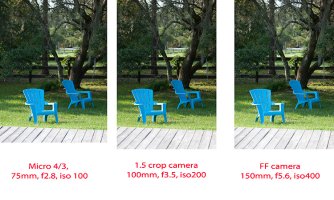
Full Frame Vs Crop Sensor

privatebydesign said:
bseitz234 said:
privatebydesign said:
bseitz234 said:
Depth of field is affected by two things: aperture and subject distance.

No, dof is affected by two things, aperture size (not number) and subject magnification.

A 17mm and 200mm shot from the same place with the same aperture value have different dof, your statement says they would be the same.

Ok good point. I was taking FL as static, basically trying to distinguish lens from sensor. But that is more accurate, I will edit.

Well we still aren't quite there. If you take the same picture from the same place with the same lens and settings and on a crop and ff cameras, then make two prints the same size, the image is different (obviously) and the dof is less in the crop camera image.

If you have two different sized prints, such that the subjects were the same size then the dof would be the same from both cameras.

DOF is dependent on magnification, to get a same sized print you have to enlarge the crop camera more so it has less dof.

It isn't until people accept that dof is subjective and dependent on magnification, that it clicks that crop cameras can have, more, less, or the same, dof as a ff camera.

Maybe it will click tomorrow... but tonight... I'm enjoying my gambling winnings from a triple overtime game.
 
Upvote 0
privatebydesign said:
bseitz234 said:
Depth of field is affected by two things: aperture and subject distance.

No, dof is affected by two things, aperture size (not number) and subject magnification.

A 17mm and 200mm shot from the same place with the same aperture value have different dof, your statement says they would be the same.
DoF is affected by 3 things:
1. entrance pupil ("aperture") size - D,
2. distance from the plane of focus (i.e. from the plane of an object we are shooting) to the entrance pupil - L,
3. diameter of the acceptable unsharpness measured in the plane of focus (i.e. as a property of the object we are shooting) - d.

If lf is front DoF and lb is back DoF, then:

(L-lf) / D = lf / d
(L+lb) / D = lb / d


If lf and lb are much smaller than L (as in macro), then lb ~= lf ~= L * d / D.

That can be derived from simple geometrical optics if we study where rays passing through a point in the front or the back DoF plane cross the plane of focus and the entrance pupil plane. No information about what happens behind the lens entrance pupil (except the information that is already contained in the choice of d) is actually needed or relevant.

The difference in the DoF of 17mm and 200mm lenses (other than from the obvious difference in D) comes from the fact that d acceptable for shooting most "17mm" subjects (sometimes up to centimeters) is unacceptable for shooting most "200mm" subjects (usually well below a millimeter, as we need to resolve hair/fabric structure).
 
Upvote 0
Kit. said:
DoF is affected by 3 things:
1. entrance pupil ("aperture") size - D,
2. distance from the plane of focus (i.e. from the plane of an object we are shooting) to the entrance pupil - L,
3. diameter of the acceptable unsharpness measured in the plane of focus (i.e. as a property of the object we are shooting) - d.

If lf is front DoF and lb is back DoF, then:

(L-lf) / D = lf / d
(L+lb) / D = lb / d


If lf and lb are much smaller than L (as in macro), then lb ~= lf ~= L * d / D.

That can be derived from simple geometrical optics if we study where rays passing through a point in the front or the back DoF plane cross the plane of focus and the entrance pupil plane. No information about what happens behind the lens entrance pupil (except the information that is already contained in the choice of d) is actually needed or relevant.

The difference in the DoF of 17mm and 200mm lenses comes from the fact that d acceptable for shooting most "17mm" subjects (sometimes up to centimeters) is unacceptable for shooting most "200mm" subjects (usually well below a millimeter, as we need to resolve hair/fabric structure).

By attributing the DoF difference between a 17mm lens and a 200mm lens at the same distance to d, you're suggesting that D, the physical diameter of the aperture, is the same for a 17mm lens and a 200mm lens set to the same f/stop. That's clearly not the case - and it's that latter difference that accounts for the DoF differential between 17mm f/4 and 200mm f/4 at the same subject distance.

I suppose you could hold D constant (for example, comparing 17mm f/2.8 with 200mm f/32 would get you close), but I'm not sure why you would want to do that.
 
Upvote 0
Kit. said:
Yes, I've added it in the edition of my post after the one you are quoting. Still, the difference in D alone is not enough to explain the difference in acceptable DoF of wide-angle and telephoto shots.

The difference in DoF based on D alone between 17mm f/4 and 200mm f/4 is massive. 17mm f/4 with a subject 20 feet away yields a DoF extending from 14 feet in front of the subject to infinity, whereas 200mm f/4 with a subject at 20 feet yields a DoF that extends approxiamtely 4 inches on either side of the subject. Not is that difference (e.g. 8" vs. infinity) more than sufficient to explain the difference in DoF, the difference is so great that d becomes basically irrelevant.

I also have to disagree with the idea that, "d acceptable for shooting most "17mm" subjects (sometimes up to centimeters) is unacceptable for shooting most "200mm" subjects (usually well below a millimeter, as we need to resolve hair/fabric structure)." One of the most efective uses of wide angle lenses (and particularly ultrawide lenses) is with extremely close subjects in the foreground, taking advantage of the perspective distortion that results from close subject placement to emphasize that subject within the wide FoV. In that case, I want the foreground subject to be as sharp as possible (although there's a practical limit on that with the resolution delivered by most ultrawide lenses, particularly if the subject is not at the center of the frame).
 
Upvote 0
neuroanatomist said:
One of the most efective uses of wide angle lenses (and particularly ultrawide lenses) is with extremely close subjects in the foreground, taking advantage of the perspective distortion that results from close subject placement to emphasize that subject within the wide FoV. In that case, I want the foreground subject to be as sharp as possible (although there's a practical limit on that with the resolution delivered by most ultrawide lenses, particularly if the subject is not at the center of the frame).

That is one very cool and under appreciated uses for shift in the TS-E's, shift so that the important part is covered by the center (or close to) of the image circle. It also works with projection distortion, you can place a person on the extreme edge of a 17mm TS-E shot and if you have shifted they have no distortion.
 
Upvote 0
neuroanatomist said:
Kit. said:
Yes, I've added it in the edition of my post after the one you are quoting. Still, the difference in D alone is not enough to explain the difference in acceptable DoF of wide-angle and telephoto shots.

The difference in DoF based on D alone between 17mm f/4 and 200mm f/4 is massive. 17mm f/4 with a subject 20 feet away yields a DoF extending from 14 feet in front of the subject to infinity, whereas 200mm f/4 with a subject at 20 feet yields a DoF that extends approxiamtely 4 inches on either side of the subject.
That's for the calculations based on the same circle of confusion, c (0.03mm). These setups have different magnifications, M (1/28 for 200mm, and 1/350 for 17mm), and as c = d * M, that gives us d200mm = 0.84mm and d17mm = 10.5mm. That's a huge difference in d.

If we require the 1mm d for our 17mm image, the DoF will extend 6ft, and not 14, on the front, and 18ft, and not infinity, on the back.

neuroanatomist said:
I also have to disagree with the idea that, "d acceptable for shooting most "17mm" subjects (sometimes up to centimeters) is unacceptable for shooting most "200mm" subjects (usually well below a millimeter, as we need to resolve hair/fabric structure)." One of the most efective uses of wide angle lenses (and particularly ultrawide lenses) is with extremely close subjects in the foreground, taking advantage of the perspective distortion that results from close subject placement to emphasize that subject within the wide FoV. In that case, I want the foreground subject to be as sharp as possible (although there's a practical limit on that with the resolution delivered by most ultrawide lenses, particularly if the subject is not at the center of the frame).
That's what we use tilt for.

However, in your calculations above it's considered OK to have a dot in the front plane of "DoF" rendered as a 1cm blob over the plane of focus.
 
Upvote 0
Kit. said:
privatebydesign said:
bseitz234 said:
Depth of field is affected by two things: aperture and subject distance.

No, dof is affected by two things, aperture size (not number) and subject magnification.

A 17mm and 200mm shot from the same place with the same aperture value have different dof, your statement says they would be the same.
DoF is affected by 3 things:
1. entrance pupil ("aperture") size - D,
2. distance from the plane of focus (i.e. from the plane of an object we are shooting) to the entrance pupil - L,
3. diameter of the acceptable unsharpness measured in the plane of focus (i.e. as a property of the object we are shooting) - d.

If lf is front DoF and lb is back DoF, then:

(L-lf) / D = lf / d
(L+lb) / D = lb / d


If lf and lb are much smaller than L (as in macro), then lb ~= lf ~= L * d / D.

That can be derived from simple geometrical optics if we study where rays passing through a point in the front or the back DoF plane cross the plane of focus and the entrance pupil plane. No information about what happens behind the lens entrance pupil (except the information that is already contained in the choice of d) is actually needed or relevant.

The difference in the DoF of 17mm and 200mm lenses (other than from the obvious difference in D) comes from the fact that d acceptable for shooting most "17mm" subjects (sometimes up to centimeters) is unacceptable for shooting most "200mm" subjects (usually well below a millimeter, as we need to resolve hair/fabric structure).

As for this, aside from the corrected error, I would again say DOF is created by two factors, aperture size, not number (I have been consistent with that) and magnification. What then defines the subjective aspect of dof is the decision on CoC size as related to reproduction size (magnification), viewing distance (magnification), and viewer acuity (taken to be "average").

There is no definitive size for CoC, and no definitive DOF, they are subjective. Mostly CoC is taking some of the subjectivity out of the the equation by normalising different formats, print sizes, and viewing distances and using "average eyesight" to do it.

From a practical point of view CoC figures are moot, people never view from "the correct" distance, they don't intuitively think as they move back and forth whist looking at a print or screen the DoF is changing, but it is.
 
Upvote 0
Kit. said:
neuroanatomist said:
Kit. said:
Yes, I've added it in the edition of my post after the one you are quoting. Still, the difference in D alone is not enough to explain the difference in acceptable DoF of wide-angle and telephoto shots.

The difference in DoF based on D alone between 17mm f/4 and 200mm f/4 is massive. 17mm f/4 with a subject 20 feet away yields a DoF extending from 14 feet in front of the subject to infinity, whereas 200mm f/4 with a subject at 20 feet yields a DoF that extends approxiamtely 4 inches on either side of the subject.
That's for the calculations based on the same circle of confusion, c (0.03mm). These setups have different magnifications, M (1/28 for 200mm, and 1/350 for 17mm), and as c = d * M, that gives us d200mm = 0.84mm and d17mm = 10.5mm. That's a huge difference in d.

If we require the 1mm d for our 17mm image, the DoF will extend 6ft, and not 14, on the front, and 18ft, and not infinity, on the back.

neuroanatomist said:
I also have to disagree with the idea that, "d acceptable for shooting most "17mm" subjects (sometimes up to centimeters) is unacceptable for shooting most "200mm" subjects (usually well below a millimeter, as we need to resolve hair/fabric structure)." One of the most efective uses of wide angle lenses (and particularly ultrawide lenses) is with extremely close subjects in the foreground, taking advantage of the perspective distortion that results from close subject placement to emphasize that subject within the wide FoV. In that case, I want the foreground subject to be as sharp as possible (although there's a practical limit on that with the resolution delivered by most ultrawide lenses, particularly if the subject is not at the center of the frame).
That's what we use tilt for.

However, in your calculations above it's considered OK to have a dot in the front plane of "DoF" rendered as a 1cm blob over the plane of focus.

If the aperture value is consistent crop the 17mm image to the 200mm image and you then have the same magnification, but very different dof. Change the aperture value to give yourself the same aperture area and crop and the DOF is the same.
 
Upvote 0
privatebydesign said:
As for this, aside from the corrected error, I would again say DOF is created by two factors, aperture size, not number (I have been consistent with that) and magnification. What then defines the subjective aspect of dof is the decision on CoC size as related to reproduction size (magnification), viewing distance (magnification), and viewer acuity (taken to be "average").

There is no definitive size for CoC, and no definitive DOF, they are subjective. Mostly CoC is taking some of the subjectivity out of the the equation by normalising different formats, print sizes, and viewing distances and using "average eyesight" to do it.

From a practical point of view CoC figures are moot, people never view from "the correct" distance, they don't intuitively think as they move back and forth whist looking at a print or screen the DoF is changing, but it is.

Exactly - which is why we ignore d in the above.
 
Upvote 0
Upvote 0
jdramirez said:
Why must I be on lsd to understand this concept?

mackguyver said:
Here are some good articles from the Luminous Landscape related to this discussion:

A very technical article about this subject:
Full sized vs. Crop Sensors

A nice photo comparison to bust a myth about DOF and lens length:
Do Wide Angle Lenses Really Have Greater Depth of Field Than Telephotos?

Micheal's latest musings on the subject:
The Full Frame Myth
LOL, I feel the same way! I've always thought the "circle of confusion" was appropriately named!
 
Upvote 0
mackguyver said:
Micheal's latest musings on the subject:
The Full Frame Myth

Interesting musings. His viewpoint seems to be that current APS-C sensors can deliver IQ on par with FF sensors in many situations - and that's true. But the converse is that FF at it's worst is equivalent to APS-C, and in many situations, it's better.

Also, aside from the IQ considerations, can I get DoF from an APS-C sensor equivalent to f/1.2 on a FF sensor with the same framing and perspective? No. Likewise, a significant portion of my shots are at ISO 3200 or higher, and APS-C is significantly inferior to FF in terms of noise at those high ISO settings.

From a practical level, we buy cameras and not sensors. There is not an APS-C dSLR that can deliver 12 fps or has the most advanced AF and metering systems that Canon has to offer.

So I keep coming back to my earlier point: the primary advantage of APS-C sensors, and the cameras in which they are used, is that they cost less.
 
Upvote 0
privatebydesign said:
I would again say DOF is created by two factors, aperture size, not number (I have been consistent with that) and magnification. What then defines the subjective aspect of dof is the decision on CoC size as related to reproduction size (magnification), viewing distance (magnification), and viewer acuity (taken to be "average").
My idea was to get rid of parameters depending on sensor format (magnification and CoC size) in the formula for DoF, and at the same time to replace CoC with something that has physical sense in the scene we are capturing. My approach is not necessarily the best way to calculate DoF, but is a very good one to understand it. In particular, it easily shows when cropping reduces the perceived DoF, and when it doesn't.

privatebydesign said:
There is no definitive size for CoC, and no definitive DOF, they are subjective. Mostly CoC is taking some of the subjectivity out of the the equation by normalising different formats, print sizes, and viewing distances and using "average eyesight" to do it.
That's the main problem with CoC. It has no easily understandable meaning in the context of the original subject, and it has no easily understandable meaning in the context of the final product either.

Divide CoC size by magnification - and you get a value that has such meaning.

It shouldn't be interpreted as if sensor-side resolution limits have no meaning at all. Of course, you cannot resolve a feature of an original object that is smaller than pixel size divided by magnification. But it's not a DoF problem.
 
Upvote 0