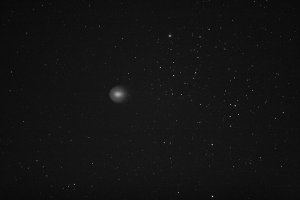
Jack Douglas said:
jrista, thanks for the hints and encouragement. I'm seriously thinking of buying the iOptron 3302B SkyTracker Camera Mount so that I can have more fun with the night sky. Any thoughts on that idea?
Jack
Jack,
Regarding astrophotography, I would recommend that you research a little before you invest any money into something like this. I'm not saying that it's a bad thing, just that you should know before you spend. This is a good site to start with:
http://www.astropix.com/INDEX.HTM
I'm sure that there are many ways of categorizing astrophotography, but off the top of my head, here are a few different types:
[list type=decimal]
[*]Lunar imaging - you likely won't need a tracking mount, just a good tripod and a good telephoto lens (+ teleconverter if you have it). The moon is bright enough that you shutter speeds will be relatively fast. This is a great place to start.
[*]Wide angle sky images (e.g. the Milky Way) - This is where the iOptron could be useful, but even this can be successfully done with just a good tripod. See the link that I posted earlier for some great advice on how to do it. This is also a great place to experiment.
[*]Planetary imaging (notably Jupoter, Saturn , and Mars) - a DSLR is not the best camera for this. You need loooong focal length ( > 1000mm) to magnify the planets enough to see detail, and a webcam or similar device is better than a DSLR. That is because you'd be cropping out 95% of the DSLR image, and you'd want to stack at least dozens, preferably hundreds of images.
[*]Images of galaxies, nebula, clusters, etc - This absolutely needs a tracking mount, but it would definitely push the limits of the iOptron, depending on what you are looking to get out of your photos. To get a really sharp image like you see some of the advanced folks getting, you're talking at least the $1k range just for the mount. Yes, it *can* be done for less, but you'd need to put a fair amount of sweat and tears into your effort.
[*]Solar imaging - the key requirement is to get a specialized solar filter to go on the FRONT of your lens/scope. If you're talking sunspot images, it isn't too bad. If you want beautiful pictures of solar flares, you're talking very specialized gear.
[/list]
Don't get me wrong, I strongly encourage you to give astrophotography a try, but I would see what you can do with your existing equipment first, then decide if you want to continue before spending money on any specialized equipment.
Finally, if you're thinking about getting a 600mm for other reasons (e.g. birding), then you've already invested 80-90% monetarily of what you need for some good deepsky imaging. However, you're only 10-20% of the way through the learning curve (but that's half the fun, right?

).
Dave