Get a 300mm or 600mm? Oh the agony...

Ken B said:
I do have 1 question, does anyone have a Moon shot with the 600mm by it's self and a Moon shot with the 600 and 2X? I can use this in a way to gauge my reach. I would love to do some Moon shots and there is a full moon comming up on the 16th of Jan. I will be using my 70-200 with a 2X this time around to give me an idea on how much more reach I want to achive.
Hi,
Hmm... Full Moon at high magnification don't look nice... the surface contrast is very low during Full Moon, so the image will look flat.

Have a nice day.
 
Upvote 0
Ken B said:
I do have 1 question, does anyone have a Moon shot with the 600mm by it's self and a Moon shot with the 600 and 2X? I can use this in a way to gauge my reach. I would love to do some Moon shots and there is a full moon comming up on the 16th of Jan. I will be using my 70-200 with a 2X this time around to give me an idea on how much more reach I want to achive.

Here is my most recent moon shot (from a while back, last time we had clear night weather with the moon in the sky). In this case, at 840mm. I'll scrounge up the uncropped version, and see if I have any 600mm shots, so you can compare magnification. Shot with the EF 600mm f/4 L II with 1.4x TC. Tripod, manually focused with live view, processed in Lightroom (click it to enlarge to full size):

high-detail-high-resolution-moon-840mm-1.jpg


I'll see if I can get a shot with the 2x TC...not actually sure if the moon will fit...it is pretty darn big at 840mm, and camera shake at 840mm already makes it pretty difficult to focus sharply. I suspect getting sharp focus at 1200mm will be a chore... :-\ We've had cloudy weather pretty much every night here in Colorado for weeks, and only had a two-day window Jan 1-3, but no moon those nights.

Here are full size crops with feature labels, for those interested in the kind of detail you can extract from the moon with a 600mm lens and 1.4x TC. ;D

high-detail-high-resolution-moon-840mm-2-detail.jpg

high-detail-high-resolution-moon-840mm-3-detail.jpg

high-detail-high-resolution-moon-840mm-4-detail.jpg
 
Upvote 0
jrista, that is truly remarkable and shows why a 600 would be nice to have! And I guess it never ends as something longer is going to give even more detail. It certainly can be challenging for one to be satisfied with what one has.

Funny, I shot my Grey parrot recently with an extension tube on the 300, allowing about 1/2 closer focus and then I was pixel peeping and wondering why his little eyelash feathers weren't that sharp. Then tonight I was holding him close and looking at his eye and I couldn't even detect any eyelash feathers. It caused me to think twice about what kind of resolution I really need to fret about. Why do I keep doing this to myself when I've already been having so much fun with my 300 and converters. I guess I'm not alone in this! ;)

Jack
 
Upvote 0
Jack Douglas said:
jrista, that is truly remarkable and shows why a 600 would be nice to have! And I guess it never ends as something longer is going to give even more detail. It certainly can be challenging for one to be satisfied with what one has.

Funny, I shot my Grey parrot recently with an extension tube on the 300, allowing about 1/2 closer focus and then I was pixel peeping and wondering why his little eyelash feathers weren't that sharp. Then tonight I was holding him close and looking at his eye and I couldn't even detect any eyelash feathers. It caused me to think twice about what kind of resolution I really need to fret about. Why do I keep doing this to myself when I've already been having so much fun with my 300 and converters. I guess I'm not alone in this! ;)

Jack

It's not just the lens. The moon is a bit of a specialty of mine...I've spent a lot of time photographing it, and I'm a stickler for excessive sharpness. Also, keep in mind that seeing conditions affect how sharp you can get the moon in the first place. The night I took this shot was EXCEPTIONAL seeing (atmospheric clarity), so I was able to get very good results. Certainly, more focal length helps, but I have managed to get very sharp results at 400mm, 500mm, and 700mm as well. Your 300mm with a 2x TC is more than capable of getting very sharp results...the most important factor, really, is the atmospheric clarity. Poor clarity, and it really doesn't matter what the quality of the lens. Keep at it, use a tripod, manually focus with live view at maximum zoom, and use a shutter release. Make sure you shelter from the wind or shoot on windless nights...and you'll be able to get good results.

Also, I process my moon images to extract the maximum amount of detail. I have a special technique, and I process a certain way to enhance color a bit, exaggerate and attenuate tones to separate different levels of highlight and shadow, etc. That has nothing to do with the lens, and everything to do with knowing your PP software and having an end vision.
 
Upvote 0
Jack Douglas said:
jrista, thanks for the hints and encouragement. I'm seriously thinking of buying the iOptron 3302B SkyTracker Camera Mount so that I can have more fun with the night sky. Any thoughts on that idea?

Jack

Definitely go for it. I am in the market for a tracking mount myself, as I've been wanting to get into deep sky astrophotography. You really can't do much without a tracking mount, for sure...if it's something you like, invest in it.
 
Upvote 0
jrista said:
Jack Douglas said:
jrista, that is truly remarkable and shows why a 600 would be nice to have! And I guess it never ends as something longer is going to give even more detail. It certainly can be challenging for one to be satisfied with what one has.

Funny, I shot my Grey parrot recently with an extension tube on the 300, allowing about 1/2 closer focus and then I was pixel peeping and wondering why his little eyelash feathers weren't that sharp. Then tonight I was holding him close and looking at his eye and I couldn't even detect any eyelash feathers. It caused me to think twice about what kind of resolution I really need to fret about. Why do I keep doing this to myself when I've already been having so much fun with my 300 and converters. I guess I'm not alone in this! ;)

Jack

It's not just the lens. The moon is a bit of a specialty of mine...I've spent a lot of time photographing it, and I'm a stickler for excessive sharpness. Also, keep in mind that seeing conditions affect how sharp you can get the moon in the first place. The night I took this shot was EXCEPTIONAL seeing (atmospheric clarity), so I was able to get very good results. Certainly, more focal length helps, but I have managed to get very sharp results at 400mm, 500mm, and 700mm as well. Your 300mm with a 2x TC is more than capable of getting very sharp results...the most important factor, really, is the atmospheric clarity. Poor clarity, and it really doesn't matter what the quality of the lens. Keep at it, use a tripod, manually focus with live view at maximum zoom, and use a shutter release. Make sure you shelter from the wind or shoot on windless nights...and you'll be able to get good results.

Also, I process my moon images to extract the maximum amount of detail. I have a special technique, and I process a certain way to enhance color a bit, exaggerate and attenuate tones to separate different levels of highlight and shadow, etc. That has nothing to do with the lens, and everything to do with knowing your PP software and having an end vision.

Also, you are using a 7D, and it is in situations like these that the extra "reach" of the crop comes into play and beats FF - there is fine detail at the limits of resolution and essentially monochrome.
 
Upvote 0
Jack Douglas said:
jrista, thanks for the hints and encouragement. I'm seriously thinking of buying the iOptron 3302B SkyTracker Camera Mount so that I can have more fun with the night sky. Any thoughts on that idea?

Jack

Jack,

Regarding astrophotography, I would recommend that you research a little before you invest any money into something like this. I'm not saying that it's a bad thing, just that you should know before you spend. This is a good site to start with: http://www.astropix.com/INDEX.HTM

I'm sure that there are many ways of categorizing astrophotography, but off the top of my head, here are a few different types:
[list type=decimal]
[*]Lunar imaging - you likely won't need a tracking mount, just a good tripod and a good telephoto lens (+ teleconverter if you have it). The moon is bright enough that you shutter speeds will be relatively fast. This is a great place to start.
[*]Wide angle sky images (e.g. the Milky Way) - This is where the iOptron could be useful, but even this can be successfully done with just a good tripod. See the link that I posted earlier for some great advice on how to do it. This is also a great place to experiment.
[*]Planetary imaging (notably Jupoter, Saturn , and Mars) - a DSLR is not the best camera for this. You need loooong focal length ( > 1000mm) to magnify the planets enough to see detail, and a webcam or similar device is better than a DSLR. That is because you'd be cropping out 95% of the DSLR image, and you'd want to stack at least dozens, preferably hundreds of images.
[*]Images of galaxies, nebula, clusters, etc - This absolutely needs a tracking mount, but it would definitely push the limits of the iOptron, depending on what you are looking to get out of your photos. To get a really sharp image like you see some of the advanced folks getting, you're talking at least the $1k range just for the mount. Yes, it *can* be done for less, but you'd need to put a fair amount of sweat and tears into your effort.
[*]Solar imaging - the key requirement is to get a specialized solar filter to go on the FRONT of your lens/scope. If you're talking sunspot images, it isn't too bad. If you want beautiful pictures of solar flares, you're talking very specialized gear.
[/list]

Don't get me wrong, I strongly encourage you to give astrophotography a try, but I would see what you can do with your existing equipment first, then decide if you want to continue before spending money on any specialized equipment.

Finally, if you're thinking about getting a 600mm for other reasons (e.g. birding), then you've already invested 80-90% monetarily of what you need for some good deepsky imaging. However, you're only 10-20% of the way through the learning curve (but that's half the fun, right? ;) ).

Dave
 
Upvote 0
20Dave said:
Jack Douglas said:
jrista, thanks for the hints and encouragement. I'm seriously thinking of buying the iOptron 3302B SkyTracker Camera Mount so that I can have more fun with the night sky. Any thoughts on that idea?

Jack

Jack,

Regarding astrophotography, I would recommend that you research a little before you invest any money into something like this. I'm not saying that it's a bad thing, just that you should know before you spend. This is a good site to start with: http://www.astropix.com/INDEX.HTM

I'm sure that there are many ways of categorizing astrophotography, but off the top of my head, here are a few different types:
[list type=decimal]
[*]Lunar imaging - you likely won't need a tracking mount, just a good tripod and a good telephoto lens (+ teleconverter if you have it). The moon is bright enough that you shutter speeds will be relatively fast. This is a great place to start.
[*]Wide angle sky images (e.g. the Milky Way) - This is where the iOptron could be useful, but even this can be successfully done with just a good tripod. See the link that I posted earlier for some great advice on how to do it. This is also a great place to experiment.
[*]Planetary imaging (notably Jupoter, Saturn , and Mars) - a DSLR is not the best camera for this. You need loooong focal length ( > 1000mm) to magnify the planets enough to see detail, and a webcam or similar device is better than a DSLR. That is because you'd be cropping out 95% of the DSLR image, and you'd want to stack at least dozens, preferably hundreds of images.
[*]Images of galaxies, nebula, clusters, etc - This absolutely needs a tracking mount, but it would definitely push the limits of the iOptron, depending on what you are looking to get out of your photos. To get a really sharp image like you see some of the advanced folks getting, you're talking at least the $1k range just for the mount. Yes, it *can* be done for less, but you'd need to put a fair amount of sweat and tears into your effort.
[*]Solar imaging - the key requirement is to get a specialized solar filter to go on the FRONT of your lens/scope. If you're talking sunspot images, it isn't too bad. If you want beautiful pictures of solar flares, you're talking very specialized gear.
[/list]

Don't get me wrong, I strongly encourage you to give astrophotography a try, but I would see what you can do with your existing equipment first, then decide if you want to continue before spending money on any specialized equipment.

Finally, if you're thinking about getting a 600mm for other reasons (e.g. birding), then you've already invested 80-90% monetarily of what you need for some good deepsky imaging. However, you're only 10-20% of the way through the learning curve (but that's half the fun, right? ;) ).

Dave

You can do a lot more than just milky way with an iOptron. People have been using devices like that to get pretty darn good Messier "deep sky" results...larger galaxies and nebula, open clusters, etc. A 100mm f/2.8 Macro lens and an iOptron could get you some pretty phenomenal results of say Orion's Belt and Sword, which contains at least 5 nebula. Slap on a 135mm or 200mm lens (so long as the whole setup is under the 8lb weight limit), and you could zero in on say just the Orion Nebula. At 200mm, periodic error in the iOptron might limit how long you can expose, but exposing for a few seconds and excessive stacking can still get you some pretty phenomenal results. It can be quite a useful tool...I was actually planning to buy one not more than two months ago, when I decided instead to save my money for more ambitious goals (i.e. Celestron EdgeHD 1100 DX.)

For $300-500, things like iOptron's devices are a good way to get started into both wide field and deep sky astrophotography without spending thousands of dollars. Now, Jack should be aware, there is no way in hell that little device is going to hold his 300mm lens...just in case he was thinking he'd slap on the 2x TC and do some hard core imaging of deep sky objects. You need a much sturdier mount with much more accurate tracking and much lower periodic error (and, probably, some autoguiding as well...and all of that mounts up to considerable cost...don't expect to get away with less than a $5000 investment.)
 
Upvote 0
jrista said:
You can do a lot more than just milky way with an iOptron. People have been using devices like that to get pretty darn good Messier "deep sky" results...larger galaxies and nebula, open clusters, etc. A 100mm f/2.8 Macro lens and an iOptron could get you some pretty phenomenal results of say Orion's Belt and Sword, which contains at least 5 nebula. Slap on a 135mm or 200mm lens (so long as the whole setup is under the 8lb weight limit), and you could zero in on say just the Orion Nebula. At 200mm, periodic error in the iOptron might limit how long you can expose, but exposing for a few seconds and excessive stacking can still get you some pretty phenomenal results. It can be quite a useful tool...I was actually planning to buy one not more than two months ago, when I decided instead to save my money for more ambitious goals (i.e. Celestron EdgeHD 1100 DX.)

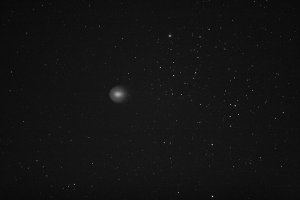
You are correct, I should have been clearer on my definition of wide angle sky photography, which is where I think that the iOptron is the best fit. Things like the North America Nebula and the Orion area are certainly doable with a moderate telephoto and some stacking/tracking. I took the attached image (assuming I successfully attached it...) of Comet 17p-Holmes with a 20D at 400mm on a tripod - single image with a 4 sec shutter, so you can definitely get much better images with a reasonable tracking mount. Just be ready for a new style of image processing, with stacking of multiple images.

For $300-500, things like iOptron's devices are a good way to get started into both wide field and deep sky astrophotography without spending thousands of dollars. Now, Jack should be aware, there is no way in hell that little device is going to hold his 300mm lens...just in case he was thinking he'd slap on the 2x TC and do some hard core imaging of deep sky objects. You need a much sturdier mount with much more accurate tracking and much lower periodic error (and, probably, some autoguiding as well...and all of that mounts up to considerable cost...don't expect to get away with less than a $5000 investment.)

A Losmandy G8 mount (as one example) should definitely be able to handle the 300mm well, and those run around $1500 with the tripod. But yes, to get into the really deep sky stuff like galaxies, the 300mm isn't long enough, and you are getting into some big bucks. For good or bad, I took the splurge myself with a heavy duty mount, but I'm just in the beginning phase of my learning curve and not yet ready to put my images up for feedback :-[.

Dave
 

Attachments

  • Comet 17P-Holmes 1200x800.jpg
    Comet 17P-Holmes 1200x800.jpg
    60 KB · Views: 1,296
Upvote 0
Dave and jrista,

Thoughts turned into a momentary urge to purchase this AM, so I'm committed. Thank you both for this helpful commentary and eye opening initial dose of information. Since I'm retired I have a fair amount of time and am simply bitten by the bug of photography. I was bitten back in 1974 when I first bought a Canon Ftb but the responsibilities and cares of life just didn't allow it to materialize much, although I had purchased an F1 and a few lenses and always shot family and travels and a little wildlife. But now - wow. The technology has advanced so much that results are close to unbelievable.

In terms of star images, I love the scenes that include landscape and wide angles and have followed threads on CR and elsewhere. A friend who's a few years ahead of me in all areas or photography already knows the basics and so he's there in the background chompin at the bit. We've both splurged on some gear and he recently bought a 1Dx and a few lenses. Now I know why an eternity ago my mother said be careful about choosing friends, they can be a bad influence! ;)

Anyway, at my age I can now start to revert to my childhood flitting as a butterfly from flower to flower having fun and exploring more of our fantastic world. Birds have been great fun this year but in the winter snow I don't have many birds. However, I do have Northern Lights and lots of stars given that I'm about 15 miles from the city with not too much light pollution, so I'll be doing my best to learn with help from the many kind folk on CR like yourselves. :)

Another friend who is a former student of mine in electronics technology is now in the photographic picture and he's a technology geek and programmer having fabrication skills and a creative spirit. We both have lathes, etc., and love doing metalwork and so with his recent motion control projects there are no end of possibilities. Personally, I'm trying to stick more with photograhy and not get sidetracked but fun is fun......

I hear good things about a Rokinon lens that I may buy but initially I was hoping my new 70-200 F2.8 would work on the mount, or my 24-70 F4. I guess only time will tell where all this leads me and I'll soon know what isn't working. Thanks again for the advice.

Jack
 
Upvote 0
Jack Douglas said:
Thoughts turned into a momentary urge to purchase this AM, so I'm committed. Thank you both for this helpful commentary and eye opening initial dose of information. Since I'm retired I have a fair amount of time and am simply bitten by the bug of photography. I was bitten back in 1974 when I first bought a Canon Ftb but the responsibilities and cares of life just didn't allow it to materialize much, although I had purchased an F1 and a few lenses and always shot family and travels and a little wildlife. But now - wow. The technology has advanced so much that results are close to unbelievable.
Jack - Best of luck with your new gear and hobby, it can be very rewarding if you stick with it, and from the sounds of your comments, you will. I am a few years behind you, with retirement on the horizon, so I'm stocking up on equipment in preparation while I still have an income. ;D

In terms of star images, I love the scenes that include landscape and wide angles and have followed threads on CR and elsewhere.
Besides just practicing general astroimaging, the next project that I'd love to tackle is a video of the night sky as it moves across the sky. I have a spot next to water that I'm eager to experiment with.

... I'll be doing my best to learn with help from the many kind folk on CR like yourselves. :)
If you haven't found it already, I recommend following the DSLR photography forum on www.cloudynights.com. There are a lot of terrific imagers on there.

I hear good things about a Rokinon lens that I may buy but initially I was hoping my new 70-200 F2.8 would work on the mount, or my 24-70 F4. I guess only time will tell where all this leads me and I'll soon know what isn't working.
Both of your existing lenses are perfectly fine to start with.
 
Upvote 0
Thanks again for the encouragement and links, Dave.

What could be better than all the various options available within photograhy. Just the fact that I can shoot a bird and then research what it is and see it's features in detail and enjoy the whole experience in a week or a year is wonderful.

A time to reflect on the life we are able to enjoy and a the freedoms we have, most thankful I am.

Jack
 
Upvote 0
Jack Douglas said:
Dave and jrista,

Thoughts turned into a momentary urge to purchase this AM, so I'm committed. Thank you both for this helpful commentary and eye opening initial dose of information. Since I'm retired I have a fair amount of time and am simply bitten by the bug of photography. I was bitten back in 1974 when I first bought a Canon Ftb but the responsibilities and cares of life just didn't allow it to materialize much, although I had purchased an F1 and a few lenses and always shot family and travels and a little wildlife. But now - wow. The technology has advanced so much that results are close to unbelievable.

In terms of star images, I love the scenes that include landscape and wide angles and have followed threads on CR and elsewhere. A friend who's a few years ahead of me in all areas or photography already knows the basics and so he's there in the background chompin at the bit. We've both splurged on some gear and he recently bought a 1Dx and a few lenses. Now I know why an eternity ago my mother said be careful about choosing friends, they can be a bad influence! ;)

Anyway, at my age I can now start to revert to my childhood flitting as a butterfly from flower to flower having fun and exploring more of our fantastic world. Birds have been great fun this year but in the winter snow I don't have many birds. However, I do have Northern Lights and lots of stars given that I'm about 15 miles from the city with not too much light pollution, so I'll be doing my best to learn with help from the many kind folk on CR like yourselves. :)

Another friend who is a former student of mine in electronics technology is now in the photographic picture and he's a technology geek and programmer having fabrication skills and a creative spirit. We both have lathes, etc., and love doing metalwork and so with his recent motion control projects there are no end of possibilities. Personally, I'm trying to stick more with photograhy and not get sidetracked but fun is fun......

I hear good things about a Rokinon lens that I may buy but initially I was hoping my new 70-200 F2.8 would work on the mount, or my 24-70 F4. I guess only time will tell where all this leads me and I'll soon know what isn't working. Thanks again for the advice.

Jack

Oh, I missed this before. Congrats on getting the tracking mount. Make SURE you learn how to properly align it. I just received my Orion Atlas EQ-G mount, and just aligned it for the first time tonight. It's a complicated device, but once you get it aligned, oh it's amazing! I've got it set up so I can use my 600mm lens as a telescope to do deep sky imaging.

Read more about it here: http://jonrista.com/2014/02/13/atlas-eq-mount-600mm-telescope/
 
Upvote 0
Jack Douglas said:
Thanks jrista, I'll be looking at your link shortly! I'm sure the investment will be well worth it, with your serious interests.

Jack

It honestly wasn't too expensive. The mount is $1400 bran new. You can often find it for around $900-$1100 used. That's all I bought. You with your 300mm f/2.8 could benefit from such a mount (BTW, you won't be able to use the big lens on something like the iOpteron SkyTracker...too heavy). If you stacked teleconverters, you could have as much as an 840mm "telescope" with just your 300mm lens, your 6D, and a good equatorial tracking mount. The wide field of a 300mm scope is pretty good for some of the larger nebula, and at 600mm you'd be just the right field of view to image Orion and Running Man Nebulas. At 840mm you would be ideal for just Orion Nebula.

Now, I had to buy some additional accessories to make the lens setup work for a scope. If you ever get interested enough to do that, I can offer more details.
 
Upvote 0
Thanks jrista as always! I was just viewing the shots of snow and ice and since it's only about -6 C I'm heading outside to see what's interesting (boy,what motivation comes from this forum!). Hopefully it will clear and I'll be posting some Sky Tracker shots one of these days.

I'm sure we'll be seeing good things from your setup soon!

Jack
 
Upvote 0
You have been following the Canon path to bankruptcy. There is another path, take a look at the Tamron SP 150-600 VC USM lens. I have seen many shots taken with this lens, some by myself, and others, they are stellar. Canon made a deal with Tamron to release the specs. for the Canon lenses, in turn Tamron had to release the first batch of lenses only with Canon mounts. Check it out you will definitely be surprised, with build quality, and glass.
 
Upvote 0