I am sure some of you already know this but in case.
Here is the formula I discover on my Canon
Supposed you have ISO speed increment set to 1/3
Base ISO: 100, 200, 400, 800, 1600 ...
So the formula will be:
[x1] [no] [yes] [x2]
where x1, x2 are base ISO.
Example:
[100] [125] [160] [200][/b]
You should avoid the ISO 125
Preferred: 160
[800][1000][1250][1600]
You should avoid the ISO 1000
Preferred: 1250
The author here explained much better than I can:
http://shootintheshot.joshsilfen.com/2010/05/13/canon-hd-dslr-native-iso/
For your specific camera model, you can look here:
https://home.comcast.net/~NikonD70/Charts/RN_ADU.htm
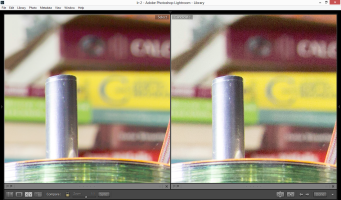
Below is picture of iso 125 vs iso 1250
where if you follow the formula, the iso 125 fall in to the NO and 1250 into the YES
Any comments?
Here is the formula I discover on my Canon
Supposed you have ISO speed increment set to 1/3
Base ISO: 100, 200, 400, 800, 1600 ...
So the formula will be:
[x1] [no] [yes] [x2]
where x1, x2 are base ISO.
Example:
[100] [125] [160] [200][/b]
You should avoid the ISO 125
Preferred: 160
[800][1000][1250][1600]
You should avoid the ISO 1000
Preferred: 1250
The author here explained much better than I can:
http://shootintheshot.joshsilfen.com/2010/05/13/canon-hd-dslr-native-iso/
For your specific camera model, you can look here:
https://home.comcast.net/~NikonD70/Charts/RN_ADU.htm
Below is picture of iso 125 vs iso 1250
where if you follow the formula, the iso 125 fall in to the NO and 1250 into the YES
Any comments?