AvTvM said:
with that much light the same shots can be made with a Nikon 1 and the tiny 30-110mm lens.
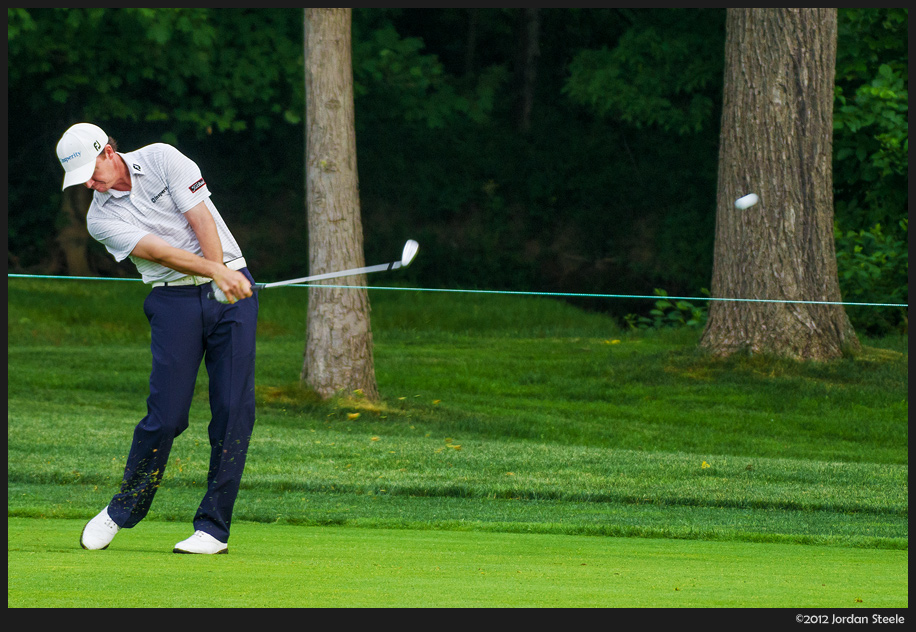
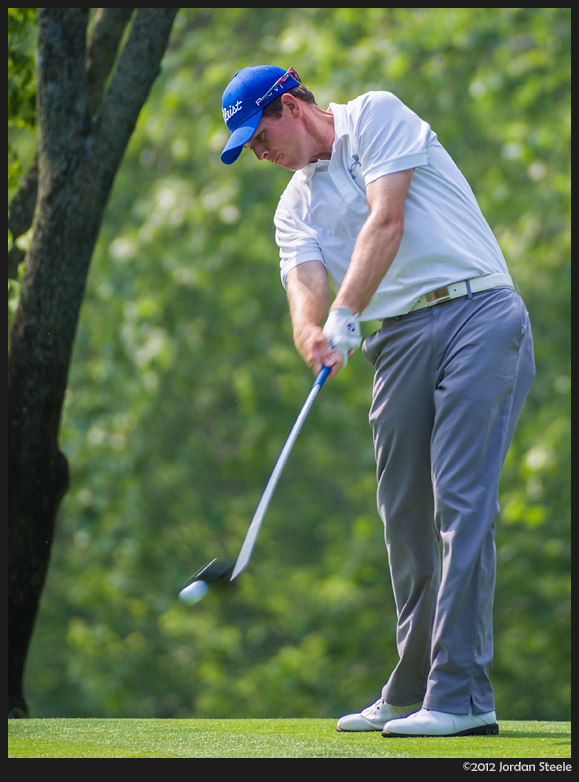
He did not even get the ball or club-hits-ball once in a picture. ;-)
The E-M5 is a lot better than the Nikon 1. If I wanted a slower lens with AF, I also could have used the Panasonic 100-300mm or Olympus 75-300mm, both of which are much smaller than the FD 50-300, but they're a stop or more slower and not as good optically.
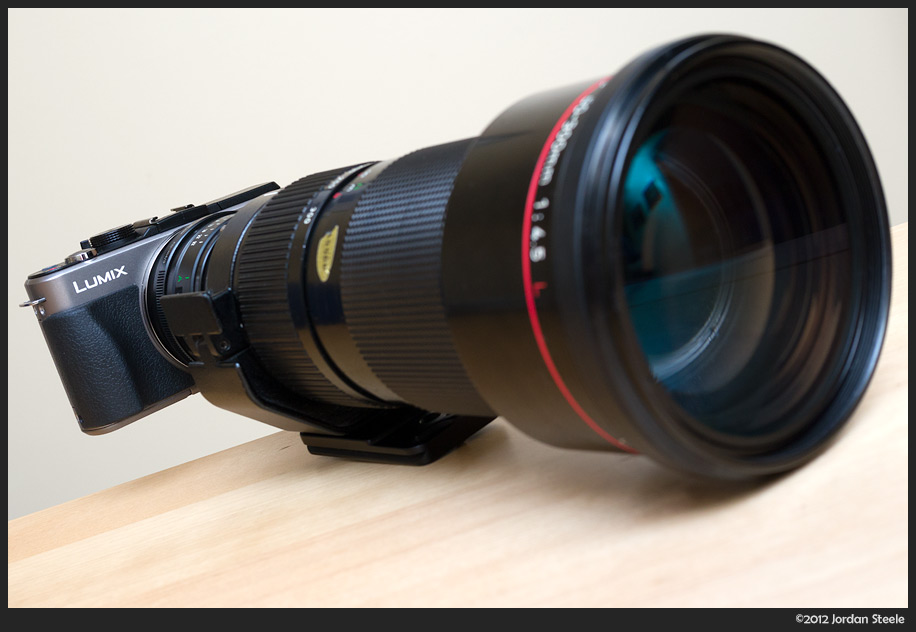
Anyway, I'm the photographer linked to in the OP (and the 50-300L picture above is mine on my GX1).
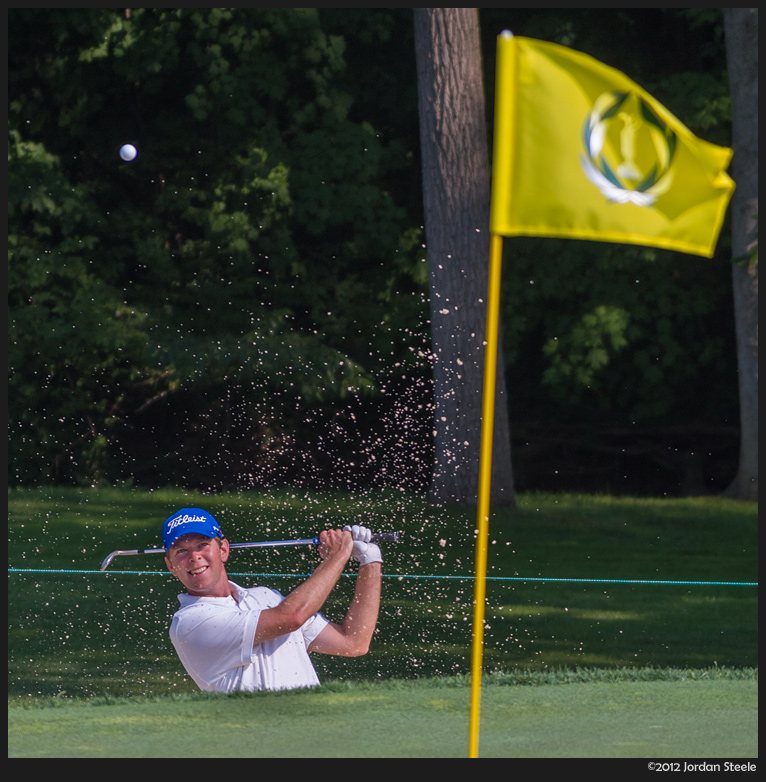
I think you're being tongue in cheek with the second comment, but just in case...when you photograph golf, you do NOT click the shutter before ball impact. That's a very quick way to have angry golfers and get removed from the premises. I did get a few shots shortly after impact when I was rather far away and using the long end when I photographed the practice rounds, but I didn't do it during the Pro-Am because it's a competition round.
For instance:
A few other points for anyone who is interested:
1) The 50-300L is a great lens! I was wary when I bought it, as many older manual focus zooms are pretty poor...this lens rocks. Also, it is rather large and heavy. However, since the FOV is the same as a 100-600mm lens on full frame, it's still smaller than a similar length lens on an APS-C or Full Frame DSLR. It is true that I wouldn't have noticed the extra size (especially since I shot the tournament with both the horizontal and vertical grips on my E-M5, which makes it just a little smaller than a DRebel with grips). Yeah, a 7D with a 100-400L would be similar in size and capability, but also a lot more expensive. But yeah, really long stuff isn't where m4/3 shines in the size department. (Aside from using shorter focal lengths for the same FOV).
2) I am a former Canon shooter...I loved the system but eventually got bogged down by all the weight. While the times I use the 50-300L are not exactly huge reduction in size and weight, it's the everyday stuff where it's big. My shoulder bag used to have the 1Ds Mark II, 70-200 f/2.8L IS II, 17-40L, Sigma 50/1.4 and 100 f/2.8L IS Macro...maybe another lens or two. All told it was close to 18 lbs of gear, and it wasn't that fun. Now I will carry my E-M5 with 7-14mm or 12mm f/2, 25mm f/1.4 and 45mm f/1.8, and either a lightweight 40-150mm zoom or if I want more depth of field control, a 135mm f/2.8 for my long lens. My kit bag now weighs about 4 lbs. It's definitely not the right choice for everyone, but it has been wonderful for me.
3) The Oly E-M5 has image quality roughly on par with my 1Ds II. Similar (or even slightly better) dynamic range, and high ISO noise is within a half stop. It's a more responsive camera, though...9fps and faster single shot AF. Of course, it's not nearly as good in continuous AF, though.
I've found the switch to Micro 4/3 wonderful, and it does some things (aside from weight) better than DSLRs...for instance, the single shot autofocus on both the E-M5 and recent Panasonic bodies (GH2, G3, GX1) is exceptionally fast and dead-on accurate. Puts the AF in almost any DSLR to shame. In low light, my GX1 absolutely smokes the 1Ds II in single shot. And, you never have to worry about front or back focus with a CDAF system.
However, if you need really shallow DOF (and thus the FF or larger sensor), or you need great continuous autofocus, a DSLR is still by far the best option. I don't see DSLRs going away just yet, but I think a large portion of the market will shift to mirrorless in the next decade, especially as continuous AF improves to match or exceed that in DSLRs.
While I'm sure there will be full frame mirrorless cameras coming eventually, they won't be quite as good in size reduction just because of the longer focal lengths needed for long lens work and the larger image circle vs APS-C or m4/3, but just like now, photographers will have to see what they're willing to trade for other advantages.
Thanks for the interest in my photos, though!