
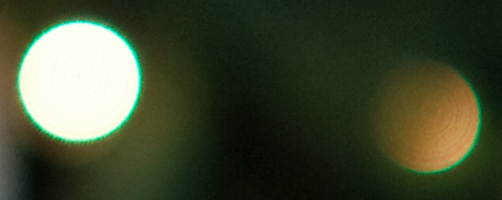
Just got my Canon 35L 1.4 and was surprised to see all this "onion skin" in the bokeh. I have tried a quick web search but can't find out what causes this. Is this amount of onion skin normal for a 35 mm L lens? Will all lenses do this wide open. This is from the central area of the image. Thanks.
You are using an out of date browser. It may not display this or other websites correctly.
You should upgrade or use an alternative browser.
You should upgrade or use an alternative browser.
Is this the normal bokeh for an L series lens
- Thread starter jeffabbyben
- Start date
- Status
- Not open for further replies.


Packlight-Thanks for the reply. No I have the 85mm 1.2. I am referring to the target like appearance of the christmas lights. You can see it really well on the close up image. The other image has it but you have to click on the jpg to enlarge it (sorry this is my first post with attachment). I have seen a few people call this onion skin but I admit I don't know what the technical term is. My 85mm I haven't noticed this artifact very much but I have seen it before.
Bluemix-no filter was used.
Bluemix-no filter was used.
Upvote
0

So in one of the recent comparisons between the Canon 24-70, Nikon 24-70 and the new Tamron 24-70 (which is supposed to be really good, even superior to the Canon, there was note that the Tamron tossed off this "onion skin" as well in it's bokeh. It seems to be something with the construction of the elements - perhaps that is true of this lens as well.
Upvote
0
L
Loswr
Guest
Both of the aberrations you're seeing are normal for the 35L, yes. The green edge of the light blur discs is longitudinal chromatic aberration (LoCA, aka bokeh fringing) - pretty much all fast primes have it, your 85L will too on specular highlights (it's magenta or green, depending on whether the OOF highlight is in front or in back of the focal plane).
The onion skin occurs in some lens designs, usually mild in typical lens designs, more noticeable and even stopped down in the 70-300 DO lens. Many times, people don't notice it because the OOF point light sources are overexposed. First shot below is an example from my 35L @ f/1.4 (on a 5DII), a 100% crop from the center of the image. Focus was on my daughter, she's off center and ~3 feet in front of the tree, and exposure was correct for her face in the fairly dim room, meaning the Xmas tree lights in the background are mostly blown like the one on the left, but the one on the right was dimmer because it was partially obscured by branches, and you can clearly see the onion skin pattern.
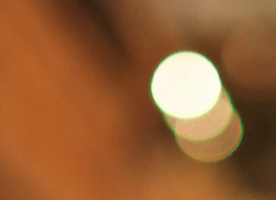
It's more prominent with smaller light sources when the focus distance is close and the light sources are also close, but still OOF. Second shot is another example 100% crop, where the OOF lights were further away (3rd shot shows a wider framing of the same shot for reference).
The onion skin occurs in some lens designs, usually mild in typical lens designs, more noticeable and even stopped down in the 70-300 DO lens. Many times, people don't notice it because the OOF point light sources are overexposed. First shot below is an example from my 35L @ f/1.4 (on a 5DII), a 100% crop from the center of the image. Focus was on my daughter, she's off center and ~3 feet in front of the tree, and exposure was correct for her face in the fairly dim room, meaning the Xmas tree lights in the background are mostly blown like the one on the left, but the one on the right was dimmer because it was partially obscured by branches, and you can clearly see the onion skin pattern.
It's more prominent with smaller light sources when the focus distance is close and the light sources are also close, but still OOF. Second shot is another example 100% crop, where the OOF lights were further away (3rd shot shows a wider framing of the same shot for reference).
Attachments

Upvote
0
H
hammy
Guest
You can find the onion ring like bokeh here
http://www.photozone.de/canon_eos_ff/773-canon2470f28mk2ff?start=1
http://www.photozone.de/canon_eos_ff/773-canon2470f28mk2ff?start=1
Upvote
0
I want to use this lens mostly for portraits but the pattern seems like it would be quite distracting. Should I expect that a different copy of the canon or even the new sigma lens would respond the same way (to the same degree) under these test conditions? I certainly don't expect to be shooting that close to lights on a regular basis but then again it wouldn't be unheard of when shooting indoors with low lighting.
Promature-They are not LED lights.
Promature-They are not LED lights.
Upvote
0
P
PackLight
Guest
jeffabbyben said:I want to use this lens mostly for portraits but the pattern seems like it would be quite distracting. Should I expect that a different copy of the canon or even the new sigma lens would respond the same way (to the same degree) under these test conditions? I certainly don't expect to be shooting that close to lights on a regular basis but then again it wouldn't be unheard of when shooting indoors with low lighting.
Promature-They are not LED lights.
Neuro has it right. I just took the pics I just made and decreased the exposure to see at what point it would replicate.
I think you have a good copy of the 35mm L and wouldn't change. I have been using mine as the walk around lens on my camera for almost four years. I have never had a problem with this, mainly because it never presents itself. Like Neuro mentioned most people will never notice because lights are usually over exposed. Also you have to be a pixel peeper to notice this, and you have to do your pixel peeping in the bokeh area.
Upvote
0
Thanks Packlight. I just took the same image with my 85mm at 1.2 and the "onion skin" is present but to much less degree and not nearly as prominent. It seems like the 35mm has this prominent target in the center of the onion that the 85mm does not have. I am not sure if that is a lens characteristic or related to focal length or whatever else may be involved. It is interesting that in another thread in the third party section titled "Sigma 35 f/1.4 DG HSM First Impressions" comparing the canon 35mm to the new sigma lens neither lens showed this characteristic (actually canon did a little) in the images shown. Although it is only a small portion of the image shown
http://lcap.tistory.com/entry/Sigma-35mm-f14-vs-Canon-35mm-f14-L
http://lcap.tistory.com/entry/Sigma-35mm-f14-vs-Canon-35mm-f14-L
Upvote
0

I seem to recall something about wide aspheric lenses (or lens elements rather) doing the "disk effect" or "target effect". Something to do with internal reflections from the non spherical element... I just spent a while looking for that... can't find it... but I "think" it was on one of the Leica web sites that caters to very high end testing of lenses.
Upvote
0
P
PackLight
Guest
jeffabbyben said:Thanks Packlight. I just took the same image with my 85mm at 1.2 and the "onion skin" is present but to much less degree and not nearly as prominent. It seems like the 35mm has this prominent target in the center of the onion that the 85mm does not have. I am not sure if that is a lens characteristic or related to focal length or whatever else may be involved. It is interesting that in another thread in the third party section titled "Sigma 35 f/1.4 DG HSM First Impressions" comparing the canon 35mm to the new sigma lens neither lens showed this characteristic (actually canon did a little) in the images shown. Although it is only a small portion of the image shown
http://lcap.tistory.com/entry/Sigma-35mm-f14-vs-Canon-35mm-f14-L
Blow up the picture the samples that say Bokeh Shape at f/1.4, you can see a few samples of it in that pic.
I just think it was the positioning of your tree and the exposure you used. I don't think you will notice this in 99% of the situations you shoot. But then I don't know what your subjects usually are.
Upvote
0

sanj said:If this is normal, I am not impressed. Especially with the fringing..
You've got pretty high standards, then. I can just imagine the scenario: "Hey Mabel, will you come look at this? You can actually see the layers in the bokeh in our portraits! What was that photographer thinking when he bought that lens, anyway? Come here, look through this microscope, you can see it for yourself..."
Don't let this stuff get in the way of taking good photographs.
Upvote
0

Ultimately, all lenses have limitations. And part of the challenge of photography is working around those limitations to get great shots. Big aperture lenses solve problems (low light, subject isolation), yes, but they also create new challenges (thin DOF, CA).
In this case, I'm sure we could come up with a dozen ways to avoid the undesirable effect. While I think we can all agree that it's frustrating to see those annoying effects. It's also a cool challenge. And occasionally, those shortcomings can be an unexpected benefit.

new day's resolution by Eric Nord, on Flickr
In this case, I'm sure we could come up with a dozen ways to avoid the undesirable effect. While I think we can all agree that it's frustrating to see those annoying effects. It's also a cool challenge. And occasionally, those shortcomings can be an unexpected benefit.
new day's resolution by Eric Nord, on Flickr
Upvote
0
- Status
- Not open for further replies.
Similar threads

- Replies
- 99
- Views
- 10K


- Replies
- 14
- Views
- 2K