Sorry for the late reply...I did not see this thread till now.
Don pretty much summed up the core of it: I've ALWAYS been fascinated by the night sky, by the cosmos in general, ever since I was a very young kid (I think I got my first telescope for Christmas when I was 6.) Astrophotography lets you, personally, "see" deeper than is usually possible, and in more vibrance and brilliance, than you can visually. That's definitely a big part of the draw...and extension of that childhood fascination with the sky that needed an active outlet.
Visual observation, even with some fairly hefty equipment (i.e. say a 12-14" cassegrain type OTA) is usually largely "gray"...color is very hard to discern until you get into the really gargantuan apertures. A lot of visual-only amateur astronomers build their own "Dobs", or Dobsonian-type truss-design telescopes, with apertures up to several feet. They are usually pretty basic in construction, have wood mounts and secondary mirror supports, use basic metal piping for the truss structure, and they grid their own mirrors (there are actually several mirror grinding parties combined with star parties that occur a couple times a year in the US, on where a guy will actually teach you how to grind your own mirrors). I've heard of some personal project dobsonians being up to 60" of aperture, there are even a couple here in Colorado that are around 40" of aperture. At those sizes, you can visually observe the universe in colorful glory, although it still isn't as detailed as what you can get with astrophotography.
When it comes to the repetition and "it's been done before" aspect, I think Soulless nailed it. This is nothing new in photography. Were all part of a VERY saturated population of people, and repetition is common with any kind of fixed subject photography. Particularly landscapes, I've seen the same scenes, image pretty much identically, from dozens if not hundreds of photographers. Monument Park? Horseshoe Bend? Zion National Park? Etc. etc. Being "unique" in the realm of landscape photography is extremely difficult...you have to set yourself apart with technique and vision, rather than subject, because every subject has already been photographed countless times over the last century.
I've noticed that architectural photography, and increasingly "stairwell" photography, are also beginning to suffer from this problem. (I love photos of stairwells and the like...especially some of the subway escalators of some of those really cool new European....but I'm beginning to see the same escalators photographed pretty much the same way over and over now...) So, I don't think that is a "detractor" to be assigned only to astrophotograph. Other forms of photography have the same issue. Were just part of a very saturated community...you have to move into the realm of action and maybe macro photography to get more unique images, however even then...once you've seen a couple dozen "Fly Eye" macro photos, you've effectively seen them all. Repetition, there isn't much getting away from it, and the only way to truly set yourself apart is with your technique and vision...don't just photograph a fly eye...photograph it with flare, do something unique with it, make it stand out and do it with the utmost precision and exquisite aesthetic....and you have yourself a wonderfully unique, interesting, likable photo that people will gravitate to. Despite the fact that it really ISN'T unique.

Soulless covered the other reason I gravitate towards astrophotography: It's a great technical challenge! It's a challenge, period. Astrophotography is probably the most difficult form of photography, and certainly one of the most expensive if you really want to do it right. It's not just about pointing a camera, composing, and pressing the shutter. There is an extensive base of knowledge, about imagers, optics, telescopes, mounts, electronics, and a slough of software packages, that is necessary to start creating truly beautiful, detailed night sky images. This holds true for pretty much anything that requires an equatorial tracking mount.
Creating the base sub frames that are ultimately integrated into a final image is meticulous, detailed, and very interactive work. When you really get into astrophotography, it isn't just about pointing at some DSO, telling your camera to take X number of frames at Y exposure time and Z ISO setting. For the best detail, color, contrast, and depth, you use a monochrome sensor with individual color filters. You image "clear" luminance, red, green, blue for broad-band color channels. You can also image in narrow-band color, filtering out all but one emission line at a time for nebula, such as Hydrogen-Alpha, Sulfur-II, and Oxygen-III. If you really want to go all out, you also image in infrared, as IR produces more "translucent" images that allow distant background objects, such as galaxies, that are normally obscured by nebula or foreground milky way dust lanes, to be seen. For EACH of these individual color channels, you have to create multiple "sub frames", so you might expose 20x1200s Lum, 15x600s Red, 15x600s Green, 15x600s Blue, 20x1200s Ha, 12x1200s SII, 12x1200s OIII, and 20x1200s IR. That's a total of over 35 SOLID hours of exposure time. That does not include any of the additional time before you start imaging to set up, polar align, drift align, inter-exposure dithering and cooldown times, etc. Some subjects might require fewer exposures, some require considerably more...depends on exactly how dim they are. Some of the worlds top astrophotographers have put 60-80 hours of exposure time into ONE single region of the sky. And that is just getting the initial light-frames themselves! There is still more work to integrate them into a full-color image.
Astrophotography is a highly technical, very meticulous, and very detailed form of art. You aren't just pointing a camera, framing, focusing, and opening the shutter. Astrophotography is more like painting than photography...you have to have your final goal entirely planned out in your head ahead of time, you have to prep, you have to be meticulous about each and every color.
You mention that astrophotography is just "visual impression being more or less filter-effect digital artwork." That is the farthest thing from the truth. Good astrophotography does not apply a bunch of filter-effects in post to create some hyper-saturated image full of colors. That's cheap, it's a cop-out, and it isn't astrophotography. A properly done astronomical photograph won't have any effect filters applied at all. Everything you see is real. Most astro images are done in visible light, so most of it is what these deep space objects would look like to the naked eye. In many cases, saturation is a choice left up to the one doing the processing, and a lot of astro images are generally oversaturated, but very rarely is it "effect-filter fakery". Many astro images these days are what we call "narrow band mapped color", where imaging was done only in Ha, SII, and OIII. Those three narrow bands of light are then mapped to red, green, and blue to produce the kind of images you normally think of as Hubble images, or "false color" images (as while these narrow bands of color do exist in the overall spectrum coming from deep sky objects, they are too narrow to be represented accurately with just R,G, and B channels in an image). There is even a form of NB mapping called "Hubble Mapped Color", but one need not use the exact blending method as Hubble. Some imagers use Ha for red and SII for green, some use SII for red and Ha for Green. Some will perform a more complex blend that uses various mixes of Ha, SII, and OII for the red, green, and blue channels to create more unique results. In general, narrow-band images produce much higher contrast, especially between dark dusty nebula and brighter emission and reflection nebula, where as visible light images are less contrasty, but often a bit more vibrant. Finally, the most advanced imagers will often blend all seven of these different color layers together to produce some rather wild results. Some, as I noted before, will even bring in an IR layer to add a whole new measure of depth and transparency to visible and/or narrow band base image.
The incredible colors you see in astro images is rarely ever from effect filters. It's all detail and color that's there in the objects themselves, and different techniques to blend various color layers together bring out different colors and aspects of detail. None of that detail is fabricated...it is EXTRACTED. You might be surprised to find out that most astro images, after calibration and stacking, usually appear as almost pitch black. For all the dozens of hours you may spend exposing, all that exposure time does is produce images where all the color is packed DEEPLY into the utter depths of the lowest levels of your image. A properly calibrated and integrated stack has at least 20 stops of dynamic range, and when you stack enough, you can end up with more than that. It is becoming pretty common these days with the more advanced tools at our disposal to save our integrations as 64-bit IEEE floating point FITS images. A 32-bit IEEE floating point TIFF can store well more than 24 stops of dynamic range...a 64-bit floating point image is, for all intents and purposes, capable of storing an infinite amount of dynamic range (more than capable of storing enough DR that, if one figured out how, they could represent a dim, distant galaxy about to be occluded near the edge of the sun, while concurrently storing enough information to resolve details on the surface of the sun itself). The very vast bulk of astrophotography post processing is geared towards "stretching" those really deep shadows to lift all the detail up into a level range that is visible to the human eye. The rest of astrophotography processing is geared towards reducing noise (because when you lift an image by 20 stops, even if you stack dozens of frames to reduce noise and improve SNR, you STILL have lots of noise), and towards enhancing the detail that exists within the stretched image. You would be surprised at how often very fine structure that you actually capture in your images appears to be flat detail...it takes some careful, meticulous, and often highly mathematical processing to separate the various levels of that detail to make it visible...but not separate them so much that the results look over-processed in the end.
So, is there a massive imbalanced trade-off in "effort vs. results" when it comes to astrophotography? It depends on how you look at it. Is there a massive imbalanced trade-off in "effort vs. results" when it comes to oil painting? Sculpting? How about architecture? All of these endeavors, which are undoubtedly great forms of art, require a far more considerable investment up front, and throughout the entire process, in order to produce one single artistic creation in the end. Astrophotography is also, without question, a form of art. As much as it is called photography, I think it may be more appropriate to compare it to painting than photography, as when you get down to the foresight and vision, the preparation, and the very manual process of stretching and detail extraction, astrophotography feels more like painting to me than photography. Just like painting, you often have to spend hours focusing one one small area of your image, figuring out the various algorithms that will enhance that detail in just the right way. And, similarly, the kind of satisfaction you get in the end, after putting in all that effort, all that dedicated, meticulous care and attention into your artistic creation...it's wonderfully satisfying.
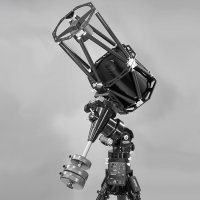
The only real drawback with astrophotography is the cost. People balk at the $6800 price tag of a 1D X, or teh $12,000 price tag of an EF 600mm f/4 L II lens. When you get right down to it, to do astrophotography well, $6800 is down right cheap! For me, my ultimate goal is to be able to produce images that approach the kind of quality you might see from Robert Gendler or Russel Croman. To achieve that level of imagery, you not only need skill, but you need the right equipment. Were talking $20,000-$40,000 mounts, $40,000 telescopes, $30,000 thermoelectrically cooled scientific grade CCD monochromatic image sensors, and robotic equipment like filter wheels, image rotators, and focusers (each of which can cost thousands of dollars each.) Were talking about $115,000 in equipment, and were still not done. This kind of equipment isn't portable, the mount weighs a few hundred pounds, the telescope (such as a 20" RCOS or PlaneWave) weighs a good hundred pounds or so, and all the other accessories pile on another couple dozen pounds. You need a permanent observatory, complete with remote operation capabilities, power, internet, etc., built under permanently dark skies, in order to use this kind of equipment. That's probably another $35,000 to $50,000. Throw in another grand or so in software, for good measure.
Without this kind of equipment, then in large part, some of what you've said, Larry, about astrophotography just being repetition, is kind of true. With the kind of equipment and setup above, you have the ability to image narrow regions of the sky very deeply, very precisely, and so long as it's all set up out under consistently, persistently dark skies away from light pollution, you can use it every time the sky is clear, from the comfort of your own home. The ability to image very narrow regions of the sky very deeply means you can, if you wish, find regions of the sky that are often only a few pixels of "most" astrophotography, and image them in extreme detail. A 20" RCOS or PlaneWave telescope is usually going to be around 3500-4000mm in focal length, and you can throw on a 2x barlow to make that 7000-8000mm. You can also use focal reducers to get a wider field (say 2700mm), image at a lesser magnification, and even do mosaic imaging to expose gigantic regions of the sky in exceptional detail.
Most of the astrophotography you'll see on the internet is usually what we call "wide field", where large multi-arc minute or even arc-hour swaths of sky are imaged all at once with a short focal length...200mm, 350mm, 400mm, 600mm. At these levels, the large scale structures are easily recognizable, their locations in the sky are well known, and you don't need as much total integration time to get decent results. And the brighter the structures are, such as Orion Nebula or Andromeda Galaxy, the more frequently they will be imaged by novice and moderately skilled amateur astrophotographers.
So there is a certain amount of "repetition" when it comes to astrophotography, more so due to a barrier to entry due to the excessive high cost of getting high quality, precise equipment that allows astrophotographers to pursue more unique targets. I doubt I'll ever be spending a hundred grand on astrophotography equipment, at least not all at once, however over the next few years, I don't think it's out of the realm of possibility to spend $35,000 to $50,000 on better equipment. I doubt I'll ever be able to afford a 20" RC Optical Systems (RCOS) Ritchey-Chretine ion-milled telescope. I also doubt I'd ever be able to afford a 20" PlaneWave CDK, which are a bit cheaper, different design, just as high quality...as even that still costs over twenty grand just for the OTA. To get serious at all, though, you have to purchase a mount that is capable of high precision, absolutely encoded, precision modeled, and permanent tracking. Such mounts are expensive, around $20,000. Once you have a mount like that, however, then your pretty much free to put any kind of OTA you want on it, and you can slowly upgrade to better and better OTAs over the years. By the time I retire, I might finally have a 20" PlaneWave CDK with a nice FLI ProLine 37x37mm 4096x4096 cooled CCD imager sitting on a nice 10Micron 2000HPS mount, and be capable of creating some of those unique images of narrow regions of the sky that most people just think of as "That little group of 50 pixels over there" in their images.



 You have provoked a lot of thought indeed, …and enlightened me far beyond my previous limited understanding of "astrophotography".




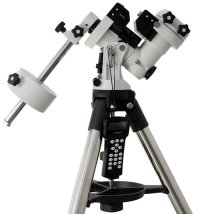
 Also, if you own a 13,000$ telescope (your 600mm lens) Why didn't you get a high precision EQ Mount? ???


