Just found ISO100 won't clip normally

I've been playing games with my ancient 30D.. I use it for various things including astrophotography.. and if you shoot the moon then you want a low ISO, fast shutter and ETTR as close as you can possibly get to the right.

I use a program called IRIS for astro image pre-processing and it allows me to inspect the un-debayered image, and to run a simple command that tells you things like the maximum pixel value.. handy if you're looking for clipped pixels.

So anyway I was thinking I had something utterly wrong when I was pushing exposures way beyond what they should be and at ISO100 I couldn't get more than 3500 out of 4095 ADC counts. Then the penny dropped as I realised the sensor/buffer was clipping, but the ADC wasn't.

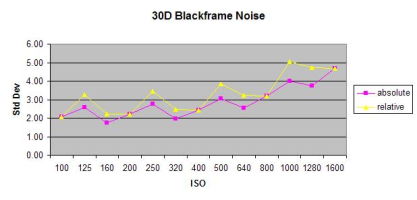
So go to ISO125 and I can just clip the image (get 4095), but also get about 25% less readout noise.

looks like I'll stop using ISO100.

I wonder if any other cameras out there are doing the same thing?
 
This test with a 60D tells that ISO 160 is better than ISO 100 which is better than ISO 125.

http://petapixel.com/2011/05/02/use-iso-numbers-that-are-multiples-of-160-when-shooting-dslr-video/

Of course this is another camera and it is related to video but I think that this supports the thesis that lowest ISO isn't always the best. (Which is most definitely true when also comparing with ISO 50)

There is also this video that shows the same as in the article but the person who uploaded this says that it is mostly with video and jpeg and not with RAW-files.

https://www.youtube.com/watch?v=LDsmVzp7p-w&feature=youtu.be
 
Upvote 0
dkaiser said:
This test with a 60D tells that ISO 160 is better than ISO 100 which is better than ISO 125.

This is because iso160 is iso200 shifted, and because of Canon's read noise problem this has the weird effect of resulting in a bit more dynamic range. After many trial&error, I've personally chosen not to hassle with the tiny difference as lower analog iso values have better color fidelity.

rfdesigner said:
So go to ISO125 and I can just clip the image (get 4095), but also get about 25% less readout noise.

That's weired because generally iso125 has iso100 as its base value and this pushing 1/3ev pushing usually makes things worse. Obviously on your old 30d, the image processing chain is older/different than on current camera bodies, Canon did a lot of work here recently.
 
Upvote 0
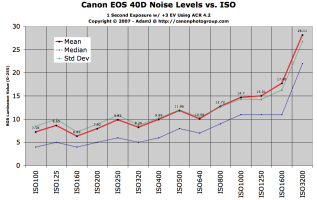
I learned about the effect of the in-camera pushing/pulling base iso's years ago when I still had a 40D. This was particularly interesting in the high iso range because it taught me I might as well use iso 1250 instead of iso 1000 when I needed sufficient shutter speed. And iso160 became my base iso except when I required longer shutter speeds. With my current camera bodies I don't worry about this anymore.
 

Attachments

  • 30d_noise.png
    30d_noise.png
    85.1 KB · Views: 819
  • 40D Noise vs ISO.png
    40D Noise vs ISO.png
    83.7 KB · Views: 249
Upvote 0
Well I just measured the read noise and well depth. (gain's a little hard to determine due to debayering, measuring raw (undebayered) pixels I get different gains for R vs G & B).

(if anyone can point me in the direction of how to post tables I'd be greatful.. things like <table> etc don't work on this site)

ISO Gain Readout noise max pixel value max (e) readout nosie (e) DR Tonal Range
3200 0.259375 9.2 4095 1062 2.38625 8.80 5.03
1600 0.51875 4.6 4095 2124 2.38625 9.80 5.53
1200 0.6916666667 3.6 3284 2271 2.49 9.83 5.57
1000 0.83 4.2 4095 3399 3.486 9.93 5.87
800 1.0375 3.2 4095 4249 3.32 10.32 6.03
625 1.328 2.5 3283 4360 3.32 10.36 6.05
500 1.66 3.3 4095 6798 5.478 10.28 6.37
400 2.075 2.5 4095 8497 5.1875 10.68 6.53
320 2.59375 2 3283 8515 5.1875 10.68 6.53
250 3.32 3 4095 13595 9.96 10.41 6.87
200 4.15 2.3 4095 16994 9.545 10.80 7.03
160 5.1875 1.8 3283 17031 9.3375 10.83 7.03
125 6.64 2.9 4095 27191 19.256 10.46 7.37
100 8.3 2.2 3521 29224 18.26 10.64 7.42

Looks like the main ISOs are not worth deviating from, and that my assumtion that more ISO would reduce read noise only happens in steps (as pointed out by other posters.. many thanks)
 
Upvote 0
If you really want to learn more about how ISO, DR, and SNR really work on Canon sensors, take a gander at this thread on the ML forum; it's probably the most authoritative source out there on the internals of the Canon RAW image readout and processing pipeline I know of.
 
Upvote 0
mrsfotografie said:
rfdesigner said:
(if anyone can point me in the direction of how to post tables I'd be greatful.. things like <table> etc don't work on this site)

Take a screenshot and upload an image file? ;)

I found the solution.. I run NoScript, and occasionally it gets set back to zero.. at which point I lose all the little extras here.. like the table button.
 
Upvote 0