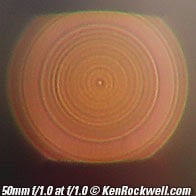
Ken Rockwell reviews canon 50mm f/1.0

Well, I have to admit, I'd like one. (50/1.0 L). I don't think I'd mind the lens' optical issues; I think it's good enough to make a lot of possible photos look really good. Those wedding pictures: Some of them looked great at f/1.0.


I think I'd enjoy exploring its possibilities and working round (or exploiting) its foibles.

In fact I'd like one more than I fancy the new Zeiss 50/1.4.

$4000 wouldn't be a problem for me, but at the moment I'm concentrating on the hi-fi. Valve monoblocs need to be bought! Well I could go and buy them now, but I'd rather not raid my savings, so I'm gonna save up for them until January. Patience can be hard! But I've wanted valve monoblocs for years; a few more months shouldn't matter too much!
 
Upvote 0
Viggo said:
neuroanatomist said:
sdsr said:
If that were the criterion we would ignore Roger Cicala too - I don't recall seeing any appealing images on his blog either.

What photographer wouldn't find this appealing?!? ;)

setup.jpg

That's a very appropriate picture for Today, Neuro. We are proud Norwegians today as Magnus Carlsen became the Chess World Champion by destroying Anand 7-3!
Appealing to a photographer, maybe. But, from a chessplayer's view, the major lenses are in the wrong position. The largest piece on the board is the king, so the biguns in the middle are the wrong way round. Also the rooks should be larger.

Carlson won by 6.5/3.5, not 7/3.
 
Upvote 0
I like reading his site....interesting at times, silly at times....take it with a grain of salt.

Anyway, I noticed his monthly subscription rates...$99/month is his highest rate, I wonder how many people pay him $99 a month.....better yet, I'd like to talk to those people and ask them why?

Quite frankly, I doubt he has even one person paying $99/month....anybody think he has one or more doing that??

I'm tempted to start a thread, does anybody subscribe to KR monthly? Why?

Again, I like his site for his info and quirkiness....we are all cast from a different mold in this life.
 
Upvote 0
AlanF said:
Viggo said:
neuroanatomist said:
sdsr said:
If that were the criterion we would ignore Roger Cicala too - I don't recall seeing any appealing images on his blog either.

What photographer wouldn't find this appealing?!? ;)

setup.jpg

That's a very appropriate picture for Today, Neuro. We are proud Norwegians today as Magnus Carlsen became the Chess World Champion by destroying Anand 7-3!
Appealing to a photographer, maybe. But, from a chessplayer's view, the major lenses are in the wrong position. The largest piece on the board is the king, so the biguns in the middle are the wrong way round. Also the rooks should be larger.

Carlson won by 6.5/3.5, not 7/3.

Yes, of course you're right 6.5/3.5, still, not even slightly close.
 
Upvote 0
Cause despite all the hate he gets from all of you, some of his reviews and texts are actually worth it. Some of them are even funny though (as said before, the Leica ones).

I know, i ever read his reviews, maybe i've read all of them. You can easily notice when some are crappy-solicitating reviews, only here to get traffic or when he never even tried the object.
He often compares concisely all the versions of the same lens (cf.Canon 17-35 ; 16-35 ; 16-35II) and i find it quite useful to get a fast overview of the subject.
Ken Rockwell's reviews are often the first ones I refer to when I consider buying new gear. Once i've read it, I'll check forums, pixel-peeper, flickr and then friends and shops.

I will never consider giving money to a single man. He doesn't make the whole job. He's giving his personal opinion. I have to check a lot of other websites and spend a lot of time doing it. He's only a small part of the process.
If some comes with a website that centralize all the informations you can get about gear on a unique website, by selecting all and only the interesting parts, maybe i'll consider that it's worth money. But for me, KR's work isn't. Even, as said a lot of time before, his reviews may even not be worth the time you spend reading them...
Sometime i fully agree with him, some other I totally don't. That's life.

Otherwise, we all accord to say that despite his amazing gear, he only shares most of the time the worst pictures i've ever seen. But it's the same on forums, even on this one, you know what i'm talkin about....
It's good to know that the gear doesn't offer you the skills. And he's here to remind it to you ! Thanks KR !


About this 50 f/1, that's kinda weird. I've been looking after this lens a few years ago. Here, in Europe, everyone used to agree about the piece of crap that lens "was". I've seen a couple sold for about 500$ in shops ! No one would spend more for this lens which was even describe as a "show-off" item, only made by Canon to prove Nikon they were the best in R&D.
 
Upvote 0
kennephoto said:
My canon 1D classic does this!

Ya but you only get 4mpx out of it ;D .
Just kidding. I own it too and that CCD sensor if by far my favorite ever. Too bad i can't work with that camera as the stupid people who buy the pictures assume that "you can't get good pictures with that low res" "and even if the pic is good, i can't do anything with a so small file". Stupids....
 
Upvote 0
LetTheRightLensIn said:
zlatko said:
noisejammer said:
Nevertheless, you have a persistent belief that apertures wider than about f/1.4 decrease the depth of field even though very little additional light reaches the photodiode.
Of course they do. You can see it. Compare a photo taken at f/1 with a photo taken at f/1.4. The one at f/1 has less depth of field.

On most digital sensors the one at f/1 won't have nearly as much less DOF as expected, less but not as much less and the faster you get the ever more less than expected. Some DSLR sensros are much better than others at getting closer to full advantage.

DoF and exposure at those ultrawide apertures aren't linked in the way you think they are. When you open up from f/2 to f/1.2, for example, the extra light isn't all hitting the sensor at progressively more oblique angles. If that we're the case, only the OOF regions of the image would be darker, and the clandestine ISO boost the camera applies would have to be selectively applied only to those regions.

I just took a series of shots of an angled page of text, from f/1.2 to f/2 with the 85L II - it's clear that DoF gets deeper with each aperture step, starting with the first step from f/1.2 to f/1.4. The steps did not appear qualitatively different.
 
Upvote 0
neuroanatomist said:
DoF and exposure at those ultrawide apertures aren't linked in the way you think they are. When you open up from f/2 to f/1.2, for example, the extra light isn't all hitting the sensor at progressively more oblique angles. If that we're the case, only the OOF regions of the image would be darker, and the clandestine ISO boost the camera applies would have to be selectively applied only to those regions.

Actually, this is what happens, in the center at least, ignoring some secondary effects like diffraction and flare/scattering. The most oblique rays contribute to the in-focus part as well, which is why the focused part gets softer, and the focus shifts, when it does.
 
Upvote 0
I don't know about anybody here but I'd surely love to have a 50mm F1.0. Having tried the 1.2, I'm not thrilled with its weight but I really love its IQ. Besides, all you really need is to focus correctly. Sharpness doesn't matter much to the overall beauty of a picture. I think if given one, it will last for me a long, long, long time. I've been using so much my F1.8 and it's still as pristine and as sturdy ( :D ) as when I bought it 4 years ago and I'd say it's my most used lens. :)
 
Upvote 0
I've shot with this lens, and yes it is quite the monster, extremely shallow photos and a unique look... but the bokeh is rather horrendous sometimes, square highlights?? And I thought the hexagonal highlights from the non-rounded aperture blades of the 50L weren't that appealing, and it can get quite nasty with all the CA, and I remember double lining as well.

It's a crazy fast aperture lens and that's it, not a beauty, just rare and expensive. If shallow is all that matters, which I love going fast, then sure, but for the price this lens should have been a lot better
 
Upvote 0
Nishi Drew said:
I've shot with this lens, and yes it is quite the monster, extremely shallow photos and a unique look... but the bokeh is rather horrendous sometimes, square highlights?? And I thought the hexagonal highlights from the non-rounded aperture blades of the 50L weren't that appealing, and it can get quite nasty with all the CA, and I remember double lining as well.

This is vignetting from the mirror box. BTW, the blades on the 50/1.2 do not affect the bokeh wide open but the cut off blur circles are still there, away from the center.
 
Upvote 0
neuroanatomist said:
LetTheRightLensIn said:
zlatko said:
noisejammer said:
Nevertheless, you have a persistent belief that apertures wider than about f/1.4 decrease the depth of field even though very little additional light reaches the photodiode.
Of course they do. You can see it. Compare a photo taken at f/1 with a photo taken at f/1.4. The one at f/1 has less depth of field.

On most digital sensors the one at f/1 won't have nearly as much less DOF as expected, less but not as much less and the faster you get the ever more less than expected. Some DSLR sensros are much better than others at getting closer to full advantage.

DoF and exposure at those ultrawide apertures aren't linked in the way you think they are. When you open up from f/2 to f/1.2, for example, the extra light isn't all hitting the sensor at progressively more oblique angles. If that we're the case, only the OOF regions of the image would be darker, and the clandestine ISO boost the camera applies would have to be selectively applied only to those regions.

I just took a series of shots of an angled page of text, from f/1.2 to f/2 with the 85L II - it's clear that DoF gets deeper with each aperture step, starting with the first step from f/1.2 to f/1.4. The steps did not appear qualitatively different.

Ever since DxO published their findings about signal gain to compensate for oblique angle light loss at fast f-numbers, people have been taking that report as gospel and making all sorts of inaccurate inferences about what that means. One popular misconception is that it means f/1.0 isn't really f/1.0, and as you pointed out, that is not correct.

Indeed, one cannot make that conclusion and at the same time say that the DOF or background blur is different, because if the oblique angles of light were not being captured to some extent, the result would not show the peripheral rays that contribute to the shallower DOF and the greater background blur in the first place. And the whole situation becomes clear once we think about the geometry of the incoming light. Yes, very oblique rays do not contribute as much to the image as perpendicular rays, but the consequence of this is vignetting, not a uniform loss of light across the image plane. If the loss was that strong, you would see it in the blur disks of out-of-focus highlights. There would be a falloff in intensity from center to edge. But we don't see that, and the camera's image processor is not sophisticated enough to compensate for it in such a specific way.
 
Upvote 0
chromophore said:
One popular misconception is that it means f/1.0 isn't really f/1.0, and as you pointed out, that is not correct.

An analogy people might be more familiar with is shooting close to or greater than 1:1 macro. Most people know that at macro distances, the DoF gets very thin. Conceptually, that's like having an aperture wider than the actual f/number. Some people also know that exposure is affected at macro distances, but in the opposite direction - an aperture setting of f/8 at 1:1 is letting in light equivalent to f/16, and f/8 at 5x mag on the MP-E 65mm gives an effective aperture of f/48 (which is why I use the twin flash!).

The underlying optical principles are different for the two scenarios, but the concept is similar - the effects of aperture on DoF and exposure can be decoupled in certain circumstances.
 
Upvote 0
Northstar said:
[...]
Anyway, I noticed his monthly subscription rates...$99/month is his highest rate, I wonder how many people pay him $99 a month.....better yet, I'd like to talk to those people and ask them why?

Quite frankly, I doubt he has even one person paying $99/month....anybody think he has one or more doing that??

Yeah, kind of hard to imagine that potential subscribers would have that kind of money left over in their monthly budget after paying Snapchick!
 
Upvote 0
chromophore said:
Ever since DxO published their findings about signal gain to compensate for oblique angle light loss at fast f-numbers, people have been taking that report as gospel and making all sorts of inaccurate inferences about what that means. One popular misconception is that it means f/1.0 isn't really f/1.0, and as you pointed out, that is not correct.

Indeed, one cannot make that conclusion and at the same time say that the DOF or background blur is different, because if the oblique angles of light were not being captured to some extent, the result would not show the peripheral rays that contribute to the shallower DOF and the greater background blur in the first place.

It will but they will be of lower intensity.

And the whole situation becomes clear once we think about the geometry of the incoming light. Yes, very oblique rays do not contribute as much to the image as perpendicular rays, but the consequence of this is vignetting, not a uniform loss of light across the image plane.

It is vignetting of the PSD (the blur of a point), a.k.a. the CoC, not vignetting in the classical sense. Classical vignetting exists, too.

If the loss was that strong, you would see it in the blur disks of out-of-focus highlights. There would be a falloff in intensity from center to edge. But we don't see that, and the camera's image processor is not sophisticated enough to compensate for it in such a specific way.

I do see that:

5D3_7377-1.jpg


It is stronger on the left, which makes sense - that disk was not in the center.
 
Upvote 0
How can he say, all photons are captured at 1.0? How can he know?
I doubt that, cause canon applies some tweak at apertures faster than f2.8, and brightens up images a bit, cause the microlenses dont get all the light when it comes from extreme angles.

There was this site and he tested a lot about it. Even made a tool to find out if the twak has been used on a particular image.

EDIT: And even when you read his explaination: The image circle is NOT round at 1.0. It is cut top and bottom... But i guess it doesnt matter. The circle will change its size depending how far you are away or defocused. And the strange rectangular shapes only occur out of center...
 
Upvote 0