Landscape tips needed on shooting the Grand Canyon

Status
Not open for further replies.
ahsanford said:
1) Should I consider renting an ultrawide prime or zoom? Given the wide open spaces, one might think I am missing 16-24mm on the list above. Rent a 16-35? Rent a 14 prime?

2) I don't own a flash (no, I'm not kidding), but I can get my hands on a friend's 430 EX II -- how essential is a flash with landscapes? In your answer, please consider that I'm only capable of doing rudimentary flash work at this stage (no trick shot / off-camera / radio stuff). I will learn that someday, I'm sure, but this isn't likely to be that moment.

3) I've never done star trail work but might give it a go one night. I'll read up on how, settings, etc., but is there any specific gear above what I'm bringing needed to do that? Is the weight of my bag enough (15-20 lb loaded up), or should I build/buy some heavy stabilizing weights?

4) For those who have been to the GC, assuming the North Rim is closed this time of year, where is the best place on the South Rim to shoot? I've heard that Lipan Point is a good spot shooting the Colorado from East to West, but I'm game for other great vistas if you know of any.

5) Will I have any flat horizons to use the ND grads against, or will I largely be bracketing for HDR to capture everything I am seeing? I am opposed to HDR just for HDR's sake, but I recognize that with any bright sky I will have to make some tough exposure decisions. Depending on my orientation to the sun, a CPL can only do so much to rein in the sky. Have any thoughts on how to manage this best?

Never shot the Grand Canyon but landscapes quite often.
So my thoughts by the numbers;

1, The 14mm is wide, very wide. The diffrence between it and the 16-35mm at 16 is very noticable. I would be renting and taking one of the following if I were going. 24mm f/1.4L, 24mm TSE or the Zeiss 21mm. If I could afford to rent one more I would rent the 14mm or the 16-35mm but only for the very widest shots. But I probably wouldn't even take the 14mm or 16mm, In stead of super wide I would plan on doing Pano's for the areas I couldn't cover.
2, Not sure a flash is going to do much for you if you are taking pictures of the Canyon. You only need it if your subject isn't the Canyon. Instance would be your faimly in front of the Canyan and you need fill flash.
3, Sounds fun and no comment here.
4, No answer on this one either.
5, HDR used lightly is not noticable. However it is best if you have a good set of Grad ND's. I am assuming you are talking 4x6. You can hand hold or manipulate the Grad's in odd positions to darken the bright sky. It doesn't have to be just horizontal. I have used mine at odd angles when taking pictures of mountain sides and such. You can be creative with the grad filters and stack to get what you need. I think they are a must have, as well as the CPL. But the best option isn't filters. The best option for landscape is always timing, unfortunatly on vacation we often do not have that luxury.

Have fun.
 
Upvote 0
PackLight said:
Never shot the Grand Canyon but landscapes quite often.
So my thoughts by the numbers;

1, The 14mm is wide, very wide. The diffrence between it and the 16-35mm at 16 is very noticable. I would be renting and taking one of the following if I were going. 24mm f/1.4L, 24mm TSE or the Zeiss 21mm. If I could afford to rent one more I would rent the 14mm or the 16-35mm but only for the very widest shots. But I probably wouldn't even take the 14mm or 16mm, In stead of super wide I would plan on doing Pano's for the areas I couldn't cover.

5, HDR used lightly is not noticable. However it is best if you have a good set of Grad ND's. I am assuming you are talking 4x6. You can hand hold or manipulate the Grad's in odd positions to darken the bright sky. It doesn't have to be just horizontal. I have used mine at odd angles when taking pictures of mountain sides and such. You can be creative with the grad filters and stack to get what you need. I think they are a must have, as well as the CPL. But the best option isn't filters. The best option for landscape is always timing, unfortunatly on vacation we often do not have that luxury.

Have fun.

Yes on 4x6 (for the ND grads, the big stopper is 4X4 as it is frame filling). Still don't know to use ND Grads with a CPL at the same time without filter stacking weirdness, rotating the ND without rotating the CPL, etc. So I typically use ND grads or CPL, never both simultaneously.

I'm with you on rotating the grads to counter the sky, but with hard grads, I'm not sure how to use them against uneven (and bright) skylines. I'll darken the tops of some rock peaks, right? I thought uneven skyline + limited movement threat (leaves moving in the wide, walking people in the frame, etc.) would mean to opt for HDR instead of ND grads, but I will try both for sure.

The big stopper, on the other hand, seems fully in play for this trip. Besides water long exposure work, it could be killer for stretching out a cloudy sky. Just got it, and I am fired up to try it.

- A


I looked at the Zeiss 21, but I won't have a
 
Upvote 0
ahsanford said:
PackLight said:
Never shot the Grand Canyon but landscapes quite often.
So my thoughts by the numbers;

1, The 14mm is wide, very wide. The diffrence between it and the 16-35mm at 16 is very noticable. I would be renting and taking one of the following if I were going. 24mm f/1.4L, 24mm TSE or the Zeiss 21mm. If I could afford to rent one more I would rent the 14mm or the 16-35mm but only for the very widest shots. But I probably wouldn't even take the 14mm or 16mm, In stead of super wide I would plan on doing Pano's for the areas I couldn't cover.

5, HDR used lightly is not noticable. However it is best if you have a good set of Grad ND's. I am assuming you are talking 4x6. You can hand hold or manipulate the Grad's in odd positions to darken the bright sky. It doesn't have to be just horizontal. I have used mine at odd angles when taking pictures of mountain sides and such. You can be creative with the grad filters and stack to get what you need. I think they are a must have, as well as the CPL. But the best option isn't filters. The best option for landscape is always timing, unfortunatly on vacation we often do not have that luxury.

Have fun.

Yes on 4x6 (for the ND grads, the big stopper is 4X4 as it is frame filling). Still don't know to use ND Grads with a CPL at the same time without filter stacking weirdness, rotating the ND without rotating the CPL, etc. So I typically use ND grads or CPL, never both simultaneously.

I'm with you on rotating the grads to counter the sky, but with hard grads, I'm not sure how to use them against uneven (and bright) skylines. I'll darken the tops of some rock peaks, right? I thought uneven skyline + limited movement threat (leaves moving in the wide, walking people in the frame, etc.) would mean to opt for HDR instead of ND grads, but I will try both for sure.

The big stopper, on the other hand, seems fully in play for this trip. Besides water long exposure work, it could be killer for stretching out a cloudy sky. Just got it, and I am fired up to try it.

- A


I looked at the Zeiss 21, but I won't have a

Not sure what you mean on stacking weirdness. I often use CPL with the 4x6 hand held, since I dont have a CPL that will mount in the Lee holder I put the CPL on and it just takes a bit of a steady hand.

For the senario you are describing I think soft grads would be real helpfull on the trip.

I wouldn't opt for HDR over any combination I can create with the camera and filters. HDR doesn't have to end up looking like the cartoonish look some people do. Here is the deal though, do your best with the filters and then bracket a set with the filters on. That way later if you don't feel you got the effect or look with just the filters and a single picture you can always do a bit of HDR with the set. Set up takes the longest, taking an extra exposure or two takes no time.
 
Upvote 0
Minh Nguyen said:
For star trails I don't use a laptop. I just set it to Bulb use a cable release and set it to lock. Then I sit back and relax and come back between 30mins to an hour later. But if others are telling you to use a laptop I would get more info on that. Maybe I'm doing it wrong. I've always been happy with my star trails though *shrug.
Note: I have a 5D m3 that I've been using for star work.
Note2: Sorry for the long winded details following.... :)

Modern autofocus lenses don't have in infinity stop, unlike the good 'ol days with FD lenses. As viewing stars through the viewfinder is pretty poor to work out if a faint object is in focus, the next best option is "live view" using the screen on the back of the camera. You can zoom up on a star, then manually focus. I find it fiddly, but do-able. Using the cable that normally plugs in to the camera / computers USB port (to download images) you can start up the "EOS Utility" on the laptop and select an option to drive the camera, via the laptop. This has an option for "live view" on the laptop screen, which is larger than the screen on the camera.
If your cable release has the ability, you can also take a series of "short" exposures (15 second, then wait 15 seconds - so 2 shots per min) over a period of a couple of hours, then string the images together into a movie (using After Effects, for example). A movie of stars rising over the Grand Canyon would look pretty neat :)
 
Upvote 0
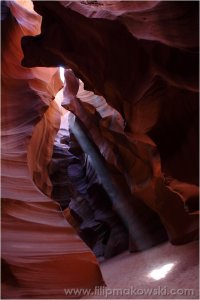
Definitely worth considering Antelope, I was there just before noon and was able to capture the sun streaming in.

http://www.flickr.com/photos/filipmakowski/6158291826/#in/set-72157627571758317

The biggest challenge is that at any time when the sun is coming in you have over 200 people in the canyon across 10+ guided groups. I had to take this photo handheld at ISO1600, f2.8 with the 16-35mm II (which I have never found to lack sharpness) as there was absolutely no time or space to put up a tripod.

Suggestion for Grand Canyon: hang around after the sun sets, you may be able to get some great shots with iridescent clouds. When I was there everyone had returned to their hotels just after the sun had set, missing the opportunity for what turned out the best part of the evening.
 

Attachments

  • Antelope Canyon, 11.48am, Paige, Arizona.jpg
    Antelope Canyon, 11.48am, Paige, Arizona.jpg
    82.3 KB · Views: 1,026
Upvote 0
ahsanford said:
DianeK said:
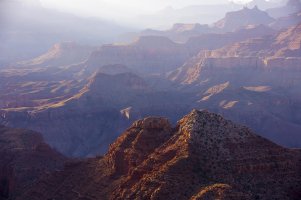
First image is Lipan Point, second is Navajo Point

Nice shots. I've noticed a blue shift like yours on the distant horizon mountains in my photos as well. It is certainly what my eyes see, so these shots are well rendered.

Can you walk me through what causes that blue cast (physically, that is)? I'm guessing it's diffraction of light through so much air (perhaps that's nonsense), but from a photog perspective, is that something you wish to capture, wish to filter out, wish to shift to true black shadows, etc.? What are the composition and post-processing considerations for this? Would I see a similar cast if I went with the longer tele?

Just curious.

- A

Thank you.
There was a general haze that day which is what I think caused the distant blue haze. Twas a very frustrating day for that reason. I don't know if a UV filter would have helped or not because I don't use them. :-\
 
Upvote 0
ahsanford said:
@DianeK and others that have been there:

One more thing comes to mind. Canyons inherently have shade challenges. The best light at sunup / sundown will come part and parcel with very large shaded areas. Is there any credence to choosing to use more unfriendly overhead/midday light to minimize the massive dynamic challenges the shadows will bring?

That's a really broad composition question, and I appreciate it depends on what you are trying to accomplish. But I'd like your thoughts on how to pick your exposure battles on sun vs. shade.

- A

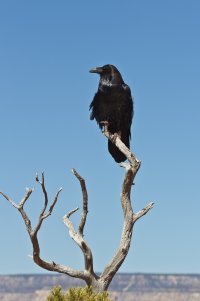
I'm afraid I'm not a very "thoughtful" shooter. The only plan so to speak I had that day was to be at the east end of the canyon on Desert View Drive so I could have the setting sun on my viewpoints (although the haze on the horizon really complicated things). When we were down about a mile on Kaibab trail it was noon, so I just did the best I could with what I had even attempting to get some detail on this raven in the harsh noon light ::)
 

Attachments

  • 1203_grandcanyon_066.jpg
    1203_grandcanyon_066.jpg
    264.1 KB · Views: 957
Upvote 0
Cali_PH said:
I'll link to an earlier response I made to someone else asking about the Grand Canyon and Antelope Canyon areas. If you want me to email you the mini-Antelope Canyon guide I mention there, feel free to PM me. I may even be able to fit it into a PM, but it was a bit long.
As the asker of the thread that Cali is refering to, I can only +1 on his recommendations.

I used my 17-40mm primarily on the 5D3 and exclusively for Upper/Lower Antelope as well as Horseshoe Bend.

I had great use of grad filters for 6am-9.30am shots I took at the Horseshoe. Oh, and bring a (big) tripod to lower antelope.

Personally, I was underwhelmed by GC - but then again, I had been on an 8-day streak of Valley of Fire, Zion, Bryce, Grand Staircase, Torrey, Capitol Reef, Canyonlands, Arches, Needles overlook (with a hailstorm!), Natural Bridges, Monument Valley, Antelopes, Horseshoe bend and then the south rim of GC.
 
Upvote 0
If the haze bothers you, I think there is one comparatively cheap option to try. You can try diminishing that effect by using a circular polarizer. What is harder to know is how much difference it makes, as this depends on the scene.

It is not like I'd typically nitpick about this stuff, but the scientific term for cause of the blue haze is scattering, not diffraction. Other than that, the explanation was correct, the blue haze is caused by stratospheric scattering, and since blue is the shortest wavelength, it is the most affected.
 
Upvote 0
My 2 cents based on my last trip to Grand canyon and Page

1) Yes. I missed a UWA on several occasions, especially the horseshoe bend in Page. I'd get a 16-35 rather than a 17-40 personally, since I had the latter (but on a 7D) and neither the colors nor the sharpness (at f/8 or f/11) were that compelling, and no experience with the 14mm.

2) I'd borrow that flash if you are taking pictures of people. The harsh sunlight necessitates fill flash and the 5DIII doesn't have a pop-up. I'd get it- I needed it.

3) Your bag should be sufficient, especially since the 70-200 will likely be in your bag and not on your camera at this point. It gets very windy and sometimes worried me.

4) Already answered above.

5) You will have plenty of flat horizons, and you will need those grad NDs.

Couple other things: The glass horseshoe is overrated and overpriced in my opinion. Get a monopod for the antelopes- it gets too crowded and too rushed for proper tripod usage, unless you are comfortable running with it and setting it up quickly (and if the tripod is carbon-fiber).

Happy shooting!

[/quote]
 
Upvote 0
Best wishes on your Grand Canyon trip. You renting or buying that 17-40mm?

I rented the 10-22mm EF-S a few times and hated it. For almost the same price as a 17-40 it wasn't nearly as sharp. Maybe it was the copy I had. On a 5DmII or mIII you might find that the 17 end of that lens isn't bad for such and expansive landscape. It'll be fun to see the results. Keep us posted.
 
Upvote 0
I'm a photo guide and workshop instructor at the Grand Canyon. I also lived there for a short time many years ago. You're going to be visiting during a great time of year! The crowds have begun to diminish and there's plenty of low-angle light to take advantage of!

Your gear list looks fine and I expect that you'll get the most out of the 24-70/2.8L and 70-200/2.8L lenses. My most commonly used focal lengths at the canyon are 24mm, 45mm, and 90mm. I also love using the telephoto focal lengths to isolate areas of strong light & shadow or interesting patters in the landscape.

An ultra-wide zoom is handy to have along, but consider that they can also have an effect of minimizing some of the finer features in the landscape. I tend to use a 16-25/2.8L or Nikon 14-24/2.8 when I capturing the night sky, including the Milky Way, as Northern Arizona is a great place to do this type of photography. Depending on when you visit, and the weather you experience, you may be able to get some shots of the canyon illuminated by the moon.

As for filters...be careful with the polarizer on a wide-angle lens. It's very easy to over polarize or have an uneven polarization effect across the sky. Neutral density grads will come in quite handy with a 2-stop soft edge and 3-stop hard edge being my most used grads at the canyon.

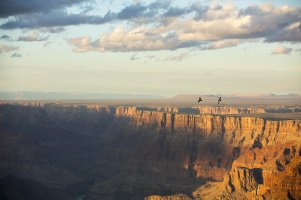
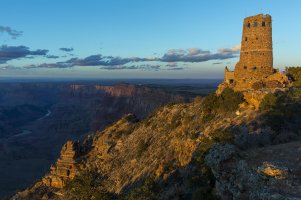
On to shooting locations. You've already received many great suggestions here on CanonRumors.com. Ths is time of the year the points at the east end of the park are great. I love Lipan Point and Moran Point for sunrise. Desert View and Navajo Point can be great at sunset. On the Hermit Road at the west end of the park there are several good points including Powell Point & Memorial, and Hopi Point. No matter where you go, remember that you don't have to stay at the points. You can and should explore a bit!

I know several other members here have mentioned the weather at the canyon, but I'll add my 2 cents. It can get quite cold this time of year. We've already been down to 3 degrees Fahrenheit once this fall and it's routinely getting down to the high teens in the morning. The wind has been blowing lately which makes the need for a good/sturdy tripod all that much more important. Dress in several layers and be prepared to add or take away as necessary.

If you're interested, you can view some of my Grand Canyon work on my website and Facebook page:


I hope you have a fantastic trip!
 
Upvote 0
Just got back, team. Nice tips.

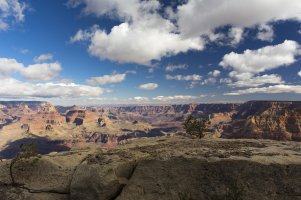
I've attached a few decent ones, shown here. Comments to follow.

- A
 

Attachments

  • _Y8A8639_2.jpg
    _Y8A8639_2.jpg
    389.3 KB · Views: 714
  • _Y8A8804.jpg
    _Y8A8804.jpg
    333.1 KB · Views: 719
  • _Y8A8876.jpg
    _Y8A8876.jpg
    291.3 KB · Views: 710
  • _Y8A8914.jpg
    _Y8A8914.jpg
    412 KB · Views: 811
Upvote 0
Okay, here were was my experience from the trip.

1) Beautiful beautiful beautiful. The GC is a gift to see and behold.

2) I used the 28mm prime (60%) and 70-200 (15%) a lot more than I thought I would. The 24-70 got less use than I thought it would, perhaps the remaining 25%. I didn't buy/rent the ultrawide, and I don't think I needed it. Someone suggested to go pano on the tripod if I needed more width, and I only needed to do that 3-4 times. Great tip.

3) Don't leave right at sunset. The light immediately after sunset can ping pong off of clouds and do some great things.

4) ND grads are punishing to dial in when it's cold, windy and you are aching from leaning over a tripod setup for an extended period. They also are hard to proof for correct placement, even at a 100% pixel playback on the 5d3's screen. Such a powerful tool needs a simpler implementation and verification, IMHO. I'm sure I'll get better at using them, but that was the biggest fail of the trip for me.

5) I shot much more handheld than I thought I would. The tripod only came out about a dozen times over the two days.

6) I brought the big stopper (10 stop darkener) and didn't use it on day one when I had great fluffy clouds. Day two there wasn't a cloud in the sky. So if you have the clouds, use it when you can. :-P

7) Simultaneous ND grad + panorama is the way to madness. I'm only using ND grads on single shots until I get better at using them.

8 ) Though it's 101 photo stuff, don't use s--- filters. I have B+W MRC UVs and CPLs for everything except my staple 77mm CPL (which was a mid-grade Hoya). As it was my only 77mm CPL, I had to constantly switch it out from the 24-70 to the 70-200. It unthreads, the two rings wiggle w.r.t. to each other, etc. I was fed up with it. [I just rectified that with a 77mm Kaesemann MRC CPL purchase, btw.]

9) Though I knew this would happen, the 24 end of the 24-70 and the 28 prime both demonstrated FOV-CPL-'pseudo-vignetting' from differing levels of sky darkness. It goes away around 35mm and up from my experience. I know you folks brought it up, and I have fought that for years with my old 10-22 EF-S lens. But I did it anyway. I just felt the sky would have been too bright if I didn't accept this tradeoff, and the CPL is 100x easier to use than the (more appropriate) ND grads.

10) A monstrous bull elk walked into the GC village behind my hotel, and in nearly complete darkness, I netted a proof-of-bigfoot level of usefulness shot of him at ISO 25,600 + handheld + fully open + IS on my 70-200mm F/2.8L IS II. I saw details and colors in that shot that my naked eyes could not see. Love my 5D3. 8)

More will hit me later, but I had a tremendous trip and learned even more about my love of photography in the process. Would do it again in a heartbeat.

Thanks again for your copious tips and insights.

- A
 
Upvote 0
And one more thing, the first picture I linked could have been an epic keeper if I had only waited for the little warrior (tree) in front to get some sunlight. Poor patience on my part.

I also should crop that into a more cinematic / pano aspect ratio. 3:2 doesn't serve such an interesting shot, IMHO.

- A
 
Upvote 0
Status
Not open for further replies.