
Looks like Canon's boat is sinking in Thailand

Feb 26, 2012
1,729
16
15,866
AB
Excerpts from IR interview w Fuji execs:

BOLD is my addition.

TI: Yes. In Thailand the size of the mirrorless market has already exceeded that of DSLR. So we exceeded the share of Canon...and became the number one within the whole category. I think it seems the young females started buying mirrorless cameras. The number one reason is because of the skin tone. So the selfies are very popular.

snip

DE: That's very good. Boy, that's so interesting about Thailand, it's fascinating to me. It's a case where pure consumers are seeing a real difference in image quality, and that's affecting their product choices. I wonder if you can extend that into other parts of the world, too?

snip

TI: About $550 as a price range, but bear in mind that was the price for Thailand. It's probably worth three months' salary or so [for customers in that market].

DE: Wow. And they're still buying them in huge quantities.
[Ed. Note: This is really incredible, that mass-market consumers are buying cameras that cost three months' salary!]


Looks like when they're choosing to spend that much of their income on a camera, Canon is not a top choice.
Very interesting.

Anyone have all the CIPA numbers for Thailand and other asian markets they can share?
 
Aglet said:
Anyone have all the CIPA numbers for Thailand and other asian markets they can share?


I believe that Thailand had more mirrorless sales last year as well.

CIPA gives numbers for All Asia and a breakout for Japan. Thailand is probably a small market compared to other Asian countries like China. Samsung claimed big sales in one of the Asian countries, but big is relative.

For January 2016, 12,058,512,000 Yen for 239,173 DSLR's and 5,936,606,000 for 124,017 Mirrorless. That's about 50,417.53 yen for a DSLR and 47,869.29 yen for a mirrorless body. Of course, the spare lenses is a different category which is not included here.

So Asia has about 50% +/- Mirrorless. Overall, sales continue to drop, but DSLR's and Mirrorless are increasing, its the P&S sales dragging the numbers down.

http://www.cipa.jp/stats/dc_e.html
 
Upvote 0
CIPA data aren't that granular. Japan and 'rest of Asia' are reported. A while back, Sony stated they were the top ILC brand in South Korea.

In CIPA's 2015 'rest of Asia', dSLRs beat MILCs by 2.5:1 (units, revenue is closer to 3:1), so it would seem Thailand and S. Korea are outliers.

Fuji may be tops in Thailand, but in the large Japanese MILC market they're barely a blip on sales charts where Canon is #3.
 
Upvote 0
I'm going to make up my own brand of range finder camera and give one to each resident of Lost Springs, Wyoming. Then I can advertise a 100% market share.

Of course, there are only 4 residents in Lost Springs, but I would not say how many people had them.
 
Upvote 0
possibly some sort of national pride if Fuji's got factories located there?
or is Thai skin tone (appreciation) something special that only Fuji seems to render satisfactorily, as is stated in the article?
 
Upvote 0
LOL. And what is the Average Salary in Thailand. A Kit 5d MK III IF they can get one of the gray market deals from Big Dig, etc., is still HALF A YEARS SALARY for most.

So I guess when all is said and done, Ladyboys prefer Mirrorless. Who knew?
 
Upvote 0
I have no statistics, but as a 12+ year resident I can tell you that the smartphone market is huge in Thailand and smartphones are definitely the preferred devices for taking photographs. I see very few DSLRs or MILCs. Thais love taking selfies and uploading them straight to Facebook. The 550D I bought my wife before we were married has hardly been used, but she has taken thousands of photos with smartphones. She gets trigger happy when using my EOS M, but it isn't a camera that she would want to carry around herself. She loves her iPhone because it is small, takes decent photos, has a direct connection to Facebook, and does everything she wants.

Skin tone is an obsession in Thailand. I had yet another conversation with a Bangkok girl a few days ago and she told me about the extreme measures Thai females take to lighten their skin. In every TV commercial break there is at least one advert for a skin whitening product.

Photo studios will lighten skin tone automatically in post production. My Thai wife, who is naturally quite dark-skinned, ends up looking like Snow White in studio photos. Thai TV soap operas have the strangest colour balance with whites in the background completely blown out and strange looking green foliage. The lighting and camera settings are chosen to make the actors look as white as possible.

If Fuji cameras have effective skin lightening options during the RAW to JPG conversion I can understand why they would be popular with some Thai females. It looks like they do, the following was taken from some Fuji X-A2 blurb: "Portrait Enhancer mode can be used to lighten skin tones for a clear and smooth appearance that is especially ideal for taking selfies."
 
Upvote 0
Interesting observation about Fuji possibly catering to specific local market expectations in Thailand. Eventually we may see more of that as camera manufacturers learn they can easily tweak software to offer local preferences other than just language.

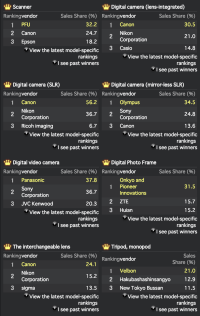
It's hard to get sales statistics for individual countries other than Japan. BCN Rankings show the mirrorless leader in Japan for 2015 was Olympus (34.5% share), 2nd Sony (24.8%), 3rd Canon (13.6%). Olympus & Sony have traded the top spots for the last couple years. The best Fuji has managed in Japan is about a 5% share.

For dSLR's Canon's share in Japan actually increased to 56.2% -- i.e. Canon outsells all other dSLR manufacturers combined in Japan!

According to CIPA data, there is no region in the world where mirrorless interchangeable lens cameras outsell dSLR's.
 

Attachments

  • 2016-BCN-camera-rankings 2015 data.png
    2016-BCN-camera-rankings 2015 data.png
    85.1 KB · Views: 233
Upvote 0
Aglet said:
Excerpts from IR interview w Fuji execs:

BOLD is my addition.

TI: Yes. In Thailand the size of the mirrorless market has already exceeded that of DSLR. So we exceeded the share of Canon...and became the number one within the whole category. I think it seems the young females started buying mirrorless cameras. The number one reason is because of the skin tone. So the selfies are very popular.

snip

DE: That's very good. Boy, that's so interesting about Thailand, it's fascinating to me. It's a case where pure consumers are seeing a real difference in image quality, and that's affecting their product choices. I wonder if you can extend that into other parts of the world, too?

snip

TI: About $550 as a price range, but bear in mind that was the price for Thailand. It's probably worth three months' salary or so [for customers in that market].

DE: Wow. And they're still buying them in huge quantities.
[Ed. Note: This is really incredible, that mass-market consumers are buying cameras that cost three months' salary!]


Looks like when they're choosing to spend that much of their income on a camera, Canon is not a top choice.
Very interesting.

Anyone have all the CIPA numbers for Thailand and other asian markets they can share?
Do you have a link to the full interview as frankly it is hard to understand.

If the Fuji exec is the one saying that US$ 550 is roughly 3 months salary, he's an absolute idiot and does not know what he is talking about. I mean seriously, that's a ridiculous thing to say as it is too vague and completely wrong as well as misleading. If a Fuji exec said that then quite honestly it puts everything else he said into question.

Also Thailand is a very difficult market to survey. Leica sells quite well as there are a lot of very rich Thais around. Canon is still number one with agencies and pros working for media companies, Nikon still number two.

But as someone above mentioned, your average Thai uses his/her smartphone to take pics.

Thais are also one of the top FB and Instagram users in the world.
 
Upvote 0
Tyroop said:
I have no statistics, but as a 12+ year resident I can tell you that the smartphone market is huge in Thailand and smartphones are definitely the preferred devices for taking photographs. I see very few DSLRs or MILCs. Thais love taking selfies and uploading them straight to Facebook. The 550D I bought my wife before we were married has hardly been used, but she has taken thousands of photos with smartphones. She gets trigger happy when using my EOS M, but it isn't a camera that she would want to carry around herself. She loves her iPhone because it is small, takes decent photos, has a direct connection to Facebook, and does everything she wants.

Skin tone is an obsession in Thailand. I had yet another conversation with a Bangkok girl a few days ago and she told me about the extreme measures Thai females take to lighten their skin. In every TV commercial break there is at least one advert for a skin whitening product.

Photo studios will lighten skin tone automatically in post production. My Thai wife, who is naturally quite dark-skinned, ends up looking like Snow White in studio photos. Thai TV soap operas have the strangest colour balance with whites in the background completely blown out and strange looking green foliage. The lighting and camera settings are chosen to make the actors look as white as possible.

If Fuji cameras have effective skin lightening options during the RAW to JPG conversion I can understand why they would be popular with some Thai females. It looks like they do, the following was taken from some Fuji X-A2 blurb: "Portrait Enhancer mode can be used to lighten skin tones for a clear and smooth appearance that is especially ideal for taking selfies."

Very enlightening!

Jack
 
Upvote 0
Jack Douglas said:
Tyroop said:
I have no statistics, but as a 12+ year resident I can tell you that the smartphone market is huge in Thailand and smartphones are definitely the preferred devices for taking photographs. I see very few DSLRs or MILCs. Thais love taking selfies and uploading them straight to Facebook. The 550D I bought my wife before we were married has hardly been used, but she has taken thousands of photos with smartphones. She gets trigger happy when using my EOS M, but it isn't a camera that she would want to carry around herself. She loves her iPhone because it is small, takes decent photos, has a direct connection to Facebook, and does everything she wants.

Skin tone is an obsession in Thailand. I had yet another conversation with a Bangkok girl a few days ago and she told me about the extreme measures Thai females take to lighten their skin. In every TV commercial break there is at least one advert for a skin whitening product.

Photo studios will lighten skin tone automatically in post production. My Thai wife, who is naturally quite dark-skinned, ends up looking like Snow White in studio photos. Thai TV soap operas have the strangest colour balance with whites in the background completely blown out and strange looking green foliage. The lighting and camera settings are chosen to make the actors look as white as possible.

If Fuji cameras have effective skin lightening options during the RAW to JPG conversion I can understand why they would be popular with some Thai females. It looks like they do, the following was taken from some Fuji X-A2 blurb: "Portrait Enhancer mode can be used to lighten skin tones for a clear and smooth appearance that is especially ideal for taking selfies."

Very enlightening!

Jack

+1
interesting to get some insight into the tech culture there, thank-you.

meanwhile, like to the whole IR interview is here

www.imaging-resource.com/news/2016/03/21/fujifilm-interview-cpplus-2016-inside-x-pro2-leap-forward-phase-detect
 
Upvote 0
Aglet said:

Frankly you deserve a medal if you managed to read that whole interview. Why does he not use a video camera, or at the very least a voice recorder, when doing such in-depth interviews? I know it is only personal opinion, but I hate reading long interviews when they are just written out in Q&A form like that.

As I am not going to read the whole thing, I will just repeat that what was said about Thais:

TI: About $550 as a price range, but bear in mind that was the price for Thailand. It's probably worth three months' salary or so [for customers in that market].

DE: Wow. And they're still buying them in huge quantities.
[Ed. Note: This is really incredible, that mass-market consumers are buying cameras that cost three months' salary!]

is totally erroneous and completely inaccurate as well as misleading.

As Tyroop said, and I concur, most Thais use their smartphones to take pictures, many even have two! And many do spend much more than they should on their phones when you consider what some of them are earning. But the average middle class Thai earns a lot more than that ridiculous figure quoted above.

Ask most middle class Thais what they think of Fuji and they will most likely say they like the food, but that the restaurants can be really busy at certain times making it difficult to get a table! ;) Yes, it is a popular and reasonably priced Japanese restaurant chain in Thailand!
 
Upvote 0