Macro

  • Thread starter Thread starter zsolex
  • Start date Start date
Status
Not open for further replies.
Z

zsolex

Guest
Hi,

I am new in macro photography.
When I got the EF 100mm /2.8 macro lens there are two ways to getting closer to the subject for bigger magnification.
- ie. 500D close-up filter
or
-extension tube

Please tell me what is the difference between twos in DOF or IQ and in another terms?
(Extension tube reduce light and need to have electrical contact to controll the aperture, close-up may reduce IQ)
 
zsolex said:
Hi,

I am new in macro photography.
When I got the EF 100mm /2.8 macro lens there are two ways to getting closer to the subject for bigger magnification.
- ie. 500D close-up filter
or
-extension tube

Please tell me what is the difference between twos in DOF or IQ and in another terms?
(Extension tube reduce light and need to have electrical contact to controll the aperture, close-up may reduce IQ)

So, you're looking to go over 1:1 magnification, right? I think you have the basics of the effect of the two ways to do that - an extension tube is just air, so no IQ effect, but the extra distance means loss of light and therefore longer exposures needed. A close-up lens will potentially decrease IQ (although the Canon 500D has only a minor impact because the optical quality is excellent). I assume you have the non-L version of the Macro (Canon doesn't make a 67mm close-up lens for the L macro, but the 58mm lenses will fit the non-L). When using an extension tube on a macro lens, DoF will be essentially the same as without the tube (i.e. very, very thin). Even though there is an apparent effect on aperture (loss of light), it's not a real effect, in that it doesn't alter DoF. A close-up lens will have no effect on DoF.

The other issue is how much additional magnification you can get. That works out to:

100mm f/2.8 Macro + 12mm extension tube - 1.17x
100mm f/2.8 Macro + 25mm extension tube - 1.38x
100mm f/2.8 Macro + 500D close-up lens - 1.21x
100mm f/2.8 Macro + 250D close-up lens - 1.41x

Generally, extension tubes are better for shorter focal lengths and close-up lenses are better for long focal lengths. 100mm is about the tipping point for that, so you can achieve similar maximum magnifications with either approach.

If you really want to go above 1:1, have you considered the MP-E 65mm? That lens starts where a normal macro lens stops, delivering 1x - 5x magnification.

Here's a shot with the MP-E 65mm at ~4x - this day lily stigma is about 5mm (0.2 inches) across:
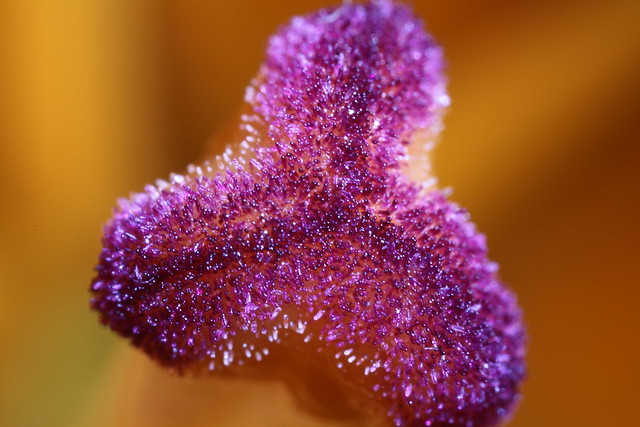

EOS 5D Mark II, MP-E 65mm f/2.8 1-5x Macro @ 4x, 0.8 s, f/10, ISO 200

 
Upvote 0
The MP-E 65 is great lens, but I am out of the budged to buy this. Great shot :)

If I am right, the extension tube(AF) is better choice than the 500D/250D,
because I can put on other lens as well and I have the some or more magnification..
 
Upvote 0
If you want to go over 1:1 magnification, the little known secret is this... use 2 lenses... If you have 2 L lenses or super sharp lenses, even better... Get a double thread filter adapter ($7-8 online) that has the filter size thread of both your lenses or close to them and use a step up/down rings to make them fit and basically mount the shorter of the two lenses to the camera and and the butt of the second lens will be sticking out. You will have a razor sharp and razor thin DOF. The bigger the ratio from the big lens to the small lens, the more 2x-4x-6x magnification you will get. Seriously, it's a little awkward however using this you can photo bed bugs and such by moving these lenses over your bed... You will never be able to sleep on your bed again haha. Use the mounted lens for focus. This was a technique taught to me by renowned photographer Ralph Clevenger from BIP. The best thing is it doesn't cost you ANYTHING more than 2 of your everyday lenses and a cheap adapter. Good luck.
 
Upvote 0
awinphoto said:
If you want to go over 1:1 magnification, the little known secret is this... use 2 lenses... If you have 2 L lenses or super sharp lenses, even better... Get a double thread filter adapter ($7-8 online) that has the filter size thread of both your lenses or close to them and use a step up/down rings to make them fit and basically mount the shorter of the two lenses to the camera and and the butt of the second lens will be sticking out. You will have a razor sharp and razor thin DOF. The bigger the ratio from the big lens to the small lens, the more 2x-4x-6x magnification you will get. Seriously, it's a little awkward however using this you can photo bed bugs and such by moving these lenses over your bed... You will never be able to sleep on your bed again haha. Use the mounted lens for focus. This was a technique taught to me by renowned photographer Ralph Clevenger from BIP. The best thing is it doesn't cost you ANYTHING more than 2 of your everyday lenses and a cheap adapter. Good luck.

:o You can't be serious. Are you serious? Is he serious? Now I want to try this. Sounds awesomely ridiculous.
 
Upvote 0
HughHowey said:
:o You can't be serious. Are you serious? Is he serious? Now I want to try this. Sounds awesomely ridiculous.

Yes, it works. There are two 'flavors' - one where you reverse mount a single lens onto the camera (using a reverse mount ring, with filter threads on one side and a body-specific bayonet mount on the other; they are usually less than $10), another where you reverse mount a second lens onto a normally-mounted lens (using a coupler, like a filter step-up ring but with both threads on the outside, also <$10). The latter case gives you increased magnification relative to the former, and to determine that you divide the focal length of the forward lens by the focal length of the reversed lens - e.g. reverse-mounting a 50mm prime on a 200mm prime gives you 4x magnification. You will usually want to reverse mount a prime lens, and 50mm is the best length (shorter would yield higher magnification, but the working distance would be too short, i.e. with a 35mm lens reversed your subject would need to be touching the rear element of the reversed lens).
 
Upvote 0
how can you put lens together? ::)
for i.e. has the same femee-female part if you put on both lens
http://cgi.ebay.com/Series-VII-7-FILTER-RETAINING-RING-DOUBLE-THREAD-BLACK-/220772925129?pt=LH_DefaultDomain_0&hash=item3367177ec9
 
Upvote 0
zsolex said:
how can you put lens together? ::)
for i.e. has the same femee-female part if you put on both lens
http://cgi.ebay.com/Series-VII-7-FILTER-RETAINING-RING-DOUBLE-THREAD-BLACK-/220772925129?pt=LH_DefaultDomain_0&hash=item3367177ec9

No, not with that - that is for filters. You need a ring with both sets of threads on the outside. For example, if you wanted to reverse mount a nifty-fifty (50/1.8 II, 52mm filter threads) onto your 100mm non-L macro (58mm threads), you'd use THIS.
 
Upvote 0
:)

How do you calculate the magnification in the cases:
I. only one lens reversed?
II. two lens to each others (Fbody = 200mm (attached normally), Freversed = 50mm ; M = 200/50=4)
how do you focuses in the case II?
 
Upvote 0
One more option to consider for more magnification - add an extender/teleconverter. Do check if they are physically compatible. I believe the new L doesn't take the Canon extender as the rear lens element will conflict with the extender's protrusion. If the non-L is similar, you're looking at getting something like a Kenko non-pro one without a protrusion.

Quality will degrade depending on the quality of the extender, but a 1.4x is probably ok in most situation. Benefits of this method are you retain near enough the same focus distance range as the native lens, and in most cases you will also maintain AF capability.

Back to the earlier reference to extension tubes, they can degrade quality if you push too far. You are operating the lens outside its normal region. Depending on the lens and how far you push, you can get field curvature and other negative effects. Stopping down for DoF also helps combat that. If you're not too ambitious with extension amount then the quality can remain very good.
 
Upvote 0
Thanks neuronatomist, had to step out for a while... yes, the coupler is what I was referring to... it has 2 sets of threads that threads onto the filter threads of your mounted lens and then the second lens reverse threads onto the other side. It works best (most secured) if the dia of the rings are the same or close, however with metal step up or step down rings, other lenses in your bag can still be used.

Neuro did a great job explaining the calculation of the magnification. As with most macro, the higher the magnification, the shallower the DOF so use very gentle and smooth movement or you can completely lost what you were trying to photograph in the first place. It's relatively cheap however it is a little known secret within the photography world so i hope they dont become hard to find because they aren't popular items. Lastly, if you get a decent microscope, you can also get an eos mount for the eye piece and mount your camera straight to it. I'm not sure what brands of microscopes does this, however this is something i played with while at BIP.
 
Upvote 0
zsolex said:
:)

How do you calculate the magnification in the cases:
I. only one lens reversed?
II. two lens to each others (Fbody = 200mm (attached normally), Freversed = 50mm ; M = 200/50=4)
how do you focuses in the case II?

You are correct in II. You focus using your main attached lens, however you can try playing with the focus of the second lens, see what you get. With such a shallow DOF and subject matter it's purely experimental and there are no wrong answers regarding focusing using this method. It's a cheap answer and play around with it to see what you can get.
 
Upvote 0
What about to put kit lens (18-55) to EF 70-200?
Is it stable solution, the kit lens is not very strong in mechanical side..
(70/15 = 4.6x)

Due to different filter size 58mm vs 67mm wont't be serious vignetting?
 
Upvote 0
Regarding vignetting, in theory the 67 glass is bigger than 58 and the 18-55 would be attached to the camera, I wouldn't think so but that's a combination I haven't tried and I suppose that's always a possibility until it is tried and tested and reported, hint hint. The thing I'd be careful about is the plastic body of the 18-55 and metal attached body of the 70-200. Just make sure to use diligence in supporting the lenses so the camera mount nor the 18-55 shell doesn't snap.
 
Upvote 0
Sort of tempted to bump the TS-E 90mm rumors thread, but it's a bit old.

How about TS-E 90mm with a stack of Kemco (for example) extenders on a 1.6 crop Rebel?

Not sure I personally need 1x; .5 sounds pretty reasonable to me. I have gotten dang good "macro-like" results even on a 50mm with that 1.6 crop factor, though nothing like Neuro's amazing picture from the last page.
 
Upvote 0
Edwin Herdman said:
Sort of tempted to bump the TS-E 90mm rumors thread, but it's a bit old.

How about TS-E 90mm with a stack of Kemco (for example) extenders on a 1.6 crop Rebel?

Not sure I personally need 1x; .5 sounds pretty reasonable to me. I have gotten dang good "macro-like" results even on a 50mm with that 1.6 crop factor, though nothing like Neuro's amazing picture from the last page.

My TS-E90 worked well with a TC and for close up images. I had bought it to use for product photos, but experimented with closeups with and without a TC. However, 90mm turned out to be a bit long for my product photos, so it did not get enough use for me to keep it.

If a person needed the tilt-shift function, it could certainly work for a near macro lens and have supurb resolution. However, the cost is comparable with the 100L, so its a tradeoff of the features you would use most. I bought a 100L to replace my TS-E90, but was sad to see it go. For me, the IS of the 100L was more useful.
 
Upvote 0
Status
Not open for further replies.