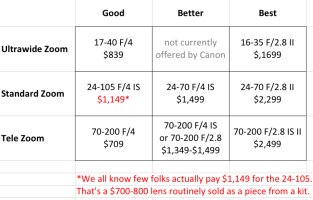
Let's look at the market-
A. Is there a room for UWA with IS?- yes- videography, high resolution of modern sensors (see wide angle IS primes). Also, corner resolution of the 17-40 could be improved and that will attract a lot of new customers.
B. Is there a room for a sharp, fast, ultrawide? - look at Nikon 14-24 sales. I don't have the numbers- but if it sells in large numbers, then that is an indication for Canon to approach that segment.
Let's look at competitors-
A. What other UWA with IS is available for canon- none.
B. Assuming, there is a market for a sharp, fast, ultrawide- is there any competition- only from some prime lenses, which are:
a) own product- 14mm II- not particularly sharp
b) Zeiss 15mm, 18mm (?) and 21mm- expensive, manual focus
c) own product- 17mm TS-E- manual focus, expensive
Take home:
A. For an ultrawide with IS- there is definitely an unmet demand. Historically, Nikon has high sales numbers for its 16-35 f/4 VR. So I think Canon can expect a large number of 16-35 II users to move to an IS lens for a low adoption cost. There will also be a small number of people upgrading from the 17-40 due to the IS and better IQ. This will include both people using it exclusively on FF, and people buying it for APS-C with an eye on potential upgrade path.
B. For a sharp, fast ultrawide- this one is less clear. Canon needs to look at the sales figures for the 14-24 and the 16-35 2.8. If there is a bigger number for the 14-24, that means lots of people are willing to pay the premium price and trade off the filter usability and range. OTOH, if the 17-35 2.8 sells better, Canon will be better off bringing out a version III of the lens, or more likely, just keep the 16-35 II around.
(by the way, the prices are off- the 17-35 2.8 costs around $1750, not $ 1950)
[p.s. I tried not to make any assumptions, including: those hankering on the CR forums for a sharp, fast UWA necessarily make up the majority of Canon's customers.]