New Canon Hi-pixel Medium format...?

Status
Not open for further replies.
Stu_bert said:
Hmmm....

No sense some of you say?

The lens problem is solved in the short term by the 645 lenses, they get access to tech. and if they've done their research, they're buying a profitable company and associated expertise cheaper / quicker than developing it initially in-house.

If they've been investing previously in Phase 1, maybe they already have their own "entry-level" MF camera using a combination of phase-one and Canon tech ready to release when they buy it fully ;D. Maybe over time, they can indeed either make their own lenses or phase 1 sensors.

Not everything needs to be a perfect fit, be instantly "converted to Canon manufactured" or developed from scratch.

Two other observations... the low end of the market (the high vol side) is being impacted a lot. So is overall sales. Do you invest now in a market which is not going to be threatened by smartphones and the like, while you still have the cash reserves? I think Canon need to innovate in the entry level - I think like Tom Hogan says, it's about the ecosystem and opening it up so it is not a closed system. It's about inviting in the CHKD and ML teams by providing them with a nice API. It's about providing seamless interfacing with not just your phone, but if you pop in a sim like you can with a tablet, then you can do so much more from your camera and a touch screen (especially if you could interchange the sim with the one from your tablet).

It's about unleashing, not crippling your hardware so Canon gear's output quality is just a world away from smartphones in video and stills. Its about adding something like Android onto it, because then you really can add quite sophisticated sw to edit and do clever things on your camera with images.

Canon, Nikon etc need to play to the strengths of dslrs but also learn from smartphones and the like.

I'd love to be able to use my camera as a webcam - the quality would be awesome. Any chance of that Canon? uh-err. Hook two of them up to shoot 3D - stills or video? uh-err. All the innovation is in an open ecosystem, not a closed one.

Sorry, carried away and off thread. :-[

Buying Phase 1 is plausible. Taking Canon manufacturing and apply it to MF to bring it into the sub $10K for a 60MP beast of Phase-1 quality is achievable and would disrupt the market. But only if they're prepared to adopt a different lens mount. Lens range to cameras is like apps libraries to smartphones - starting from scratch does not accelerate market penetration and allows your competitors to react before you've captured the market...

Very good observations!
 
Upvote 0
Drizzt321 said:
To be fair, the Mamiya RB/RZ are pretty freakin' big and unwieldy. Granted, with MF you often aren't swinging it around like you do with a 35mm format camera, but from the pics I've seen the 6x4.5 format cameras are much handier and easier to shoot with not from a tripod.

Much of a muchness, I think, depends if you're used to Waist Level Finders or Viewfinders, and what you shoot. I started on (d)SLRs, but like I said, I'm getting more and more used to WLF, for full-body portraits and street it's just easier. Headshots handheld the level-prism of the Mamiya is better. I got TTL metering prisms with all my MF gear to begin with, because I was used to my 3 & 7D, but the freedom of WLF and my external meter is very liberating.

I've just compared my MF cameras, the Mamiya 645AF is actually bigger than my 6x6 Hasselbladski (Kiev 88CM). The body is shorter (because of the smaller mirror and shorter flange-distance), but then the viewfinder sticks out further. The Mamiya is wider because of the grip, the Hasselbladski is more cubic. Height-wise the Mamiya's prism is smaller (because it's integrated probably helps), but only by 1cm, and that's comparing the Hasselbladski's 45-degree prism (the level prism is smaller I think, but I don't have one, and with the WLF it's shorter than the Mamiya).
Ironically, given my usage, last big shoot I did with the Mamiya was down the Great Ocean Road to Melbourne and back with a 45mm. 645 for me is landscapes (and conserving film 500km from the nearest shop that sells 120), and landscapes go on a tripod, but as I discovered, viewfinder on a tripod is rather unwieldy, give me Live-View or WLF any day. 6x6 is my street and waist-level full-body portrait machine, it just works better handheld for me.
So yeah, you're right, but the other way. It's not that 6x6 is easier on a tripod, it's that the 645 sucks on a tripod (at least for me, YMMV)

But yes, RB/RZ are bigger, I've never held one but I've seen them in shops, it's a whole world again up from the Hasselbladski size. Partly comes from the bellows focussing, partly from the larger mirror, partly from just the build quality (ever seen a 7D next to a 1000D?). But I know some people who shoot street with them, I've seen a GF680 used handheld, and hell, I've heard from a guy who shoots street with a Speed Graphic.

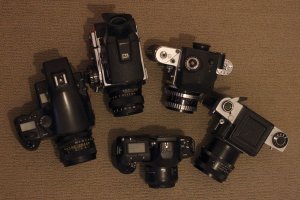
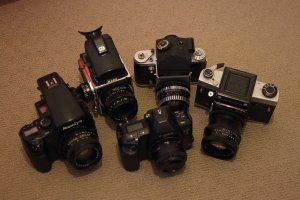
Anyway, just for a size comparison, here's some shots with standard lenses. Mamiya 645AF with Volna-3 80/2.8 (I don't have a Mamiya 80mm), Kiev 88CM with 45degree TTL-Spot prism and Vega-12 90/2.8, Pentacon Six with Kiev-TTL meter and Zeiss Biometar 80/2.8, Kiev 60 with Zeiss Biometar 120/2.8, and Eos 3 with Nifty Fifty. I don't feel any of them are more unwieldy than my 3 / 7D, once I put a zoom onto the Canons they're bigger than the MF.
 

Attachments

  • IMG_2059brs1500x1000.JPG
    IMG_2059brs1500x1000.JPG
    350.1 KB · Views: 733
  • IMG_2060brcs1500x1000.JPG
    IMG_2060brcs1500x1000.JPG
    1.5 MB · Views: 738
Upvote 0
Interesting, thanks dr croubie. The 645 cameras seem not all that much bigger than my 5d3. Depends on the specific one of course, but the larger 35mm digital bodies are actually fairly well sized I suppose.

Makes me want to go out and get a 645 body now, hehe.

And I'll agree, the WLF is awesome, although I'd need a smaller body to use it with (TLR perhaps?) rather than the RB67 that I have. 7+ pounds is not exactly easy to operate hand held, even with neck strap. Especially with a 1/400 max shutter speed with a giant mirror slap.
 
Upvote 0
Why would Canon need to buy an MF company? They have enough inhouse engineering to just scale up the existing 1DX technology and go. They already have the silicon fab house, and the rest of the technology is the same as 35mm. With their economy of scale they could produce the MF at the same price as the 1DX. The MF manufacturers high prices are really due to their economy of scale.
 
Upvote 0
sjprg said:
Why would Canon need to buy an MF company? They have enough inhouse engineering to just scale up the existing 1DX technology and go. They already have the silicon fab house, and the rest of the technology is the same as 35mm. With their economy of scale they could produce the MF at the same price as the 1DX. The MF manufacturers high prices are really due to their economy of scale.

It's also economies of who will buy MF. There's a lot fewer in the market for MF than there is for 35mm format. Plus, economies of scale or not, as someone else pointed out in this thread or another, the larger the single piece of silicon (whether it is a CPU or image sensor), it becomes significantly more expensive to make. It's not a linear cost difference, it's something more like log or exponential. Maybe even geometric, I don't know.

Take the Sony RX1, it's $2800. Besides the amazing lens, the sensor is probably the other most expensive piece of the camera since it's FF. Then compare it to the RX100. Sure, the lens in the RX100 is probably not quite as good, but it's also a zoom lens which adds expense, but then it's an APS-C sensor which reduces costs a good bit.

Then you also have to make lenses that can project for MF image sensor. Let's say you use the 24mm v2 TS-E as an example (since I believe it does project the size of MF or larger). That's well over $2K. And we're not talking any AF at all. And if Canon chooses to go the leaf shutter route, the lens gets even more expensive.
 
Upvote 0
Drizzt321 said:
Then you also have to make lenses that can project for MF image sensor. Let's say you use the 24mm v2 TS-E as an example (since I believe it does project the size of MF or larger). That's well over $2K. And we're not talking any AF at all. And if Canon chooses to go the leaf shutter route, the lens gets even more expensive.

You don't wanna know what MF lenses cost...
(I took Leica off that list because, well, they're Leica, but they're even worse.)
 
Upvote 0
I really don't care how they go big megapixel, as long as I can use my ef lenses, they just need to do it. I have considered switching to Nikon many times. Why is it taking them so long and why do they feel the need to lag behind nikon in this area? Hopefully it means when they do reveal, it will be big and good.
 
Upvote 0
ankorwatt said:
Canons own 2 fab lines is not enough, the cost of one stitched MF sensor will be very high and take resources from the old sensors fab lines. Canon have a high internal cost regarding there own sensors and the sensor lines does not generate any money, other departments does

Hi ankorwatt, isn't this a bit like saying VW Audi (insert alternate brand here it makes no difference) engine plant makes no money, only the body line, it's not a car without an engine, it's not a camera without a sensor?
Not trying to be facetious just asking.

Cheers Graham.
 
Upvote 0
ankorwatt said:
Valvebounce said:
ankorwatt said:
Canons own 2 fab lines is not enough, the cost of one stitched MF sensor will be very high and take resources from the old sensors fab lines. Canon have a high internal cost regarding there own sensors and the sensor lines does not generate any money, other departments does

Hi ankorwatt, isn't this a bit like saying VW Audi (insert alternate brand here it makes no difference) engine plant makes no money, only the body line, it's not a car without an engine, it's not a camera without a sensor?
Not trying to be facetious just asking.

Cheers Graham.

well , the info I have is that that Canon is sluggish and has taken a decision that the sensor must be in the house.
Now Fujitsu are mounting together some of Canons sensors so the plates then leave the house anyway. Canon's sensor department is supported by other units, it would be better to put manufacturing at factories that have already invested in the right equipment, so do Aptina, Nikon, Omnivision and even Sony with several others.
The downside of outsourcing is that you are beholden to the manufacturing tech std at that factory. And of course trying to keep NDAs enforced is far more difficult when it's not your company.

The upside is that you have more choice / competition and can leverage that to your advantage. Plus you should negate the potential loss of margin of outsource as they should be able to do it cheaper than you based on scale.

Net result I agree, if Canon cannot invest in new equipment as quick as their competitors as they're not achieving the scale, which in itself is a vicious circle, then the only solution appears to be outsource that aspect of manufacturing to specialists....
 
Upvote 0
Status
Not open for further replies.