Next Canon step in the matter of their sensors

What will be next Canon move in the area of their sensor department?

  • They will run some marketing campaign admitting to mistake and offer some solution for future.

    Votes: 0 0.0%

  • Total voters
    91
Status
Not open for further replies.
itsnotmeyouknow said:
lol said:
TrumpetPower! said:
In what real-world situation does the 5DIII have insufficient image quality for the job but the D800 does have sufficient IQ? That is, when would you put down the 5DIII and pick up the D800 instead of a medium format kit?


e.g. using the 100-400L as an example.
On 7D: 160-640mm equivalent at 18MP
On hypothetical 46MP full frame sensor: 100-400mm at 46MP, 400-640mm effective at >18MP by cropping.

Increased resolution over most of the range, while maintaining the total reach, and more effective zoom range compared to 7D.

So why do people bother paying thousands for EF 400 L's and above if they could simply buy 1 camera and crop in? Because of quality. I would rather have Canon get the quality right first at 22.3. I have a 41mp medium format if I want bigger, but then medium format also has a different quality to it that the D800 can't fully replicate. If you need to get closer, GET closer. Stop decreasing you IQ by cropping in in post.

That is why I got the 600 as well. The 400 f/2.8 makes a good portrait lens on a ff too :D
 
Upvote 0
They will never admit their new sensor is not good. Especially with another new sensor coming into the 1dx and 1dc!!!!

If this ultimately hurt their sale and they start loosing ground to nikon and sony, they will react, if not, they wont care!
 
Upvote 0
TrumpetPower! said:
Here's something I'd generally be interested in -- but, please, only reply if you have real-world experience, and not if you're only projecting your expectations from interpretations of an unfocused high-ISO macro shot of the inside of soWmebody's lenscap you saw posted on the 'Net.

In what real-world situation does the 5DIII have insufficient image quality for the job but the D800 does have sufficient IQ? That is, when would you put down the 5DIII and pick up the D800 instead of a medium format kit?

I personally can't think of any.

Cheers,

b&

shooting distant birds (high density sensor puts more pixels per duck)

for making 13x19" or larger prints

shooting scenes with lots of dynamic range (IMO a huge difference here, this is the biggest difference)
 
Upvote 0
JR said:
They will never admit their new sensor is not good. Especially with another new sensor coming into the 1dx and 1dc!!!!

If this ultimately hurt their sale and they start loosing ground to nikon and sony, they will react, if not, they wont care!

Sales numbers seem to be indeed the best indicator of marketing efficiency and technical effort.
Thanks all for the participation in this survey as far.

I'm really interested in your opinion, not only what you think about 5d3, but also and even more, what do you think, that Canon really thinks about it. Critics suggested, that Canon has hurried up with this release and it was marketing pressure. Enthusiasts emphasize (and here is more of them), that this is a good product fullfilling their expectations.

If Canon decided to show up this release under pressure only, we could maybe sooner than later see it's successor or rather something between 5d3 and 1dx like Craig suggested. If Canon is happy with 5d3 then most probably things would go as usual (I'm convinced that it's too early to speculate before 1dx was sent to public and tested in the field).
 
Upvote 0
Canon is likely quite happy with the performance of the 5D3; it's selling like crack, it actually does do a lot of things considerably better than the 5D2, at least for most of the crowd who asked for those improvements.

I sure hope they are listening to all the forum griping tho, as well as those of us who've also bothered to let them know directly, that we expected better overall sensor performance from them, especially at the low ISO end.

I'm very curious to see how the 1DX performs, at BOTH ends of the ISO range. There'd better be some seriously clean low ISO performance with sensor read noise as low as what the competitors are achieving.
If they can't pull it off, it will hurt their marketing in the longer term, especially if they can't compete with the likes of the D800/D4/D7000/D5100/D3200/K5.
After decades of being an all-Canon gig I've started to explore what the competition has to offer, and some of it's mighty tantalizing. So much so I've started to collect some Nikon gear and even the Pentax K5 is of some interest for a few of its unique features.

I really think Canon needs to look at what the competition has brought to the market and pay attention to its loyal customers who'd like some of the same without having to buy it from the competition.

There's one way to help them do that.... TELL THEM.
 
Upvote 0
jrista said:
TrumpetPower! said:
Here's something I'd generally be interested in -- but, please, only reply if you have real-world experience, and not if you're only projecting your expectations from interpretations of an unfocused high-ISO macro shot of the inside of soWmebody's lenscap you saw posted on the 'Net.

In what real-world situation does the 5DIII have insufficient image quality for the job but the D800 does have sufficient IQ? That is, when would you put down the 5DIII and pick up the D800 instead of a medium format kit?

I personally can't think of any.

Cheers,

b&

Landscapes...in a heartbeat! The average sunset landscape can have a DR well above 12 stops, even above 14 stops. The more DR the better for landscape shots. Not that you will necessarily use all of it in the final product, but that you can always use the leeway when it comes to landscape shots. Being able to do even a touch of shadow recovery where necessary without encountering the color-blotched noise-infested pattern-ridden shadows that Canon is well-known for would be a godsend. Not to mention the improved sharpness on the D800e.

I'm not suggesting that improvements are unwelcome or claiming that the D800 doesn't hold a slight edge in certain areas.

But are you really shooting landscapes in situations where you'd be able to tell the difference in the final print between the 5DIII and the D800, short of examining them with a loupe?

And if your landscapes won't sell with the 5DIII, would you really be able to sell them with the D800 instead?

That's my point. If the 5DIII isn't good enough, the marginal improvement the D800 might be able to offer really isn't going to do the trick, either, even if it's better. If you can't cut the branch with a hunting knife, a Bowie knife isn't going to cut it either; you need a saw or a hatchet.

LetTheRightLensIn said:
shooting distant birds (high density sensor puts more pixels per duck)

Does the extra density, combined with noise characteristics and AF performance / frames per second of the D800 really result in a better print once both have been cropped, even if you've got more PPD from the D800?

Distance-limited telephoto (or macro) shooting is about the only scenario I can think of where the difference might be discernible, but I'm still skeptical about whether or not there'll be a real-world difference in prints based on sensor characteristics alone. I'm even more skeptical that the non-sensor bits of the D800 will let it make as good a use of its sensor as the 5DIII will of its.

for making 13x19" or larger prints

Eh, 13" x 19" is puny. If you're buying these cameras to print at 13" x 19", you've wasted your money.

I'll buy a cup of coffee for anybody who can show me side-by-side 24" x 36" prints made from a 5DIII and a D800 that, when made from the same tripod in the same studio and independently processed by the same (competent) person to maximize final print quality (not just the same recipe applied to both) for each which can be readily distinguished at standard viewing distances.

I can maybe see the D800 pulling away at 36" x 54", but still not at standard viewing distances. And, once again, if your bread and butter is 36" x 54" prints (or bigger) and the 5DIII format won't get you the gigs, you need medium format, not the D800.

shooting scenes with lots of dynamic range (IMO a huge difference here, this is the biggest difference)

In what real-world situation does the 5DIII have insufficient DR but the D800 does where you wouldn't be doing multiple exposures for HDR in the first place? And let's not forget that the 5DIII can do 6 FPS fire-and-forget several-shot brackets with a just couple button presses.

Once again, as I see it, if the 5DIII is inadequate, the answer isn't the D800 but something else entirely (in this case, a different technique).

Cheers,

b&
 
Upvote 0
TrumpetPower! said:
In what real-world situation does the 5DIII have insufficient DR but the D800 does where you wouldn't be doing multiple exposures for HDR in the first place? And let's not forget that the 5DIII can do 6 FPS fire-and-forget several-shot brackets with a just couple button presses.

You sound like you never shoot storms or other action where HDR bracketing is impractical.
HDR bracketing is great for limited DR jpegs, they should not be necessary with a properly exposed raw file.

Real world example is right here.

www.fredmiranda.com/5DIII-D800/index_controlled-tests.html

Just imagine it as a landscape.

here's another, less extreme:

www.a2bart.com/tech/darknoise.htm

Then again, if you and your customers are happy with snaps out of the camera that you don't care to process to look better that's fine. Why disparage those whose artistic work is benefited by a camera that can provide a better base file?
 
Upvote 0
Aglet said:
You sound like you never shoot storms or other action where HDR bracketing is impractical.

I'll grant you that I haven't shot storms. I am, however, having a hard time imagining even a fast-moving storm that would have sufficient DR that you could use a shutter speed that won't move / blur in a single D800 exposure but that would be a problem with a single pair of 6FPS 5DIII exposures (with nearly twice the resultant DR of the single D800 exposure).

HDR bracketing is great for limited DR jpegs, they should not be necessary with a properly exposed raw file.

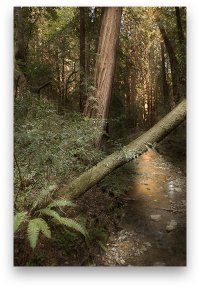
Um...no. Not even close. The attached HDR I did with three 5D (classic) RAW exposures manually composited. And not even the D800, I'm sure, would have had a hope of a chance at doing this with a single exposure. Notice the shadows under the fern in the lower left? That's at the bottom of Muir Woods. And notice the blue sky peeking through the top center? It's still blue.

Real world example is right here.

www.fredmiranda.com/5DIII-D800/index_controlled-tests.html

Just imagine it as a landscape.

I'm sure it wouldn't occur to Fred to try to make a print of either with the shadows pushed all the way to the midtones. And, if that's really the vision he had in mind, he'd have taken a second exposure for the shadows and composited it in -- just as I did in the attached shot.

You'll also notice that dynamic range was the only advantage Fred found that the Nikon had, and it had some other very crippling focus-related problems (and, frankly, laughably inferior glass) that kept him from using it for anything real.

In other words, it's the Canon, inferior DR and all, that's putting bread on his table and the Nikon that's good only for those JPEG snapshots you're referring to. And, as I've been pointing out everywhere, there's no visible resolution differences at 24" x 36".

Cheers,

b&
 

Attachments

  • Muir-Woods.jpg
    Muir-Woods.jpg
    166.4 KB · Views: 951
Upvote 0
LetTheRightLensIn said:
shooting distant birds (high density sensor puts more pixels per duck)

for making 13x19" or larger prints

shooting scenes with lots of dynamic range (IMO a huge difference here, this is the biggest difference)

I think you will find

- 22mp will be near enough native printing for A3 - 18x11 ish
- a dr of 12 will print the same as a dr of 14

I think you will find that 12mp images were printing very well on 30 x 24 using software to expand the image

If you are not close enough to birds with a large white then it is your field skills that need improving, not the camera. If you are a serious BIF shooter then the 5DIII is the wrong camera for you - and the D800 would be even worse.
 
Upvote 0
briansquibb said:
If you are a serious BIF shooter then the 5DIII is the wrong camera for you - and the D800 would be even worse.

Now you've got me wondering...I'd think the 5DIII would be second only to the not-yet-for-sale 1DX for BIF. I'd expect the 5DIII's new AF to trump even the 1DIV's framerate -- and, as you note, with a Big White, cropping shouldn't be a big deal.

On the other hand, I've not done any serious BIF (yet). So what's better than the 5DIII, presumably mounted to a 600 f/4, with or without the 1.4x, and why?

b&
 
Upvote 0
jrista said:
TrumpetPower! said:
Here's something I'd generally be interested in -- but, please, only reply if you have real-world experience, and not if you're only projecting your expectations from interpretations of an unfocused high-ISO macro shot of the inside of soWmebody's lenscap you saw posted on the 'Net.

In what real-world situation does the 5DIII have insufficient image quality for the job but the D800 does have sufficient IQ? That is, when would you put down the 5DIII and pick up the D800 instead of a medium format kit?

I personally can't think of any.

Cheers,

b&

Landscapes...in a heartbeat! The average sunset landscape can have a DR well above 12 stops, even above 14 stops. The more DR the better for landscape shots. Not that you will necessarily use all of it in the final product, but that you can always use the leeway when it comes to landscape shots. Being able to do even a touch of shadow recovery where necessary without encountering the color-blotched noise-infested pattern-ridden shadows that Canon is well-known for would be a godsend. Not to mention the improved sharpness on the D800e.

great pictures can be taken with ANY camera - I know people with cheap cameras that get amazing pictures without blowing thousands of dollars on bodies alone! they actually enjoy photography and don't waste time arguing over the interwebs over their toys!
 
Upvote 0
TrumpetPower! said:
I'll grant you that I haven't shot storms. I am, however, having a hard time imagining even a fast-moving storm that would have sufficient DR that you could use a shutter speed that won't move / blur in a single D800 exposure but that would be a problem with a single pair of 6FPS 5DIII exposures (with nearly twice the resultant DR of the single D800 exposure).

have a closer look at the example from a2bart from the other link.
1/1000s, f/5, ISO100.
that held the cloud hilites and motion in check. A push in post brought up the rest of the landscape and then other localized contrast and toning was used to embellish it.
That is a real-world example of a wide DR scene nicely squeezed into the DR of a print or display. An even wider DR could be accommodated using the same methods but only if the shadow noise level of the camera was low enough to not make a mess of it - as in the Fred Miranda example. You don't have to bring shadows up to midtones to see the noise from a camera like the 7D, you can leave them 3 stops below mid and there's still obvious banding.

When lively storms have clouds moving 100+ mph, trees thrashing around and all the foliage on the move, no camera's fast enough to capture 2 or more frames without serious movement artifacts to deal with in conventional multi-shot HDR. I've wasted plenty of time trying to bracket such scenes and put them together in post; results were not acceptable even in slower moving weather conditions. Not to mention re-curving a multishot HDR to try and get a natural feeling image is a hassle. IMO, you can get a much nicer result with a simple fill-light or shadows adjustment using Adobe's products. LR4 does this with minimal artifacting or halos and it takes about 15 seconds to do it. More complex toning control is available if needed.

No more multi-shot HDR silliness for me unless I need to capture more than 9 or 10 stops of DR and present them all. Even then, I'll likely get a better result from just one ETTR raw file from one of the quieter new Nikons (or older Canons) where the hilites aren't clipped.

TrumpetPower! said:
Um...no. Not even close. The attached HDR I did with three 5D (classic) RAW exposures manually composited. And not even the D800, I'm sure, would have had a hope of a chance at doing this with a single exposure. Notice the shadows under the fern in the lower left? That's at the bottom of Muir Woods. And notice the blue sky peeking through the top center? It's still blue.

Yes, not bad if you like that sort of look but again, multishot HDR has a hard time maintaining natural looking color and contrast. The shadow levels of that one could have been left a little lower too.
And I'd love to see what I can do with 1 shot from the D800 against a 3-shot HDR on the same scene. A nicer job in much less time, I'm thinking. :) Multishot HDR has its uses, but it's not needed if the camera can handle the scene without it. And that would be any scene where the camera's noise-free DR is at least one or 2 stops greater than the scene being shot. That means the D800 and D5100 are gonna give me 2 more stops to work with, in ONE shot, than anything from Canon at this time.

TrumpetPower! said:
You'll also notice that dynamic range was the only advantage Fred found that the Nikon had, and it had some other very crippling focus-related problems (and, frankly, laughably inferior glass) that kept him from using it for anything real.

yes, the nikon was hindered on Fred's shoot by inferior glass and a less then adequate live view mode, pity that latter especially as it's super useful on the Canons.
But to say the the better DR was the ONLY advantage the D800 had is like saying the only advantage one of these 2 motorized vehicles has is wings. Wings are pretty damn important if you intend to fly.

Glass is one thing causing me some consternation because Canon's latest TSE 17 and 24mm are on my wish list. Really wish there was something comparable for the D800 so I hope Samyang pulls a supermodel out of a cake with the 24mm F-mount version they're working on. Or maybe (chuckle) the 1DX will have a much lower noise pattern than the 5Ds...

TrumpetPower! said:
In other words, it's the Canon, inferior DR and all, that's putting bread on his table and the Nikon that's good only for those JPEG snapshots you're referring to. And, as I've been pointing out everywhere, there's no visible resolution differences at 24" x 36".

I'd be plenty happy with the rez from my 5D2 if I could push it more. The difference in rez is secondary for this purpose. I've printed 24x36" from my 40D that looks just fine with appropriate sharpening in post, and that's at nose-to-paper distances and ~100ppi. Getting 180+ppi at the same size would only look better at much closer to normal viewing distance. I'll take it if if I got it. :) No complaints about file size either. (NEF compressed raw isn't all that bad for size)

 
Upvote 0
TrumpetPower! said:
briansquibb said:
If you are a serious BIF shooter then the 5DIII is the wrong camera for you - and the D800 would be even worse.

Now you've got me wondering...I'd think the 5DIII would be second only to the not-yet-for-sale 1DX for BIF. I'd expect the 5DIII's new AF to trump even the 1DIV's framerate -- and, as you note, with a Big White, cropping shouldn't be a big deal.

On the other hand, I've not done any serious BIF (yet). So what's better than the 5DIII, presumably mounted to a 600 f/4, with or without the 1.4x, and why?

b&

The simple answer is the 1D4 - if pushed it can also cope with the 600 + 2x - and of course the 1.3 crop helps too.

The 1D4 rolls along at 10fps -the AF doesn't come into it. The 5DIII strolls along at 6fps (my low continuous speed on the 1d4)

The beauty of the 1D4 (and other series 1) is that wherever the AF point is is the place whee the metering is done, the 5DIII meters at the centre point. So with the 5DIII unless you are using centre point focussing you have to choose between correct metering or AF.

The 1D4 also has the option to manually set the shutter speed and the aperture with auto iso and also be able to set exposure compensation to get further refinements on metering. This isn't possible with the 5DIII

I think that you will find that there is so little in the AF speeds (40ms) that you wont notice the difference - this is one of those headline moments that means nothing in real life "5DIII AF faster than the mighty 1D4". Likewise with the D800 "you dont need long lens because you can get it from cropping" - providing that at 4fps you can capture the moment.

The 1D4 high speed burst is 28 images, the 5DIII is 18 images

I am talking here about the advantages of the 1D4 for sporting/birds/wildlife - not for the traditional 5D strengths of weddings/studio/landscape
 
Upvote 0
88 people voted - quite a nice feedback. Thank you.

Summarizing results:
1. They will work harder to get better results and follow the path they do now
2. They don't care and think 5d3 sensor is fine
3. They will run some marketing campaign to defend the results achieved with current 5d3 sensor
4. They will care a S___ and listen to pros who actually use cameras out in the field.

So we here rather think, that Canon finds 5d3 a good product and doesn't see a need to buy sensors form third party company but rather work harder.
What I find very important for us is also (no matter what we think about current gear prices) help Canon not to decrease income because of those comparisons. If sales decreases because of public not buying gear scared with tests, numbers and comparisons then we also will notice it in less money spent on R&D. Canon might not care for numbers and tests and listen to pros but the question is whether the public buying equipment will do it as well?
 
Upvote 0
briansquibb said:
TrumpetPower! said:
briansquibb said:
If you are a serious BIF shooter then the 5DIII is the wrong camera for you - and the D800 would be even worse.
(W)hat's better than the 5DIII (for BIF), presumably mounted to a 600 f/4, with or without the 1.4x, and why?
The simple answer is the 1D4 - if pushed it can also cope with the 600 + 2x - and of course the 1.3 crop helps too.

The 1D4 rolls along at 10fps -the AF doesn't come into it. The 5DIII strolls along at 6fps (my low continuous speed on the 1d4)

I can see how a faster framerate would be welcome for flying birds, to get the wings positioned exactly how you envision. But I'd have thought the repetitive motion of the wings alone would mean a sufficient number of shots with a good composition...and that you'd want the better autofocus to make sure that you have more in-focus shots to choose from.

The beauty of the 1D4 (and other series 1) is that wherever the AF point is is the place whee the metering is done, the 5DIII meters at the centre point. So with the 5DIII unless you are using centre point focussing you have to choose between correct metering or AF.

Really? Autoexposure with BIF? I'd have thought the way to go is with an incident meter. This is outdoors, right? Except for fast-moving partial cloud cover, the light's not changing. I mean, if these birds were in the trees I could understand...but "flying" implies "out in the open," right? You want great metering for weddings where you're shooting in all directions and every subject is in different light. But for shooting in a single direction from a fixed location outdoors? I don't think it'd even occur to me to check what the camera thought the exposure should be. Even if you don't have a meter, that's what your gray card is for.

The 1D4 high speed burst is 28 images, the 5DIII is 18 images

Yes, but both represent half a minute of continuous shooting. Are you really going to be machine-gunning for thirty seconds straight without letting your finger off the trigger even once? This is still photography we're talking about, not the movies.

I am talking here about the advantages of the 1D4 for sporting/birds/wildlife - not for the traditional 5D strengths of weddings/studio/landscape

Me, too. And, frankly, the only real advantage I can personally think of for the 1D4 is for its framerate...and that again can go away if the 5DIII gets more frames-in-focus per second even if the 1D4 has some additional frames-not-in-focus thrown in the mix for a higher total frames-per-second. Obviously, I haven't compared the two and I don't recall seeing anybody else doing a side-by-side comparison.

Cheers,

b&
 
Upvote 0
TrumpetPower! said:
I am talking here about the advantages of the 1D4 for sporting/birds/wildlife - not for the traditional 5D strengths of weddings/studio/landscape

Me, too. And, frankly, the only real advantage I can personally think of for the 1D4 is for its framerate...and that again can go away if the 5DIII gets more frames-in-focus per second even if the 1D4 has some additional frames-not-in-focus thrown in the mix for a higher total frames-per-second. Obviously, I haven't compared the two and I don't recall seeing anybody else doing a side-by-side comparison.

Well, there is also the extra reach of the 1D4 with its APS-H sensor. That is something people keep seeming to forget about with all the new FF cameras flying about, but high density cropped sensors really do have something extra to offer that FF can't touch. Reach is everything when it comes to birds/BIF/wildlife, and you get a hell of a lot more bang for your buck with a cropped sensor and a middle-grade lens.
 
Upvote 0
Status
Not open for further replies.