
You are using an out of date browser. It may not display this or other websites correctly.
You should upgrade or use an alternative browser.
You should upgrade or use an alternative browser.
Patent: Canon Tilt-Shift with Image Stabilization
- Thread starter Canon Rumors
- Start date
Patience, patience. They just innovated the TS-macro idea by looking at the H-system, it will take some time and iterations until it's other benefits make the same transition.Jeff said:I personally would find it more useful if Canon's TSE lenses could communicate with the image's metadata file so post lens correction such as CA could be accurately applied.

Of course I understand that for flower photographers the IS could be desired by them.
For macro work you have all kinds of motion induced problems, with anything along the depth axis becoming dominant as magnification increases. That has some implications: Subject motion as well as the placement of the focal plane become a major issue. The most useful tools the deal with those would be a short flash duration and some sort of sharpness mask in LV, with stabilization solving only a low priority subset of the challenges.
Upvote
0
Product and food photographers already use the TSE 90 for close-up work, with or without extension tube. I am TS-naive, understanding the principle (same as large format), but have not used on small format. I know that many experienced close-up / macro photographers can create image stacks hand-held by setting shutter on fast burst and moving camera forward a millimeter or two during the captures. I have tried this for flowers and it does work, more or less.
Upvote
0

keithcooper
Canon Rumors Premium
It's very much one of Canon's 'ideas type' patents rather than for example a specific lens design formula.
Perhaps Canon has been looking at how the TS-E90 gets used, for ideas...
Whilst looking at unusual lenses, I'd like to see a telecentric version of something like the MP-E65 as well
BTW Using my TS-E17 handheld a lot has definitely helped my ability to visualise the whole (shifted) shot and see any slight errors in camera pointing, even when using a tripod.
So much so, that I incorporate using it (or the 24mm) hand held into training courses - I've found it helps some people 'get it' more easily wrt shift and tilt. It's interesting to see what use of T/S 'works' for different people. Such training work also helps me when writing articles and the like, to come up with alternate ways of explaining.
Perhaps Canon has been looking at how the TS-E90 gets used, for ideas...
Whilst looking at unusual lenses, I'd like to see a telecentric version of something like the MP-E65 as well
BTW Using my TS-E17 handheld a lot has definitely helped my ability to visualise the whole (shifted) shot and see any slight errors in camera pointing, even when using a tripod.
So much so, that I incorporate using it (or the 24mm) hand held into training courses - I've found it helps some people 'get it' more easily wrt shift and tilt. It's interesting to see what use of T/S 'works' for different people. Such training work also helps me when writing articles and the like, to come up with alternate ways of explaining.
Upvote
0

AcutancePhotography said:I should have been more specific in my question: How common is it to use tilt with a T/S lens hand held?
It's not particularly difficult; as you say the degree of tilt amplifies the declination of the focal plane, but generally hand-held you're shaking the camera vertically ( heave ) but not so much in pitch.
What I'd love to see from Canon would be a modular tilt-shift family; one common T/S mechanism module that mounts to the camera, perhaps holding the IS unit, and then a range of actual lens units that attach to it. Rather like using medium format lenses with T/S adapters on 35mm cameras today.
Then they could upgrade the optics separately from the mechanism. Of course that's why they'll never do it, looking at how much $$$ they earned in the 24mm Mk I to II upgrade.
Upvote
0
keithcooper
Canon Rumors Premium
StudentOfLight said:Maybe if we had focus peaking in an EVF then handheld tilt could be reliable.
I use the small printed tilt tables I keep in my camera bag - perfectly reliable, subject to my ability to estimate distances if I don't have a tape measure (it's in the same bag as tripod bits).
http://www.northlight-images.co.uk/article_pages/using_tilt.html
EVFs - not yet thanks, I'm still fine with my 1Ds3 optical VF.
Using the rear screen for focus involves me getting my glasses out, which depends on me having them with me...

Upvote
0
I shoot over half my images with TS-lenses, 999/1000 times on a tripod. If I apply shift or tilt, I sure wont hand-hold the camera. IMO that will produce sloppy images, at best, requiring much work in post.
If I am going to/have to hand-hold the camera I prefer using 85/50/24mm normal lenses. I dont see the point using TS lenses this way...
Sindre Ellingsen
If I am going to/have to hand-hold the camera I prefer using 85/50/24mm normal lenses. I dont see the point using TS lenses this way...
Sindre Ellingsen
Upvote
0
degos said:\What I'd love to see from Canon would be a modular tilt-shift family; one common T/S mechanism module that mounts to the camera, perhaps holding the IS unit, and then a range of actual lens units that attach to it.
That sounds like a pretty good idea. I wonder what the technical difficulties would be with that? You would lose infinity if you used a standard lens, but I wonder if a family of lenses specifically designed for this modular attachment could be cost effective?
Upvote
0
keithcooper
Canon Rumors Premium
Sindre Ellingsen said:I shoot over half my images with TS-lenses, 999/1000 times on a tripod. If I apply shift or tilt, I sure wont hand-hold the camera. IMO that will produce sloppy images, at best, requiring much work in post.
If I am going to/have to hand-hold the camera I prefer using 85/50/24mm normal lenses. I dont see the point using TS lenses this way...
Sindre Ellingsen
Well I seriously disagree
Even more heretically, I regularly do up/down stitches of two shots with the 17mm...
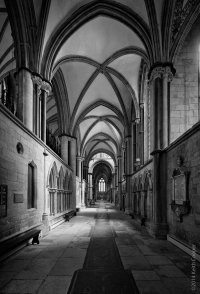
I do take a tripod with me when I'm on paying work, and I can see how I really should when I'm visiting cathedrals, given the 'sloppy results' you can easily get hand held ;-) [Lincoln Cathedral TS-E17]
Ho hum, it seems that YMMV...
Attachments
Upvote
0
Hi Keith, long time between drinks, yeah!
Yes! Its clearly obvious that you need to upgrade from that 'LENSBABY', "sloppy results" n' all... ;D
I keep hearing "Pentax" when I read the Tread Tittle. Ho Hum 8)
Yes! Its clearly obvious that you need to upgrade from that 'LENSBABY', "sloppy results" n' all... ;D
I keep hearing "Pentax" when I read the Tread Tittle. Ho Hum 8)
Upvote
0
Different strokes for different folks. But I do not pretend to know how everyone uses each piece of equipment they own nor will I make blanket statements about what types of results shall come from using them a certain way simply because I do not do it myself.
That being said, I know plenty of full-time photogs that use TSE lenses exclusively handheld. The only time I or any of them uses a tripod is for subject matters that have line distortion which needs to be corrected for. Otherwise, the goal for many of us is simply to alter the plane of focus so that we can get multiple parts (at different depths) of the frame in focus with large apertures which would normally not be possible with non tilting lenses.
Also, I've gotten good enough with both ovf, evf, and rear lcd lv that I don't have any issues with "sloppy" images due to inability to focus intentionally on what I want. When I adapt the TSE lenses to mirrorless bodies, this becomes even easier as I can just follow the line of peaking.
On the other hand, there are also a slew of photogs out there that simply use it to cause blur which could theoretically just be replicated in post. Something I think is a waste of TSE. But as I have stated previously, different strokes for different folks. If you and the people looking at your images are happy, who am I to judge? lol.
That being said, I know plenty of full-time photogs that use TSE lenses exclusively handheld. The only time I or any of them uses a tripod is for subject matters that have line distortion which needs to be corrected for. Otherwise, the goal for many of us is simply to alter the plane of focus so that we can get multiple parts (at different depths) of the frame in focus with large apertures which would normally not be possible with non tilting lenses.
Also, I've gotten good enough with both ovf, evf, and rear lcd lv that I don't have any issues with "sloppy" images due to inability to focus intentionally on what I want. When I adapt the TSE lenses to mirrorless bodies, this becomes even easier as I can just follow the line of peaking.
On the other hand, there are also a slew of photogs out there that simply use it to cause blur which could theoretically just be replicated in post. Something I think is a waste of TSE. But as I have stated previously, different strokes for different folks. If you and the people looking at your images are happy, who am I to judge? lol.
Upvote
0
keithcooper said:Sindre Ellingsen said:I shoot over half my images with TS-lenses, 999/1000 times on a tripod. If I apply shift or tilt, I sure wont hand-hold the camera. IMO that will produce sloppy images, at best, requiring much work in post.
If I am going to/have to hand-hold the camera I prefer using 85/50/24mm normal lenses. I dont see the point using TS lenses this way...
Sindre Ellingsen
Well I seriously disagree
Even more heretically, I regularly do up/down stitches of two shots with the 17mm...
I do take a tripod with me when I'm on paying work, and I can see how I really should when I'm visiting cathedrals, given the 'sloppy results' you can easily get hand held ;-) [Lincoln Cathedral TS-E17]
Ho hum, it seems that YMMV...
Well, maybe I drink too much...
My statement about sloppy results, are in regards to my own experience and (lack of)results when shooting with no tripod. Some shots may work out, but a majority wont.
In a complex multiple shot scene, with subjects ranging from 50cm to infinity, I find hand-holding irrational. It may work if I shoot it many times over, and spend triple the time in post. For less complex scenes I will still use a tripod, just to make sure it wont give me problems in post.
In contrast to your example: A 3x5 image shifted panorama:
http://www.flickr.com/photos/sindreellingsen/18203908338
If I did this hand held, the change of roll, pitch, yaw and forwards/backwards motion of the camera would ruin the final image, or make it really hard to assemble. Carrying a tripod is not that hard, so why not.
Spaces where tripods are considered weapons of mass destruction, is another matter
Upvote
0
keithcooper
Canon Rumors Premium
Sindre Ellingsen said:Well, maybe I drink too much...
...
If I did this hand held, the change of roll, pitch, yaw and forwards/backwards motion of the camera would ruin the final image, or make it really hard to assemble. Carrying a tripod is not that hard, so why not.
Spaces where tripods are considered weapons of mass destruction, is another matter
I did say I usually took a tripod on paying work - hand holding my gigapan is something I'm still working on though...
The example you give is hardly something I'd shoot hand held, whilst the cathedral shot has no close foreground to cause any parallax issues.
Sorry, but carrying a tripod when I'm just out and about is a right pain in the rear. I virtually never use one for any landscape work. As I said though ... YMMV ;-)
Upvote
0
Similar threads


- Replies
- 4
- Views
- 2K
- Replies
- 27
- Views
- 8K

- Replies
- 6
- Views
- 2K

- Replies
- 26
- Views
- 8K