Perseid Meteor Shower. Share your photos.

Here's my image and my story....

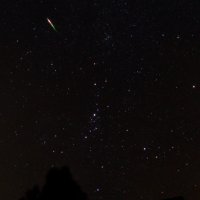
When I heard about the Perseid meteor shower I decided early on that I wanted to try and shoot it from the summit of Mount Evans in Arapaho National Forest. I mainly do long exposure star trails, but I thought I'd try some shorter-exposure high-ISO work with the 5D3 to get "frozen" stars with a meteor streak in the the shot. That requires a lot of luck, I know, but I set out none the less with this goal in mind.

I spent most of yesterday getting my gear ready, charging batteries, testing speedlights, getting the color gels laid out that I would use, etc. I even got my cold weather gear out since I knew the summit would be chilly.

The clear sky charts were questionable, but a clearing was indicated between 1am - 4am, so I thought I'd go for it. I set out early, around 9:30pm, and I'm glad I did. The base of Mount Evans is about an hour from Denver, and then there's the summit road to drive. I forgot how dicey that summit road is, and in the middle of the night, the sheer drop-offs make for quite a white knuckle drive. I think the 14-mile summit access road took me an hour alone.

When I got to the top, I immediately started setting up my gear and taking some shots. The sky was clear, and I didn't want to waste it. Good thing too - because within about 40 minutes heavy clouds rolled in and the rest of the night was a bust. The shot below is my favorite of about only 12 photos I took last night. This is by far the fewest number of photos I've ever taken given the amount of preparation and driving I did.

Even with only one good photo to show for my efforts, it was well worth it....

perseid900.jpg
 
Upvote 0
justsomedude said:
Here's my image and my story....

When I heard about the Perseid meteor shower I decided early on that I wanted to try and shoot it from the summit of Mount Evans in Arapaho National Forest. I mainly do long exposure star trails, but I thought I'd try some shorter-exposure high-ISO work with the 5D3 to get "frozen" stars with a meteor streak in the the shot. That requires a lot of luck, I know, but I set out none the less with this goal in mind.

I spent most of yesterday getting my gear ready, charging batteries, testing speedlights, getting the color gels laid out that I would use, etc. I even got my cold weather gear out since I knew the summit would be chilly.

The clear sky charts were questionable, but a clearing was indicated between 1am - 4am, so I thought I'd go for it. I set out early, around 9:30pm, and I'm glad I did. The base of Mount Evans is about an hour from Denver, and then there's the summit road to drive. I forgot how dicey that summit road is, and in the middle of the night, the sheer drop-offs make for quite a white knuckle drive. I think the 14-mile summit access road took me an hour alone.

When I got to the top, I immediately started setting up my gear and taking some shots. The sky was clear, and I didn't want to waste it. Good thing too - because within about 40 minutes heavy clouds rolled in and the rest of the night was a bust. The shot below is my favorite of about only 12 photos I took last night. This is by far the fewest number of photos I've ever taken given the amount of preparation and driving I did.

Even with only one good photo to show for my efforts, it was well worth it....

perseid900.jpg

Great picture under adventerous conditions! At which ISOs do you shoot nightsky regularly? While shooting with my 30D yesterday night at Iso 800 I just made up my mind to go definitely for a 5D3. Moonless or small crescent moon nightsky shots don't produce very usable material at these Isos. Especially if you aim for the Milky Way. As I really like to take these pictures, I kinda feel the limits gearwise. Which are the highest ISO you shoot at? 3200, 6400 or higher? Thanks for any hints. Cheers, Peter
 
Upvote 0
pedro said:
Great picture under adventerous conditions! At which ISOs do you shoot nightsky regularly? While shooting with my 30D yesterday night at Iso 800 I just made up my mind to go definitely for a 5D3. Moonless or small crescent moon nightsky shots don't produce very usable material at these Isos. Especially if you aim for the Milky Way. As I really like to take these pictures, I kinda feel the limits gearwise. Which are the highest ISO you shoot at? 3200, 6400 or higher? Thanks for any hints. Cheers, Peter

Thanks, Pedro, Victor and Brett!

This was really the first time I had attempted to do "frozen" stars with my 5D3. I've done them on my 7D with an f/2.8 Tokina lens at lower ISOs with some decent results. But the fastest lens I have for my 5D3 is my 17-40 f/4L. Being limited to f4 on the widest end, I really had to push the ISO up to 6400 with a 30 second exposure. 30 seconds is about as long as you can go at 17mm before you start seeing star movement. Even on this image, at original size, you can see the stars slightly blurred from the earth's rotation. Even with this reduced size version, you can still see some movement blur on the stars in the far right of the frame.

So to answer your question, the ISO 6400 leaves a little to be desired from a noise/potential-print standpoint, although it's workable with heavy NR in post. If I were to do this again I'd rent an f/2.8 lens, so I could drop a few stops in ISO and get a cleaner result.

On a side note, I started doing astrophotography on my 40D. As long as you stay below ISO 400, and don't mind star trails, you'll get results plenty clean enough for printing from your 30D!
 
Upvote 0
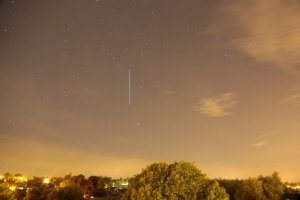
I raced home from a wedding reception, busted out my T3i w/ the kit lens. Sadly, it's widest angle I have. (I could pop the 24-105 on, but I'd loose filed of view. (Tried to buy the Tokina 11-16mm earlier in the week but the local places are sold out. Grrr.)

A couple of test exposures later I settled for 18mm, f3.5, ISO1600, 30 seconds. Set the magic lantern interval at 30 secs.

Unfortunately, I didn't realize the lens had started to get covered in condensation after a few dozen shots. I only got two usable frames and even they are a bit dodgy.

Tried to go buy those hand warmers. Impossible to find in the middle of the summer.

I picked up a microwaveable gel pack, I'll keep nuking it and putting it back on the lens tonight.

[me=Frost]crosses fingers for clear skies.[/me]

Enjoy.


IMG_2148.jpg by MRG Photo, on Flickr


IMG_2154.jpg by MRG Photo, on Flickr
 
Upvote 0
I'm gonna post some in a week , I work in the Great Noth of Quebec and here it,s almost aaaaaaaalways cloudy, but tonight was a special exception with beautiful Aurora Borealis ( we have a lot at this time of the year) and some HUGE perseids ( I was only able to have one a picture tough).
 
Upvote 0
Here's my result. This is in the cloudy & humid deep South Sunday AM, before the moon came up.

This was a multiple exposure (30 seconds each, over several hours), and I picked the best seven shots that had meteors in them. Hopefully they're meteors anyway, they were well under 30 seconds in exposure each, so probably are.

One clean background from the set, and seven composite layers of meteors.
 

Attachments

  • stacked-streaks.jpg
    stacked-streaks.jpg
    174.6 KB · Views: 1,733
Upvote 0
justsomedude said:
pedro said:
Great picture under adventerous conditions! At which ISOs do you shoot nightsky regularly? While shooting with my 30D yesterday night at Iso 800 I just made up my mind to go definitely for a 5D3. Moonless or small crescent moon nightsky shots don't produce very usable material at these Isos. Especially if you aim for the Milky Way. As I really like to take these pictures, I kinda feel the limits gearwise. Which are the highest ISO you shoot at? 3200, 6400 or higher? Thanks for any hints. Cheers, Peter

Thanks, Pedro, Victor and Brett!

This was really the first time I had attempted to do "frozen" stars with my 5D3. I've done them on my 7D with an f/2.8 Tokina lens at lower ISOs with some decent results. But the fastest lens I have for my 5D3 is my 17-40 f/4L. Being limited to f4 on the widest end, I really had to push the ISO up to 6400 with a 30 second exposure. 30 seconds is about as long as you can go at 17mm before you start seeing star movement. Even on this image, at original size, you can see the stars slightly blurred from the earth's rotation. Even with this reduced size version, you can still see some movement blur on the stars in the far right of the frame.

So to answer your question, the ISO 6400 leaves a little to be desired from a noise/potential-print standpoint, although it's workable with heavy NR in post. If I were to do this again I'd rent an f/2.8 lens, so I could drop a few stops in ISO and get a cleaner result.

On a side note, I started doing astrophotography on my 40D. As long as you stay below ISO 400, and don't mind star trails, you'll get results plenty clean enough for printing from your 30D!

@justsomedude: Thank you for answering. You are right, I really get fine results on my 30D below ISO 400 shooting star trails. At full moon the same ISOs work for frozen stars as well. Going 5D3 I will use my 28 / 2.8 then until I have a WA zoom lens. Althoug the field of view will remain a bit narrowed due to the optics. Maybe ISO 3200 is a workable ISO. Combined with the 2.8 I get the extra stop in comparison to the 3.5 crop lens. Hoping for clear nights in late fall to check that out. Milky Way is always at "its best" then. Cheers and thanks again.
 
Upvote 0
justsomedude said:
I mainly do long exposure star trails, but I thought I'd try some shorter-exposure high-ISO work with the 5D3 to get "frozen" stars with a meteor streak in the the shot. That requires a lot of luck, I know, but I set out none the less with this goal in mind.
Nice, I like the colour of the meteor, you don't see too many of these. A method to improve your odds is of course to take many short exposures sequentially. There should be about 1 meteor per minute (for the whole sky), so it shouldn't take too long to capture one in your field of view, on average only a few minutes total exposure time.

This year was unfortunately clouded out for me, but I have one from 2010 that also showed nice colour. The green light at the start of the trail is due to heated magnesium or copper, while atmospheric oxygen and nitrogen are responsible for the red colour at the end. In the background you see the constellation of Perseus.
5D2 and 24/1.4L II.
 

Attachments

  • Perseid.jpg
    Perseid.jpg
    82.9 KB · Views: 1,365
Upvote 0
Excellent work guys. Im really wanting to get into this. I only have a 35L that might be appropriate. Is this going to be wide enough? Also how do you set focus? Do you set it manually to infinity? With a 30 sec exposure will the camera capture alot more stars than the eye can see? Thanks!
 
Upvote 0
Apply the "rule of 600" for this type of photo. Divide 600 on your focal, for example 600:24= 25 seconds, which is the longest shutter you can use without seeing trails.

the 35 would give you 17 seconds, so you might need a pretty high iso, but helped a huge amount by the 1,4 aperture.
 
Upvote 0
I wasn't able to get out for any shots this year, but i too have shots of the ISS. That's currently my thing. As for focusing, the first time i manually set it to infinity then dialed it back the slightest bit. it was okay, but i've gotten better results leaving it at infinity. i'd like to try manually focusing using the magnified live view, but i'm either so hard pressed for time, or i actually forget that my camera can do it. the the 5dmk3 is my current camera. the 5d had been my most current camera and i forget about some of the bells and whistles i now have access to. I've mostly been shooting around f2.8/f4 iso800 30sec, usually always to the stop at the wide end of my 16-35. I adjust for clouds and ambient light and stuff. when i want longer exposures i use my kitchen timer! I just can't bring myself to drop another dime on something like that(the fancy timer release), besides at 30sec+ what's the difference between 40 seconds or 42?I've been back and forth for a long while now about selling my 16-35 to fund a 24mm 1.4, but so far haven't as there are lots of things the zoom can do that the 24 can't. either way it's a compromise, and so far i've just stayed put. so if i post a few ISS shots here under the meteor heading i won't get a spanking?
 
Upvote 0
Risc32 you should look at the shutterboss: http://www.bhphotovideo.com/c/product/749827-REG/Vello_RC_C2_ShutterBoss_Timed_Remote_for.html

I have 5d3 + 16-35 as well, I have noticed some vingetting on the wide end as well. There is a huge difference between 30 and 40 some odd seconds based off the previously mentioned rule of 600. I'm in the same boat as you selling 16-35 for 24 1.4, I am still on the line but I'm leaning towards keeping 16-35. The reason? 16mm. Yes its 2.8 and not as sharp as the 1.4 but 16mm is too good for stars.

I'm looking into magic lantern and seeing if its supported on the 5d3 since they have a built in intervelometer.
 
Upvote 0