It looks like they just posted their review:
http://www.photozone.de/canon_eos_ff/877-canon_1635_4is
http://www.photozone.de/canon_eos_ff/877-canon_1635_4is

From this review I would say that it leaves enough space for an improved 16-35 f/2.8 - in version III or a 12/14-24 f/2.8mackguyver said:It looks like they just posted their review:
http://www.photozone.de/canon_eos_ff/877-canon_1635_4is

Mt Spokane Photography said:Its just a interesting observation, but I've noticed that a little improvement to a lens not only comes at a big jump in price, but also size and weight. One can see why its not f/2.8. It might be extremely expensive and huge.
I have the f/2.8 version, so size, cost, and weight wise there would be little advantage.
At f/4, the new lens is definitely better, but at f/5.6 or smaller, where much of the use comes, the main difference is the IS, and, as noted, it appears to affect the resolution when used. And, I can use f/2.8 when needed, and its very good in the center, but soft at the edges and bad in the corners.
I'd say go for the f/4 if you are buying a new one.
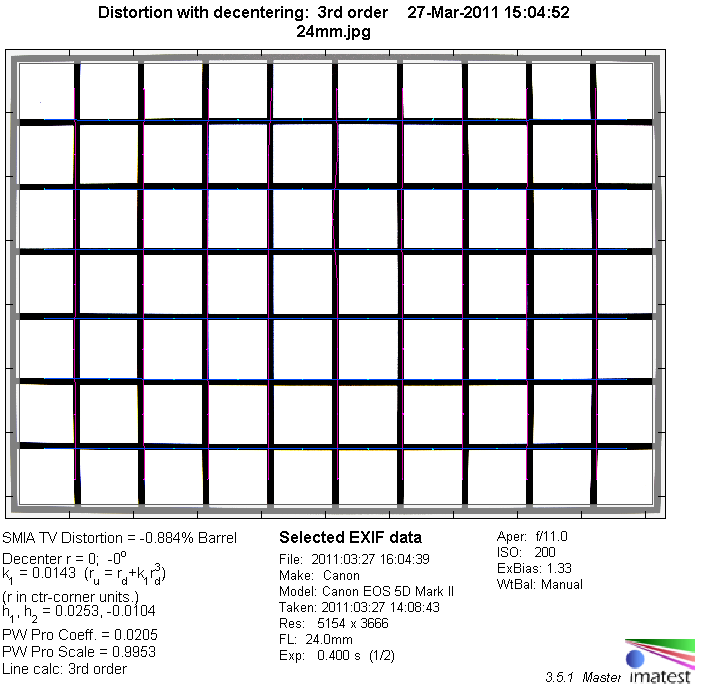
9VIII said:The most interesting thing for me is that it's basically distortion free at 24mm. I have to wonder why they can manage that in a zoom lens when I have never seen a 24mm (or basically any wide angle lens) with no distortion.
You'd think that would be a higher priority given how much architecture gets shot with these.
(If I didn't already have the Sigma 18-35f1.8 I would probably be getting a 16-35f4 IS.)
mackguyver said:It looks like they just posted their review:
http://www.photozone.de/canon_eos_ff/877-canon_1635_4is

mackguyver said:I started my 16-35 f/4 IS vs 24L, 24-70 II, TS-E 17, TS-E 24 II comparison today with a set of infamous brick wall photos. I'm happy to say that all of the lenses are very sharp and control CA well. The 16-35 f/4 IS has tons of contrast and compares very well to the 24-70 II. Distortion at 16mm is a bit worse that I'd hoped, but soon DxO and others will have profiles. Vignetting is also rather bad in the extreme corners wide open, but stopping down helps a lot.
Tomorrow I'll give them a test with exterior building shots and over the coming weeks, I'll add lots more to my review. More to come...
100 said:9VIII said:The most interesting thing for me is that it's basically distortion free at 24mm. I have to wonder why they can manage that in a zoom lens when I have never seen a 24mm (or basically any wide angle lens) with no distortion.
You'd think that would be a higher priority given how much architecture gets shot with these.
(If I didn't already have the Sigma 18-35f1.8 I would probably be getting a 16-35f4 IS.)
If you go from barrel distortion to pincushion distortion there will always be a point in-between the two where there is almost no distortion.
The TS-E 24mm f/3.5 L II doesn't have much distortion so there are good (24mm) wide angle primes.
9VIII said:100 said:9VIII said:The most interesting thing for me is that it's basically distortion free at 24mm. I have to wonder why they can manage that in a zoom lens when I have never seen a 24mm (or basically any wide angle lens) with no distortion.
You'd think that would be a higher priority given how much architecture gets shot with these.
(If I didn't already have the Sigma 18-35f1.8 I would probably be getting a 16-35f4 IS.)
If you go from barrel distortion to pincushion distortion there will always be a point in-between the two where there is almost no distortion.
The TS-E 24mm f/3.5 L II doesn't have much distortion so there are good (24mm) wide angle primes.
That is a spectacular lens, but a $2,000 manual focus small aperture non-IS non-weather sealed lens isn't quite what I was thinking of.
They could take this exact lens formula at 24mm, remove the zoom capability, and you'd have one of the best 24mm prime lenses on the market. That just sounds wrong to me.
LetTheRightLensIn said:9VIII said:100 said:9VIII said:The most interesting thing for me is that it's basically distortion free at 24mm. I have to wonder why they can manage that in a zoom lens when I have never seen a 24mm (or basically any wide angle lens) with no distortion.
You'd think that would be a higher priority given how much architecture gets shot with these.
(If I didn't already have the Sigma 18-35f1.8 I would probably be getting a 16-35f4 IS.)
If you go from barrel distortion to pincushion distortion there will always be a point in-between the two where there is almost no distortion.
The TS-E 24mm f/3.5 L II doesn't have much distortion so there are good (24mm) wide angle primes.
That is a spectacular lens, but a $2,000 manual focus small aperture non-IS non-weather sealed lens isn't quite what I was thinking of.
They could take this exact lens formula at 24mm, remove the zoom capability, and you'd have one of the best 24mm prime lenses on the market. That just sounds wrong to me.
24 1.4 II and 24 2.8 IS also have low distortion at 24mm
9VIII said:They could take this exact lens formula at 24mm, remove the zoom capability, and you'd have one of the best 24mm prime lenses on the market. That just sounds wrong to me.
9VIII said:Maybe sort of? The 16-35f4IS is achieving nearly zero distortion, nothing else comes close except the 24mm TS-E.
It just looks like one of those things that can be done but no-one bothers.
9VIII said:100 said:9VIII said:The most interesting thing for me is that it's basically distortion free at 24mm. I have to wonder why they can manage that in a zoom lens when I have never seen a 24mm (or basically any wide angle lens) with no distortion.
You'd think that would be a higher priority given how much architecture gets shot with these.
(If I didn't already have the Sigma 18-35f1.8 I would probably be getting a 16-35f4 IS.)
If you go from barrel distortion to pincushion distortion there will always be a point in-between the two where there is almost no distortion.
The TS-E 24mm f/3.5 L II doesn't have much distortion so there are good (24mm) wide angle primes.
That is a spectacular lens, but a $2,000 manual focus small aperture non-IS non-weather sealed lens isn't quite what I was thinking of.
9VIII said:They could take this exact lens formula at 24mm, remove the zoom capability, and you'd have one of the best 24mm prime lenses on the market. That just sounds wrong to me.
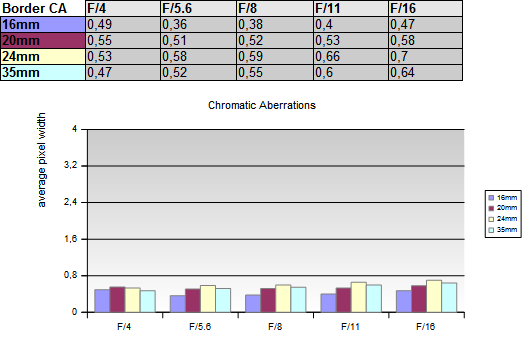
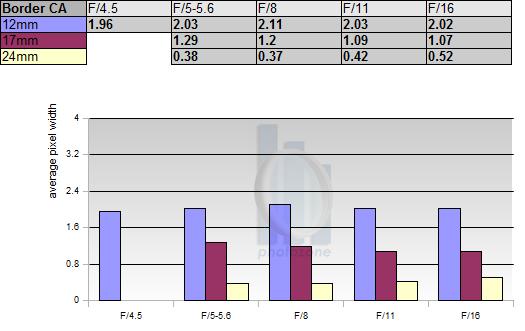
100 said:At 24mm the EF 16-35mm might be nearly distortion free but it also has the worst border and corner resolution wide open at 24mm and it has the worst chromatic aberrations throughout the aperture range.
Image distortion is not the only factor in image quality. With good lens profiles minor image distortion is not a big deal.

neuroanatomist said:9VIII said:They could take this exact lens formula at 24mm, remove the zoom capability, and you'd have one of the best 24mm prime lenses on the market. That just sounds wrong to me.
9VIII said:Maybe sort of? The 16-35f4IS is achieving nearly zero distortion, nothing else comes close except the 24mm TS-E.
It just looks like one of those things that can be done but no-one bothers.
I'm sure it could be done. Would you pay $1199 for a 24mm f/4 IS prime lens with nearly no distortion? Maybe you would, but you'd be in a fiscally irrelevant minoroty as far as Canon is concerned.
neuroanatomist said:9VIII said:They could take this exact lens formula at 24mm, remove the zoom capability, and you'd have one of the best 24mm prime lenses on the market. That just sounds wrong to me.
9VIII said:Maybe sort of? The 16-35f4IS is achieving nearly zero distortion, nothing else comes close except the 24mm TS-E.
It just looks like one of those things that can be done but no-one bothers.
I'm sure it could be done. Would you pay $1199 for a 24mm f/4 IS prime lens with nearly no distortion? Maybe you would, but you'd be in a fiscally irrelevant minoroty as far as Canon is concerned.
raptor3x said:I thought I had a good copy of the Tokina 16-28 but Photozone's results show their copy as being significantly superior to both the 17 TS-E and 16-35 IS at the wide end in terms of corner resolution. This was definitely not my experience.
LetTheRightLensIn said:100 said:At 24mm the EF 16-35mm might be nearly distortion free but it also has the worst border and corner resolution wide open at 24mm and it has the worst chromatic aberrations throughout the aperture range.
Image distortion is not the only factor in image quality. With good lens profiles minor image distortion is not a big deal.
16-35 f/4 IS at 24mm has less CA of all types (including longitudinal purple fringing) than the 24 1.4 II or 24 2.8 non-IS (I don't know about the 24 IS CA; I know the 24 T&S II has low CA)