Post Your Comet Pictures

Should be very close to the crescent moon tonight 400mm or 600mm is the way to go. Just watch the exposure times due to star trailing. The longer lenses will enhance the movement.

TrumpetPower! said:
I've been at the Grand Canyon the past couple nights and never saw a thing. Seeing how small it is in those 800mm shots, I can understand why...even if it actually is in the shots I took, it wouldn't be more than a few pixels.

So...I know to definitely plan on setting up the 400 with the 1.4x tonight, and to not bother with anything other than the 70-200 on the other body for the "wide"-angle shot. Bummer...I was hoping to have more of the Canyon in the shot. Maybe I'll set up the 70-200 on a pano head....

b&
 
Upvote 0
East Wind Photography said:
Should be very close to the crescent moon tonight 400mm or 600mm is the way to go. Just watch the exposure times due to star trailing. The longer lenses will enhance the movement.

Thanks for that.

I'll be shooting tethered and / or chimping on the rear LCD...but remind me...what's that rule of thumb again for star trails and focal length v shutter speed...?

One thing I've been meaning to try out, and was going to try out tonight with Andromeda regardless, was using stacking to do some deep-ish sky stuff without a tracking mount for the tripod. The idea is to go ahead and shoot up to 25,600 ISO if need be to get the non-trailed exposure, but shoot a whole hell of a lot of frames, align them in Photoshop, and use the average blend mode to get rid of the noise. And then track the object manually. So, yes, I'll be cropping a fair amount around the edges because I'm not going to be perfect at tracking, but that's okay. I might even make use of that, and leave the edges ragged for artistic effect....

Cheers,

b&
 
Upvote 0
People, you have posted lovely pictures! It is so light polluted here! I cant get a shot so close to the horizon... Well, may be the next comet... and by that time Canon should have the f8 focus fix for five-D3 (absolutely arbitrary alliteration).

;)
 
Upvote 0
You can focus on the cresent moon or jupiter using live view...either AF or manually and then swtch the lens to manual focus and dont touch it.

rpt said:
People, you have posted lovely pictures! It is so light polluted here! I cant get a shot so close to the horizon... Well, may be the next comet... and by that time Canon should have the f8 focus fix for five-D3 (absolutely arbitrary alliteration).

;)
 
Upvote 0
East Wind Photography said:
You can focus on the cresent moon or jupiter using live view...either AF or manually and then swtch the lens to manual focus and dont touch it.

Gaffer's tape is awesome for preventing focussing shifts from "oops" types of causes. Just be sure that focus doesn't shift as you tape down the ring!

b&
 
Upvote 0
East Wind Photography said:
You can focus on the cresent moon or jupiter using live view...either AF or manually and then swtch the lens to manual focus and dont touch it.

rpt said:
People, you have posted lovely pictures! It is so light polluted here! I cant get a shot so close to the horizon... Well, may be the next comet... and by that time Canon should have the f8 focus fix for five-D3 (absolutely arbitrary alliteration).

;)
May be I'll give it a shot tomorrow. Worst case I'll get just the crescent moon...
 
Upvote 0
TrumpetPower! said:
East Wind Photography said:
You can focus on the cresent moon or jupiter using live view...either AF or manually and then swtch the lens to manual focus and dont touch it.

Gaffer's tape is awesome for preventing focussing shifts from "oops" types of causes. Just be sure that focus doesn't shift as you tape down the ring!

b&
Knowing me, not touching the lens is a better idea...
 
Upvote 0
I actually made an effort to inspect the western sky at dusk couple of days ago...granted orange flare and city scape overwhelmed everything... but there was a brilliant streak from a jet trail, but no comet that I could see. Oh well.
 
Upvote 0
No real rule of thumb as it depends on the camera. Crop factor will increase the trailing.

TrumpetPower! said:
East Wind Photography said:
Should be very close to the crescent moon tonight 400mm or 600mm is the way to go. Just watch the exposure times due to star trailing. The longer lenses will enhance the movement.

Thanks for that.

I'll be shooting tethered and / or chimping on the rear LCD...but remind me...what's that rule of thumb again for star trails and focal length v shutter speed...?

One thing I've been meaning to try out, and was going to try out tonight with Andromeda regardless, was using stacking to do some deep-ish sky stuff without a tracking mount for the tripod. The idea is to go ahead and shoot up to 25,600 ISO if need be to get the non-trailed exposure, but shoot a whole hell of a lot of frames, align them in Photoshop, and use the average blend mode to get rid of the noise. And then track the object manually. So, yes, I'll be cropping a fair amount around the edges because I'm not going to be perfect at tracking, but that's okay. I might even make use of that, and leave the edges ragged for artistic effect....

Cheers,

b&
 
Upvote 0
The following link will send you to the stardate.org website viewing guide for the comet along with a diagram of it's location in the sky over the next several days: http://stardate.org/mediacenter/March2013_CometPanstarrs

In Austin, Texas it started to come into view at about 8:20 PM CST Monday. It is my understanding that tonight it should be a little higher and appear several minutes later. If you have older eyes like me, I would recommend using binoculars to help find it. I kept looking just above the horizon, but it was actually higher than I expected. I was fortunate to have an astronomy buff with me who had watched it the night before and who brought out his star viewing rig to observe it. I must say, I am pretty good at finding things when someone has me look through their binoculars which are mounted on a tripod and locked on to the object.

Good luck.
 
Upvote 0
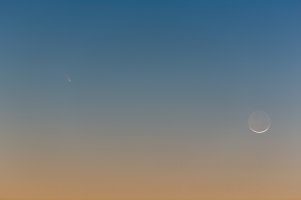
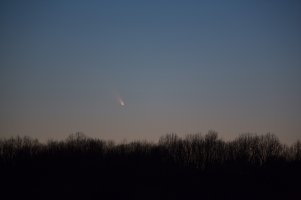
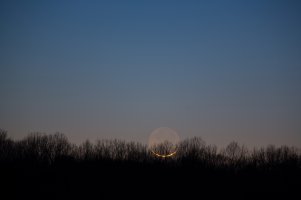
Clear air tonight. Used my 5DIII

#1 - 300mm f/2.8L shot at F4 ISO400 2 seconds
#2 - 300mm + 1.4xiii f/4 ISO1000 2 seconds
#3 - 300mm + 1.4xiii f/4 ISO1600 2 seconds
#4 - Too enticing not to get this one too
 

Attachments

  • comet  1950 130312-4.jpg
    comet 1950 130312-4.jpg
    361.6 KB · Views: 1,429
  • comet  1958 130312-2.jpg
    comet 1958 130312-2.jpg
    502.7 KB · Views: 1,459
  • comet  2004 130312-1.jpg
    comet 2004 130312-1.jpg
    410.7 KB · Views: 1,400
  • moon 130312-1.jpg
    moon 130312-1.jpg
    387.6 KB · Views: 1,468
Upvote 0
No worries. Though it will fade some in the coming weeks it will also be higher in the sky and have a darker background. It will be a binocular object through most of April so still possible to photograph. What was special tonight was it's proximity to the moon which I was hoping would have been a bit closer. 300mm was about the most you could go with a full frame camera and still get both in the frame.

Rest up your knee and shoot when you are up for it.

emag said:
I have 2cameras, 3 scopes and great western horizon......and just spent the day in ER after my knee blew out at work. Can't even stand up, let alone take a photo. Maybe in a few days. Murphy has struck.
 
Upvote 0
I used my 70-200mm tonight on the shore of Lake Travis outside Austin and got a few shots.

original.jpg


original.jpg
 
Upvote 0
East Wind, I like your first and second ones best. Also very good earthshine on the moon. Hopefully I can get a few shots, probably with my 135, or 85.

Here's one I shot of the Orion Nebula about a year ago. There's star trailing, but you can still see it. 10 seconds with 400 f/5.6L and crop camera (roughly 600mm equivalent), ISO 800. It was still very under-exposed...so got a lot of banding and chrominance noise when I lifted it in post, but I tried to take some of the noise out.
 

Attachments

  • Orion Nebula, March 2012, 400mm, 9374.JPG
    Orion Nebula, March 2012, 400mm, 9374.JPG
    19.9 KB · Views: 1,164
Upvote 0