Primes for wildlife ...

I do around 4 Safari trips a year to different parts of Africa, each trip anywhere between 2 weeks and as long as 6 weeks, 2013 I've spent 3 months on Safari in Africa.

If you intend/need to do a reasonable amount of Travel to get to where you intend to use the gear, consider your carry on baggage and what restrictions are going to apply, as Photographers we tend to think like Gun People, what gear always at the top of the list, the rest we feel we can take care of.

In Africa most Airlines strictly apply 8Kgs as a bench mark for carry on, I Fly Business Class where ever I can & that allows 11Kgs, on Main Airlines you won't be able to book an empty seat, but I do that on the small Charter flights between airports & the Camps, that allows me to carry more than the 20Kgs the smaller flights will restrict you to. Never ever ever ever etc, Check in Camera gear within Africa, it's a huge Business in stolen Camera gear in this Continent, won't make any difference who you Fly with, all the African airlines have the same issue, they simply cannot control theft from checked in Baggage, it's a total lottery.

Which brings me to Insurance, complete must if Travelling in Africa, don't leave home without it. Now Lenses.

The 300f/2.8 L II goes where ever I go, always. This is the absolute fastest focussing & sharpest Lens Canon make in my experience, works absolutely well with the III Series 1.4x Converter, pretty good with the 2x. But, you need to be able to get close, in most South African situations it's the perfect Lens, generally a lot of bush, Animals are generally closer due to the amount of bush. Completely hand holdable and I almost never use it on a Tripod or Monopod.

The 400f/2.8 L II is another superb Lens, I recently sold mine, but I've been extremely Happy with this Lens both in it's series 1 form and later when i upgraded to the series 2 version. But, it's still heavy, so expect to be using it for your best shots on a tripod or a monopod. I used to always carry as standard kit the 300 + 400 and 1.4x converter. 1.4x works amazingly well on this Lens, the 2x a little soft.

600f/4 L II, superb, just a brilliant lens, lovely weight, best shots again from a Tripod or monopod, crisp & sharp. 1.4x works just amazingly well on this Lens, the 2x a little soft. I use this Lens only when I'm scheduling to Safari in the Serengeti (Tanzania) or the Masai Mara (Kenya), the Lens needs large open spaces to be worth carrying, but if you have the open areas with Wildlife further away, this is the lens to have.

As soon as the 200-400f/4 was released I was about the first in Asia (Singapore) to get one, haven't for a moment regretted getting it, just a brilliant lens. Being able to to zoom to fill the frame 200-560 f/4 to f/5.6, my Imaging has taken a leap forward, way less cropping to get the right shot, close enough at 560 f/5.6 to be just about perfect. Light enough to hand hold for short periods, but gets heavy quick, used mostly again on Tripod/Monopod or bean bag. But, you give up light, it doesn't sound like a lot, but going from the 300/400 f/2.8 Lenses to a f/4 has required an adjustment, mostly now I shoot at minimum ISO400 as a Base where I may have shot a lot with the 300/400 at ISO200 as a base, but I feel the adjustment has been worthwhile. Major added advantage with this Lens is you don't need to change out converters, it's a flip of the switch in/out, that simple, huge benefit in lost shots, dust on the sensor etc, when I use the 600 + 1.4x I generally set the Lens like that onto a 1Dx Body and that's how it stays, I'de love to see a 600 with the Converter assembly of the 200-400f/4.

My standard rig now is 300f/2.8 + 200-400f/4 for places like Botswana, South Africa, Zambia, Namibia. If the Serengeti or Masai Mara it's those + the 600 and generally a hassle with Airline Carry On rules, which I either circumvent with bringing my son/s, extra seats where possible, pay off the check in person for a tag to allow the extra carry on.

All of these Lenses work exceptionally well with the 5DMK III or the 1 Dx, but, you will miss the 12 fps of the 1 Dx on Safari, nothing quite like it, the 5DMK III at 6 fps is Ok, but (there's always a but) it can't compete with the 1Dx, for Safari, the 1Dx is the Safari tool with spades.

I hope this helps, what ever you decide you can't go wrong with any of these Lenses, enjoy your Imaging.
 
Upvote 0
eml58 said:
I do around 4 Safari trips a year to different parts of Africa, each trip anywhere between 2 weeks and as long as 6 weeks, 2013 I've spent 3 months on Safari in Africa.

If you intend/need to do a reasonable amount of Travel to get to where you intend to use the gear, consider your carry on baggage and what restrictions are going to apply, as Photographers we tend to think like Gun People, what gear always at the top of the list, the rest we feel we can take care of.

In Africa most Airlines strictly apply 8Kgs as a bench mark for carry on, I Fly Business Class where ever I can & that allows 11Kgs, on Main Airlines you won't be able to book an empty seat, but I do that on the small Charter flights between airports & the Camps, that allows me to carry more than the 20Kgs the smaller flights will restrict you to. Never ever ever ever etc, Check in Camera gear within Africa, it's a huge Business in stolen Camera gear in this Continent, won't make any difference who you Fly with, all the African airlines have the same issue, they simply cannot control theft from checked in Baggage, it's a total lottery.

Which brings me to Insurance, complete must if Travelling in Africa, don't leave home without it. Now Lenses.

The 300f/2.8 L II goes where ever I go, always. This is the absolute fastest focussing & sharpest Lens Canon make in my experience, works absolutely well with the III Series 1.4x Converter, pretty good with the 2x. But, you need to be able to get close, in most South African situations it's the perfect Lens, generally a lot of bush, Animals are generally closer due to the amount of bush. Completely hand holdable and I almost never use it on a Tripod or Monopod.

The 400f/2.8 L II is another superb Lens, I recently sold mine, but I've been extremely Happy with this Lens both in it's series 1 form and later when i upgraded to the series 2 version. But, it's still heavy, so expect to be using it for your best shots on a tripod or a monopod. I used to always carry as standard kit the 300 + 400 and 1.4x converter. 1.4x works amazingly well on this Lens, the 2x a little soft.

600f/4 L II, superb, just a brilliant lens, lovely weight, best shots again from a Tripod or monopod, crisp & sharp. 1.4x works just amazingly well on this Lens, the 2x a little soft. I use this Lens only when I'm scheduling to Safari in the Serengeti (Tanzania) or the Masai Mara (Kenya), the Lens needs large open spaces to be worth carrying, but if you have the open areas with Wildlife further away, this is the lens to have.

As soon as the 200-400f/4 was released I was about the first in Asia (Singapore) to get one, haven't for a moment regretted getting it, just a brilliant lens. Being able to to zoom to fill the frame 200-560 f/4 to f/5.6, my Imaging has taken a leap forward, way less cropping to get the right shot, close enough at 560 f/5.6 to be just about perfect. Light enough to hand hold for short periods, but gets heavy quick, used mostly again on Tripod/Monopod or bean bag. But, you give up light, it doesn't sound like a lot, but going from the 300/400 f/2.8 Lenses to a f/4 has required an adjustment, mostly now I shoot at minimum ISO400 as a Base where I may have shot a lot with the 300/400 at ISO200 as a base, but I feel the adjustment has been worthwhile. Major added advantage with this Lens is you don't need to change out converters, it's a flip of the switch in/out, that simple, huge benefit in lost shots, dust on the sensor etc, when I use the 600 + 1.4x I generally set the Lens like that onto a 1Dx Body and that's how it stays, I'de love to see a 600 with the Converter assembly of the 200-400f/4.

My standard rig now is 300f/2.8 + 200-400f/4 for places like Botswana, South Africa, Zambia, Namibia. If the Serengeti or Masai Mara it's those + the 600 and generally a hassle with Airline Carry On rules, which I either circumvent with bringing my son/s, extra seats where possible, pay off the check in person for a tag to allow the extra carry on.

All of these Lenses work exceptionally well with the 5DMK III or the 1 Dx, but, you will miss the 12 fps of the 1 Dx on Safari, nothing quite like it, the 5DMK III at 6 fps is Ok, but (there's always a but) it can't compete with the 1Dx, for Safari, the 1Dx is the Safari tool with spades.

I hope this helps, what ever you decide you can't go wrong with any of these Lenses, enjoy your Imaging.

Wow!!!! Many thanks for the very detailed info!!!! :)
 
Upvote 0
xROELOFx said:
I'm not really sure if this is helpfull, but something to consider is AF speed. To me this is the main difference between primes, primes + extenders or (big)zooms. Primes are just faster at it. Once you put an extender on, it will be slower. But, with small or shy subjects like birds, the longer reach you have the better.

If this AF speed really matters depends on the subject and what 'pose' you want to photograph. If your subject is stationary or does not move a lot (or moves slow), a smaller prime + extender can be excellent. For fast moving subjects you of course want fast AF. So a longer prime would be the better choice.

If that subject tends to move from/towards you often (and fast), a zoom like the new 200-400 would be a good choice as well. Since you can zoom in/out to get the subject in your FOV, it's easier to get a full body shot. With a prime you're stuck at that focal length, this can sometimes mean parts or your subject are cut off.

A nice trick I like about zooms is that it makes finding a subject easier: zoom to 200mm to get the subject in your sight, then quickly zoom to 400mm (or 560 or whatever with extender) to get the wanted framing. Finding a subject wich moves quick can be pretty difficult at the longer focal lengths, wich will often result in cut off parts like missing wing tips or worse. I have a whole collection of an eagle catching a fish who got too close :(

So it really depends on what you want to shoot, where you're taking the pics, and of course your personal skills and preferences. Good luck anyway :)

I really wish Canon would have made a 400-600 zoom instead of 200-400. I have yet to encounter something that fills the frame on my 400f5.6, and given the amount of cropping I was doing with my 800mm mirror lens it seems like 800-1600mm would be the ideal focal length for birds. That said, I'm sure the 200-400 is absolutely brilliant for pretty much everything but birds.
Anyway, here's hoping the 800f5.6Mk2 has a built in 2xTC.
 
Upvote 0
Wow, I guess I am in the minority here using the 500 f4. I use it and 300 2.8, but I also shoot sports, so the 500 f4 and 300 2.8 combo is more versatile for me.

Man, it must be nice to have access to all that equipment. I may take out a loaner from CPS for the 400 2.8 II and 600 II.

To the OP. Are you a CPS member? If so, do a loaner to see which is best for you.
 
Upvote 0
DaveMiko said:
I am in the process of deciding which prime to get, for the time being, to use for wildlife. I have my mind set on the 300 f2.8 IS II, but I was wondering: What's the difference, practical and theoretical, between this lens and, say, the 400 f2.8, the 500 f4 , the 600 f4? The obvious answer would be the different focal lengths and, of course, price tag. But is there anything else that is significant, as far as the differences between them are concerned?! ??? ::)

The difference between the 300/2.8 L II and the 600/4 L II is massive. Both are phenomenal lenses, don't get me wrong, but if/when you need extra reach, the 600/4 can be paired with a 2x TC for 1200mm of bliss. Keep in mind that subject size in frame is the square of the difference in focal length. So, a 600mm lens will result in the subject being four times larger in frame. With that TC, the subject is 16 times larger in frame.

At the very least, 600mm is often the difference between needing to crop and not. With 1200mm, it is sometimes the difference between scaring off your subject, and getting the perfect shot. I have recently been trying to photograph coyotes hunting prairie dogs. At 600mm, you have to be pretty close to frame the shot nicely, and get good detail. Coyotes are always on the move, and they KNOW when they are being followed. They will even use tactics like splitting up the group in order to lead the photographer astray, so they can hunt in peace. At 1200mm, you can stay back at a relatively comfortable distance without losing the quality your looking for.

It really depends on what you want to shoot, and how much you want/can handhold. There is no question that the 300mm f/2.8 L II is a superb hand-holdable lens, and quite versatile with TCs with 420mm f/4 and 600mm f/5.6 options. If your primary subject is deer, elk, moose, etc. then the 300mm should be ideal. If you like to photograph more elusive subjects, like coyote or mountain goat and the like, then I would recommend the 500mm or 600mm lens and both the 1.4x and 2x TCs. Not only are goats and canines and similar animals smaller than your average deer, then often tend to be more wary and maintain a greater distance, so extra focal length really helps.

Even in the case of deer, 600mm at a moderate distance gets you some amazing detail. This photo of a doe in the shadows of a tree at sunset was shot hand-held with the EF 600mm f/4 L IS II. I'd never seen this kind of quality and detail in a deer's fur coat from the distance I was standing until I took this shot:

E2XAQ3n.jpg


Click for full size (warning, its retina size, 2880x1800, so quite large).
 
Upvote 0
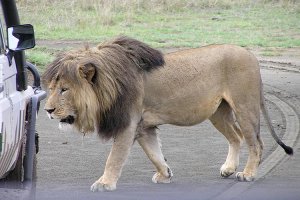
They get much closer than that....on one trip in Sabi Sabi, one Lion actually rubbed up against the legs of the tracker sat on the front wing!

Mention was made earlier of the thieving at airports. I have first hand experience.....
Flying back from The Kruger to Jo'burg on SAA, I had no choice but to put my camera bag on their trolley to put in the hold because the flight was full and their wasn't any room on board. At Jo'burg the bag didn't appear and I was told it would be on the next flight but I had seen it being loaded so I stood my found on the runway at Jo'burg. The pilot got involved, other crew too. Pilot did a personal search of the hold, nothing. I made it quite clear that I wasn't leaving the runway until they had found the $30K worth of kit and....surprise surprise, it mysteriously appeared after being found in the area reserved for pets in transit. Hidden out of site for obvious reasons....

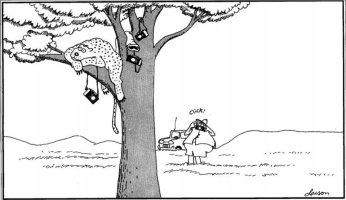
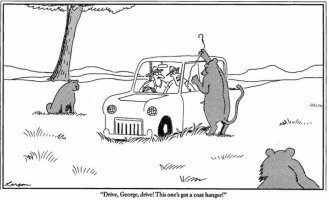
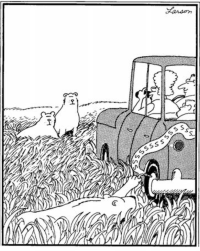
The Farside clip was cute, but they really did come quite close to the Land Rovers...
[/quote]
 
Upvote 0
I experienced this too. You never know. It is like the lions (hyenas, not so much Jackals), and even sometimes cheetah s seem to not even notice a vehicle or anyone in it. I think it is important for that reason to have two bodies with long and short lenses. Sorry, a bit off topic.

sek
neuroanatomist said:
Methodical said:
Don Haines said:
neuroanatomist said:
In the Ngorongoro Crater, the lions came close enough for a 16-35mm to work fine.
Thanks for the laugh.

The Farside clip was cute, but they really did come quite close to the Land Rovers...
 
Upvote 0
neuroanatomist said:
Methodical said:
Don Haines said:
neuroanatomist said:
In the Ngorongoro Crater, the lions came close enough for a 16-35mm to work fine.
Thanks for the laugh.

The Farside clip was cute, but they really did come quite close to the Land Rovers...
Being as you are still here posting, I guessed that you were inside the vehicle :)
 

Attachments

  • farside06.jpg
    farside06.jpg
    62.3 KB · Views: 836
  • Farside12.png
    Farside12.png
    459.5 KB · Views: 873
Upvote 0
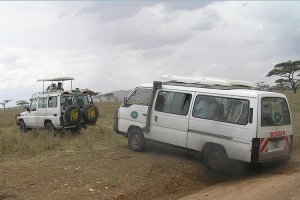
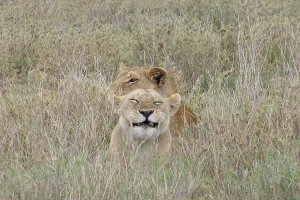
One more tip - at least in Tanzania, there are Land Rover safaris and minivan safaris. Choose an outfitter that uses Land Rovers. If you're in a minivan, you may need help from one of the 'real' safari vehicles. We found it amusing, so did the nearby lionesses.
 

Attachments

  • Need a Tow.jpg
    Need a Tow.jpg
    55.5 KB · Views: 860
  • Smile.jpg
    Smile.jpg
    100.7 KB · Views: 878
Upvote 0
neuroanatomist said:
Wildlife is, by definition, wild - you usually can't get all that close.
Unless you stand really still and they just walk right by you, like this little one did the other day while I was shooting Pelicans in flight. He was about 6-7 feet away (as you can see from the angle). This is the @600mm (300 2.8 IS II + 2x III), ISO 6400, 1/500s on my 5DIII, processed with the new DxO 9 PRIME. Killer combo on all fronts (forgive the white balance):
St_Marks_NWR_20131110_3058_DxO-L.jpg


neuroanatomist said:
Personally, I'll likely get the 300 II at some point soon. However, while that's partly as a more portable bird/wildlife lens, it's main use will be sports, since my older daughter is now starting to participate in several.
I find it a killer combo with the teleconverters and as you say, it can be used for sports, landscapes, and many other things as well. I have hand held it 99% of the time no matter the light.

To the OP, I find 600mm enough reach for most wildlife, because most of what I shoot is either close enough for 600mm or way too far for an 800mm + 2x. Being able to drop down to 300mm is great for closer subjects as well, and I hear the 300 + extenders/extension tubes also make it a great macro lens for less than 1:1 work. To me, it's versatility and price trumped the other options. I'll happily rent a 600mm for trips and other occasions, though.
 
Upvote 0
I find the 300 2.8 works well with the TC's both the 1.4 and the 2.

it's a light way to carry from 300mm to 600mm. But it takes a while to swap so you have to be ahead of the game.

I have a 100-400 and a 70-200. The 100-400 is good for wild life but not the standard of the 300. The 70-200 is a great lens and works well with the 2xTC. But of course neither of them are primes.

I've not used the 500 or 600, and of course they can be used with TC's for even more range.

If I was going to get any other lens it would be the 200 -400, and I know you didn't ask about primes but I bet its a really useful lens.
 
Upvote 0