Proper way to store lens

I use a soft-sided fishing reel case to house lenses at home, particularly vintage lenses without their own cases. $25.00, holds up to 10 lenses depending on diameter, has adjustable gray fabric covered dividers, a sewn on handle, and a decent zipper. The case just gets put on a shelf. The longest lenses stay in their original cases (L lenses or Sigma lens). Thus the lenses are protected from dust. The two or three most commonly used lenses sit in the most commonly used camera bag along with the camera, shutter release, polarizer, microfiber cloth, and other essentials (plastic bag for rain; sealed "clif bar". Now, I don't live in an extremely humid climate, and the nylon lens cases and fishing reel holder are permeable. Tiny lenses (bellows lenses: microscope and enlarger lenses) are kept in a plastic box along with a calcium carbonate moisture absorber.
 
Upvote 0
Talys said:
I'm going to put a plug in for SKB with thinktank dividers :)

The SKB cases are very nice, and the thinktank dividers are very thoughtful. They're much thinner than Pelican, which can be both good and bad -- Pelican dividers are not very adjustable and are so thick that they take up a ton of space, with the tradeoff that they provide more protection. The ThinkTank dividers, I think, protect enough protection, and let me cram in a lot more stuff.

The lid organizer is also a great price on these, and really well designed, compared to the pelican ones. There are also SKBs where the inside is a removable zippered container with shoulder strap, or backpack (by ThinkTank), neither of which are exhorbitantly expensive.

I'm not a fan of the cut-it-up-yourself dividers or the pluck foam, because I tend to reorganize my storage quite often -- as I buy more storage or as my gear changes.

+1

I keep finding storage answers with ThinkTank gear. I shoot with the padded belt and a couple PeakDesign Capture Clips, then add a ThinkTank pouch as needed. The "go bag" is a ThinkTank Airport Commuter where I typically keep two bodies, one with a short zoom and one with a long zoom, ready to go for the next event.

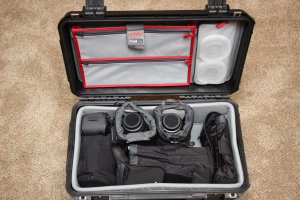
For the extra gear, I invested in an SBK hard case with the ThinkTank dividers. But, I don't use the dividers. This case is mainly for storage at home and only occasionally for travel. Instead of the dividers, I store lenses in ThinkTank lens pouches as in the photo below. This photo shows two short zooms in padded pouches, a long white zoom (with hood) in a skin pouch, a flash in a skin pouch, and 5D3 with the attached 24-70 in a pouch.

This has been far more flexible than fixed dividers. If I travel, I just take what I need and use knee pads and/or a hand towel for extra padding. (The knee pads have become standard shooting attire and the towel can be handy on location.)
 

Attachments

  • IMG_2575.JPG
    IMG_2575.JPG
    1.5 MB · Views: 173
Upvote 0
I keep mine on an airtight plastic container (think of a giant tupperware container, but the brand I use is Biokips). The lenses are usually separated according to lens type: one container for the prime lenses, one for telephoto zoom lenses and the teleconverters, one for the wide zoom lenses, one for the cameras and finally one for batteries, chargers, memory cards etc. Inside each container I keep a hygrometer (I live in a very humid place) and a Eva-Dry dissecant. I try to keep relative humidity between 30% and 60%.
 
Upvote 0
Always store stuff below 60% RH, above that and fungus can grow. You can get indicator cards like this:

https://www.ebay.co.uk/i/281843583742?chn=ps&adgroupid=13585920426&rlsatarget=pla-142405564146&abcId=&adtype=pla&merchantid=115075915&poi=&googleloc=1006976&device=c&campaignid=207297426&crdt=0

My gear is stored in my lowpro bag.. and kept in the dryest part of the house.. our bedroom as it has the bigger dehumidifier in there (we have two plus a small HRV), all going 100% most of the time it just about keeps the humidity down to the mid 50s (I live in soggy britain) anything less than 50% humidity here is unheard of, we go weeks at a time with humidity never falling below 80%. I gave up on dessicant as I was having to cook it so often.
 
Upvote 0
Hi guys! I need your comment on this. I have some lenses that I need to store but have to clean em first. I have read this guide and I want your feedback if it is accurate
https://www.adorama.com/alc/bags-cases-pouches-picking-a-means-for-carrying-and-storing-your-gear. Thanks!
 
Upvote 0
If you have a Canon 50mm F1.4 USM lens, manually rotate the focus on the lens so it retracts fully, after you turn your camera off.
This lens has a particularly sensitive focus motor which is easily damaged if hit on the front element.
 
Upvote 0
shane.haumpton said:
Hi guys! I need your comment on this. I have some lenses that I need to store but have to clean em first. I have read this guide and I want your feedback if it is accurate
https://www.adorama.com/alc/bags-cases-pouches-picking-a-means-for-carrying-and-storing-your-gear. Thanks!
The link doesn't work for me. Takes me to a Adorama Learning Center menu page. I spent a few minutes trying to locate the referenced article, but gave up.
 
Upvote 0
Based on my observations over many camera stores, it seems to me that most lens (especially telephoto) are stored horizontally.

So I store all my lens in a horizontal fashion in a dry cabinet with caps on.

If there is a good sun, I would take out the lens and remove the caps to "sunbathe" the glass elements (be careful not to focus the rear to material that are flammable) .

My setting for the humidity is 40~50%

When transportation, the lens are usually in a vertical fashion. (I am using TT Digital Holster 40v2 or a shoulder bag)

when I change lens during shooting, I would drop the lens into the TT Large Lens Drop In (with Hood and no front cap), take another lens, remove the rear cap, mount the new lens and take the rear cap to cover the dropped lens before storing away the dropped lens to other pouches.

:P
 
Upvote 0