
Question about Canon Lens Quality, Sir

surapon

80% BY HEART, 15% BY LENSES AND ONLY 5% BY CAMERA
Aug 2, 2013
2,957
6
29,406
76
APEX, NORTH CAROLINA, USA.
Dear Teachers and Friends.
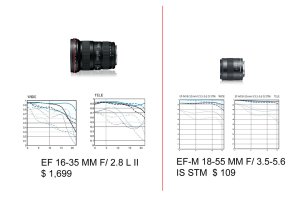
Just bother my low level brain , that why some canon cheapest lens is sharper ( According to the Charts) than the High end " L " lens---Yes, I know that This L Lens is Faster Lens.
Yes, I just order My New toy EF -M 18-55 mm F/ 3.5 - 5.6 IS STM = $ 109 US Dollars for my new toy EOS-M--For the Low Price, I think that this Lens is Cheap and No good at all, But, When I compare with His Bigger Brother EF 16-35 mm F/ 2.8 L II ( $ 1699)---Per Canon Chart, This Cheapo is Sharper than the High cost one. Am I wrong ?----May Be my Brain not working to night.
Yes, I know---We can not compare the Slow Lens and Faster Lens-----BUT, My Canon EF-M 22 mm. F/ 2.0 is not bad at all, yes , less sharper at the center( 9.0 compare to 9.5), but sharper at the corners.
MAY BE MY WRONG THINKING OF THE POOR BRAIN is drive me crazy.
Please, I need your Help to correct me if I wrong. Yes, If I take the Photo at High F stop at F = 8.0 in the day time, Bright Sun Shine at ISO = 100, Am I right that The Cheapo EF-M 18-55 mm is Sharper all of the Picture include all corners = ???
Thousand Thanks, Sir.
Surapon
 

Attachments

  • C-1.jpg
    C-1.jpg
    91.4 KB · Views: 1,674
I suspect you are right, but we're merely talking about choosing horses for courses. Compared with designing a normal zoom for an APS-C sensor, the complexities of designing a 16-35 lens to cover a FF sensor, where you are essentially wanting good image quality across a sensor with about three times the area, with a wider aperture make it a sgnificantly harder optical challenge. It shouldn't be a big shock that a lens designed specifically for an APS-C sensor performs as well or better than a lens designed with a FF sensor in mind. As metioned above, people don't get the full benefit of the "L".

Still, I wouldn't discount the use of "L" lenses entirely. In addition to sharpness, there is also light gathering, bokeh, weather sealing etc to consider. I used to love how my 70-200 performed on my 30D. (But then, I was never a fan of my 17-40 + 30D combo and picked up a 10-22 pretty quickly. Maybe there is a FF wide angle zoom problem?)
 
Upvote 0
Hillsilly said:
I suspect you are right, but we're merely talking about choosing horses for courses. Compared with designing a normal zoom for an APS-C sensor, the complexities of designing a 16-35 lens to cover a FF sensor, where you are essentially wanting good image quality across a sensor with about three times the area, with a wider aperture make it a sgnificantly harder optical challenge. It shouldn't be a big shock that a lens designed specifically for an APS-C sensor performs as well or better than a lens designed with a FF sensor in mind. As metioned above, people don't get the full benefit of the "L".

Still, I wouldn't discount the use of "L" lenses entirely. In addition to sharpness, there is also light gathering, bokeh, weather sealing etc to consider. I used to love how my 70-200 performed on my 30D. (But then, I was never a fan of my 17-40 + 30D combo and picked up a 10-22 pretty quickly. Maybe there is a FF wide angle zoom problem?)

I have the same experience. My 17-40 on the 7D never impressed me. I also bought then the 10-22 which is doing a great job on the 7D. I even tought about selling the 17-40 at that time. After buying the 5Diii, my opinion changed however for the 17-40. That 17-40 is so much better on the 5Diii, also the 24-105 performance is better on the 5Diii.

It seems to me that the "L" versions do not allways get the max on APS-C sensors. However, my 70-200 is great on both devices. For a crop sensor I would never suggest to buy a 17-40, but do use the 10-22.

@ Mr Surapon: If the conditions are good then your 18-55 might do a great job or even a better job than the 16-35, however if conditions are worse (low light), the combo of 16-35 with a FF will be much beter.

Francois
 
Upvote 0
Hillsilly said:
Maybe there is a FF wide angle zoom problem?

It's just really hard to design such a good lens given constraints on cost and size/weight. Canon's 16-35L II is a decent lens, far from stellar. It's a little better than the 17-40L. The Nikon 14-24/2.8 is better, but far from perfect (the D800 + 14-24 landscape sample shot I saw on Nikon's own website had pretty mushy corners).

If you want corner-to-corner sharpness in a wide or ultrawide focal length, consider the TS-E 24L II or TS-E 17L. Of course, one reason those lenses are so sharp is that, like using an EF lens on APS-C, you're using only the central 'sweet spot' of an image circle much larger than the sensor. When you get toward the maximum tilt or shift of the TS-E lenses, you lose some of the IQ benefit.
 
Upvote 0
I am too impressed with the quality of that "kit lens". I see two reasons why it has very good percepted sharpness:
(1) For a mirrorless system you can place the last lens where you need it. Most SLR wide angle (zoom) lenses are strong retrofocus constructions to keep the mirror area clear. Having more freedom in lens element placement gives you more options for a good overall correction of aberrations.
(2) A lot of aberration correction is done in camera or used as a preset for e.g. DPP. Perhaps this lens was developed with post processing in mind to correct aberrations.

Just my 2ct. Best - Michael
 
Upvote 0
There is also the issue of the design generation - the STM lens is much newer, and there has been more experience in computer-aided design.

The 18mm of an APS-C lens corresponds to the view of a 27mm lens on full frame. 28 mm FF lenses are pretty easy to design. 16mm FF lenses are more difficult to design. Full frame zooms incorporating 16mm are even more difficult to design, particularly those that retain filter rings. Remember that to the designer there is no such thing as a "perfect" lens, just a lens with optimal compromises on price, weight, center sharpness, corner sharpness, aperture, bokeh, coma, chromatic aberrations, flare resistance, etc.

For the time being, I have gone the prime route for full frame, with a current line up of Samyang 14mm f/2.8 manual focus lens, Zeiss 21mm f/2.8 manual focus lens (a dream lens, sharp at f/2.8 out to the corners, great color and microcontrast, I was a lucky dog to find a used copy at the time I was ready to shell out for the 6D plus lens), Sigma 35mm f/1.4 , and some 40 year old legacy lenses in the 50-60mm range and 105-135mm range, my favorites being the Nikkor 50mm f/1.2 AIS and Mamiya-Sekor 60mm f/2.8 macro and Nikkor 105mm f/2.5 AIS, with adapters of course. The M42 lenses were mine from my film days, the Nikkors were from my father's film days. It is a reasonable landscape kit, but the manual focus manual aperture lenses are a PITA for action.
 
Upvote 0
takesome1 said:
Dear Surapon,

The chart for the 16-35 reflects the IQ out to the corners of a FF.
That is why the lower part of the chart goes to 20.
Where the M is only showing the crop and stops after 13.
You would need to compare only a portion of the chart on the 16-35.

Thank you, Sir, Dear Mr. takesome1.
Wow, I learn some thing New again to day.
Surapon
 
Upvote 0
takesome1 said:

Thanks you, Sir, Dear Mr. takesome1
Ha, Ha, Ha, My Old eyes are bad , when i move to the right, I see the Cheaper Lens EF-M is sharper than " L " Lens.
Yes, My Bad / poor quality eyes.
Surapon
 
Upvote 0
candc said:
I tried an ef-s 18-55 stm on an sl1 and was really impressed with how good it was. I understand that the ef-m 18-55 stm is really good also. I am sure that you will be pleased with it, especially considering its $109!

Dear Mr. candc
Thanks, Your Good Thinking for this EF-M, make me feel Better.
Yes, Sir, When I have free time on this weekend, I will try to compare with " L " Lens same Focal Length and report back to you.
Have a great weekend, Sir.
Surapon
 
Upvote 0
Mt Spokane Photography said:
You pay a lot of $$$ for that wider aperture, and for the red ring. That's why I often recommend that crop camera users should get a EF-s lens and not a "L" lens. They are not getting the full benefit of the "L".

Ha, Ha, Ha-----Dear Teacher Mr. Mt Spokane. You are 1,000 % Right---We just pay the money for the " RED RING" and the Wider Aperture of the Bigger Glass.
Well, For my self, Because of Now, Canon Cameras have a great Usable High ISO with Less Digital Noise than 5-8 years ago. Not many time that I need Wider Aperture ( Because of I need Very deep DOF when I shoot the Group Picture in the shade area), Except, I need to get rid of cluster Back ground, and want Super Blur back ground like F = 1.2.
Have a great weekend, Sir.
Surapon
 
Upvote 0
Hillsilly said:
I suspect you are right, but we're merely talking about choosing horses for courses. Compared with designing a normal zoom for an APS-C sensor, the complexities of designing a 16-35 lens to cover a FF sensor, where you are essentially wanting good image quality across a sensor with about three times the area, with a wider aperture make it a sgnificantly harder optical challenge. It shouldn't be a big shock that a lens designed specifically for an APS-C sensor performs as well or better than a lens designed with a FF sensor in mind. As metioned above, people don't get the full benefit of the "L".

Still, I wouldn't discount the use of "L" lenses entirely. In addition to sharpness, there is also light gathering, bokeh, weather sealing etc to consider. I used to love how my 70-200 performed on my 30D. (But then, I was never a fan of my 17-40 + 30D combo and picked up a 10-22 pretty quickly. Maybe there is a FF wide angle zoom problem?)

Thanks, Dear Hillsilly.
You are Right----Most of the Time, We think that The Low cost/ Cheapo Lens are not Good, But, I always forget that Canon have design the Lens for the Best of Their ability for Difference type of Camera and Difference size of Sensor.
Nice to talk to you, Sir.
Surapon
 
Upvote 0
alexanderferdinand said:
The 16-35 is- although named L- not the real cracker.
Some tests are good, some are bad.
Mine I had was bad, at f8 in the corners, sold it.
Bought a Tokina 16-28/2,8; never lokked back.
FF is a factor too.

Thanks, Dear alexanderferdinand.
I am very glad that I never have EF 16-35 L.
I Have Tamron 11-18 mm. Since 2004, And I use for Bright Sunshine Scenery view of Landscaping ay F = 8.0 Only, And I still fell in love with this Cheap Lens.
Have a great weekend.
Surapon
 
Upvote 0
FEBS said:
Hillsilly said:
I suspect you are right, but we're merely talking about choosing horses for courses. Compared with designing a normal zoom for an APS-C sensor, the complexities of designing a 16-35 lens to cover a FF sensor, where you are essentially wanting good image quality across a sensor with about three times the area, with a wider aperture make it a sgnificantly harder optical challenge. It shouldn't be a big shock that a lens designed specifically for an APS-C sensor performs as well or better than a lens designed with a FF sensor in mind. As metioned above, people don't get the full benefit of the "L".

Still, I wouldn't discount the use of "L" lenses entirely. In addition to sharpness, there is also light gathering, bokeh, weather sealing etc to consider. I used to love how my 70-200 performed on my 30D. (But then, I was never a fan of my 17-40 + 30D combo and picked up a 10-22 pretty quickly. Maybe there is a FF wide angle zoom problem?)

I have the same experience. My 17-40 on the 7D never impressed me. I also bought then the 10-22 which is doing a great job on the 7D. I even tought about selling the 17-40 at that time. After buying the 5Diii, my opinion changed however for the 17-40. That 17-40 is so much better on the 5Diii, also the 24-105 performance is better on the 5Diii.

It seems to me that the "L" versions do not allways get the max on APS-C sensors. However, my 70-200 is great on both devices. For a crop sensor I would never suggest to buy a 17-40, but do use the 10-22.

@ Mr Surapon: If the conditions are good then your 18-55 might do a great job or even a better job than the 16-35, however if conditions are worse (low light), the combo of 16-35 with a FF will be much beter.

Francois

Thanks, Dear Francois.
Yes, I just get That Awesome, Tiny EF-M 18-55 mm 2 days ago, and I fell in love with her, That Perfected for EOS-M in the Low Light ( High ISO ),and produce the Great Sharp Pictures.
Yes, You are Right, Every Cameras and Every Lenses con be gret for us, If we Know how to use at the best of Their Ability.
Have a great Weekend, Sir.
Surapon
 
Upvote 0
neuroanatomist said:
Hillsilly said:
Maybe there is a FF wide angle zoom problem?

It's just really hard to design such a good lens given constraints on cost and size/weight. Canon's 16-35L II is a decent lens, far from stellar. It's a little better than the 17-40L. The Nikon 14-24/2.8 is better, but far from perfect (the D800 + 14-24 landscape sample shot I saw on Nikon's own website had pretty mushy corners).

If you want corner-to-corner sharpness in a wide or ultrawide focal length, consider the TS-E 24L II or TS-E 17L. Of course, one reason those lenses are so sharp is that, like using an EF lens on APS-C, you're using only the central 'sweet spot' of an image circle much larger than the sensor. When you get toward the maximum tilt or shift of the TS-E lenses, you lose some of the IQ benefit.

Good Evening, Sir, Dear Teacher Mr. neuroanatomist.
You are 1000% right, If we know the Ability of the Lenses that we have and Use 100% of their Ability, Yes, I have TS-E 24 II past 6 Months, And Still take time to learn to use this Awesome Canon Lens---Not 50% of Her Ability yet.
BUT, Super Sharp Wide Angle details from corners to corners, Sharper than many 24 MM. Lenses that I Have.
Have a great Weekend, Sir.
Surapon
 
Upvote 0
mb66energy said:
I am too impressed with the quality of that "kit lens". I see two reasons why it has very good percepted sharpness:
(1) For a mirrorless system you can place the last lens where you need it. Most SLR wide angle (zoom) lenses are strong retrofocus constructions to keep the mirror area clear. Having more freedom in lens element placement gives you more options for a good overall correction of aberrations.
(2) A lot of aberration correction is done in camera or used as a preset for e.g. DPP. Perhaps this lens was developed with post processing in mind to correct aberrations.

Just my 2ct. Best - Michael


Dear Mr. Michael.
Thanks for Great Reasons for me to feel Happy about the Cheap and Good Lens, Kit Lens, that Fit to EOS-M, The Tiny and Great Camera.
Have a great Weekend, Sir.
Surapon
 
Upvote 0