
You are using an out of date browser. It may not display this or other websites correctly.
You should upgrade or use an alternative browser.
You should upgrade or use an alternative browser.
Report: New Canon Super Telephoto Lenses Coming in May
- Thread starter Canon Rumors
- Start date




I would like any telephoto lens to be as light as possible. I owned the FD 400mm 2.8 and at over 6Kg with a camera body it was very difficult to use. My EF 500mm ii is much more manageable at 3.97Kg on a R6ii with adapter. Currently the RF 600mm is 3.76 with a R6ii, how much heavier is acceptable for the 'benefit' of two built in extenders. I would prefer the extenders in my backpack for when I need them rather than supporting their weight in the my left hand when I don't.
I shot with the Nikon 400 4.5/600 6.3/800 6.3. I'd buy the trio if that sort of thing ever came to RF. I'd never look at another big white again.
Upvote
0

I'm thinking more like a tommy gun implementation:Highly doubtful. One set of flip-out 1.4x elements, yes. Two sets of them, no.

In which case we could also get 4x, 8x, and 16x extenders that spin into place for rapid duck action!
Upvote
0

A 600-1200 f/4-f/8 zoom would be a nice twist and much more useful that dual TCs.
... and it would cost $30,000
Upvote
0
and weigh a large number of pounds... and it would cost $30,000
Upvote
0

Since, the current 400 & 600 primes are EF lenses adapted to the RF mount; their due for a refresh. Before the world cup would make sense, but that doesn't mean they will do it.
As for a switchable teleconverter; I would prefer a completely separate unit. That way it can be used on other lenses and when it's needed. A built in teleconverter adds weight, length, and cost to the lens. I only need 1.4, not a fan of a 2.0 teleconverters ( my personal opinion). They have a working switchable teleconverter from the EF 200-400mm, that has shown reliability for years. Why haven't they adapted this into a separate teleconverter; there is no doubt in my mind it would sell. I would buy it. SEE DISCUSSION BELOW. I've learned you can't make a generic separate switchable teleconverter.
In my opinion, since the introduction of the RF mount Canon has put the long glass needs on the back burner. During this time, Sony & Nikon have developed better options and it's time for Canon to step up. The classic example is the gap between the 100-500mm and 400/600mm primes in the "L" series lenses. If you want upgrade to 600mm or faster glass from your 100-500, your ONLY option is a $13 to 14k prime. Then there is the mythical 300-600mm that has been teased for years. This would be a great wildlife lens, if their smart enough to make it a variable aperture of f4 to 5.6. For those of us that shoot in low light and want better bokeh; a fixed f5.6 aperture is unacceptable at the 300 to 400mm range for the anticipated price of at least 7K.
As for a switchable teleconverter; I would prefer a completely separate unit. That way it can be used on other lenses and when it's needed. A built in teleconverter adds weight, length, and cost to the lens. I only need 1.4, not a fan of a 2.0 teleconverters ( my personal opinion). They have a working switchable teleconverter from the EF 200-400mm, that has shown reliability for years. Why haven't they adapted this into a separate teleconverter; there is no doubt in my mind it would sell. I would buy it. SEE DISCUSSION BELOW. I've learned you can't make a generic separate switchable teleconverter.
In my opinion, since the introduction of the RF mount Canon has put the long glass needs on the back burner. During this time, Sony & Nikon have developed better options and it's time for Canon to step up. The classic example is the gap between the 100-500mm and 400/600mm primes in the "L" series lenses. If you want upgrade to 600mm or faster glass from your 100-500, your ONLY option is a $13 to 14k prime. Then there is the mythical 300-600mm that has been teased for years. This would be a great wildlife lens, if their smart enough to make it a variable aperture of f4 to 5.6. For those of us that shoot in low light and want better bokeh; a fixed f5.6 aperture is unacceptable at the 300 to 400mm range for the anticipated price of at least 7K.
Last edited:
Upvote
0
For what dental care costs here, ours could easily afford them.I met a retired dentist (how cliche is that) in Japan who owned both this Nikon and the EF 1200/5.6.
Upvote
0

A 1x-1.4x switchable TC is NOT just a matter of 'adapting it into a separate teleconverter'. A teleconverter mounted behind a lens, with the optics 'flipped out of the way' would be an empty tube between the camera and the lens...that's called an extension tube, and what it does is reduce the minimum focus distance at the cost of losing the ability to focus the lens on distant subjects. Probably not what you would want with teleconverter on a telephoto lens, y'know?As for a switchable teleconverter; I would prefer a completely separate unit. That way it can be used on other lenses and when it's needed. A built in teleconverter adds weight, length, and cost to the lens. I only need 1.4, not a fan of a 2.0 teleconverters ( my personal opinion). They have a working switchable teleconverter from the EF 200-400mm, that has shown reliability for years. Why haven't they adapted this into a separate teleconverter; there is no doubt in my mind it would sell. I would buy it.
That hypothetical 1x-1.4x TC would require reducing optics for the 1x setting, a completely different set of optics than the extender optics that would need to flip in when the 1.4x elements flip out. Same thing as the magical unicorn 1x-1.4x-2x TC that people have been dreaming about after someone misinterpreted a Canon patent for something completely different that happened to have 1-1.5-2x markings on the diagram.
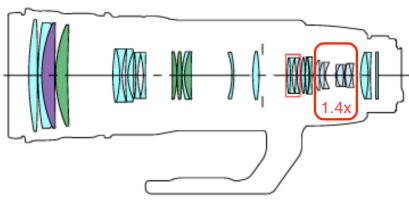
The reason a 1.4x flip in TC works in a lens is precisely because it's part of the lens design and not something that mounts behind the lens. There are lens optics that sit behind the 1.4x TC optics in the lens, as I labeled them in the EF 200-400/4, which is why the lens can maintain infinity focus with the TC flipped out.
Upvote
0
Any new 600 f/4 is going to be expensive, but if the zoom is built as a variable TC (i.e. magnifier), rather than the more elaborate approach used in most zooms, the size hit might not be that significant. The current approach to 800 and 1200 lenses takes the magnifier approach and making it variable is not impossible. I have an interesting Vivitar 2x macro TC (in FD mount) that is a combo of a 2x TC and a variable extension tube rolled into one. With some of Canon's recent exploits, it is not unreasonable to expect that they might take a new approach. Not much doubt that any sensible way to combine several Super Telephotos into one would be a big cost saver for Canon and might even reduce the price a bit thanks to increased production volume of the single design.and weigh a large number of pounds
Upvote
0

A 1.4x TC built into a lens does not have to be any different to a separate 1.4x TC added to a lens. The lens is simply designed to focus onto the sensor without the 1.4x TC in place, and the 1.4x TC optics are designed so that they don't screw with that. You showed exactly this with the dual TC design in an earlier reply. Either one or both of the 1.4x TCs can flip out of place. When both are out of the way, the lens can still maintain infinity focus even though there is only air there now.A 1x-1.4x switchable TC is NOT just a matter of 'adapting it into a separate teleconverter'. A teleconverter mounted behind a lens, with the optics 'flipped out of the way' would be an empty tube between the camera and the lens...that's called an extension tube, and what it does is reduce the minimum focus distance at the cost of losing the ability to focus the lens on distant subjects. Probably not what you would want with teleconverter on a telephoto lens, y'know?
That hypothetical 1x-1.4x TC would require reducing optics for the 1x setting, a completely different set of optics than the extender optics that would need to flip in when the 1.4x elements flip out. Same thing as the magical unicorn 1x-1.4x-2x TC that people have been dreaming about after someone misinterpreted a Canon patent for something completely different that happened to have 1-1.5-2x markings on the diagram.
The reason a 1.4x flip in TC works in a lens is precisely because it's part of the lens design and not something that mounts behind the lens. There are lens optics that sit behind the 1.4x TC optics in the lens, as I labeled them in the EF 200-400/4, which is why the lens can maintain infinity focus with the TC flipped out.
Upvote
0
I'll reply for the benefit of others who may read this thread, in the hope that your cluelessness doesn't engender false hope in others. Spreading misinformation seems to be a pattern for you, among other distasteful habits that you exhibit.
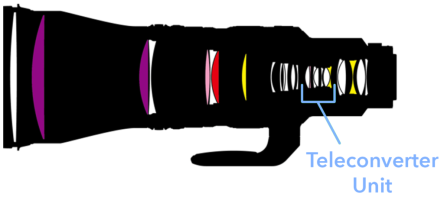
The only way in which your statement would be correct would be for a lens to be designed to take a drop-in TC, like a really fat drop-in filter holder. There would need to be optics behind that big hole in the lens barrel. Moreover, in these expensive lenses the TCs are designed for optimal performance with each lens' optics. For example, the TC group in the Nikkor 600/4 + 1.4x has an SR element (their equivalent of Canon's BR elements aka 'blue goo'), whereas the TC group in the Nikkor 400/2.8 + 1.4x does not.
In other words, each supertele lens would need it's own specific drop-in TC, rather than having a generic drop-in TC for a series of lenses that would have more of a negative optical impact than tailor-made TCs for each lens. So even the kludgy idea you are suggesting (well, that you would have suggested if you actually understood optical design) would not happen. A dedicated TC for each lens...why make a drop-in version at all, then? That would be foolish, something that manufacturers' lens designers are not. That's why both Canon and Nikon have made lenses with flip-in TCs, not completely removable drop-in TCs.
And not separate flip-in TCs...because physics. The nice thing about physics is that it remains true even when people like you don't understand it.
I will try to simplify with a picture of the Canon patent design that perhaps you can understand. Only one set of 1.4x TC optics flips out of place, though it does so in two pieces to minimize the size of the overall optic. When the rear split 1.4x group ('B') moves out of the optical path, the front 1.4x group ('A') slides further back into position but remains in the optical path. At no time is there an empty tube.
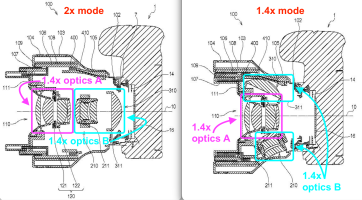
This is still not the thing you think is happening, i.e. there is no 1x form for this design or any other. As already stated, an extension tube precludes infinity focus, so a '1x' option in a switchable TC would require reducing optics to flip in when the TC optics flip out.
Yes, it does have to be different. A flip-out TC works when the TC is added within the lens. Notice how in the block diagram of the EF 200-400/4 that I posted above, there is a (weak) converging group behind the TC optics. The same is true for any lens with a flip-in TC. Here's the Nikon 600/4 + 1.4x, which has even more optics (but still net weak convergence) behind the TC group.A 1.4x TC built into a lens does not have to be any different to a separate 1.4x TC added to a lens. The lens is simply designed to focus onto the sensor without the 1.4x TC in place, and the 1.4x TC optics are designed so that they don't screw with that.
The only way in which your statement would be correct would be for a lens to be designed to take a drop-in TC, like a really fat drop-in filter holder. There would need to be optics behind that big hole in the lens barrel. Moreover, in these expensive lenses the TCs are designed for optimal performance with each lens' optics. For example, the TC group in the Nikkor 600/4 + 1.4x has an SR element (their equivalent of Canon's BR elements aka 'blue goo'), whereas the TC group in the Nikkor 400/2.8 + 1.4x does not.
In other words, each supertele lens would need it's own specific drop-in TC, rather than having a generic drop-in TC for a series of lenses that would have more of a negative optical impact than tailor-made TCs for each lens. So even the kludgy idea you are suggesting (well, that you would have suggested if you actually understood optical design) would not happen. A dedicated TC for each lens...why make a drop-in version at all, then? That would be foolish, something that manufacturers' lens designers are not. That's why both Canon and Nikon have made lenses with flip-in TCs, not completely removable drop-in TCs.
And not separate flip-in TCs...because physics. The nice thing about physics is that it remains true even when people like you don't understand it.
No. Clearly, you don't understand what I posted, or the underlying Canon patent application. More importantly, you don't understand the relevant optical concepts. A lens cannot maintain infinity focus with an extension tube behind the lens, and if all the optical elements of a TC mounted behind the lens were to move out of the optical path, you would have an empty tube behind the lens...i.e., an extension tube.You showed exactly this with the dual TC design in an earlier reply. Either one or both of the 1.4x TCs can flip out of place. When both are out of the way, the lens can still maintain infinity focus even though there is only air there now.
I will try to simplify with a picture of the Canon patent design that perhaps you can understand. Only one set of 1.4x TC optics flips out of place, though it does so in two pieces to minimize the size of the overall optic. When the rear split 1.4x group ('B') moves out of the optical path, the front 1.4x group ('A') slides further back into position but remains in the optical path. At no time is there an empty tube.
This is still not the thing you think is happening, i.e. there is no 1x form for this design or any other. As already stated, an extension tube precludes infinity focus, so a '1x' option in a switchable TC would require reducing optics to flip in when the TC optics flip out.

Upvote
0
I admit that I'm not an expert in optics and that I've never seen the optical design for the 200-400mm. I see your point, but I have 2 questions.A 1x-1.4x switchable TC is NOT just a matter of 'adapting it into a separate teleconverter'. A teleconverter mounted behind a lens, with the optics 'flipped out of the way' would be an empty tube between the camera and the lens...that's called an extension tube, and what it does is reduce the minimum focus distance at the cost of losing the ability to focus the lens on distant subjects. Probably not what you would want with teleconverter on a telephoto lens, y'know?
That hypothetical 1x-1.4x TC would require reducing optics for the 1x setting, a completely different set of optics than the extender optics that would need to flip in when the 1.4x elements flip out. Same thing as the magical unicorn 1x-1.4x-2x TC that people have been dreaming about after someone misinterpreted a Canon patent for something completely different that happened to have 1-1.5-2x markings on the diagram.
The reason a 1.4x flip in TC works in a lens is precisely because it's part of the lens design and not something that mounts behind the lens. There are lens optics that sit behind the 1.4x TC optics in the lens, as I labeled them in the EF 200-400/4, which is why the lens can maintain infinity focus with the TC flipped out.
View attachment 228797
1. Isn't the EF to RF adapter a hollow tube with adapting electronics. To my knowledge I have not heard of any focus issues. It seems that these multiple different EF lens on RF cameras are able to maintain focus.
2. Following your logic, then to have a separate switchable teleconverter and not produce an extension tube; it would require additional glass. How about a teleconverter that adds 1.12 ( 1/3 of a stop ), which would be similar to the native lens. But could then switch to 1.4 or 1.5. This is probably too simplified for complex optics; just thinking out loud.
Last edited:
Upvote
0
Yes, it is a hollow tube...but not an extension tube. An extension tube is something that positions the lens such that the lens mount is farther away from the sensor than the specified flange focal distance (mount surface to sensor).I admit that I'm not an expert in optics and that I've never seen the optical design for the 200-400mm. I see your point, but I have 2 questions.
1. Isn't the EF to RF adapter a hollow tube with adapting electronics. To my knowledge I have not heard of any focus issues.
The EF lens mount has a flange focal distance of 44 mm, whereas the RF lens mount has a flange focal distance of 20 mm. In other words, the EF lens is already designed to focus the image at a distance of 44 mm from the mount. Thus, the adapter is needed so the lens mount is that distance from the sensor on an RF camera body.
I doubt it. If you remember the switch from FD to EF mount that happened decades ago, Canon released an adapter for their expensive lenses. The FD mount had a 42 mm flange distance, but a 2 mm thick adapter isn't very feasible (but not impossible, google "Ed Mika adapters"). The Canon FD-EOS adapter was 12mm thick (much thinner than a switchable TC could be), the same as the EF 12 extension tube. The optics in that adapter to correct for infinity focus resulted in the adapter being a 1.26x teleconverter.2. Following your logic, then to have a separate switchable teleconverter and not produce an extension tube; it would require additional glass. How about a teleconverter that adds 1.12 ( 1/3 of a stop ) that can switch to 1.4. This probably too simplified for complex optics; just thinking out loud.
Upvote
0
The EF to RF adapter is just a hollow tube because the RF mount is physically closer to the sensor than the EF mount (20mm vs 44mm) so the adaptor puts an EF lens exactly in the same place as it would be on a EF mount camera - hence why it doesn't cause focus issues - it actually solves them.I admit that I'm not an expert in optics and that I've never seen the optical design for the 200-400mm. I see your point, but I have 2 questions.
1. Isn't the EF to RF adapter a hollow tube with adapting electronics. To my knowledge I have not heard of any focus issues. It seems that these multiple different EF lens on RF cameras are able to maintain focus.
2. Following your logic, then to have a separate switchable teleconverter and not produce an extension tube; it would require additional glass. How about a teleconverter that adds 1.12 ( 1/3 of a stop ), which would be similar to the native lens. But could then switch to 1.4 or 1.5. This is probably too simplified for complex optics; just thinking out loud.
Upvote
0
Thanks for the additional information, always good to learn something new.Yes, it is a hollow tube...but not an extension tube. An extension tube is something that positions the lens such that the lens mount is farther away from the sensor than the specified flange focal distance (mount surface to sensor).
The EF lens mount has a flange focal distance of 44 mm, whereas the RF lens mount has a flange focal distance of 20 mm. In other words, the EF lens is already designed to focus the image at a distance of 44 mm from the mount. Thus, the adapter is needed so the lens mount is that distance from the sensor on an RF camera body.
I doubt it. If you remember the switch from FD to EF mount that happened decades ago, Canon released an adapter for their expensive lenses. The FD mount had a 42 mm flange distance, but a 2 mm thick adapter isn't very feasible (but not impossible, google "Ed Mika adapters"). The Canon FD-EOS adapter was 12mm thick (much thinner than a switchable TC could be), the same as the EF 12 extension tube. The optics in that adapter to correct for infinity focus resulted in the adapter being a 1.26x teleconverter.
Upvote
0
Thanks for the information. Always good to learn something new.The EF to RF adapter is just a hollow tube because the RF mount is physically closer to the sensor than the EF mount (20mm vs 44mm) so the adaptor puts an EF lens exactly in the same place as it would be on a EF mount camera - hence why it doesn't cause focus issues - it actually solves them.
Upvote
0
I currently have the RF 400 mm f2.8 lens and would strongly consider the upgraded version as long as the weight does not get any heavier. A built in 1.4x TC would be nice, but I would also want to ensure I could use an external 1.4x TC as well so I could switch between a 560 mm f4 and a 800 mm f5.6 at a flip of a switch. Lastly, there would be the question which is sharper. My current 400 mm f2.8 lens with my 2x extender or the new lens with two 1.4x extenders engaged. Will be interesting to see what the specifics are at the end of May.
Upvote
0
Doesn't matter how long it took for Nikon. They have 2 modern lenses with TC, Canon has 0. The last one is from 15 years ago. And while Nikon managed to make these 2 pro lenses, they also made a whole series of light and affordable tele primes. In the meantime Canon added TC elements and "glued" RF adapter onto years old EF designs.Yes, and it only took Nikon 9 years to innovate that switchable 1.4x TC, after Canon launched the EF 200-400mm with that feature in 2013. Or if you prefer, you can start counting from 1984 when Canon released a handful of FDn 1200mm f/5.6L + 1.4x lenses for the LA Olympics.
You always find a way to defend Canon, no matter what. It's getting boring.
Upvote
0
Whatever. Nikon has over 50 Z lenses ranging from 12-800mm. Canon has over 60 RF lenses ranging from 10-1200mm. Sony has more than both. Of course there will be lenses that one has and the other does not. Canon has an f/2 zoom. Nikon has an f/0.95 prime. Etc. If one doesn't have the lens(es) you want, either wait, switch brands, or run multiple brands.Doesn't matter how long it took for Nikon. They have 2 modern lenses with TC, Canon has 0. The last one is from 15 years ago. You always find a way to defend Canon, no matter what. It's getting boring.
Most likely, part of the dynamic is that Canon is prioritizing lenses their market research indicates their customers want, and Nikon is making lenses that Canon doesn’t offer precisely because Canon doesn’t make them.
Upvote
0
Similar threads
- Replies
- 60
- Views
- 12K

- Replies
- 76
- Views
- 7K

- Replies
- 127
- Views
- 11K

- Replies
- 148
- Views
- 18K
- Replies
- 92
- Views
- 8K