Same ole, same ole' Filters vs no filters...

Richard8971

"There is no spoon" - Neo
Oct 3, 2011
403
0
7,666
54
Tucson, AZ
www.oldpueblophotos.com
I know this horse has been beaten over and over but I can't seem to remember ever seeing a side by side comparison of using cheaper filters vs not using them.

I believe in using them (cheaper filters) if you are NOT a professional and want a little extra protection for your glass. Kind of like the discussion I have with people who ask me what kind of paint gun (I paint cars for a living professionally) they should buy when they want to do paint work at home. My SATA NR 4000 is a $700.00 paint gun that I use daily and my paycheck depends on it.

Do I recommend to the average person that they spend $700 on a gun they will only use only once or twice? No. I recommend the Harbor Freight SATA-copy HVLP gun they have for $60.00.

Will the $60.00 paint gun work? Yes and it will produce a fantastic finish. Will it hold up professionally? Probably not as well as the real SATA. Does that make it junk? Not at all, it has a place and will do it's job just fine.

This also is not a discussion on putting a $20 filter on a $1700 L-class lens. If you are going to put a filter on it, buy a good one, not a cheap one. But for the average to really good lens, the average filter will do just fine.

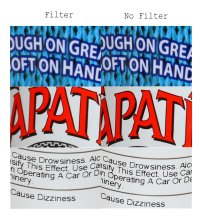
The cheap filters have a place in photography as do the expensive ones. I put an inexpensive Hoya filter on my EF 70-300L IS USM and did 6 shots of 3 different objects, 1 with the filter and 1 without. Random, handheld, so it could be equivalent to normal shooting as it can be.

I was surprised by the results. The crops are close to 100% and are very tight to show fine detail. Can you tell a difference? Yup. Will it kill a photo? Nope. I doubt in an average print you would really be able to tell them apart.
 

Attachments

  • Test.jpg
    Test.jpg
    680.5 KB · Views: 1,070
If you use a good filter, you may not be able to detect a difference, cheap filters may or may not cause issues like distortion or loss of sharpness. But, you probably did not put a filter on to use it in a studio under good lighting.

In bright sunlight, filters can cause flare from reflections and the cheapies really stand out there due to poor coatings or none at all.

I have B&W filters for most of my lenses, but they just sit in their little cases, haven't used one in years. I'm not against using them, I just don't go into rough weather or places where they make sense to add protection.

A while back, Roger at lens rentals had a little fin and took some shots with many cheap filters stacked, and compared them with expensive filters. His lens rentals have a habit of going out with B&W filters and coming back with cheap ones.

Here is a link to a comparison.
http://www.lensrentals.com/blog/2011/06/good-times-with-bad-filters

On a more serious note, he also recently traced a issue with damaged glass on the front of a lens to bad filters.
http://www.lensrentals.com/blog/2013/10/bad-times-with-bad-filters
 
Upvote 0
I had seen that comparison. My crops above prove that even one cheap filter can affect the image quality. BUT....

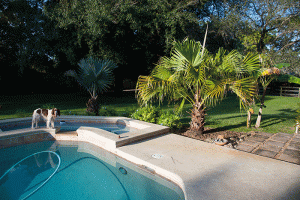
Try this test. I will upload these two pics. One was taken with a cheap filter and one without. See if you can pick which is which without cheating. (IE don't save it to your PC and zoom in) Just look at them here on the website. I will reveal which is which after a few people take a guess.

I am just trying to show that in a 100% zoom, you CAN tell them apart. But can you viewing it normally? I bet most can't. Unfortunately I had to size them down a little bit to post here but the quality is still there. The full size look identical to what you see here.

Canon 7D, 1/320s, f8, ISO 200, on board flash. EF 70-300L IS USM.

Good luck!

D
 

Attachments

  • a1.jpg
    a1.jpg
    440.4 KB · Views: 1,048
  • b1.jpg
    b1.jpg
    445.3 KB · Views: 1,003
Upvote 0
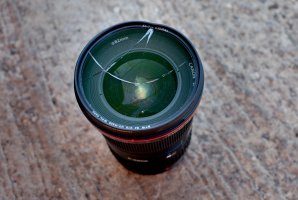
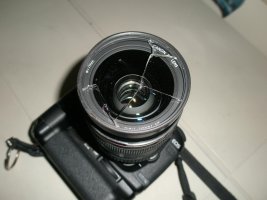
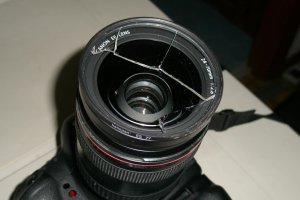
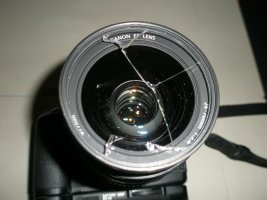
What a coincidence! ... just yesterday, my 5D MKIII with EF 16-35 f/2.8 L II mounted on Manfrotto 055CXPRO4 got flung out about 10 feet from a height of 6 feet ... when I saw it fall, I was pretty certain everything must've died ... but to my great relief, the 5D MK III had two tiny scratches, one bottom leg of my Manfrotto broke (http://www.canonrumors.com/forum/index.php?topic=18004.msg333840#msg333840), and the EF 16-35 L II lens had a dent on the filer thread. But what protected the front element of the lens was the 82mm B+W XS-Pro filter, which cracked after hitting a metal hook on the shipyard floor. I borrowed a Plier from one of the electricians at the shipyard and gently broke the glass of the B+W filter (as I could not remove it from the lens due to it being stuck real bad) and continued on with my shooting.
While I understand and agree with Richard's point of view about cheaper filters, I think it is important to have the best filters you can afford on your better lenses ... had I not to have a filter on (or even with a cheap filter) I am pretty certain I would have damaged a lens, that would have cost me almost $2000 to replace, instead I'm only looking at $150 to $175 to replace the filter ... but most importantly I would not have been able to complete the shooting.
My view on having filters on all the time (on all my lenses) is that it is one less thing for me to worry about when I take the lens out ... if I keep removing filters and putting them on (for normal / not so safe places), I most likely will forget to put the filter on one day and that could be the day, like yesterday, when the lens fells down ... its like my insurance, better to have it and not need it than to not have and need it.
 

Attachments

  • Busted B+W Filter-1.jpg
    Busted B+W Filter-1.jpg
    558 KB · Views: 1,058
Upvote 0
I keep cheap filters on most of the time, but when I do a portrait session or just in general want to make sure nothing is in the way I take them off. When finished, I make sure to put them back on for protection. I am certain that they decrease IQ but I can't motivate getting expensive ones. For CPL and ND I did spend the little extra to get good ones.
 
Upvote 0
Top one doesn't have the filter. At least, that's my deduction. I use filters when walking around just shooting random images/ scouting locations. When doing actual work, I prefer to not, if conditions allow


Richard8971 said:
I had seen that comparison. My crops above prove that even one cheap filter can affect the image quality. BUT....

Try this test. I will upload these two pics. One was taken with a cheap filter and one without. See if you can pick which is which without cheating. (IE don't save it to your PC and zoom in) Just look at them here on the website. I will reveal which is which after a few people take a guess.

I am just trying to show that in a 100% zoom, you CAN tell them apart. But can you viewing it normally? I bet most can't. Unfortunately I had to size them down a little bit to post here but the quality is still there. The full size look identical to what you see here.

Canon 7D, 1/320s, f8, ISO 200, on board flash. EF 70-300L IS USM.

Good luck!

D
 
Upvote 0
I have always left high quality filters on my glass. Filters & energy absorbing hoods have done more than their designed purpose for me over the years. Together they have saved me plenty of money absorbing the bumps and biffs that are all part of a day's work. A filter makes me feel OK about cleaning down a lens with my shirt when under pressure. They eventually pick up a myriad of barely visible scratches and are routinely changed every few years. Better the filter than the front element!

I don't want to feel like I'm walking on eggshells every time I pull a camera out of the bag. The path to unhindered creativity is not always easy on the gear, so in my view, a pragmatic approach to the use of filter and hood is an everyday must.

-pw
 
Upvote 0
Richard8971 said:
I had seen that comparison. My crops above prove that even one cheap filter can affect the image quality. BUT....

Try this test. I will upload these two pics. One was taken with a cheap filter and one without. See if you can pick which is which without cheating. (IE don't save it to your PC and zoom in) Just look at them here on the website. I will reveal which is which after a few people take a guess.

I am just trying to show that in a 100% zoom, you CAN tell them apart. But can you viewing it normally? I bet most can't. Unfortunately I had to size them down a little bit to post here but the quality is still there. The full size look identical to what you see here.

Canon 7D, 1/320s, f8, ISO 200, on board flash. EF 70-300L IS USM.

Good luck!

D
The top one looks to have a little more contrast, unless lighting changed slightly.
 
Upvote 0
pwp said:
I have always left high quality filters on my glass. Filters & energy absorbing hoods have done more than their designed purpose for me over the years. Together they have saved me plenty of money absorbing the bumps and biffs that are all part of a day's work. A filter makes me feel OK about cleaning down a lens with my shirt when under pressure. They eventually pick up a myriad of barely visible scratches and are routinely changed every few years. Better the filter than the front element!

I don't want to feel like I'm walking on eggshells every time I pull a camera out of the bag. The path to unhindered creativity is not always easy on the gear, so in my view, a pragmatic approach to the use of filter and hood is an everyday must.

-pw

+1 on that, possibly +1000.
 
Upvote 0
I think lenses below $500 should not use filters because the cheap will degrade the image, and the best filters cost almost the price of the lens, and not worth it. Moreover, use lens hood in all my lens and the protection they provide is really necessary. As I have no lens above $1000, then did not buy expensive filters. I did a test that you can play to test your filters. Photographed with filter "HOYA UV" cheap that has single coating, and another picture with a filter very cheap like "VIVITAR UV MULTI COATED". To cause reflections used a LED illuminator appointed to the lens, on the edge of the image frame. The result is that the super cheap "MULTI COATED" had soft reflections, and "HOYA" with single coating was distracting reflections. If you have expensive lenses, invest in filters of good brands, but always multi coated filters.
 
Upvote 0
I've spent more money repairing (pretty damn sure) my 2 most dropped lenses. 70-200/2.8I and 16-35/2.8II. In both cases I DO NOT use filters on them. The only filter that will ever see use on either is my 8 stop ND. Beyond that I've never had a drop where it's had an problem damaging the front element and trust me, I've had some damn good drops. Filter ring, especially on the 16-35 always seems to take the brunt of the damage. Where as having the lens hood on the 70-200 is it's saving grace.
 
Upvote 0
It looks like an 82mm B+W XS-PRO filter runs just shy of $120. With the original filter in pieces, a replacement would be needed, so I'm wondering...

How would the cost of replacing a front element compare to buying two of these 82mm filters? (Anyone know what a front element would cost?) Is it a wash?

Considering it a bit further...if the lens needs service for bent filter threads and/or misaligned groups (to put it back in perfect working order), what would that cost, and how would (case A) the cost of two filters plus service compare to (case B) service that included the replacement of the front element?

To date, I am happy to say I have no experience with such things. (Dropped filters, hoods, and caps are another story altogether....)
 
Upvote 0
ugly_bokeh said:
It looks like an 82mm B+W XS-PRO filter runs just shy of $120. With the original filter in pieces, a replacement would be needed, so I'm wondering...

How would the cost of replacing a front element compare to buying two of these 82mm filters? (Anyone know what a front element would cost?) Is it a wash?

Considering it a bit further...if the lens needs service for bent filter threads and/or misaligned groups (to put it back in perfect working order), what would that cost, and how would (case A) the cost of two filters plus service compare to (case B) service that included the replacement of the front element?

To date, I am happy to say I have no experience with such things. (Dropped filters, hoods, and caps are another story altogether....)
Each model lens has a different cost. But I imagine that replacing the front element (depends on Lens) should cost more than 40% of the lens, which can mean almost $ 1000 in a 24-70 F2.8 II. The big question is: Use the filter would prevent further internal damage, or the front thread of the lens? And if repairing internal damage and the front thread costing 30% of the lens, the 10% difference is worth the use of expensive filter? I still think that using the lens hood protects better than a filter.
 
Upvote 0
I have been against filter use for many years, though I did use UV filters with film cameras when UV was an issue, the strength of peoples feelings on the matter often surprises me. I do occasionally use UV filters as protection (to complete weather sealing) on my 16-35. I use hoods over 90% of the time.

There are, of course, pros and cons that most of us know about but here is my take. Good quality filters are not cheap, new front elements that are much more durable than most people think, are surprisingly affordable. I would say both Rienzphotoz and Surapon were very lucky their broken filter glass did not damage the front element, nobody would claim a UV filter offers any kind of impact protection and a broken filter has the potential to further damage the element it is supposed to be protecting.

I was recently hanging out with a long time Nikon shooter and he was impressed with the clarity of my files, I pointed out that he used UV filters and not hoods and even though they were multicoated filters they still reduced contrast. So I showed him, this gif is two unprocessed RAW images converted to jpegs with the same settings in LR out of his D3 and 24-120 f4 (the Nikon equivalent to the Canon 24-105 f4), one with his filter, one without. The light is behind us and whilst his filter could have used a clean it was a decent (I forget what make) multicoated filter.
 

Attachments

  • Untitled1.gif
    Untitled1.gif
    454.9 KB · Views: 725
Upvote 0
Richard8971 said:
I had seen that comparison. My crops above prove that even one cheap filter can affect the image quality. BUT....

Try this test. I will upload these two pics. One was taken with a cheap filter and one without. See if you can pick which is which without cheating. (IE don't save it to your PC and zoom in) Just look at them here on the website. I will reveal which is which after a few people take a guess.

I am just trying to show that in a 100% zoom, you CAN tell them apart. But can you viewing it normally? I bet most can't. Unfortunately I had to size them down a little bit to post here but the quality is still there. The full size look identical to what you see here.

Canon 7D, 1/320s, f8, ISO 200, on board flash. EF 70-300L IS USM.

Good luck!

D

First, a1.jpg, has UV filter, second, b1.jpg, does not. IMHO :)
 
Upvote 0
Hoya S-HMC and HD filters do not degrade IQ or cause flare. Most other filters do. (B+W has a reputation for not degrading IQ, but I've never used or tested them to know for sure.) How much degradation depends on the filter.

Filters complete weather sealing on some lenses and offer some scratch/impact protection. Any impact strong enough to shatter the filter and shove the glass into the front element, thereby damaging the front element, would have shattered the front element any way without the filter. Unless we're talking about one of the handful of lenses with really deep, recessed front elements (i.e. some macros come to mind).

Some hoods are deep and offer good impact resistance. Others are useless for this.

I leave filters on everything except my EF-M 22mm (cost/benefit is low plus the front element is tiny). I generally use hoods except on my M lenses (they don't seem to offer much protection or shading).

I would be in the camp that says only use filters when necessary if all filters degraded IQ. But I can't make my Hoya S-HMC and HD filters degrade IQ. Every time I've thought one of those filters was contributing to an IQ issue such as flare and removed it, I've realized that I only wasted my time taking it off. It has never made a bit of difference in IQ.
 
Upvote 0
ugly_bokeh said:
It looks like an 82mm B+W XS-PRO filter runs just shy of $120. With the original filter in pieces, a replacement would be needed, so I'm wondering...

How would the cost of replacing a front element compare to buying two of these 82mm filters? (Anyone know what a front element would cost?) Is it a wash?

Considering it a bit further...if the lens needs service for bent filter threads and/or misaligned groups (to put it back in perfect working order), what would that cost, and how would (case A) the cost of two filters plus service compare to (case B) service that included the replacement of the front element?

To date, I am happy to say I have no experience with such things. (Dropped filters, hoods, and caps are another story altogether....)
Where I live any repair to a lens takes minimum 14 days (and up to 2 months), also the service center chaps are not very competent ... but if I do give it to the service center (and pray that they fix the front element in 2 weeks) the minimum labor charge is US$ 124 ... from what I'm told by the service center guy here, the cost of replacing the front element would be at least $850 (excluding labor charges and any other charges) ... also I don't always trust service centers - what guarantee do I have that they don't use one of my lens parts to fix someone else's and then tell me that my lens is not repairable?

I'd rather spend another $120 + US$ 53 shipping charges to replace the B+W filter.
 
Upvote 0