Same ole, same ole' Filters vs no filters...

HyperFocus Photography said:
Top one doesn't have the filter. At least, that's my deduction. I use filters when walking around just shooting random images/ scouting locations. When doing actual work, I prefer to not, if conditions allow

This, in a way, proves my point. The bottom photo is the one without a filter. This thread wasn't about using them/not using them, cheap filters vs expensive ones... This was to prove a point.

My first set of pics proves that, 1) YES, you can tell (under very close examination) the loss of image quality using a cheap filter on an high quality lens. (or any lens for that matter)

and 2) When you are viewing the photograph under normal circumstances, you CANNOT really (it was about 50/50) tell if a filter (expensive or cheap) was used or not.

If you don't like using them, then don't. If you like using them and the ones you use are from Best Buy, then more power to you. I doubt anyone, anywhere will be able to tell the difference. :)

D
 
Upvote 0
It runs abour $360 usd plus shipping, and waiting.

sek
ugly_bokeh said:
It looks like an 82mm B+W XS-PRO filter runs just shy of $120. With the original filter in pieces, a replacement would be needed, so I'm wondering...

How would the cost of replacing a front element compare to buying two of these 82mm filters? (Anyone know what a front element would cost?) Is it a wash?

Considering it a bit further...if the lens needs service for bent filter threads and/or misaligned groups (to put it back in perfect working order), what would that cost, and how would (case A) the cost of two filters plus service compare to (case B) service that included the replacement of the front element?

To date, I am happy to say I have no experience with such things. (Dropped filters, hoods, and caps are another story altogether....)
 
Upvote 0
Richard8971 said:
HyperFocus Photography said:
Top one doesn't have the filter. At least, that's my deduction. I use filters when walking around just shooting random images/ scouting locations. When doing actual work, I prefer to not, if conditions allow

This, in a way, proves my point. The bottom photo is the one without a filter. This thread wasn't about using them/not using them, cheap filters vs expensive ones... This was to prove a point.

My first set of pics proves that, 1) YES, you can tell (under very close examination) the loss of image quality using a cheap filter on an high quality lens. (or any lens for that matter)

and 2) When you are viewing the photograph under normal circumstances, you CANNOT really (it was about 50/50) tell if a filter (expensive or cheap) was used or not.

If you don't like using them, then don't. If you like using them and the ones you use are from Best Buy, then more power to you. I doubt anyone, anywhere will be able to tell the difference. :)

D


Er, but under normal viewing I did tell............

privatebydesign said:
First, a1.jpg, has UV filter, second, b1.jpg, does not. IMHO :)
 
Upvote 0
privatebydesign said:
Richard8971 said:
This, in a way, proves my point. The bottom photo is the one without a filter.
Er, but under normal viewing I did tell............

Well, given an n of 2 with opposite results, it only makes sense to let the one that supports your hypothesis determine your conclusion, right?

Richard8971 said:
If you like using them and the ones you use are from Best Buy, then more power to you. I doubt anyone, anywhere will be able to tell the difference.

I guess you didn't try my suggested test. I shoot indoors a lot, there are usually strong light sources (ceiling light fixtures, floor lamps, etc.) in the frame. In that situation, a cheap filter is a bad idea (I did try a cheap Tiffen once, since it came on a used lens I bought - if you'll pardon the New Englandism, wicked bad flare; no issues with my B+W MRC filters).
 
Upvote 0
As some others have said, one of the biggest differences in "expensive" and "cheap" filters is the AR coatings. The more expensive filters with the better coatings reduce flair much better than their counterparts with lesser or no coatings.

On my broadcast lenses(that I make my money with) I have filters on all of them. The Schneider super-duper-double-quadruple-secret-sauce coated clear filter that I have on my W/A is $330(127mm filters are not cheap anyway). I had just replaced the filter on my W/A that was a few years old with the Schneider the morning I was doing a corporate shoot for a tool manufacturer. We were shooting in a junkyard demonstrating the effectiveness of some of the equipment and one of the scenes involved some metal cutting. I thought I was a "safe distance" away. The next scene I noticed that there were some spots on the lens when the sunlight hit it. I cleaned the lens(actually the front filter), but to no avail. The filter had been pitted by flying sparks. I was a little mad because I had literally just put the brand new $300+ filter on only about an hour before. BUT pitting a $330 filter that I could replace in a minute or two was MUCH better than pitting the front element of a $25,000 lens. That would have been a triple whammy: trying to work around the damage for the rest of the shoot, the cost to have the element replaced and pulling the lens(my bread & butter lens, if you will) out of service for the repair.

We stopped down for a few minutes, I removed the "new" filter and put the old one back on, then emailed my sales rep and ordered ANOTHER $330 filter. That cut into the profit a little that day, but it could have been a lot worse.

The funny thing is, I don't have a single protective filter on any of my still lenses, though.
 
Upvote 0
My 2p worth....

I generally have a filter on my lenses, especially my wide angle where i get nice and close to action. I was once shooting near a road and a small stone flicked up from a passing car and hit my lens square on the front... It made a rather horrid noise, and cracked my filter! Would it have cracked my lens as easily? Probably not, but i was damn relieved i had it on and didn't have to find out!

So now i use them when I am not in ideal conditions (which living in india is pretty much 100% of the time)... I don't have one on my 70-200 though as i generally use the monster of the lens hood for protection... :)

If you want to use one, buy a good one.... :) Also remember some lenses (eg 24-105) need the filter to complete the weather sealing...

I have also had times of animals licking my lenses (a cow in particular surprised me once)... instead of having to take the time right there and then to clean the lens to continue shooting, i could just take the filter off and carry on (taking an extra step back mind)! :)
 
Upvote 0
I don't use filters for protective purposes. Impact protection is better with lens hoods. Also, there's no substitute for being smart, careful, deliberate, and prepared in advance. A filter is not extra insurance against impact damage.

What I *do* use filters for, however, is for convenience. If the design of a lens makes it hard to get the front element clean (e.g., recessed front element, delicate coating, or large diameter), I am more likely to keep a filter on it just so that I don't have to waste so much time being careful to keep it dust free. This lets me go out and shoot in salty or dusty conditions without a lot of downtime. If I'm shooting at the beach, I definitely use a filter because once the atmospheric salt hits the front element, you can lose a lot of contrast, and I don't want to be slowed down trying to carefully wipe my lens clean. I can just wipe the salt off the filter.

I keep a filter on my 85/1.2L II all the time, but my 35/1.4L doesn't usually need one.
 
Upvote 0
I have done many side-by-side sharpness tests with my Hoya HD filters and have yet to see any difference... From telephotos to UWA lenses, even at 200% magnification I can not see a difference.

Using cheap filters? Sure you will see some IQ loss. But using high end filters should eliminate that problem. I use them for ease of cleaning only, and while I have gone through periods of taking them all off and all that, I never saw any difference.

My testing when I did side-by-side images included a tripod, remote shutter, mirror-lockup, etc... Target was usually something with high levels of detail such as minty dollar bills, distant subjects and a variety of conditions such as back-lit trees.
 
Upvote 0
chromophore said:
Impact protection is better with lens hoods.
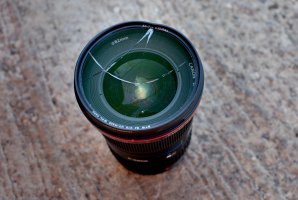
True, however lens hood protection is good only if the fall is on a relatively flat surface ... if the lens fall on an object that is smaller than the circumference of the lens hood, a filter will take the hit instead of the lens front element ... this is exactly what happened to my lens (see the pic below). A lens hood and a filter provide much better protection.
chromophore said:
A filter is not extra insurance against impact damage.
I disagree with your statement.
A filter is indeed an extra insurance against impact damage to the lens front element. If it wasn't for the extra insurance of the filter on my EF 16-35 f/2.8 L II lens, I would have had to spend almost US$2000 to get a new lens or wait for about a month and spend at least US$1000 to get the front element replaced.
 

Attachments

  • Busted B+W Filter-1.jpg
    Busted B+W Filter-1.jpg
    558 KB · Views: 333
Upvote 0
If you use a camera outside I think a HIGH QUALITY filter is a good idea, I like to go with the B+W XS-PRO 007m CLEAR.

Reasons are plentiful:
-Minimal impact on images, at worst you might a bit more flare, otherwise not noticeable.
-Don't have to be as concerned for bumping/scraping front of camera accidentally
-Easier to clean
-A scratched/scuffed lens is much harder to sell and has much lower resale value than a pristine one.

And the big ones most people miss:
-Even if you are the most careful person in the world, and you use a lens hood, if you use your camera outside the front lens element *will still get damaged*. Outside there is wind, wind carries dust, sand, dirt, water, and other particles. Like the windshield of a car, over time the front lens element will get worn down/pitted from its original state due to being out in the elements. If you had used a filter, you can simply replace the filter and bingo back to new.
-Though the actual front lens element may not be the most expensive part, unless you service lenses yourself there will still be costly service feeds in replacing it.

Now it IS true that most of the time damage to the back element is MUCH more visible than damage to the front element. But, damage can still have an impact both in your photos and for resale value.
 
Upvote 0
Rienzphotoz said:
I disagree with your statement.
A filter is indeed an extra insurance against impact damage to the lens front element. If it wasn't for the extra insurance of the filter on my EF 16-35 f/2.8 L II lens, I would have had to spend almost US$2000 to get a new lens or wait for about a month and spend at least US$1000 to get the front element replaced.

And I disagree with yours. Your experience does not prove that it was the filter that saved your lens. Your lens may not have been damaged by that same impact. Furthermore, there are cases where the broken glass from the filter actually contributes to scratching and pitting of the front element. Your single anecdote does not account for the variety of failure modes.

My point is that a filter was never designed to be a form of impact protection. A filter is an optical flat that is thinner and structurally weaker than the curved front element of a lens. It would be unwise to rely on it or count on it in any fashion to save your lens in a fall.
 
Upvote 0
chromophore said:
What I *do* use filters for, however, is for convenience. If the design of a lens makes it hard to get the front element clean (e.g., recessed front element, delicate coating, or large diameter), I am more likely to keep a filter on it just so that I don't have to waste so much time being careful to keep it dust free. This lets me go out and shoot in salty or dusty conditions without a lot of downtime.

+1
 
Upvote 0
I feel like we have this filter debate about once a month and it goes around in circles with no conclusion. Ever.

I've seen people with filters on a kit lens with a lens cap on top of that!! :o

I've seen bare lenses, no hood (or hood reversed!) no filter, when they prob shoulda used somethin! :(

Why do we care what other people do with their stuff? Let's never see this thread again (until next month!) :D

Btw - I use hoods for bumps and general protection but filters only when there's sand or water involved. Reason? I paid for L lenses and don't want another piece of glass in front of it. If it breaks it breaks. I'll (cry and) buy another one!
 
Upvote 0
chromophore said:
Rienzphotoz said:
I disagree with your statement.
A filter is indeed an extra insurance against impact damage to the lens front element. If it wasn't for the extra insurance of the filter on my EF 16-35 f/2.8 L II lens, I would have had to spend almost US$2000 to get a new lens or wait for about a month and spend at least US$1000 to get the front element replaced.

And I disagree with yours. Your experience does not prove that it was the filter that saved your lens. Your lens may not have been damaged by that same impact. Furthermore, there are cases where the broken glass from the filter actually contributes to scratching and pitting of the front element. Your single anecdote does not account for the variety of failure modes.

My point is that a filter was never designed to be a form of impact protection. A filter is an optical flat that is thinner and structurally weaker than the curved front element of a lens. It would be unwise to rely on it or count on it in any fashion to save your lens in a fall.
1. It is NOT an "anecdote" ::) ... there are plenty of people whose lens front element was saved due to a filter.

2. I know what happened to my lens coz I was there and saw it happen, unless of course you are claiming to be an accomplished prophet or soothsayer who can see things beyond the scope of your eyes. ::)
I do agree that "a filter was never designed to be a form of impact protection" however it is one of the benefits of using a filter.
 
Upvote 0
Rienzphotoz said:
What a coincidence! ... just yesterday, my 5D MKIII with EF 16-35 f/2.8 L II mounted on Manfrotto 055CXPRO4 got flung out about 10 feet from a height of 6 feet ... when I saw it fall, I was pretty certain everything must've died ... but to my great relief, the 5D MK III had two tiny scratches, one bottom leg of my Manfrotto broke (http://www.canonrumors.com/forum/index.php?topic=18004.msg333840#msg333840), and the EF 16-35 L II lens had a dent on the filer thread. But what protected the front element of the lens was the 82mm B+W XS-Pro filter, which cracked after hitting a metal hook on the shipyard floor. I borrowed a Plier from one of the electricians at the shipyard and gently broke the glass of the B+W filter (as I could not remove it from the lens due to it being stuck real bad) and continued on with my shooting.
While I understand and agree with Richard's point of view about cheaper filters, I think it is important to have the best filters you can afford on your better lenses ... had I not to have a filter on (or even with a cheap filter) I am pretty certain I would have damaged a lens, that would have cost me almost $2000 to replace, instead I'm only looking at $150 to $175 to replace the filter ... but most importantly I would not have been able to complete the shooting.
My view on having filters on all the time (on all my lenses) is that it is one less thing for me to worry about when I take the lens out ... if I keep removing filters and putting them on (for normal / not so safe places), I most likely will forget to put the filter on one day and that could be the day, like yesterday, when the lens fells down ... its like my insurance, better to have it and not need it than to not have and need it.


Amen to that, I had a similar experience in that I was doing a shoot in a stream with a waterfall and I slipped on a mossy rock. I thought for sure that I cracked the lens of my 16-35 L II lens when I looked at it. Luckily the only thing that cracked was my ND filter which I had a heck of a time getting off. I did not wince at all while purchasing a replacement filter of the same ilk!! ::)
 
Upvote 0
neuroanatomist said:
I guess you didn't try my suggested test. I shoot indoors a lot, there are usually strong light sources (ceiling light fixtures, floor lamps, etc.) in the frame. In that situation, a cheap filter is a bad idea (I did try a cheap Tiffen once, since it came on a used lens I bought - if you'll pardon the New Englandism, wicked bad flare; no issues with my B+W MRC filters).

No offence but this wasn't about a controlled test using blah, blah and doing blah, blah. I picked up my camera with the filter on, took a shot. Took the filter off and took the same shot. Did the same thing with the other two. Just random shots that anyone of us could take. I DID take these indoors, with normal indoor lighting conditions, using my onboard flash. Nothing special...

Again, if you don't like filters, then don't use them. My test was to show that even though under very close examination you can spot a difference, but just viewing a photo normally, its a lot harder.

Life is too short. Go out and take some photos!

D
 
Upvote 0
Zv said:
I feel like we have this filter debate about once a month and it goes around in circles with no conclusion. Ever.

I've seen people with filters on a kit lens with a lens cap on top of that!! :o

I've seen bare lenses, no hood (or hood reversed!) no filter, when they prob shoulda used somethin! :(

Why do we care what other people do with their stuff? Let's never see this thread again (until next month!) :D

Btw - I use hoods for bumps and general protection but filters only when there's sand or water involved. Reason? I paid for L lenses and don't want another piece of glass in front of it. If it breaks it breaks. I'll (cry and) buy another one!

I did this a little differently. I used some photo examples of why its not overall a big deal if you use filters or not.

I have to wonder, if you are so tired of these threads, why do you open them and read/respond to them? Hmmm.... ???

D
 
Upvote 0
Richard8971 said:
Zv said:
I feel like we have this filter debate about once a month and it goes around in circles with no conclusion. Ever.

I've seen people with filters on a kit lens with a lens cap on top of that!! :o

I've seen bare lenses, no hood (or hood reversed!) no filter, when they prob shoulda used somethin! :(

Why do we care what other people do with their stuff? Let's never see this thread again (until next month!) :D

Btw - I use hoods for bumps and general protection but filters only when there's sand or water involved. Reason? I paid for L lenses and don't want another piece of glass in front of it. If it breaks it breaks. I'll (cry and) buy another one!

I did this a little differently. I used some photo examples of why its not overall a big deal if you use filters or not.

I have to wonder, if you are so tired of these threads, why do you open them and read/respond to them? Hmmm.... ???

D

:P
 
Upvote 0
All my lenses have b&w filters and I don't see degradation. When I'm slipping lenses in and out of bags the front gets dirty with dust, fingerprints. I have no worry wiping them off with a tshirt or a cloth. They have saved my lenses from liquids before and some impacts. If you baby your gear sure but as a pro I don't have time to be worrying about my front element.
 
Upvote 0