Show your Bird Portraits

Valvebounce said:
Hi Wiebe.
Nice shot, nice to see one from their level, unfortunately where I see them is on a sloping beach and even putting the camera on almost on the ground you I am still shooting somewhat down on them. I have taken lots of shots of these little fellows and watched them for ages more, they work very hard Turning Stones looking for their living, they must turn tonnes!
The lapwing is a good shot too.

Cheers, Graham.

Nat_WA said:
Another one from the coast,
Turnstone at the foot of a breakwater dam

Hi Graham,

actually this one was also from a sloping (almost 45 degree) dam...
However, from the top down I could put my camera level with the surface the bird was scouring for food. You'll see that the bird is 'leaning' towards me in order to maintain balance. They don't seem to mind the steep and slippery surface (... as I would ;))

Wiebe.
 
Upvote 0
Jack Douglas said:
Wiebe, V nice.

Still wondering why it is that enlarged photos open two ways. One with a slider and inability to see the whole photo and the other in an alternate window. Wiebe's shots with slider, my Junco in a new frame. Can't be just my computer. Seems there is a threshold relating to the size of posted photo?? What is it?? I have trouble believing anyone interested in a sharper/larger view wants 1/2 a bird with little background.

Jack

Hi Jack,

I really don't know what drives this difference in opening... Next time I'll use a somewhat larger format (now I limit dimensions to 1800x1440) to see if it opens in a separate window. I noticed that you're using larger dimensions so that might be it.
You can however always force CR images to open in a separate window by right-clicking on the image and choosing to open in a new tab/window (PC/Win; probably something similar exists for Mac).

Wiebe.
 
Upvote 0
Hi Wiebe.
I guess it is because the bird is mid step it is not so obvious it is leaning until you point it out! :)

Cheers, Graham.

Nat_WA said:
Valvebounce said:
Hi Wiebe.
Nice shot, nice to see one from their level, unfortunately where I see them is on a sloping beach and even putting the camera on almost on the ground you I am still shooting somewhat down on them. I have taken lots of shots of these little fellows and watched them for ages more, they work very hard Turning Stones looking for their living, they must turn tonnes!
The lapwing is a good shot too.

Cheers, Graham.

Nat_WA said:
Another one from the coast,
Turnstone at the foot of a breakwater dam

Hi Graham,

actually this one was also from a sloping (almost 45 degree) dam...
However, from the top down I could put my camera level with the surface the bird was scouring for food. You'll see that the bird is 'leaning' towards me in order to maintain balance. They don't seem to mind the steep and slippery surface (... as I would ;))

Wiebe.
 
Upvote 0
Nat_WA said:
Anyone here to identify this one?

According to a local bird watcher it should be a Sanderling, but it doesn't fully match that description... Could also be some kind of Stint (Little stint?)

I'm not an ornithologist but I can try to answer:

Your Bird is definitely not Sanderling because it has fourth finger visible better on the first shot (Sanderlig doesn't have that finger). And I don't know for any season when the Sanderling would have such a plumage.
The bill does not belong to genus Calidris (Sanderling, Peeps and Sandpipers) - it belongs to genus Pluvalis (Plovers). Since your Lapwing is the Northern Lapwing, I would assume your plover is the European Golden plover because of the overlapping territory. Otherwise it is hard to tell just by that pictures which one it is - American Golden Plover or the European Golden Plover - the under-wing coverts are not exposed on the pictures. On other hand the legs are not as long as in the American golden plover, so one more "plus" for the European Golden Plover. Also, if my identification of the Lapwing is correct, you took your pictures in Eurasia where the American Golden Plover does not exist (just one report?).
Sorry for the long explanation but there is no other way to tell you why I think you have that species on the pictures.
 
Upvote 0
ISv said:
Nat_WA said:
Anyone here to identify this one?

According to a local bird watcher it should be a Sanderling, but it doesn't fully match that description... Could also be some kind of Stint (Little stint?)

I'm not an ornithologist but I can try to answer:

Your Bird is definitely not Sanderling because it has fourth finger visible better on the first shot (Sanderlig doesn't have that finger). And I don't know for any season when the Sanderling would have such a plumage.
The bill does not belong to genus Calidris (Sanderling, Peeps and Sandpipers) - it belongs to genus Pluvalis (Plovers). Since your Lapwing is the Northern Lapwing, I would assume your plover is the European Golden plover because of the overlapping territory. Otherwise it is hard to tell just by that pictures which one it is - American Golden Plover or the European Golden Plover - the under-wing coverts are not exposed on the pictures. On other hand the legs are not as long as in the American golden plover, so one more "plus" for the European Golden Plover. Also, if my identification of the Lapwing is correct, you took your pictures in Eurasia where the American Golden Plover does not exist (just one report?).
Sorry for the long explanation but there is no other way to tell you why I think you have that species on the pictures.

Thanks ISv for your elaborate analysis! :)
I guess you are right; although the Golden Plover is better known in its breeding/summer plumage, its winter plumage matches my picture quite well.
And indeed, location is Eurasia ;) About 95% of my bird pictures are taken in my home country (as in profile) - the Netherlands. This season is good for spotting migratory birds - many species visit and forage in the coastal / wetland areas here. For identification I still rely mostly on internet and more knowledgeable people - like you...! So bear with me if I get it wrong (again) ;)

Wiebe.
 
Upvote 0
@ ISv, Thanks for taking the time to help out here on our thread. As best I can tell, being with the thread a few years now, most of us are bird "enthusiasts" but not birders when it comes to identification. I find the books I have and even the reference internet material to still leave me scratching my head in many instances.

Personally, my camera is helping me learn a lot about aspects of nature. These things fade like a flame soon after the initial experience since my memory is not great, so looking at photos after the fact is a rewarding experience.

Jack
 
Upvote 0
Hi Jack.
I'd have to +1 that sentiment, I am slightly wiser now than before but not much! ;D I like to take photo's of things, birds being one of those things as they are a challenge.

Cheers, Graham.

Jack Douglas said:
@ ISv, Thanks for taking the time to help out here on our thread. As best I can tell, being with the thread a few years now, most of us are bird "enthusiasts" but not birders when it comes to identification. I find the books I have and even the reference internet material to still leave me scratching my head in many instances.


Jack
 
Upvote 0
Hi Alan.
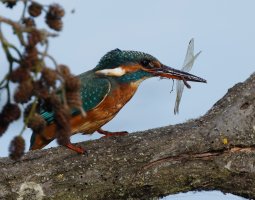
Great shot, congratulations you got two elusive or hard to photograph subjects in the one shot! :o ;D
Probably best not to post it on the dragonfly thread. ??? ;D
Could you please point out to the bird the bit about fisher in his name, he is the King of Fishers, nothing to do with dragonflies! ::) :)

Cheers, Graham.

AlanF said:
One for you Jack, the DO at 800mm. But, I didn't know whether to put it on a dragonfly thread.
 
Upvote 0
Valvebounce said:
Hi dpc.
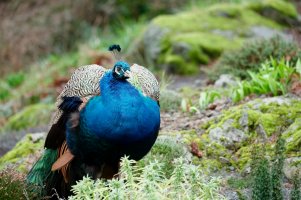
Very nice shot, very vain bird, one spent the day looking in chrome bumpers and hubcaps at his reflection, either that or he was a bit simple and he thought it was another bird! ;D

Cheers, Graham.
Ps yes I know he probably saw it as a threat to his position as it postured right back at him when he challenged it. :)

dpc said:


Thanks, Graham! 8)
 
Upvote 0
Hi Wiebe,
I'm not that much knowledgeable in the bird's taxonomy as it may look. Here, on Hawaii we have a number of migrants during the winter - all are shore/see birds. It is how it happened to know something about the shore birds. And the other, specific to Hawaii thing is that we get migrants/vagrants from different locations and they come in different full or intermediate plumage, some are molting and you don't see what you normally have to see, so we need to know the complete picture for the given species. Most of the shore birds have many "faces" and you have to know them in order to get the identification right. I hate to have picture with just a number :). If you are like me I would recommend "Shorebirds of North America, Europe and Asia" from Richard Chandler. Internet is helping too, but be careful for misidentified pictures that can fool you (there are many!). In many cases it is better to have different books on the same topic to get to the right answer...
Concerning the pictures you posted lately - I'm jealous for the Bar-tailed Godwit :-[. All your shots were very good, but that species I have never seen in life >:(!
 
Upvote 0
Hi Jack,
I'm not Canon user and it was my first post here but I used to visit Canon rumors 3-4 times a week in the last few years (mostly for the birds/nature but also to learn something in this and the other sections) :). All this time I was enjoining your pictures, hopefully soon I can post some pictures too (I don't think I'm allowed right now).

I'm enthusiast in both photography and birding (well, I'm scientist - molecular biology but it's rather different from ornithology despite of similarity of some methods). For me the pictures I'm taking are something like the "scalps" the hunters are taking for memory but without killing anything: you hike/walk you see something interesting (for me it's normally nature :)) and you you take it home... as a picture. Our memories have some limit, you can't take in your head everything you see and the photography is helping in this regard. But it's also: challenging/sport by itself ;)
 
Upvote 0