
Sigma WR ceramic filter line - pricing announced

I used to go filterless, when my lenses were all under $500. Now that I have a lot more invested in my lenses, I use B+W filters. It gives me piece of mind if I'm shooting in a drizzle, or a rodeo with dirt flying around. I'm not afraid to wipe the filter down with my shirt if I need to.

These Sigma filters look interesting, though it seems to me that an impact that would break a lesser filter would likely be bad for the the lens internally anyway - so I wouldn't be swayed to switch for that. However, if it matches the optical quality of B+W and improves upon it with dust and water repellence, than I would consider it when buying one for a new lens.
 
Upvote 0
neuroanatomist said:
Maiaibing said:
Mt Spokane Photography said:
They claim that it prevents damage to a lens. I don't see how that's possible

Found my old YES-my-filter-saved-my-lens documented samples (there are lots of such forum threads around). It is as often the barrel as the front element which is saved by using a filter.:

(snipped links to save space)

I've seen at least that many 'My filter broke on impact and the filter glass scratched my front element' threads.

Having said that, personally I use a filter on most lenses that take them (except the M22/2).

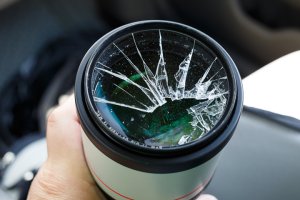
You mean like this? I dropped an EF 300mm f/4L IS USM on a concrete floor. It was in one of those off-white Canon lens cases that come with some L lenses. The case didn't do much to absorb the shock. I had no idea I had broken the filter and lens cap until I opened the case a few hours later, after the shards of glass had time to bounce around and scratch the lens glass. I got the filter off and did the best I could without any cleaning supplies to get rid of the broken glass and dust and still got some great bird photos despite the dirty dusty front element. Later, I very carefully used an air blower and lens papers moistened with lens cleaner to get the glass dust off the front element.

The lens works fine, but now there are some small scratches that don't affect image quality. For this lens, I haven't bothered putting another UV filter on it. The hood is large and built into the lens. That's enough protection. I still use filters as protection on other lenses. I kept the broken filter and lens cap from the 300mm as a reminder to be careful with my gear.

As for these Sigma filters, they sound impressive but are too expensive for me. I'll stick with B+W.
 

Attachments

  • broken.JPG
    broken.JPG
    279.9 KB · Views: 212
Upvote 0
mpphoto said:
I dropped an EF 300mm f/4L IS USM on a concrete floor. It was in one of those off-white Canon lens cases that come with some L lenses. The case didn't do much to absorb the shock. I had no idea I had broken the filter and lens cap until I opened the case a few hours later, after the shards of glass had time to bounce around and scratch the lens glass. I got the filter off and did the best I could without any cleaning supplies to get rid of the broken glass and dust and still got some great bird photos despite the dirty dusty front element. Later, I very carefully used an air blower and lens papers moistened with lens cleaner to get the glass dust off the front element.

The lens works fine, but now there are some small scratches that don't affect image quality. For this lens, I haven't bothered putting another UV filter on it. The hood is large and built into the lens. That's enough protection. I still use filters as protection on other lenses. I kept the broken filter and lens cap from the 300mm as a reminder to be careful with my gear.

As for these Sigma filters, they sound impressive but are too expensive for me. I'll stick with B+W.

How unfortunate. First time I have ever seen a documented case like this. Impressive the lens elements survived the impact without being messed up and needing re-adjustment. Did you ever check it for de-centering (of course mostly important for those who shoot brick walls or landscapes...)?
 
Upvote 0
mpphoto said:
neuroanatomist said:
Maiaibing said:
Mt Spokane Photography said:
They claim that it prevents damage to a lens. I don't see how that's possible

Found my old YES-my-filter-saved-my-lens documented samples (there are lots of such forum threads around). It is as often the barrel as the front element which is saved by using a filter.:

(snipped links to save space)

I've seen at least that many 'My filter broke on impact and the filter glass scratched my front element' threads.

Having said that, personally I use a filter on most lenses that take them (except the M22/2).

You mean like this? I dropped an EF 300mm f/4L IS USM on a concrete floor. It was in one of those off-white Canon lens cases that come with some L lenses. The case didn't do much to absorb the shock. I had no idea I had broken the filter and lens cap until I opened the case a few hours later, after the shards of glass had time to bounce around and scratch the lens glass. I got the filter off and did the best I could without any cleaning supplies to get rid of the broken glass and dust and still got some great bird photos despite the dirty dusty front element. Later, I very carefully used an air blower and lens papers moistened with lens cleaner to get the glass dust off the front element.

The lens works fine, but now there are some small scratches that don't affect image quality. For this lens, I haven't bothered putting another UV filter on it. The hood is large and built into the lens. That's enough protection. I still use filters as protection on other lenses. I kept the broken filter and lens cap from the 300mm as a reminder to be careful with my gear.

As for these Sigma filters, they sound impressive but are too expensive for me. I'll stick with B+W.

I think people are missing the point that the Sigma filter probably wouldn't break in these circumstances.

We need to get Digital Rev to do a drop test (or just send them a filter and let nature run its course).
 
Upvote 0
This Sigma video is very misleading, not to say other things.

This test only shows that it is stronger than that particular other filter shown (we don't know which). It does not show that it will protect your lens from impact, as the video might imply.

I would really love to see this test's results using a base cylinder with a diameter equal to that of the filter.
Then, and only then, I would become a believer !!!!!!!!!!!
 
Upvote 0
Spanish, I saw the same thing! For all the precision in the magnetic ball drop and high speed video, the guy goes and just slaps the filter (off center for the Sigma) down on a surface that DOSE NOT represent a filters architecture on a lens! There is NO direct support behind a filter on a lens! I'm not a materials engineer, but the issue of flexability and tensile strength spanning the distance over the filter thread distance is Very important! From what I know Ceramics are harder/stronger, yet more brittle, so in a span they have diminishing returns the greater the distance and the thinner the material. This test would then be ideal for the attributes of ceramics, but not much of a real world comparison!

Plus it's a Sigma, so you need a dock to adjust the strength! (no one seamed to get my first joke, so I'm trying again :o)
 
Upvote 0
Crosswind said:
Too bad that there isn't something like this for my 8-15mm L fisheye, just bigger and greatly curved... to maintain the ability of a full 180° fov, while having some scratch protection:) I have to be very careful with it.

I am not careful with my EF 15 fisheye, TS-E 17, or EF 11-24. I have found the front coatings, especially on the newer lenses, to be remarkably robust.
 
Upvote 0
I love the way the Sigma filter took the punch without a scratch joyfully spinning, mocking the mortals.
Kudos to the art director. And thousand per cent reminds me of the good old days of the Soviet Five Year Plans.


Unless you break your lenses only after you have finished your shoot, I think it is a brilliant idea have this protection in front of your Front Element.
 
Upvote 0
I use protection filters since long (three decades+). No crash so far, but several little scratches on these protection filters.

With my lens collection and the amount of protection filters, I could have bought one new lens instead of all the protection filters, true. I don't use cheap nor uncoated filters here.

What I like is the option to be in a couple of seconds later ready to get my shot (after something happened), and not have to wait weeks to get my lens repaired, and have to rent a similar lens on top of that. Worse case, some of my lenses are of course vintage glass, I would have no idea how to repair those.

I have no fear to clean those filters with my shirt if there is not time for a proper cleaning, I wouldn't do that with a naked front element of course.

I look forward to the ceramic ones, even I might use them only on upper level glass, $2K+, so only a few here.
 
Upvote 0
As someone mentioned, with the strength of this glass, what is the optical quality/compromise are we going to have? I completely get that the thicker the glass it is, the more glass light has to go through to get to the sensor... THAT'S the test that will show it's true colors. That being said, a nice high quality filter is always a good insurance policy... I understand the theory of shock traveling to the outwards elements meaning that in case of strong shock (dropping) the outwards most elements, in theory, should take the brunt of the damage, so in this case, that would be the filter instead of the front element... But i do get things are never the same and no two drops are the same...
 
Upvote 0
JP4DESIGNZ said:
This is the best explanation of why anyone would want a protective filter I ever heard. :D

Its a good reminder from Canon that:

1) Lens surfaces are actually soft and easily prone to damage in spite of the often repeated forum claims that lens surfaces are "hard" and "tough".

2) That sometimes you may not be able to see that a lens front has sustained damage - which again can lead people to believe 1).
 
Upvote 0