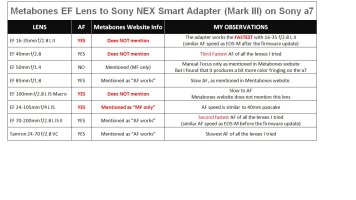
I've owned an A7 for a week and for the past couple of days have been trying the Metabones EF adapter using, as it happens, the 40mm pancake along with the 85mm 1.8, comparing it informally along the way with the same lenses on the 5DIII. I've not had a chance yet to process more than a few of the images, let alone look at all of them closely, but so far I'm inclined to conclude that - somewhat to my surprise - these lenses both create better images on the Sony than on the Canon, including greater sharpness and detail across the frame. The difference isn't huge, and would doubtless seem less on smaller monitors, but on a 30" monitor it's quite noticeable even without zooming in. (I now feel tempted to rent an A7r for comparison.) I also get the impression that the camera meters better, among other things. A remarkable image-generating device, and engagingly light, too (I've been using it, a Fuji xe-1 and an OM-D for the past few weeks, after which the 5DIII felt heavy and bulky), and, with its excellent EVF and magnification, a great vehicle for manual focus lenses.
BUT - using the adapter you don't want to be in a hurry. I find it oddly engaging, but it feels a bit as though the AF mechanism was designed by Heath Robinson (do a google image search of you don't know his work) - the lens strolls towards the right place, arrives, looks around a bit to admire the view, moves a tad further, returns to the right place, whereupon it announces that you may press the shutter, assuming you haven't lost interest (in very low light you may need to try more than once, but I was generally pleased by how well it did walking home from work last night after dark). I'm exaggerating, of course, but if there's a chance your subject will soon move, let alone is moving, good luck. On the other hand, when the camera thinks it's in focus, it really is - as precisely accurate as it is with the (much faster) native kit lens or as the (extremely fast) AF on OM-Ds.
You should know, by the way, that not all Canon lenses are supported (with the 50mm 1.4 you get aperture control but not AF), and that the list of supported lenses on metabones' site is incomplete (e.g. they don't mention the 28mm IS, 40mm or the 100mm L, but mine work just fine). And, of course, you can forget about automatic corrections based on lens profiles in LR, DxO etc., so while the 24-105L works too, correcting all that distortion at the wide end might be rather a bore.
So it's rather frustrating in some ways - you may get better-looking photos from Canon lenses on the Sony A7s than you do on Canon bodies, but the process for doing so is slower and a bit more convoluted. And once you've spent $400 on the adapter, they're no longer the cheapest FF cameras you can buy. Then again, its versatility is marvelous (and if you have a bunch of x->EF adapters, you can just add them to the metabones). Unless you're patient and willing/able to buy the native lenses, the most sensible route to take for those who need fast focusing is presumably to get an A-mount adapter and some A mount Sony/Minolta AF lenses which, I've read, focus even faster via that adapter than they do on A-mount bodies (though I've no idea if lens profiles in LR etc. still work for any of them).
Unless you're happy with the kit lens (which seems to be surprisingly good for something so cheap and light) and don't want/need wider or longer lenses, I doubt there are many for whom this would likely be their only camera. If you want to read about a professional photographer's attempts to make it his, this blog is worth looking at:
http://soundimageplus.blogspot.co.uk/search/label/Sony%20A7r