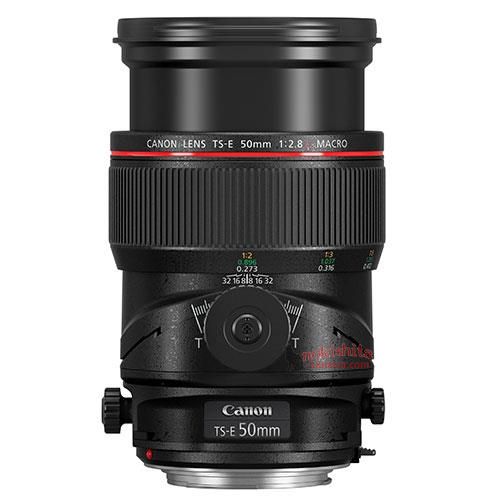
Specifications & Images of the Upcoming Canon Lenses

keithcooper said:
Yes, it does, but it's the sort of thing where you can quickly come up against the maximum tilt and limitations of the razor thin DOF. It can give ugly OOF areas as well.

I have stacked tilted shots to get a thicker focal plane, but it can be fiddly to set up - not for anything alive...

Oh I definitely agree on the stacking, no good way to do it in the field. I'm a big fan of stacking at the microscopic level. I have a specimen manipulator setup that I use.

Something I'm considering is that if I add extension tubes to this theoretical 50mm lens, it's inevitably going to get darker with the increased magnification ("effective f-stop" I think?). I'm going to be using the MT-24EX (and I'm guessing an adapter?) to compensate.

Right now my solution with the MP-E 65mm is to set the lens up at 1x to give me the results I want, and with increased magnification I open up on aperture. Usually this is somewhere between f/11-f/14, ISO200, and between 1/160 and 1/200 shutter at 1x. On the way up to 5x, the aperture changes but nothing else does. This has fairly repeatable results for almost any situation, and the only thing you have to worry about is killing your background and turning it all black. Sometimes the background being blacked out looks ok, but more often than not you'd like to have a nice colored backdrop. Examples of both:

36294961380_c6c0b714de_z.jpg


36566669752_cf78c9c278_z.jpg


To give an example of where I am thinking (possibly incorrectly) that this new lens will benefit me is a shot like this. A gorgeous spined assassin bug that I was only able to have enough DoF for his large right forearm and head. Since I am angled down, would this shot not benefit from tilt so that the abdomen is in focus as well? He stands less than 1cm tall, and from the DoF calculators that I am looking at this lens should have just under 2cm in focus at the minimum focusing distance at f/13.

36294992090_437f9eaf19_z.jpg


I have read up on your discussion and articles of tilt shifts, and I'm assuming if I have my J and all that lined up correctly, with some extension tubes I should be able to lay the focus plane flat. I also understand that with the increased magnification I am going to lose DoF.

Basically I am REALLY looking forward to an article from you on tilt shift macro ;D
 
Upvote 0
Drainpipe said:
keithcooper said:
Yes, it does, but it's the sort of thing where you can quickly come up against the maximum tilt and limitations of the razor thin DOF. It can give ugly OOF areas as well.

I have stacked tilted shots to get a thicker focal plane, but it can be fiddly to set up - not for anything alive...

Oh I definitely agree on the stacking, no good way to do it in the field. I'm a big fan of stacking at the microscopic level. I have a specimen manipulator setup that I use.

Something I'm considering is that if I add extension tubes to this theoretical 50mm lens, it's inevitably going to get darker with the increased magnification ("effective f-stop" I think?). I'm going to be using the MT-24EX (and I'm guessing an adapter?) to compensate.

Right now my solution with the MP-E 65mm is to set the lens up at 1x to give me the results I want, and with increased magnification I open up on aperture. Usually this is somewhere between f/11-f/14, ISO200, and between 1/160 and 1/200 shutter at 1x. On the way up to 5x, the aperture changes but nothing else does. This has fairly repeatable results for almost any situation, and the only thing you have to worry about is killing your background and turning it all black. Sometimes the background being blacked out looks ok, but more often than not you'd like to have a nice colored backdrop. Examples of both:

36294961380_c6c0b714de_z.jpg


36566669752_cf78c9c278_z.jpg


To give an example of where I am thinking (possibly incorrectly) that this new lens will benefit me is a shot like this. A gorgeous spined assassin bug that I was only able to have enough DoF for his large right forearm and head. Since I am angled down, would this shot not benefit from tilt so that the abdomen is in focus as well? He stands less than 1cm tall, and from the DoF calculators that I am looking at this lens should have just under 2cm in focus at the minimum focusing distance at f/13.

36294992090_437f9eaf19_z.jpg


I have read up on your discussion and articles of tilt shifts, and I'm assuming if I have my J and all that lined up correctly, with some extension tubes I should be able to lay the focus plane flat. I also understand that with the increased magnification I am going to lose DoF.

Basically I am REALLY looking forward to an article from you on tilt shift macro ;D

Most of that goes over my head, I know nothing about macro photography or the use of tilt shift lenses for macro work but just wanted to say those are wonderful photographs, the colours in the first one are great but I really love the second one. Was that spider dead? Or just sitting very still.

I'm mainly a landscape photographer and have over the years used the 17 and 24 TS lenses a lot and come to love them - so nice to have trees stay straight!

It really makes me think that Canon are being smart to bring out these new TS lenses - whether it's landscape or architecture or macro or product photography I think there is a lot of demand out there.
 
Upvote 0
Compared to the 135 2.0 (rather light and compact, really sharp wide open, maybe the fastest AF when it was released, extremely reliable focusing even wide open on moving subjects) i never understood why the 85 1.2 was such a slow, fat and hesitant monster. hope they fixed it with the new version, however i guess the price will be astronomical and way above 2000€/$.
 
Upvote 0
mjg79 said:
Most of that goes over my head, I know nothing about macro photography or the use of tilt shift lenses for macro work but just wanted to say those are wonderful photographs, the colours in the first one are great but I really love the second one. Was that spider dead? Or just sitting very still.

I'm mainly a landscape photographer and have over the years used the 17 and 24 TS lenses a lot and come to love them - so nice to have trees stay straight!

It really makes me think that Canon are being smart to bring out these new TS lenses - whether it's landscape or architecture or macro or product photography I think there is a lot of demand out there.

That spider was actually a very active mother that was protecting a clutch of eggs! She stayed still for at least 1/160th ;D

And that's my other plan: buy this as a landscape lens and macro if it works.
 
Upvote 0
Drainpipe said:
mjg79 said:
Most of that goes over my head, I know nothing about macro photography or the use of tilt shift lenses for macro work but just wanted to say those are wonderful photographs, the colours in the first one are great but I really love the second one. Was that spider dead? Or just sitting very still.

I'm mainly a landscape photographer and have over the years used the 17 and 24 TS lenses a lot and come to love them - so nice to have trees stay straight!

It really makes me think that Canon are being smart to bring out these new TS lenses - whether it's landscape or architecture or macro or product photography I think there is a lot of demand out there.

That spider was actually a very active mother that was protecting a clutch of eggs! She stayed still for at least 1/160th ;D

And that's my other plan: buy this as a landscape lens and macro if it works.
When it comes to spiders Jumping spiders are the worst subjects(unless you are out photographing on cold morning). Right now I have few tarantulas and trapdoor spiders from western ghats to photograph and they sit still with flash firing 20-30 times while I am taking photos for stacking. In my experience butterflies, some flies and jumping spiders are literal pain to get good stack series unless you are taking benefit of cold winter mornings.
 
Upvote 0
Actually now that I think about it, it's *possible* that it would be like the 16-35 line; this may be a more intermediately priced offering, with an updated version of the 1.2 also in the works to sit atop the 85mm line and have the best optical performance. I would fully expect a hefty price increase in that case.

Although, on the other hand, the difference between 1.4 and 1.2 is less significant than the difference between 2.8 and 4...and with the 5DSR I would take 1.4 and IS over 1.2 without thinking twice...
 
Upvote 0
Act444 said:
Actually now that I think about it, it's *possible* that it would be like the 16-35 line; this may be a more intermediately priced offering, with an updated version of the 1.2 also in the works to sit atop the 85mm line and have the best optical performance. I would fully expect a hefty price increase in that case.

Although, on the other hand, the difference between 1.4 and 1.2 is less significant than the difference between 2.8 and 4...and with the 5DSR I would take 1.4 and IS over 1.2 without thinking twice...

Canon have to be careful though, the 16-35 F4 is on par in sharpness to my 35L mkii. The more expensive and faster glass would have to justify the fee other than light gathering ability.
 
Upvote 0
Drainpipe said:
...

I have read up on your discussion and articles of tilt shifts, and I'm assuming if I have my J and all that lined up correctly, with some extension tubes I should be able to lay the focus plane flat. I also understand that with the increased magnification I am going to lose DoF.

Basically I am REALLY looking forward to an article from you on tilt shift macro ;D

The problem may well be that you likely won't get the tilt you want at macro magnifications

The tilt tables (and J distance) become increasingly difficult work out and to apply at close focus distances, and I use the iterative method I also describe for focusing with tilt.

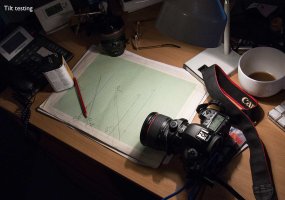
I've been experimenting with the TS-E 90 and 65mm of extension (and the 24 and 17) and this is my desk after quite a few different settings. The lines near the pencil are the focal planes at ∞ with and without full tilt and focus adjustment - note that the tilt doesn't give that much effect at 90mm. The magnification with the tubes is not quite 1:1 (nearer 0.75 x)

If I get a chance I'll do a write up over the weekend, but my suspicion is that the obtainable effects are not going to be as pronounced as many might wish...
 

Attachments

  • tilt-testing.jpg
    tilt-testing.jpg
    229.6 KB · Views: 191
Upvote 0
wockawocka said:
Act444 said:
Actually now that I think about it, it's *possible* that it would be like the 16-35 line; this may be a more intermediately priced offering, with an updated version of the 1.2 also in the works to sit atop the 85mm line and have the best optical performance. I would fully expect a hefty price increase in that case.

Although, on the other hand, the difference between 1.4 and 1.2 is less significant than the difference between 2.8 and 4...and with the 5DSR I would take 1.4 and IS over 1.2 without thinking twice...

Canon have to be careful though, the 16-35 F4 is on par in sharpness to my 35L mkii. The more expensive and faster glass would have to justify the fee other than light gathering ability.

You've a good point - I had version II of the 16-35 2.8 lens, wasn't thrilled with it but kept it anyway...fully planned to upgrade to version III until the f4 IS version came out. Ended up trading in my old 2.8 for the f4 IS version, now I find it good enough for my needs and have not (yet) seen a need to pick up or upgrade to the 2.8 III.
 
Upvote 0
I for one am looking very forward to this lens. I sold my 85mm 1.2L II in anticipation for this one. I primarily shoot with my Sigma 135mm 1.8 Art (which I absolutely love), but there have been times where I wish I had the 85mm for tighter situations.
 
Upvote 0
Ladislav said:
So 50 TS-E will extend when focusing? That is a disappointment. I expected same design as 24 TS-E II which does not extend.

canon_2-1.jpg

I'd hazard a guess that this is related to .5x max magnification, in a similar way that the 24-70 F/4L IS extends to provide additional macro magnification. I'd be curious to see if it zooms during the entire focus cycle, or only when you approach max close focus. I'm also curious to see if the 90 and 135 extend.

I'm not really the target audience for these tilt shifts, but I'm interested to see the results and how they work out. It wouldn't hurt to be able to pile both a macro lens and a tilt-shift lens into one specialist lens, rather than buying a macro and a tilt-shift for both effects.

I think Canon has totally sold me on the new 85mm if they can keep the price somewhat reasonable though. I wouldn't be surprised if the 85mm ends up in my hands by Christmas. (Is there a rumor yet about the release date?)
 
Upvote 0
Ladislav said:
So 50 TS-E will extend when focusing? That is a disappointment. I expected same design as 24 TS-E II which does not extend.

canon_2-1.jpg
The clue would, I suspect, be in the name - Macro ... that and the longer focal length.

The 24 and 17mm are retrofocus designs (they don't work at all well with extension tubes)

The current 90 and 45 are very different designs, so I'd expect the 50 to be broadly similar. The 90 ad 135 both extend in the latest pics

What's the issue with extension?
 
Upvote 0
Ladislav said:
I think Canon has totally sold me on the new 85mm if they can keep the price somewhat reasonable though. I wouldn't be surprised if the 85mm ends up in my hands by Christmas. (Is there a rumor yet about the release date?)

Based on the 35/1.4II pictures and release, it will probably be announced early next week and ship in late September.

Another picture:

canon_4.jpg
 
Upvote 0
DigiAngel said:
Compared to the 135 2.0 (rather light and compact, really sharp wide open, maybe the fastest AF when it was released, extremely reliable focusing even wide open on moving subjects) i never understood why the 85 1.2 was such a slow, fat and hesitant monster. hope they fixed it with the new version, however i guess the price will be astronomical and way above 2000€/$.

I've often wondered that myself. Both the 50/1.0 and 85/1.2 suffered with that strange and slow focus - could a more modern system nowadays make such a lens perform better or is there an inherent limitation with such extreme apertures? I suppose the size and weight will be unavoidable. But it is an alluring prospect - imagine an 85/1.2 that focused like the 135.

The 135L is an example of when a manufacturer finds a near perfect formula and just hits it out the park. It happens from time to time - other examples would be the Zeiss 21mm/2.8, the Nikon 14-24, the Contax/Rollei Zeiss 35/1.4, the Nikon Noct, Canon's 24mm TS-E - just lenses that perform so perfectly for their intended role. The 135L is very much in that category which is why after all these years it is still for most people the best choice for a 135mm lens.

Many people would put the 85L in that category of special lenses of course and in terms of image quality it deserves to be but its overall use is hurt by the auto focus I think. Perhaps the coming 1.4 lens is an admission that a 1.2 lens will always be compromised? I don't know enough about lens design to be able to say. Has anyone else ever made a full frame lens faster than 1.4 that has fast autofocus?
 
Upvote 0
keithcooper said:
The clue would, I suspect, be in the name - Macro ... that and the longer focal length.

The 24 and 17mm are retrofocus designs (they don't work at all well with extension tubes)

The current 90 and 45 are very different designs, so I'd expect the 50 to be broadly similar. The 90 ad 135 both extend in the latest pics

What's the issue with extension?
I own the TS-E 45 and it does not extend when focusing.
 
Upvote 0
littleB said:
keithcooper said:
The clue would, I suspect, be in the name - Macro ... that and the longer focal length.

The 24 and 17mm are retrofocus designs (they don't work at all well with extension tubes)

The current 90 and 45 are very different designs, so I'd expect the 50 to be broadly similar. The 90 ad 135 both extend in the latest pics

What's the issue with extension?
I own the TS-E 45 and it does not extend when focusing.

Ah - good to know, since it's a few years since I tried one.

Looks as if the 50mm extension is likely for the macro aspect then
 
Upvote 0
mjg79 said:
DigiAngel said:
Compared to the 135 2.0 (rather light and compact, really sharp wide open, maybe the fastest AF when it was released, extremely reliable focusing even wide open on moving subjects) i never understood why the 85 1.2 was such a slow, fat and hesitant monster. hope they fixed it with the new version, however i guess the price will be astronomical and way above 2000€/$.

I've often wondered that myself. Both the 50/1.0 and 85/1.2 suffered with that strange and slow focus - could a more modern system nowadays make such a lens perform better or is there an inherent limitation with such extreme apertures? I suppose the size and weight will be unavoidable. But it is an alluring prospect - imagine an 85/1.2 that focused like the 135.

The 135L is an example of when a manufacturer finds a near perfect formula and just hits it out the park. It happens from time to time - other examples would be the Zeiss 21mm/2.8, the Nikon 14-24, the Contax/Rollei Zeiss 35/1.4, the Nikon Noct, Canon's 24mm TS-E - just lenses that perform so perfectly for their intended role. The 135L is very much in that category which is why after all these years it is still for most people the best choice for a 135mm lens.

Many people would put the 85L in that category of special lenses of course and in terms of image quality it deserves to be but its overall use is hurt by the auto focus I think. Perhaps the coming 1.4 lens is an admission that a 1.2 lens will always be compromised? I don't know enough about lens design to be able to say. Has anyone else ever made a full frame lens faster than 1.4 that has fast autofocus?

It is all in the design, it is actually derived from the old FD 85/1.2 formula (1976), but heavily changed (the EF Mk1 which is not too different to the Mk2 still dates back to 1989). The EF mount opening is just enough for the glass needed. And with this formula, it is the front group that has to move, which is really big and heavy (and can't really be moved mechanically, needs electronic coupling for manual focus).

So yes, they can do something completely new with a clean sheet design. But those development costs will have to be embedded in the price as well.

By the way, looking at examples with the latest focusing systems, in some situations when it is already locked on the target it can track fairly well, it really doesn't seem that bad overall considering its design.

https://www.youtube.com/watch?v=1FgYrB-DYQY


So a fast glass with fast (and precise) autofocus is really not that easy to make and there are other considerations regarding the type of glass used.

For instance, the Nikkor 105/1.4 existed in a more compact form using fluorite glass instead of ED, it may have been smaller and lighter, but the price would have been astronomically high (just like that Canon 50/1.0L)

Look at the Sigma 50 1.4 ART compared to the Canon 50 1.2 L. Yes, it is (truly) internally focusing, but it is also double the size and weight, and it is still not super quick at focusing.
Same with the Sony Zeiss FE 50 1.4 ZA and Leica Summilux-SL 50 1.4 both are huge and heavy, and they are not even SLR lenses.

Yes the 135/2 is still an impressive lens (135mm lenses seem to be a lot easier to design), but compared to the Sigma 135/1.8 it starts to show its age (even though the latter is - again - huge and heavy and probably not quite as good with AF).
 
Upvote 0
keithcooper said:
The problem may well be that you likely won't get the tilt you want at macro magnifications

The tilt tables (and J distance) become increasingly difficult work out and to apply at close focus distances, and I use the iterative method I also describe for focusing with tilt.

I've been experimenting with the TS-E 90 and 65mm of extension (and the 24 and 17) and this is my desk after quite a few different settings. The lines near the pencil are the focal planes at ∞ with and without full tilt and focus adjustment - note that the tilt doesn't give that much effect at 90mm. The magnification with the tubes is not quite 1:1 (nearer 0.75 x)

If I get a chance I'll do a write up over the weekend, but my suspicion is that the obtainable effects are not going to be as pronounced as many might wish...

If I am looking at this right, the sensor plane vs focal plane has about a 30° angle between them, correct? To me I think that would make a huge difference. To be honest that is about the result I was expecting. I'm not expecting these lenses to be miracle workers ;D
 
Upvote 0