Speedlite zoom setting in flash modifiers and camera ISO (with test results!)

IMG_0001

Amateur photon abductor
Nov 11, 2013
364
0
7,251
Hello dear fellows,

In the last few months, I've been eager to start artificial lighting more seriously and I've been looking around for general knowledge on how to light my subjects correctly. Now, I think the cosmetic part of lighting I can deal with. However, now that I've acquired a pair of light stands and flash modifiers for my speedlites (nothing fancy really, just a pair of small 33'' umbrellas and two brolly boxes, 1 is 33'' and the other 40'') I'm a bit underwhelmed by the light intensity I'm able to achieve. Admittedly, I was expecting those modifiers to be a bit big for a single speedlite. Yet, the 33'' brolly needs to be at about 1m max to have somewhat decent exposure and this seems close to my untrained eye, not much room for composition if I want to avoid seeing the box in the image.

I've mainly tried to shoot in a dark room (light colored walls so stray light is bouncing all over) at ISO 100 and apertures from 2.8 and up. The flash unit is a Sigma EF610DG Super. Supposed to output GN61m at 105mm zoom, but I've mostly tried with the head at the 24mm setting to reduce the hotspot in the brolly. Now my questions are, as the title says:

1 - What zoom setting is best to maximize brightness in a light diffuser?
2 - Is it reasonable to shoot ISO 100 for a single off-camera speedlite?

I've tried some guesswork in playing with the various settings at hand, but since I've not been systematic enough, I did not come to any valid conclusions. Researching the web on those topics also provided me with all and the opposite as an answer. Possibly this post by Neuro was the most helpful I've found, but I'm not sure how this relates to big modifiers (http://www.canonrumors.com/forum/index.php?topic=18529.msg346022#msg346022 ). Therefore, I'd be interested in hearing how people around here set-up.
 
Re: Speedlite zoom setting in flash modifiers and camera ISO

1: You need to do your own test with your own gear. Set up the flash and modifier and point the camera directly at it, then take your shot, close down until you see the pattern of the flash in the mod and adjust your zoom to suit.
2: Only for narrow dof images in general. ISO 200 gives your flash, effectively, twice as much power, why not use it? With well exposed subjects iso can easily be used at 400 and 800 even in older cameras, just not for low key stuff. But I already demonstrated that for you http://www.canonrumors.com/forum/index.php?topic=20523.msg388422#msg388422

Hands on testing trumps all internet "opinions" don't forget at least half the posters on any subject don't have a clue what they are talking about.
 
Upvote 0
Re: Speedlite zoom setting in flash modifiers and camera ISO

+1 for testing. However, your setup sounds like it ought to work, unless your flashes are too weak.

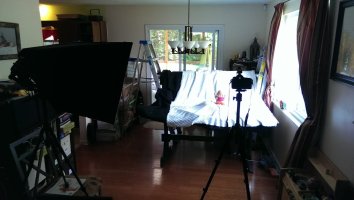
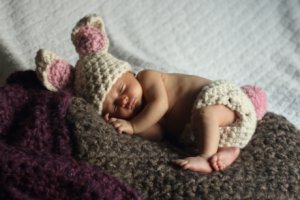
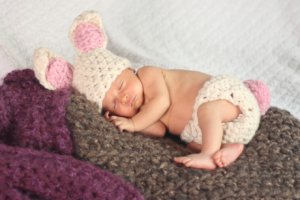
In the following shot you'll see a (super-messy) setup I used to do some shots last weekend. The softbox is about 40''. It was a good 2m away from the subject and the flash (a crappy, old sunpak) was at 1/16 power.

In the first shot the window seems to be casting a lot of light, but as you'll see in the following two (one with the flash on and one with the flash off) the window only provided fill.

The settings I used were: ISO 200, f/1.4, 1/160
 

Attachments

  • setup.jpg
    setup.jpg
    150.3 KB · Views: 520
  • no_flash.jpg
    no_flash.jpg
    130.1 KB · Views: 523
  • with_flash.jpg
    with_flash.jpg
    128.1 KB · Views: 483
Upvote 0
Re: Speedlite zoom setting in flash modifiers and camera ISO

I shoot ISO 100 with speedlights in modifiers all the time. They're plenty powerful enough. The only time I come anywhere close not having enough power is if I'm painting a background a color and/or I'm shooting at really small apertures (f/18+).

As to the question 'why not use higher ISO', because I usually don't want any ambient 'noise' and I prefer to work with the lights on. If I'm doing small aperture stuff then I'll bump it up a bit, but normally I'm below 1/4 power on my speedlights anyway so I figure why not minimize noise and ambient light.

OP: Something is wrong with your setup. At f/2.8 and ISO 100 I have had to put ND filters on my flashes because the minimum setting is sometimes still too powerful even through a modifier.
 
Upvote 0
Re: Speedlite zoom setting in flash modifiers and camera ISO

privatebydesign said:
1: You need to do your own test with your own gear. Set up the flash and modifier and point the camera directly at it, then take your shot, close down until you see the pattern of the flash in the mod and adjust your zoom to suit.
2: Only for narrow dof images in general. ISO 200 gives your flash, effectively, twice as much power, why not use it? With well exposed subjects iso can easily be used at 400 and 800 even in older cameras, just not for low key stuff. But I already demonstrated that for you http://www.canonrumors.com/forum/index.php?topic=20523.msg388422#msg388422

Hands on testing trumps all internet "opinions" don't forget at least half the posters on any subject don't have a clue what they are talking about.

Thanks Private,

I've taken a few pictures of the modifier, it provided a good insight on the light distribution, but I felt it was hard to judge on the intensity. Probably, by proceeding rigorously I will get to the point I want. I think I'll try to see if I can convert to B&W and posterize on a few levels to compare the contours and intensity of the light.

I was reluctant to use higher ISOs because, as you said, 1 ISO stop is like giving your flash twice the power, but it also effectively gives ambient light twice the power. Therefore, changing the ISO might also change the feeling of the image drastically. I'm not all that fussy about noise though, I can work around it.

I do intend to test for myself as there is no replacement for experience. Nonetheless, I felt that I could make use of others knowledge to guide those experiments. In my original post, I almost said that I was turning to CR to get some more info pointing in all directions, but I refrained thinking that may be some might not be amused and keep their answer for themselves. Honestly, I feel I've been around CR long enough to weight most answers, as opposed to info gathered from the internet in general.
 
Upvote 0
Re: Speedlite zoom setting in flash modifiers and camera ISO

anthonyd said:
+1 for testing. However, your setup sounds like it ought to work, unless your flashes are too weak.

In the following shot you'll see a (super-messy) setup I used to do some shots last weekend. The softbox is about 40''. It was a good 2m away from the subject and the flash (a crappy, old sunpak) was at 1/16 power.

In the first shot the window seems to be casting a lot of light, but as you'll see in the following two (one with the flash on and one with the flash off) the window only provided fill.

The settings I used were: ISO 200, f/1.4, 1/160

Thanks,

It is amazing how light can really shape the subject being photographed. You would never guess that the the subject in the first and last image is the same ;)
 
Upvote 0
Re: Speedlite zoom setting in flash modifiers and camera ISO

Skirball said:
I shoot ISO 100 with speedlights in modifiers all the time. They're plenty powerful enough. The only time I come anywhere close not having enough power is if I'm painting a background a color and/or I'm shooting at really small apertures (f/18+).

As to the question 'why not use higher ISO', because I usually don't want any ambient 'noise' and I prefer to work with the lights on. If I'm doing small aperture stuff then I'll bump it up a bit, but normally I'm below 1/4 power on my speedlights anyway so I figure why not minimize noise and ambient light.

OP: Something is wrong with your setup. At f/2.8 and ISO 100 I have had to put ND filters on my flashes because the minimum setting is sometimes still too powerful even through a modifier.

Thanks,

This was the kind of info that I was looking for to benchmark my tests.

I think I need to check that my flash is behaving adequately. I'll have a go tonight with a fresh set of batteries and a static model and light setup. I did felt like ISO 100, F2.8 and the light at 1m and full power should just be plenty powerful.
 
Upvote 0
Re: Speedlite zoom setting in flash modifiers and camera ISO

IMG_0001 said:
1 - What zoom setting is best to maximize brightness in a light diffuser?

StoFen:


Honl Heavy Frost:


Click through for test descriptions, and there are images in the set for the Honl snoots and grids, too.
 
Upvote 0
Re: Speedlite zoom setting in flash modifiers and camera ISO

neuroanatomist said:
IMG_0001 said:
1 - What zoom setting is best to maximize brightness in a light diffuser?

StoFen:


Honl Heavy Frost:


Click through for test descriptions, and there are images in the set for the Honl snoots and grids, too.

Thanks Neuro,

I had seen this thread already, but I was not sure on how to extrapolate those results to larger diffusers so I'll take the opportunity to ask you to help me think this out.

Basically, it looks to me like under 35mm, or even 50mm, the efficiency of the reflector is very low and there is a lot of power loss. As a result, for small diffusers that will get completely lit anyways, just going up to 50mm is likely to improve the general intensity of the output.

However, if the diffuser is bigger, it seems to me that concentrating the light is likely to bias the light towards the section directly lit by the flash while the rest of the diffuser will only be comparatively faintly lit. This would then translate to a uneven lighting of the subject if I'm correct.

As other have said, I guess I'll need to try this for my particular setup.
 
Upvote 0
Re: Speedlite zoom setting in flash modifiers and camera ISO

The whole point of a diffuser is soften the light; use the widest setting you can (don't use the pulldown wide angle option) that doesn't shoot outside the umbrella. With the brollys it doesn't matter. And I don't know if your previous question was answered: a single speedlight can do just fine in a 43" umbrella.

But something is wrong, ISO 100, f/2.6 and flash at full power should be nuking your subject, even at a meter. What are you using to trigger? You don't happen to have any filters on your lens do you? Do you just have the one flash? I suggest trying another.
 
Upvote 0
Re: Speedlite zoom setting in flash modifiers and camera ISO

Skirball said:
The whole point of a diffuser is soften the light; use the widest setting you can (don't use the pulldown wide angle option) that doesn't shoot outside the umbrella. With the brollys it doesn't matter. And I don't know if your previous question was answered: a single speedlight can do just fine in a 43" umbrella.

But something is wrong, ISO 100, f/2.6 and flash at full power should be nuking your subject, even at a meter. What are you using to trigger? You don't happen to have any filters on your lens do you? Do you just have the one flash? I suggest trying another.

I don't have a filter on the lens and the flash is my only one with good manual power. My other flashes are either an old small manual flash with only 3 power settings or another with GN55m, but that only do ETTL or full power so it could only be used to gain a stop if the Sigma is not powerful enough for some situation. The triggering is via the camera flash, but as a commander only. This way I can set the off camera flash power from my camera but the small flash does not contribute to the exposure.
 
Upvote 0
Re: Speedlite zoom setting in flash modifiers and camera ISO

So I did a series of more systematic test on a new set of batteries. First conclusion, the new batteries solved the power issue. As I don't use my flashes that often, I did not realize how slow the recycling was until I put the new battery set. My bad there...

Second conclusion, the walls of the room I inteded to use for occasional shoots are too light and the flash light just bounces everywhere. I knew it would, I just did not expect it would be that bad. The room is about 3m x 4m (9'x12') so its also a bit cramped.

Finally, the wide angle coverage does even out the light significantly and the general output loss is not that bad I think. However, up to 50mm, it does not look too bad. I'll try to post the resulting images and a more thorough analysis tomorrow evening.

Thanks everyone.
 
Upvote 0
Re: Speedlite zoom setting in flash modifiers and camera ISO

IMG_0001 said:
So I did a series of more systematic test on a new set of batteries. First conclusion, the new batteries solved the power issue. As I don't use my flashes that often, I did not realize how slow the recycling was until I put the new battery set. My bad there...

Second conclusion, the walls of the room I inteded to use for occasional shoots are too light and the flash light just bounces everywhere. I knew it would, I just did not expect it would be that bad. The room is about 3m x 4m (9'x12') so its also a bit cramped.

Finally, the wide angle coverage does even out the light significantly and the general output loss is not that bad I think. However, up to 50mm, it does not look too bad. I'll try to post the resulting images and a more thorough analysis tomorrow evening.

Thanks everyone.

Only way to beat that is to use lower power and put the lights very close and baffle them, either grids, flags, snoots etc.
 
Upvote 0
Re: Speedlite zoom setting in flash modifiers and camera ISO

privatebydesign said:
IMG_0001 said:
So I did a series of more systematic test on a new set of batteries. First conclusion, the new batteries solved the power issue. As I don't use my flashes that often, I did not realize how slow the recycling was until I put the new battery set. My bad there...

Second conclusion, the walls of the room I inteded to use for occasional shoots are too light and the flash light just bounces everywhere. I knew it would, I just did not expect it would be that bad. The room is about 3m x 4m (9'x12') so its also a bit cramped.

Finally, the wide angle coverage does even out the light significantly and the general output loss is not that bad I think. However, up to 50mm, it does not look too bad. I'll try to post the resulting images and a more thorough analysis tomorrow evening.

Thanks everyone.

Only way to beat that is to use lower power and put the lights very close and baffle them, either grids, flags, snoots etc.

I was planning on using the room we're setting up for our upcoming 2nd son as an occasional studio, but after trying it out, I think I will stick to the larger living room. It is about 4m x 6m and thinking of it, it also has a NorthX North East facing patio door that could be used as key sometimes. Itappeared to be more of a hassle to setup, but if I can reduce the baffling/flagging work and have more room for composing, it is probably worth it.
 
Upvote 0
Re: Speedlite zoom setting in flash modifiers and camera ISO

privatebydesign said:
Only way to beat that is to use lower power and put the lights very close

Exactly, as they were intended. If your light source is a foot or two from your subject then the light that goes across the room and bounces back is going to be relatively insignificant. For the average guy working out of his livingroom it's not going to be an issue.
 
Upvote 0
Re: Speedlite zoom setting in flash modifiers and camera ISO

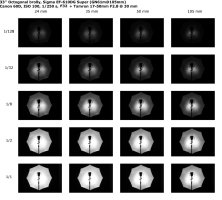
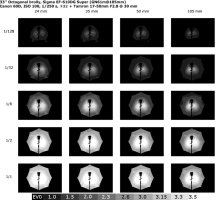
For everyone enjoyment, I did a chart of the lighting evenness in my 33'' brolly results for different zoom setting and flash power. Basically, 24 mm and 35 mm appear to be best for light evenness and appear to provide about the same intensity as 105 mm. Therefore, not much loss inside the reflectors it appears and no reasons to zoom out.

Note that the flash head was pointed at -7o in order to light the center of the brolly as best as possible. The second image is posterized to 10 levels and the greyscale indicate the relative exposure values from the diffuser area. EDIT: The greyscale should be read the other way around with black as 0 and +3.5 for white. I'll try to update the chart with a corrected scale.Edit 2: Figure 2 greyscale corrected. Edit 3: Aperture was F32, not F2.8, another update will follow. Sorry for the inconvenience. Edit 4: Updated aperture.
 

Attachments

  • Brolly_Test_Merged_Lum_Desaturate_small.jpg
    Brolly_Test_Merged_Lum_Desaturate_small.jpg
    104.2 KB · Views: 429
  • Brolly_Test_Merged_Lum_Desaturate_10levels_small.jpg
    Brolly_Test_Merged_Lum_Desaturate_10levels_small.jpg
    116.6 KB · Views: 415
Upvote 0
Hey all,

Ok, I might be over simplifying this in my head, so please correct me if my line of thinking is off here....

Since the flash head zoom correlates to the focal length of the lens, at least in TTL, to find the appropriate flash zoom to fill a modifier, place your lens where the flash head would be in the modifier, if possible i.e. umbrella or mounted on the back of a softbox, and use the FL needed to just see the outer edges of the modifier. Then, the ISO and flash power settings would be adjusted for achieving the desired exposure. That way, the flash zoom for a particular modifier would be a consistent value. Again, let me know if this line of thinking is off the mark.

Gary W.
 
Upvote 0
Gary W. said:
Hey all,

Ok, I might be over simplifying this in my head, so please correct me if my line of thinking is off here....

Since the flash head zoom correlates to the focal length of the lens, at least in TTL, to find the appropriate flash zoom to fill a modifier, place your lens where the flash head would be in the modifier, if possible i.e. umbrella or mounted on the back of a softbox, and use the FL needed to just see the outer edges of the modifier. Then, the ISO and flash power settings would be adjusted for achieving the desired exposure. That way, the flash zoom for a particular modifier would be a consistent value. Again, let me know if this line of thinking is off the mark.

Gary W.

I don't know what zoom has to do with exposure. But yes, that is how I determined how wide I could go on my umbrellas. If it spills outside the umbrella, then it's too wide; go as wide as you can without spill. I never bothered to look at the highlight pattern within the umbrella, I just figured wider is better. With a brolly or a softbox it doesn't matter, there is no spill; I just set it to 24mm. For reference, I set my flash to 28mm with umbrellas. A couple of mine could go to 24 and a couple leaked at that setting so I just set them all to 28 so I don't have to worry about which is which.
 
Upvote 0
Hey all,

I wasn't saying flash zoom had something to do with exposure, just the adjustment to fill the modifier used to it's edges. One softbox may require a flash zoom of 24mm, another one 28mm or 35mm, maybe, depending on the size and shape of the modifier.

Gary W.
 
Upvote 0
A couple of questions:
1) are you using ETTL?
2) how are you calculating the correct aperture to use? Are you using a light meter?
I find that ETTL never works properly when I use speedlites with light modifiers and it often results in a shot that is under exposed. The camera's meter is easily fooled, for example if your model moves slightly or if you change the composition.
Using a light meter will allow you to set the exposure accurately and then, once set, you don't need to change it. Just leave the speedlites on manual and they will produce the same amount of light for every shot. You only need to meter again if you move the speedlites or if you increase or decrease the power.
It will also let you see the ratio of flash to ambient light and it will allow you to alter the balance between your speedlites, for example if you want the key light to be more powerful than the fill light.
The zoom setting really only changes the character of the light - so use a telephoto setting if you want to create a highlight on your subject, or a wide angle setting of you want a more even spread of light.
When using a softbox or umbrella I leave my speedlites set to 35mm and I find that works quite well.
With regard to the placement of your speedlites - you do need to put them quite close to your model, but this is because it will give the light a much softer, shadowless character. Placing the speedlites a long way from your model will create harsh shadows, which is usually not the effect you want to achieve. I put my speedlites as close as possible to the model, so they are only just out of shot.
Of course a speedlite is usually less powerful than a studio strobe, but that should not be an issue unless you are placing them a long way from your subject
 
Upvote 0