
You are using an out of date browser. It may not display this or other websites correctly.
You should upgrade or use an alternative browser.
You should upgrade or use an alternative browser.
Spiral Arm of the Milky Way above the Texas Desert
- Thread starter Axilrod
- Start date
RomanRacela said:@Axilrod - What was your ISO when you shot these? Was the moon out? If it was, what phase of the moon was it? I'm not sure if having moonlight is important so the foreground illuminated a bit. I too have had difficulty focusing at night.
It's at ISO3200 in both. It was a new moon, but this month was weird, there was no completely full moon, the 11th and 12th just had like a 5% moon, but never was truly new (here: http://www.moonconnection.com/moon-january-2013.phtml).
But I suppose you could use a slight bit of moonlight to your advantage, or you can easily light the foreground with MINIMAL light, I mean even a single tiny LED could light the entire thing with these kind of exposure times. For example, in the shot with the van below, that red/green light inside is actually the little green led on a Macbook Pro charger, and a red LED on a phone charger. Pretty crazy huh? The bright red light in the bottom left corner is the LED on the back of the 5D3 that was doing the time lapse.
16-35L II, ISO3200, f/2.8, 30 seconds (Used a Night Sky preset and exported to show you, post processing a bit too much for me, but you get the idea).

Here is one with nothing in the foreground, so kinda boring, but lot of cool stuff is visible
24LII, ISO3200, f/2, 20 seconds.

Upvote
0
Axilrod said:For those of you looking for dark skies, this light pollution map is great:
http://www.blue-marble.de/nightlights/2010
Great link--thanks!!
Upvote
0
@Axilrod: Thank you for the useful tips. I would love to take shots like that. I especially like the first one.
My only serious problem is that I happen to be almost constantly in densely populated areas with massive light polution, so seeing the milky way like this just doesn't happen. Should I ever happen to get to a reasonably empty area at least now I know the settings to use.
My only serious problem is that I happen to be almost constantly in densely populated areas with massive light polution, so seeing the milky way like this just doesn't happen. Should I ever happen to get to a reasonably empty area at least now I know the settings to use.
Upvote
0
AmbientLight said:@Axilrod: Thank you for the useful tips. I would love to take shots like that. I especially like the first one.
My only serious problem is that I happen to be almost constantly in densely populated areas with massive light polution, so seeing the milky way like this just doesn't happen. Should I ever happen to get to a reasonably empty area at least now I know the settings to use.
Yeah it's all about getting somewhere dark enough and at the right time of the month. I shot some in Oregon in August (where it is pretty damn dark) and there was a half or quarter moon and the pics turned out nothing like this at all. Even if you drive just an hour or so outside of your city it will be a big improvement, shooting in pretty much any city is almost pointless. I wish I had been in New York during the blackouts, that would have been AMAZING!
I used to see pictures of the Milky Way and think that the people were doing something magical and amazing and doing crazy post processing (which in some cases they were), either way it seemed like it was very hard to do. And in some respects it is, but honestly finding dark enough skies is really 90% of it. Like I said, my buddy that has pretty much no experience got some amazing pictures after I adjusted the settings for him.
And if you have a Mark III (or even a Mark II) go ISO 3200, wide open or close to it, and do 600/focal length to determine the maximum exposure you can use before the stars start to blur. Some people do 500/focal length to be safe. And with the ISO you may want to use 1600 if you're only in a medium dark area.
Oh and this one people forget alot, TAPE OVER THE VIEWFINDER! Or use the piece on your neck strap that is designed to go over it (but is difficult to get on and doesn't seem to work very well). Stray light can enter the viewfinder.
Other tips I learned from this experience and past research:
•Use a remote trigger when possible
•Focusing - Get in live view, punch in 10x and move the focus ring close to the infinity mark. You'll see stars come into focus and should be able to eyeball the sweet spot.
•Use Mirror Lockup and Silent Shooting (SS only if you have a Mark III)
•Turn off all in-camera noise reduction
•Tape over viewfinder
•White balance is debatable, but I shot these at 2800K as a starting point. Daylight balanced will make it look yellowish/red. 2800 may look a bit too blue initially, but it's a good point to make adjustments from.
•Take off the neck strap, heavy winds can cause enough movement to screw with the image.
•Be prepared to deal with the environment. Me and a buddy almost used an entire box of 24 hand, toe, and body warmers. Also, get some lights that will shine red, so if you have a time lapse or something going you can turn on the light without worrying about it picking up as much as normal light.
Upvote
0

Axilrod, great Photos & appreciate the posting, this is the reason I like this site, I do a lot of Photography in Africa, mostly wildlife, but this is something I've been thinking on for a while, with your great Post here I'll give it a go in March when I'm back in Botswana. Thanks
Upvote
0

@ Axilrod - thanks for the info. I'll definitely try your tips.
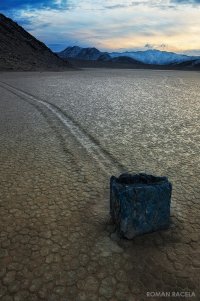
I was in Death Valley last month just before Christmas and was thinking of shooting some Milky Way stuff at Racetrack Playa but the temp was in the 20s and I just couldn't hack the cold. I just ended up shooting some sunrise and sunsets there. Plus, like you said, the Milky Way's bulging disc in the middle wasn't visible so it looked a bit odd to me and didn't give me any extra motivation to stay up. I'll go back there in late spring or early summer and maybe I'll take home with me a Milky Way image.
Here's one from that trip.
I was in Death Valley last month just before Christmas and was thinking of shooting some Milky Way stuff at Racetrack Playa but the temp was in the 20s and I just couldn't hack the cold. I just ended up shooting some sunrise and sunsets there. Plus, like you said, the Milky Way's bulging disc in the middle wasn't visible so it looked a bit odd to me and didn't give me any extra motivation to stay up. I'll go back there in late spring or early summer and maybe I'll take home with me a Milky Way image.
Here's one from that trip.
Attachments
Upvote
0

Axilrod said:Keep in mind these are individual exposures, most of the really insane pictures of the Milky Way you see are a bunch of stacked exposures, but I don't have a tracking mount yet so I couldn't do that.
I know alot of astronomy buffs may be sickened by these, but the general public love shots that look like this. It was a learning experience and I'm thrilled to have had the chance to finally get some shots like these. I'm going back in the summer since that's when the brightest part of the Milky Way is visible.
A few quick comments:
1) Excellent photos! I love the colors and the contrast.
2) I'm somewhere between "general public" and "astronomy buff" (closer to the latter in visual experience and knowledge, but a newbie in terms of astrophotography skills and experience), and I can assure you that nobody would be sickened by these. For starters, this is precisely the right way to start taking nighttime images. And these are phenomenal regardless of how long you've been doing it.
3) You can actually stack photos without tracking, although you might need to do a little photoshop work with the landscape. There is stacking software that takes into account the movement of stars, both lateral and rotation.
And, it is possible to stretch images and sqeeze data out of even relatively short exposure images. Here is an image that I took a number of years ago of Comet 17P-Holmes on a tripod, only 4 seconds exposure at ISO 3200, 200mm @ f/2.8 with a 20D. Not eye-popping by any means, but just showing what you can capture in just a few seconds at a longer focal length (8 seconds started showing exaggerated star trails).

Keep 'em coming!
Regards,
Dave
Upvote
0
Don't just shoot; look and really see.
To the OP: thanks for posting those literally awesome pictures.
I feel like I should share something else about the night sky to those who might be interested. Just go to a really dark place as some on here have advocated, and, if you're a city or suburban bred person, just look. When one hasn't seen it before, it is a revelatory experience like few others you may have in your lifetime.
I grew up in the LA area and then on Long Island - near NYC - and then settled in the suburbs around Detroit. I had never thought much about the night sky at all, except that it was a little better to sleep with less light coming through my widow than during the day.
I remember, when I was about 26 years old, going with an old girlfriend to visit her artist friend who lived in the woods, waaaaay off the beaten track, in the vast empty Michigan Upper Peninsula, in a couple of small sandwiched together mobile homes with the adjoining walls broken down to form a sort of fiberglass and plastic hillbilly castle. We all three sat on the steps leading up to his doorway one chilly November night, and I, certainly not expecting much, had a near religious experience when I looked up to see what seemed to be literally millions of visible stars. I was shocked, astounded. I just silently sat there, open mouthed, and stared for over an hour and a half without uttering a sound. Wow!
I repeated that same experience when out working in the deserts of California, Arizona and Utah. Shooting cars at sunup and sundown brought me to places where light pollution was almost non-existent. Sometimes, when setting up for a dawn shot, we would work on the cars and camera positions until just after the end of "nautical" dusk and then stay the night in vehicles or in sleeping bags until the just-before-dawn call time. My whole crew would typically barbeque some food, drink beer and then smell the occasional burning cigar or wafting bouquet of an assistant's trusty blunt break up the nearly perfect lack of anything from the city . After scaring the new guys with tales of scorpions and rattlers under the tarps and hearing an occasional coyote or other small critter break the otherwise eerie silence, we would all look into the sky and see the miracle of the universe right there before us, in the real world 3-D that makes those plastic glasses and Imax screens seem puny and uninteresting. I kind of wished that someone of us could play some mournful tune on an old harmonica, just to compliment what I felt were the faint voices in the desert wind of the ghosts of all those lonely cowboys of the American West who really had lived under the stars and loved it so much that they stayed living there, in the insufferable deserts and on the desolate prairies, as long as "progress" allowed.
Sometimes, pictures are not enough. Sometimes, you should just put down the camera, to not just record the world, but to live in it. The brilliantly adorned night sky, as countless generations of our long past forbears in song, story and legend saw it, is one excuse to sometimes do just that.
Regards,
David
To the OP: thanks for posting those literally awesome pictures.
I feel like I should share something else about the night sky to those who might be interested. Just go to a really dark place as some on here have advocated, and, if you're a city or suburban bred person, just look. When one hasn't seen it before, it is a revelatory experience like few others you may have in your lifetime.
I grew up in the LA area and then on Long Island - near NYC - and then settled in the suburbs around Detroit. I had never thought much about the night sky at all, except that it was a little better to sleep with less light coming through my widow than during the day.
I remember, when I was about 26 years old, going with an old girlfriend to visit her artist friend who lived in the woods, waaaaay off the beaten track, in the vast empty Michigan Upper Peninsula, in a couple of small sandwiched together mobile homes with the adjoining walls broken down to form a sort of fiberglass and plastic hillbilly castle. We all three sat on the steps leading up to his doorway one chilly November night, and I, certainly not expecting much, had a near religious experience when I looked up to see what seemed to be literally millions of visible stars. I was shocked, astounded. I just silently sat there, open mouthed, and stared for over an hour and a half without uttering a sound. Wow!
I repeated that same experience when out working in the deserts of California, Arizona and Utah. Shooting cars at sunup and sundown brought me to places where light pollution was almost non-existent. Sometimes, when setting up for a dawn shot, we would work on the cars and camera positions until just after the end of "nautical" dusk and then stay the night in vehicles or in sleeping bags until the just-before-dawn call time. My whole crew would typically barbeque some food, drink beer and then smell the occasional burning cigar or wafting bouquet of an assistant's trusty blunt break up the nearly perfect lack of anything from the city . After scaring the new guys with tales of scorpions and rattlers under the tarps and hearing an occasional coyote or other small critter break the otherwise eerie silence, we would all look into the sky and see the miracle of the universe right there before us, in the real world 3-D that makes those plastic glasses and Imax screens seem puny and uninteresting. I kind of wished that someone of us could play some mournful tune on an old harmonica, just to compliment what I felt were the faint voices in the desert wind of the ghosts of all those lonely cowboys of the American West who really had lived under the stars and loved it so much that they stayed living there, in the insufferable deserts and on the desolate prairies, as long as "progress" allowed.
Sometimes, pictures are not enough. Sometimes, you should just put down the camera, to not just record the world, but to live in it. The brilliantly adorned night sky, as countless generations of our long past forbears in song, story and legend saw it, is one excuse to sometimes do just that.
Regards,
David
Upvote
0
RomanRacela said:@ Axilrod - thanks for the info. I'll definitely try your tips.
I was in Death Valley last month just before Christmas and was thinking of shooting some Milky Way stuff at Racetrack Playa but the temp was in the 20s and I just couldn't hack the cold. I just ended up shooting some sunrise and sunsets there. Plus, like you said, the Milky Way's bulging disc in the middle wasn't visible so it looked a bit odd to me and didn't give me any extra motivation to stay up. I'll go back there in late spring or early summer and maybe I'll take home with me a Milky Way image.
Here's one from that trip.
Awesome picture man, yeah some night shots from there would have been sick!
Upvote
0
20Dave said:Axilrod said:Keep in mind these are individual exposures, most of the really insane pictures of the Milky Way you see are a bunch of stacked exposures, but I don't have a tracking mount yet so I couldn't do that.
I know alot of astronomy buffs may be sickened by these, but the general public love shots that look like this. It was a learning experience and I'm thrilled to have had the chance to finally get some shots like these. I'm going back in the summer since that's when the brightest part of the Milky Way is visible.
A few quick comments:
1) Excellent photos! I love the colors and the contrast.
2) I'm somewhere between "general public" and "astronomy buff" (closer to the latter in visual experience and knowledge, but a newbie in terms of astrophotography skills and experience), and I can assure you that nobody would be sickened by these. For starters, this is precisely the right way to start taking nighttime images. And these are phenomenal regardless of how long you've been doing it.
3) You can actually stack photos without tracking, although you might need to do a little photoshop work with the landscape. There is stacking software that takes into account the movement of stars, both lateral and rotation.
And, it is possible to stretch images and sqeeze data out of even relatively short exposure images. Here is an image that I took a number of years ago of Comet 17P-Holmes on a tripod, only 4 seconds exposure at ISO 3200, 200mm @ f/2.8 with a 20D. Not eye-popping by any means, but just showing what you can capture in just a few seconds at a longer focal length (8 seconds started showing exaggerated star trails).
Keep 'em coming!
Regards,
Dave
Thanks for the info! That's good to know, I didn't realize that stacking software could do that. I'm looking into telescopes now, there are so many options it's kind of overwhelming. And that pic makes me wish I had some longer lenses, nice shot.
Upvote
0
Axilrod - Great pictures! especially the one with the van.
I think your tip on removing the neck strap is very valid - it messed up my first attempt at star trails.
But during my later attempts i used the rubbery thing in the neck strap to cover the viewfinder.
I think your tip on removing the neck strap is very valid - it messed up my first attempt at star trails.
But during my later attempts i used the rubbery thing in the neck strap to cover the viewfinder.
Upvote
0
Axilrod said:Go to the Indian Pass Peninsula!
I'm in Pensacola, my astronomy club's dark site is in Blackwater River State forest, VERY nice in winter and about a 55 mile drive. I do astronomy outreach for scout groups that have a campground farther into Blackwater Forest, spectacular skies and very stable air. I frequently head to Gulf Islands National Seashore and nearby Big Lagoon State Park, they're both very close and dark towards the Gulf, not too shabby overhead. Our summer skies are very hit and miss and any location is a serious mosquito feed on summer evenings - August is particularly useless, miserable humid and perpetual thunderstorms. We do somewhat of a 'sidewalk astronomy' gaze at Pensacola Beach two nights per month in the warmer weather, near first quarter moon. Lots of light pollution but with a modified camera and LPR filters it's surprising what can be picked out. Meet a lot of interesting folks from all over who come for a few weeks.
Upvote
0
Thanks for the compliments folks. Just thought of something else. When it's pitch black framing can be very difficult, but try to get it as close as you can on the first try. Shooting 30 second exposures means you can only take a couple pictures a minute at most, so you're not going to end up with as many images as you're used to getting, so try and make them count! Just one more reason to scout the location during the day whenever possible.
Oh, for anyone looking for a way to check out what is going to be where in the night sky, Stellarium (http://www.stellarium.org) is an awesome free application for that. You put in your exact location, and can pick any date and time and it will show you exactly what will be in the sky and you can simulate what you'll see at any speed over any amount of time. It's a must have!
Oh, for anyone looking for a way to check out what is going to be where in the night sky, Stellarium (http://www.stellarium.org) is an awesome free application for that. You put in your exact location, and can pick any date and time and it will show you exactly what will be in the sky and you can simulate what you'll see at any speed over any amount of time. It's a must have!
Upvote
0
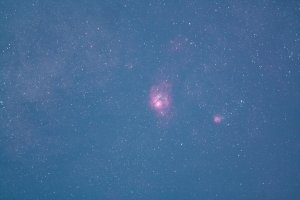
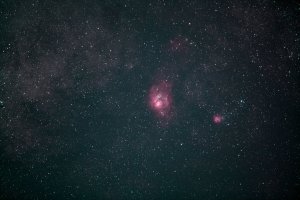
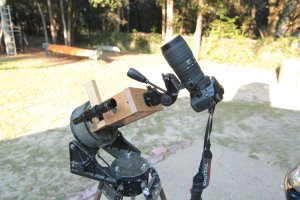
These were shot from VERY light polluted Pensacola Beach during a public stargaze. Before and after gussying up to counter the light pollution. They were taken with a modified 40D using a Sigma 70-200 at 200/2.8. You can pick up a T3i for a song now and have it modified for astro work. Plop it on an equatorial mount with a drive and you have a setup that can do some amazing work. The camera is on my grab and go astrophoto setup. The tripod and drive base are from an old scope that I have since mated to a much better computerized mount. Nothing fancy but it does the job and fits neatly in my motorcyle sidecar when I don't feel like lugging the big guns.
Attachments
Upvote
0
emag said:These were shot from VERY light polluted Pensacola Beach during a public stargaze. Before and after gussying up to counter the light pollution. They were taken with a modified 40D using a Sigma 70-200 at 200/2.8. You can pick up a T3i for a song now and have it modified for astro work. Plop it on an equatorial mount with a drive and you have a setup that can do some amazing work. The camera is on my grab and go astrophoto setup. The tripod and drive base are from an old scope that I have since mated to a much better computerized mount. Nothing fancy but it does the job and fits neatly in my motorcyle sidecar when I don't feel like lugging the big guns.
Wow that's awesome, you could have gotten some amazing stuff in Texas!
Upvote
0
emag said:These were shot from VERY light polluted Pensacola Beach during a public stargaze. Before and after gussying up to counter the light pollution. They were taken with a modified 40D using a Sigma 70-200 at 200/2.8. You can pick up a T3i for a song now and have it modified for astro work. Plop it on an equatorial mount with a drive and you have a setup that can do some amazing work. The camera is on my grab and go astrophoto setup. The tripod and drive base are from an old scope that I have since mated to a much better computerized mount. Nothing fancy but it does the job and fits neatly in my motorcyle sidecar when I don't feel like lugging the big guns.
Oh and what's the story with your equatorial mount? Did you make that yourself?
Upvote
0

Axilrod said:R1-7D said:Absolutely beautiful shots!
20 seconds, hey? That's all it takes to get all the stars like that without a dolly?
Not sure what you mean about the dolly, I guess maybe you're referring to a tracking mount? Yeah this is what you get from 20 seconds when it's pitch black, that's the crucial part.
Yeah, I meant the track mount. Thanks! I am going to have to try this sometime. Finding a completely dark sky is the difficult part.
Upvote
0
Similar threads

L
- Replies
- 12
- Views
- 7K
L