The Canon EOS 90D is Coming Later in 2018 [CR2]

unfocused said:
Excuse my ignorance, but are dynamic range and noise interchangeable? Can a sensor have better noise control without having more dynamic range? I'm unconcerned about dynamic range, but I would like cleaner files.

Not exactly, but close enough if you keep sensor size fixed. Dynamic range in a camera sensor is capped from the top by photosite well capacity (hard cap; the sensor just saturates and no extra information beyond that can be recovered because there isn't any) and from the bottom the noise floor (soft cap; the weaker the signal you're trying to recover the more you amplify noise as well, resulting in lower and lower signal/noise ratio).

At medium to high ISOs nowadays, the noise component of sensor signal is entirely dominated by photon shot noise: the statistical variation expected simply because photons are discrete packets of energy randomly hitting the sensor. The weaker the signal to be amplified, the fewer photons and more random the pattern. The only way to improve that is to gather more photons. This means either using a lower ISO and a longer exposure time (or a bigger aperture), using a larger sensor with larger photosites (or more of them so their signal can be averaged), or making the sensor more effective at gathering light.

If we want to keep exposure and sensor size fixed, the last one is our only option. Not all of the sensor surface is light-sensitive; around every individual photosite there has to be room for wiring and support structure. The photodiode:scaffolding ratio has climbed over the years, but there's a natural cap so diminishing returns are inevitable. Light-focusing microlenses and, more recently, back-side illuminated sensors are some of the ways the effective light-sensitive surface area has been improved.

Most digital cameras utilize Bayer filters over monochrome CMOS sensors to allow color information to be recorded. The color matrix necessarily blocks some of the light as each Bayer cell filters out perfectly good photons that just happen to have a wrong wavelength. Improvements here are based on coming up with dyes that are optimally transparent to photons of the "right" wavelength range. Or you can of course opt to rid of the color filter altogether (see Leica Monochrom and many astro cameras).

Even of those photons that are lucky enough to hit a photodiode, not 100% can be converted to useful signal. The quantum efficiency of a modern CMOS photodiode is somewhere between 50 and 90 percent, depending on wavelength. CCD sensors can have high (~90%) quantum efficiencies which is why they're popular in astro imaging.

Adding all of this up, state-of-the-art sensors are already well over 50% efficient at converting photons exiting the lens to useful signal. So there's less than one stop of improvement possible even in theory, and returns are definitely diminishing.
 
Upvote 0
exquisitor said:
Talys said:
I love my 80D -- it's easily my favorite camera. It literally has everything I want from a camera for most purposes, including size, EXCEPT that the sensor has too much noise for my taste on most photos shot at higher ISOs.

The one thing that I'm looking for that would make me buy this is visibly better higher ISO performance. If it can be as clean as a 6DII at least at ISO 800, I'll seriously consider it. If it's as clean at 1200-1600, I'll buy it in an instant. Maybe this will happen with a new sensor; don't know.

As mistaspeedy already mentioned this is not going to happen. But it would be nice if 90D would be on par with the current 24 MP Sony sensor at high ISO.

Why is it impossible for Canon to make an APSC sensor superior to Sony?
 
Upvote 0
Talys said:
exquisitor said:
Talys said:
I love my 80D -- it's easily my favorite camera. It literally has everything I want from a camera for most purposes, including size, EXCEPT that the sensor has too much noise for my taste on most photos shot at higher ISOs.

The one thing that I'm looking for that would make me buy this is visibly better higher ISO performance. If it can be as clean as a 6DII at least at ISO 800, I'll seriously consider it. If it's as clean at 1200-1600, I'll buy it in an instant. Maybe this will happen with a new sensor; don't know.

As mistaspeedy already mentioned this is not going to happen. But it would be nice if 90D would be on par with the current 24 MP Sony sensor at high ISO.

Why is it impossible for Canon to make an APSC sensor superior to Sony?

Theoretically speaking, if Canon somehow manages to make some new breakthrough, they could make something better than Sony (but I doubt it, since Sony invests HUGE money in cutting edge fabs and sensor technology).
However, this is not the thing we said was 'impossible'.
'Impossible' was referring to huge leaps and strides in APS-C sensor performance to make it match the full frame 6D mark II. The huge difference in sensor size will not be overcome anytime soon.
Anyone who owns any modern APS-C camera, and wants a big leap in performance should be looking to jump to full frame (or get better glass that is 1 or 2 stops faster). Getting a new camera body isnt going to make much difference.
 
Upvote 0
Talys said:
exquisitor said:
Talys said:
I love my 80D -- it's easily my favorite camera. It literally has everything I want from a camera for most purposes, including size, EXCEPT that the sensor has too much noise for my taste on most photos shot at higher ISOs.

The one thing that I'm looking for that would make me buy this is visibly better higher ISO performance. If it can be as clean as a 6DII at least at ISO 800, I'll seriously consider it. If it's as clean at 1200-1600, I'll buy it in an instant. Maybe this will happen with a new sensor; don't know.

As mistaspeedy already mentioned this is not going to happen. But it would be nice if 90D would be on par with the current 24 MP Sony sensor at high ISO.

Why is it impossible for Canon to make an APSC sensor superior to Sony?

Because, as it was already mentioned in the thread, the Sony sensor is quite near to the physical limit of the current technology. So the new Canon sensor could be a bit better than Sony sensor, but not by far. I am rather realist, that's why on par is what I would expect from Canon.
FF sensor gets 2.56x more light than APS-C. This physical difference can not be overcome easily. So if you want cleaner files at higher ISO, get bigger sensor.

P.S. mistaspeedy was faster...
 
Upvote 0
Talys said:
exquisitor said:
Talys said:
I love my 80D -- it's easily my favorite camera. It literally has everything I want from a camera for most purposes, including size, EXCEPT that the sensor has too much noise for my taste on most photos shot at higher ISOs.

The one thing that I'm looking for that would make me buy this is visibly better higher ISO performance. If it can be as clean as a 6DII at least at ISO 800, I'll seriously consider it. If it's as clean at 1200-1600, I'll buy it in an instant. Maybe this will happen with a new sensor; don't know.

As mistaspeedy already mentioned this is not going to happen. But it would be nice if 90D would be on par with the current 24 MP Sony sensor at high ISO.

Why is it impossible for Canon to make an APSC sensor superior to Sony?

it's not impossible, simply improbable and is it worth it really? the differences between the various 24MP sensors is small enough that you are really splitting hairs.

Some of Sony's high ISO gains was when they bought out Aptina.

Also alot of Sony semiconductor R&D goes into smartphone sized sensors, the improvements at that level usually ripple up into the bigger sensors.

Canon really doesn't have such a R&D feed so things tend to move slower.
 
Upvote 0
mistaspeedy said:
Talys said:
As mistaspeedy already mentioned this is not going to happen. But it would be nice if 90D would be on par with the current 24 MP Sony sensor at high ISO.

Why is it impossible for Canon to make an APSC sensor superior to Sony?

Theoretically speaking, if Canon somehow manages to make some new breakthrough, they could make something better than Sony (but I doubt it, since Sony invests HUGE money in cutting edge fabs and sensor technology).
However, this is not the thing we said was 'impossible'.
'Impossible' was referring to huge leaps and strides in APS-C sensor performance to make it match the full frame 6D mark II. The huge difference in sensor size will not be overcome anytime soon.
Anyone who owns any modern APS-C camera, and wants a big leap in performance should be looking to jump to full frame (or get better glass that is 1 or 2 stops faster). Getting a new camera body isnt going to make much difference.
[/quote]

To be clear, I didn't say that I was looking for 90D to match 6DII in high ISO performance. I realize that given today's technology that's just not going to happen. However, at ISO 800, I find the 80D's photos to be noticeably worse than the 6DII -- I'd like to see that gap significantly narrowed, whether it's actually less SNR, or whether it cleans up better in post, I don't care. Really, it's just up to ISO 1600 that's a big deal to me, because it would significantly improve my ability to do bird photography with a crop camera on cloudy days, and also with f/6.3 and f/8 apertures.

And anyways, the 90D is going to get a new sensor, so the question is, how is the new sensor going to be better than the old one? Prevailing wisdom seems to be, "it's not going to be much different at all" -- I'm hoping for more :) It's fine if it isn't -- but this will mean I probably won't buy it, because the 80D gives me almost everything I could want from an APSC; many of the peripheral things that could be improved to distinguish it from 77D and make it more like 7D are just not things I care enough about to buy another body for. And it isn't that I don't appreciate the convenience improvements on 6DII (like vastly improved remote tethering configuration), it's just that it isn't worth enough to me for a purchase.
 
Upvote 0
The Canon 7D2 has been blown away by the Nikon D500 and now the Nikon D850 has blown away the 5D4. Canon needs to respond with innovative technologies. Waiting 4-5 years to release camera upgrades no longer works. A 7D3 is badly needed now.
 
Upvote 0
djack41 said:
The Canon 7D2 has been blown away by the Nikon D500 and now the Nikon D850 has blown away the 5D4. Canon needs to respond with innovative technologies. Waiting 4-5 years to release camera upgrades no longer works. A 7D3 is badly needed now.

What is innovative about the D500 and D850? They seem like incremental upgrades to earlier models to me, Nikon do it and they are called innovative, Canon do it and they are doomed. Get real.
 
Upvote 0
Rumor has it that the 90D will not have 4K video.

However, don't worry! My same source tells me they will offer a paid upgrade for the 90D to have 4K video, for just $25,000 extra. They gotta protect those C700 sales, after all.
 
Upvote 0
privatebydesign said:
djack41 said:
The Canon 7D2 has been blown away by the Nikon D500 and now the Nikon D850 has blown away the 5D4. Canon needs to respond with innovative technologies. Waiting 4-5 years to release camera upgrades no longer works. A 7D3 is badly needed now.

What is innovative about the D500 and D850? They seem like incremental upgrades to earlier models to me, Nikon do it and they are called innovative, Canon do it and they are doomed. Get real.

I still don’t know if they’re cheating like Fuji does, but the D500 has the cleanest APS-C high ISO image quality on the market by a wide margin (using DPReview’s studio test, which is supposedly only good for judging image noise because that aspect of an image isn’t affected by the lens).
Nikon effectively did everything right with the D500 and it’s just hard to find criticisms.
 
Upvote 0
dp3294 said:
Rumor has it that the 90D will not have 4K video.

However, don't worry! My same source tells me they will offer a paid upgrade for the 90D to have 4K video, for just $25,000 extra. They gotta protect those C700 sales, after all.
It is perfectly possible that the 90D does not have 4K. Perhaps they still haven't solved the problem of how to do realtime 4K encoding with anything else than MJPEG within the given power budget in a DSLR. MJPEG is a non-starter for consumer cameras due to file size and the needed fast cards and interfaces.

If they had the technology, they would likely already have added low quality very low bitrate 4K to the 6D2 and 80D. Good enough to appear in the spec sheets for those people that want 4K but don't actually need it.
 
Upvote 0
9VIII said:
privatebydesign said:
djack41 said:
The Canon 7D2 has been blown away by the Nikon D500 and now the Nikon D850 has blown away the 5D4. Canon needs to respond with innovative technologies. Waiting 4-5 years to release camera upgrades no longer works. A 7D3 is badly needed now.

What is innovative about the D500 and D850? They seem like incremental upgrades to earlier models to me, Nikon do it and they are called innovative, Canon do it and they are doomed. Get real.

I still don’t know if they’re cheating like Fuji does, but the D500 has the cleanest APS-C high ISO image quality on the market by a wide margin (using DPReview’s studio test, which is supposedly only good for judging image noise because that aspect of an image isn’t affected by the lens).
Nikon effectively did everything right with the D500 and it’s just hard to find criticisms.

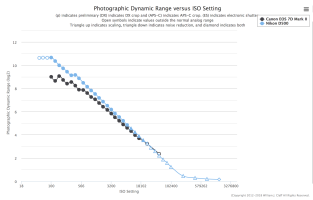
Looks like they are just cheating. This means that the Nikon is pre 'adjusting' the file where the Canon isn't, I am constantly criticized for saying this but make a preset that is ISO and camera specific that optimizes the Canon output and you are on a level playing field.

http://www.photonstophotos.net/Charts/PDR.htm#Canon%20EOS%207D%20Mark%20II,Nikon%20D500
 

Attachments

  • Screen Shot 2018-01-30 at 9.58.27 AM.png
    Screen Shot 2018-01-30 at 9.58.27 AM.png
    201 KB · Views: 136
Upvote 0
midluk said:
If they had the technology, they would likely already have added low quality very low bitrate 4K to the 6D2 and 80D. Good enough to appear in the spec sheets for those people that want 4K but don't actually need it.

Or maybe they have staff who know the math, but don't want to put crappy, worthless video on the camera just to tick another box.

I've not seen streaming 4K TV, so I don't know which looks better, highly compressed 4K or 1080p at a similar bitrate. There is probably a gray area in there somewhere in which it doesn't make any visible difference, or an extremely subtle one. OTA 720p might look better than either.

I have shot 4K video with my iPhone. It has been quite serviceable to allow for using editing to compensate for lack of zoom lenses. I've not bothered to try to figure out what kind of bitrate it involves.
 
Upvote 0