The State of the Canon Full Frame Mirrorless Development

CanonFanBoy said:
Canon undercuts Sony in the lens department big time... yet Canon is more profitable. https://www.adorama.com/iso70200g2ma.html

Agreed, on both counts. A big chunk of that profit is because Canon makes and sells a lot more lenses.

The 70-200/2.8 is the most egregious difference of all of them, and frankly, the Canon is a better lens. DXO "score" aside, the Canon has much better CA in the corners and more pleasing bokeh, plus autofocus in one shot mode on the Sony GM is terrible (it hunts). Zoom and MF ring are just plain nicer to handle on the Canon.

The price differences are stark if you add up all the most popular lenses in 2.8. But one big difference is that the performance gap between Canon f/4's and 2.8's are smaller than the Sony ones, and another huge one is that the Canon used market is vast, whereas the Sony is nonexistent, or asking as much/more than retail.

Though you can get great prices on second-hand A7RII's :)
 
Upvote 0
I don't understand the "fixed focal length" FF camera idea. 24-70? Yeah, I could understand that. But fixed? No. The sensor is one of the big cost factors in FF isn't it? The camera would still be expensive for most people and not near as versatile.

Anyway, I have an old Canon A-1 and a really old Voigtlander Vito CL. They both came with 50mm lenses. The Voigtlander is a fixed lens camera.

I agree with Talys on the perspective part. I have to be careful with a 35mm up close. 50mm would make more sense to me if a FF fix lens camera made any sense at all. I don't think it does. I just think it would be too expensive for what it is.
 
Upvote 0
CanonFanBoy said:
I agree with Talys on the perspective part. I have to be careful with a 35mm up close. 50mm would make more sense to me if a FF fix lens camera made any sense at all. I don't think it does. I just think it would be too expensive for what it is.

Sigma's fixed lens Foveon quattro rigs are much maligned pieces of tech, but they tried to wrestle with this -- they offered different fixed lens compact cameras of various focal lengths (21 / 28/ 45 / 75 FF equiv), which seems hyper-specialized at face value.

But one wonders how small a 24-50 f/3.5-5.6 (or possibly fixed f/4) could be in a similar nested-in-the-body design as the RX1R II.

- A
 
Upvote 0
CanonFanBoy said:
I agree with Talys on the perspective part. I have to be careful with a 35mm up close. 50mm would make more sense to me if a FF fix lens camera made any sense at all. I don't think it does. I just think it would be too expensive for what it is.

Before I got my first SLR about 1969, I had a Yeshica rangefinder film camera. It had a 45mm lens. That seemed to be a perfect focal length, mostly because I was used to using it and saw things that way. In theory, a "normal" lens has a focal length equal to the diagonal of the film frame. I don't know whether anybody uses that definition any more, but if so, a since FF digital camera sensor approximates the frame of 35mm film (by definition I would think), then the same number would apply. The diagonal is just slightly smaller than 45mm, so my Yashica had it about right. With the SLR I got a 55mm f/1.2 FD lens. It seemed slightly telephoto to me after using the 45mm for some years. I guess the 40mm pancake is as close to normal as Canon's line gets.
 
Upvote 0
ahsanford said:
CanonFanBoy said:
I agree with Talys on the perspective part. I have to be careful with a 35mm up close. 50mm would make more sense to me if a FF fix lens camera made any sense at all. I don't think it does. I just think it would be too expensive for what it is.

Sigma's fixed lens Foveon quattro rigs are much maligned pieces of tech, but they tried to wrestle with this -- they offered different fixed lens compact cameras of various focal lengths (21 / 28/ 45 / 75 FF equiv), which seems hyper-specialized at face value.

But one wonders how small a 24-50 f/3.5-5.6 (or possibly fixed f/4) could be in a similar nested-in-the-body design as the RX1R II.

- A

It would be a tough decision for the companies, I guess.

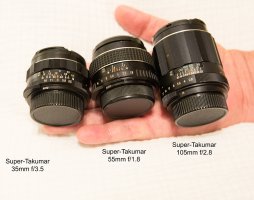
I've been fooling around with old Takumar lenses and they are surprisingly small. Granted, they are not AF lenses and not zooms, but they are FF and very compact. Not that anyone would want these in this day and age (though I do), but just to point out that things don't have to be huge.

Three lenses in the palm of my hand. :) Make the lenses small enough and people wouldn't mind carrying around a pouch (fanny pack?) with a couple of primes.

Do they still make fanny packs? I'm getting too old. Do kids even know what a fanny is these days?
 

Attachments

  • Takumars.jpg
    Takumars.jpg
    453 KB · Views: 100
Upvote 0
CanonFanBoy said:
I don't understand the "fixed focal length" FF camera idea. 24-70? Yeah, I could understand that. But fixed? No. The sensor is one of the big cost factors in FF isn't it? The camera would still be expensive for most people and not near as versatile.

Anyway, I have an old Canon A-1 and a really old Voigtlander Vito CL. They both came with 50mm lenses. The Voigtlander is a fixed lens camera.

I agree with Talys on the perspective part. I have to be careful with a 35mm up close. 50mm would make more sense to me if a FF fix lens camera made any sense at all. I don't think it does. I just think it would be too expensive for what it is.

Fixed to get a wide aperture. f1.4 types.
 
Upvote 0
CanonFanBoy said:
I don't understand the "fixed focal length" FF camera idea. 24-70? Yeah, I could understand that. But fixed? No. The sensor is one of the big cost factors in FF isn't it? The camera would still be expensive for most people and not near as versatile.

Anyway, I have an old Canon A-1 and a really old Voigtlander Vito CL. They both came with 50mm lenses. The Voigtlander is a fixed lens camera.

I agree with Talys on the perspective part. I have to be careful with a 35mm up close. 50mm would make more sense to me if a FF fix lens camera made any sense at all. I don't think it does. I just think it would be too expensive for what it is.

The concept seems to be to very high IQ with wide aperture and a fast shutter in a very small size and light weight package. I guess you zoom with your feet, stitch to go wider and crop to get the equivalent of a longer focal length. If your start with a 42 meg sensor like the RX1RII, a fair amount of cropping is possible.

I don't know how much I would pay for one of these cameras, if anything, but I do find the idea interesting. On the other hand my closest equivalent is my 5DIV with the 40mm pancake. Bigger, heavier and a couple of stops slower, but not bad. Also, if I feel like carrying some more weight, I bring along my 85mm f 1.8 which gives me a longer focal length and another stop of aperture.
 
Upvote 0
BillB said:
The concept seems to be to very high IQ with wide aperture and a fast shutter in a very small size and light weight package. I guess you zoom with your feet, stitch to go wider and crop to get the equivalent of a longer focal length. If your start with a 42 meg sensor like the RX1RII, a fair amount of cropping is possible.

A leaf shutter, I presume, with its advantages of fast sync?
 
Upvote 0
stevelee said:
BillB said:
The concept seems to be to very high IQ with wide aperture and a fast shutter in a very small size and light weight package. I guess you zoom with your feet, stitch to go wider and crop to get the equivalent of a longer focal length. If your start with a 42 meg sensor like the RX1RII, a fair amount of cropping is possible.

A leaf shutter, I presume, with its advantages of fast sync?

Many of the big sensor companies (canon and sony included) have global shutter technology. I expect that's where things will go in the future rather than leafs.
 
Upvote 0
stevelee said:
3kramd5 said:
Many of the big sensor companies (canon and sony included) have global shutter technology. I expect that's where things will go in the future rather than leafs.

Explain, please.

I believe the biggest hurdle in fast flash sync is the mechanical component, part of which you risk catching in the exposure. Leaf shutters are also mechanical but they only need cover the iris of the lens rather than the full area of the sensor or film.

Global shutters are fully electronic and read each pixel simultaneously. There are no moving parts to synchronize with the light, and no part of the sensor will be read sooner than another, thus illumination will be equal across the frame. Currently they might not read fast enough, but that seems easier to accomplish than redesigning an entire lens lineup to include mechanical shutters. For a fixed one-off lens that may not be a big deal, but there is an holistic ecosystem driving the technology in all components, including sensors.

Global shutters also avoid the jello effect on moving objects created by rolling shutters, which is important particularly for video clients, and I think that’s largely what’s driving their development (think: machine vision feeding AI in a factory environment).

The higher the resolution, the harder this is to accomplish. The highest resolution commercially available global shutter I’m aware of is 47.5MP (built by CMOSIS), but can only read 30FPS. That’s great for video (8k30p), but not flash sync. They have a 2MP sensor with ten times faster readout. I’m not too familiar with the canon and Sony designs other than they are currently also towards the lower end of resolution. I expect it’s merely a matter of bandwidth (which is also being driven by video) to improve that, resulting in high resolution stills imaging with quick flash sync using existing lenses.
 
Upvote 0
3kramd5 said:
Global shutters are fully electronic and read each pixel simultaneously. There are no moving parts to synchronize with the light, and no part of the sensor will be read sooner than another, thus illumination will be equal across the frame. Currently they might not read fast enough, but that seems easier to accomplish than redesigning an entire lens lineup to include mechanical shutters. For a fixed one-off lens that may not be a big deal, but there is an holistic ecosystem driving the technology in all components, including sensors.

Global shutters also avoid the jello effect on moving objects created by rolling shutters, which is important particularly for video clients, and I think that’s largely what’s driving their development (think: machine vision feeding AI in a factory environment).

Thanks.
 
Upvote 0
stevelee said:
3kramd5 said:
Global shutters are fully electronic and read each pixel simultaneously. There are no moving parts to synchronize with the light, and no part of the sensor will be read sooner than another, thus illumination will be equal across the frame. Currently they might not read fast enough, but that seems easier to accomplish than redesigning an entire lens lineup to include mechanical shutters. For a fixed one-off lens that may not be a big deal, but there is an holistic ecosystem driving the technology in all components, including sensors.

Global shutters also avoid the jello effect on moving objects created by rolling shutters, which is important particularly for video clients, and I think that’s largely what’s driving their development (think: machine vision feeding AI in a factory environment).

Thanks.

Global shutters (on CMOS) will be great, once they are good enough that they don't have any downsides for still photography. For me, it will just be that I can use fast shutter speeds without HSS or relying on T.1.

In the meantime though, usually, 1/8 or 1/16 will yield a low enough T.1 freeze any action, or I can rely on HSS. Really, the biggest difference will be that I can use a speedlight or a 2 pound mini strobe instead of a full 10 pound one when dealing with outdoors/sun.
 
Upvote 0
yep. and even more! global shutter means finally getting rid of the 2 remaing mechanical, moving parts in cameras: slapping mirrors and flicking shutter blades. last 2 remnants of 19th century photo-tech that have way too long been denying us the full potential of digital photography in a number of important ways.

looking forward to getting solid-state cameras. wheathersealing much easier. no lubricants needed. none of them splattering all over image sensors (at least in some nikon mirrorslappers). absolutely no vibrations during exposure. direct impact on IQ / sharpness. and image capture in total silence ... less conspicuous, no disturbing. unless an artificial shutter sound is consciously enabled by user (not as default by camera maker!).

really hope it gets implemented in mirrorless cameras asap now. but wont hold my breath ... knowubg "innovative" Canon.
 
Upvote 0
AvTvM said:
yep. and even more! global shutter means finally getting rid of the 2 remaing mechanical, moving parts in cameras: slapping mirrors and flicking shutter blades. last 2 remnants of 19th century photo-tech that have way too long been denying us the full potential of digital photography in a number of important ways.

looking forward to getting solid-state cameras. wheathersealing much easier. no lubricants needed. none of them splattering all over image sensors (at least in some nikon mirrorslappers). absolutely no vibrations during exposure. direct impact on IQ / sharpness. and image capture in total silence ... less conspicuous, no disturbing. unless an artificial shutter sound is consciously enabled by user (not as default by camera maker!).

really hope it gets implemented in mirrorless cameras asap now. but wont hold my breath ... knowubg "innovative" Canon.

Oh you mean apart from reduced dynamic range and problems using flash. And the fact that no-one has found a way round these for all situations you can used a DSLR.

Stupid AvTvM.
 
Upvote 0
AvTvM said:
yep. and even more! global shutter means finally getting rid of the 2 remaing mechanical, moving parts in cameras: slapping mirrors and flicking shutter blades. last 2 remnants of 19th century photo-tech that have way too long been denying us the full potential of digital photography in a number of important ways.

looking forward to getting solid-state cameras. wheathersealing much easier. no lubricants needed. none of them splattering all over image sensors (at least in some nikon mirrorslappers). absolutely no vibrations during exposure. direct impact on IQ / sharpness. and image capture in total silence ... less conspicuous, no disturbing. unless an artificial shutter sound is consciously enabled by user (not as default by camera maker!).

really hope it gets implemented in mirrorless cameras asap now. but wont hold my breath ... knowubg "innovative" Canon.

Go buy yourself a bullet-style security camera... that ticks off all your boxes. No moving parts. Global shutter! Wide lens! Solid state! It even works in the dark. Or a Ring doorbell :D It even has audio!

It's easy to get a global shutter camera. It just needs to be CCD instead of CMOS.
 
Upvote 0