
You are using an out of date browser. It may not display this or other websites correctly.
You should upgrade or use an alternative browser.
You should upgrade or use an alternative browser.
Tips on shooting hockey?
- Thread starter ahsanford
- Start date
- Status
- Not open for further replies.
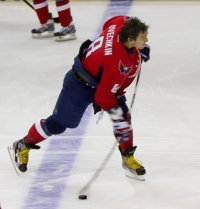

One thing I would say is to find your settings while players are warming up before the game, and then stick with them.
No auto iso, set fixed iso somewhere between 1600 to 6400 at 2.8 with shutter speed at 1/640 to 1/1000. (All depending on the light)
I like center focus point with 8 surrounding....servo case number 1 or 4 seem to work.....center weighted average meter.
It looks like you need to do some custom white balance because your shots are too blue, as others have mentioned.
Shooting over the glass will net you best IQ, but there is nothing better than a nice shot from on the ice, behind and slightly to the side of the goal or in the corners...the downside is that you have to live with slightly less IQ as the plexiglass dulls the image...always trade offs in photography.
Have you gone back for more hockey yet?
No auto iso, set fixed iso somewhere between 1600 to 6400 at 2.8 with shutter speed at 1/640 to 1/1000. (All depending on the light)
I like center focus point with 8 surrounding....servo case number 1 or 4 seem to work.....center weighted average meter.
It looks like you need to do some custom white balance because your shots are too blue, as others have mentioned.
Shooting over the glass will net you best IQ, but there is nothing better than a nice shot from on the ice, behind and slightly to the side of the goal or in the corners...the downside is that you have to live with slightly less IQ as the plexiglass dulls the image...always trade offs in photography.
Have you gone back for more hockey yet?
Attachments
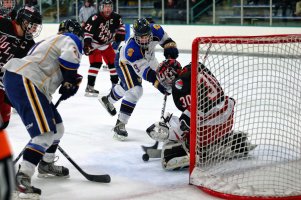
Upvote
0

Something I haven't quite seen yet with regard to Exposure and White Balance - you'll never get it consistently spot on in the arena. You'll get close but that's all you can hope for. Arenas use lights that pulse at 60Hz. Since you aren't going to be shooting at 1/60 or below, you are going to catch the lights at different points in their phasing. This will cause your sequential shots to vary both in exposure and color (white balance) as the lights change intensity and color. Set you camera as others have said using manual settings and choose a manual white balance that you like and don't change it. Avoid AWB at all costs.
The trick is to at least try to keep things as consistent as possible so when you clean things up in post, the variation will be more predictable and easier to deal with. As you can imagine, AWB would wreak havoc on the WB consistency. And I totally agree, RAW is the way to go. Avoid JPG because you will likely want to adjust more than JPG will allow.
Here's a great write up on this issue...
http://www.sportsshooter.com/message_display.html?tid=20873
FWIW, your pictures already look great. I can't wait to see the next set!! Have FUN!!! 8)
The trick is to at least try to keep things as consistent as possible so when you clean things up in post, the variation will be more predictable and easier to deal with. As you can imagine, AWB would wreak havoc on the WB consistency. And I totally agree, RAW is the way to go. Avoid JPG because you will likely want to adjust more than JPG will allow.
Here's a great write up on this issue...
http://www.sportsshooter.com/message_display.html?tid=20873
FWIW, your pictures already look great. I can't wait to see the next set!! Have FUN!!! 8)
Upvote
0
FTb-n said:Yes, I was refering to the tripod ring that comes with the 70-200L.
I do use a Bogen (now Manfrotto) quick release tilt head on my mono-pod so I can tilt down and up. The tilt and the quick release work well for me. This is a personal preference thing. Some prefer mounting the lens tripod ring directly to the mono-pod without a head. You'll have to figure out which works best for you. (But, be wary of the ball mount. It never stays put when shooting action.)
http://www.amazon.com/Manfrotto-234RC-Monopod-Quick-Release/dp/B000JLM50I/ref=sr_1_3?ie=UTF8&qid=1351732295&sr=8-3&keywords=manfrotto+qr+tilt+head
personal preferences to be sure; here's mine: I brought in the 234C and sent it right back because I wanted something beefier atop my Gitzo. I also wanted a head that could rotate 180 to accomodate the difference between my camera body plate and my 70-200 lens plate. The RRS monopod head is expensive, but for me its perfect. 2-axes of rotation is all you really need for a monopod -- I didn't want a ballhead for the same reasons you mentioned, but this RRS head is a real wahoo I have to say.
http://reallyrightstuff.com/ProductDesc.aspx?code=MH-02-Pro&type=0&eq=MH-02-Pro-001&desc=MH-02-Pro%3a-Head-with-Indexing-Pro-Clamp&key=ait
Its available in the lever mount too...
Upvote
0
MRLinVA said:Typical setup has been 7D with 70-200 MkII sometime with 2x ext, sometimes 300mm 2.8 MkII. Have not had a chance to try out the 1Dx due to the lockout. :-[
I love the ref that is just standing with hands on hips....I can read his mind, "I wonder if I have any beer in the fridge at home"
Upvote
0
RustyTheGeek said:Picture a thought bubble over his head of Homer Simpson thinking, Ummmm! Beeer!
you r funny rusty! lol
Upvote
0
Anybody used t2i/3i/4i and the 70-200mm IS II lens to shot hockey? I just bought the lens but need a body and don't want to spend too much (already spent on the lens  ).
).
BTW, I bought the lens to shoot pics for my son's pee wee hockey games. I have an old Canon 300D (6 MP) and I did try it with the 70-200mm IS II lens. The result is not very good - the highest ISO I can set is 1600 and this only give ma about 1/250 SS with 'correct' exposure which is still a little bit dark to me. I shoot with Av and already set the aperture to f/2.8 which is the widest.
Thanks in advance!
Tom
).BTW, I bought the lens to shoot pics for my son's pee wee hockey games. I have an old Canon 300D (6 MP) and I did try it with the 70-200mm IS II lens. The result is not very good - the highest ISO I can set is 1600 and this only give ma about 1/250 SS with 'correct' exposure which is still a little bit dark to me. I shoot with Av and already set the aperture to f/2.8 which is the widest.
Thanks in advance!
Tom
Upvote
0

I've used a T2i and a 60D for figure skating. Both can handle the higher ISO, but both will have theire fair share of OOF shots do to relatively slow focus tracking. The T2i has a very slow burst mode and buffer. The buffer on the 60D is better for JPEGs, but RAW will fill up if you're not careful.
Consider Canon's refurb store. I saved a bunch last year with my 7D from there.
Of the crop bodies currently available, I think your choice will narrow down to two options.
1. T4i -- With Digic 5, has the best high ISO noise reduction for JPEGs. RAW images should be very similar. Also offers auto-focus for video. However, this is NOT a high action body. Only 5fps and a RAW buffer of only 6 shots. You can get excited about the action on the ice, fire lots of shots in a hurry (not all in burst), only to have a full buffer when the puck enters the net. But, the price is good. (The new T5i is essentually the same camera with minor updates.)
http://shop.usa.canon.com/webapp/wcs/stores/servlet/product_10051_10051_320718_-1
2. 7D -- The best sports crop Canon makes. Compared to the T-series and the xxD, it's focus system is amazing and a great match for the 70-200. I bought my 70-200 when I had a 60D and was frustrated with roughly 20% OOF of figure skating shots. 20% doesn't sound bad, but if your key moments are among the 20%, it's terrible. For me, the 60D held me back from the full potentual of the 70-200. As for the buffer -- nothing to worry about (I use use Transcend 600x cards). 8fps is a nice bonus. Slower burst rates are often useless after the second shot. For figure skating, I prefer shutter speeds between 1/500 and 1/800 at f2.8. I routinely shoot at ISO 1600- 3200. You will get noise, but Lightroom 4 does a great job at cleaning it up.
http://shop.usa.canon.com/webapp/wcs/stores/servlet/product_10051_10051_260463_-1
Consider Canon's refurb store. I saved a bunch last year with my 7D from there.
Of the crop bodies currently available, I think your choice will narrow down to two options.
1. T4i -- With Digic 5, has the best high ISO noise reduction for JPEGs. RAW images should be very similar. Also offers auto-focus for video. However, this is NOT a high action body. Only 5fps and a RAW buffer of only 6 shots. You can get excited about the action on the ice, fire lots of shots in a hurry (not all in burst), only to have a full buffer when the puck enters the net. But, the price is good. (The new T5i is essentually the same camera with minor updates.)
http://shop.usa.canon.com/webapp/wcs/stores/servlet/product_10051_10051_320718_-1
2. 7D -- The best sports crop Canon makes. Compared to the T-series and the xxD, it's focus system is amazing and a great match for the 70-200. I bought my 70-200 when I had a 60D and was frustrated with roughly 20% OOF of figure skating shots. 20% doesn't sound bad, but if your key moments are among the 20%, it's terrible. For me, the 60D held me back from the full potentual of the 70-200. As for the buffer -- nothing to worry about (I use use Transcend 600x cards). 8fps is a nice bonus. Slower burst rates are often useless after the second shot. For figure skating, I prefer shutter speeds between 1/500 and 1/800 at f2.8. I routinely shoot at ISO 1600- 3200. You will get noise, but Lightroom 4 does a great job at cleaning it up.
http://shop.usa.canon.com/webapp/wcs/stores/servlet/product_10051_10051_260463_-1
Upvote
0
Thanks for the reply!
I just bought a refurbished t2i yesterday from Canon Store (can't help buying it due to the attractive price at $336 ). Will try it out to see how it goes.
Regarding to the IS lens, should I turn it off or set it to mode 2 when shooting hockey? Thanks again!
Tom
I just bought a refurbished t2i yesterday from Canon Store (can't help buying it due to the attractive price at $336
). Will try it out to see how it goes.Regarding to the IS lens, should I turn it off or set it to mode 2 when shooting hockey? Thanks again!
Tom
Upvote
0
tomx said:Thanks for the reply!
I just bought a refurbished t2i yesterday from Canon Store (can't help buying it due to the attractive price at $336
Regarding to the IS lens, should I turn it off or set it to mode 2 when shooting hockey? Thanks again!
Tom
Turn IS off and don't shoot slower than 1/500. At 1/500 or faster, the IS wont help you...and I've read that some pro sport shooters believe it slows down AF speed so they leave it off.
Upvote
0
$336 is a good price for the T2i, congrats.
Regarding IS, leave it on and in mode 2. According to Chuck Westfall, IS provides a steady image that helps the camera lock on to focus.
Also, remember the reciprocal rule of thumb for film/FF bodies. On average, the minimum safe hand-held shutter speed is the reciprocal of the focal length. This general assumes a stationary subject and a stationary photographer who is bracing the camera in some fashion (typically with how they hold the camera). For sports, the photographer is moving the camera to shoot. I would suggest a shutter speed 2-4 times faster would be necessary to eliminate camera movement from the equation.
A 200mm lens on a crop body is effectively a 320 (when compared to FF). The minimum safe shutter speed for stationary subjects would be 1/320. For sports, 2-4 times faster would be 1/640-1/1280. But, it is still possible that a moving camera (as with tracking the action) could impart some blur even at 1/1000 of a second.
I shoot in similar situations and lighting with the same lens and similar body. Shooting at 1/1000 indoor could be challenge. Don't be afraid to shoot above ISO 3200. Also, leave the IS on, it may help and won't hurt.
Regarding the T2i (or any non-7D crop) and hockey. Use AI SERVO and center point focusing. But, understand what AI SERVO does. It does NOT read the exact focus at the time that the shutter fires. Instead, it tracks the speed and direction of movement and predicts what the focus will be when it fires. This means that it might take a second to get accurate focus and it can be fooled when the subject changes direction. The 7D has a processor dedicated for focusing to keep up. The other crop bodies do not.
When shooting hockey, get in the habit of letting up on the shutter when the subject changes direction. When you again press half way, the camera will start over with the tracking and won't be fooled by the previous direction of the subject. I've had lots of OOF shots with my 60D because of this.
Last note regarding ISO. This sounds counterintuitive, but it's better to overexpose at 6400 than underexpose at 3200. Noise happens when pixels are starved for light. Overexposing (1/3 to 2/3 stops) helps prevent this and the exposure can be fixed in post. Experiment with ISO. If you doubt shooting this high, experiment with some, then go back to comfort ISO. 1600 was my comfort zone max until I started experimenting, now I routinely shoot between 2000 and 4000.
Good luck.
Regarding IS, leave it on and in mode 2. According to Chuck Westfall, IS provides a steady image that helps the camera lock on to focus.
Also, remember the reciprocal rule of thumb for film/FF bodies. On average, the minimum safe hand-held shutter speed is the reciprocal of the focal length. This general assumes a stationary subject and a stationary photographer who is bracing the camera in some fashion (typically with how they hold the camera). For sports, the photographer is moving the camera to shoot. I would suggest a shutter speed 2-4 times faster would be necessary to eliminate camera movement from the equation.
A 200mm lens on a crop body is effectively a 320 (when compared to FF). The minimum safe shutter speed for stationary subjects would be 1/320. For sports, 2-4 times faster would be 1/640-1/1280. But, it is still possible that a moving camera (as with tracking the action) could impart some blur even at 1/1000 of a second.
I shoot in similar situations and lighting with the same lens and similar body. Shooting at 1/1000 indoor could be challenge. Don't be afraid to shoot above ISO 3200. Also, leave the IS on, it may help and won't hurt.
Regarding the T2i (or any non-7D crop) and hockey. Use AI SERVO and center point focusing. But, understand what AI SERVO does. It does NOT read the exact focus at the time that the shutter fires. Instead, it tracks the speed and direction of movement and predicts what the focus will be when it fires. This means that it might take a second to get accurate focus and it can be fooled when the subject changes direction. The 7D has a processor dedicated for focusing to keep up. The other crop bodies do not.
When shooting hockey, get in the habit of letting up on the shutter when the subject changes direction. When you again press half way, the camera will start over with the tracking and won't be fooled by the previous direction of the subject. I've had lots of OOF shots with my 60D because of this.
Last note regarding ISO. This sounds counterintuitive, but it's better to overexpose at 6400 than underexpose at 3200. Noise happens when pixels are starved for light. Overexposing (1/3 to 2/3 stops) helps prevent this and the exposure can be fixed in post. Experiment with ISO. If you doubt shooting this high, experiment with some, then go back to comfort ISO. 1600 was my comfort zone max until I started experimenting, now I routinely shoot between 2000 and 4000.
Good luck.
Upvote
0
Regarding IS, leave it on and in mode 2. According to Chuck Westfall, IS provides a steady image that helps the camera lock on to focus.
I'll repeat...leave IS off when shooting faster than 1/500...IS is great when shooting at slower shutter speeds, but does nothing at fast shutter speeds other than potentially slow you down
Here's a blog post from Scott Kelby where he discusses this issue...(Nikon VR is the same as Canon IS)
"Well, if you’re shooting with a VR (Vibration Reduction) lens, once your shutter speed gets above 1/500 of a second, you should turn VR off to avoid any shutter lag or slower frame advance rates caused by the VR trying to stabilize the lens. (At high shutter speeds, you don’t really need to VR—after all, Vibration Reduction was designed to let you hand hold in low light, slow shutter speed situations. If you’re shooting with shutter speeds above 1/500 of a second, you really don’t need the VR"
http://scottkelby.com/2008/quick-tip-for-nikon-sports-shooters/
Last note regarding ISO. This sounds counterintuitive, but it's better to overexpose at 6400 than underexpose at 3200. Noise happens when pixels are starved for light. Overexposing (1/3 to 2/3 stops) helps prevent this and the exposure can be fixed in post. Experiment with ISO. If you doubt shooting this high, experiment with some, then go back to comfort ISO. 1600 was my comfort zone max until I started experimenting, now I routinely shoot between 2000 and 4000
This is very good advice...I learned this by mistake when I shot an entire period overexposed by 2/3 stop...once I got the images into post processing I realized that many of my "mistake" shots looked fantastic, the overexposed images allowed me to see faces under helmets much better....now I regularly shoot 1/2 stop overexposed in hockey.
Upvote
0
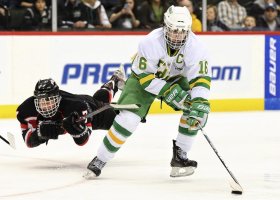
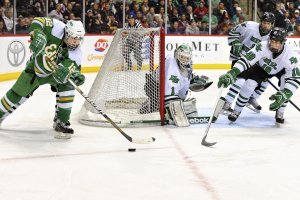
Great shots, Northstar! Having spent countless hours trying capture figure skating, I can appreciate everything that went into these shots, particularly the timing. Was this with your 1Dx or 5D3?
Back to the IS question. When to use IS is still a hotly debated topic. I suspect the real answer is “it depends.” It may depend on the focal length, the body (FF or crop), the subject matter, and/or the manufacturer.
In this thread, we are considering a T2i with the EF 70-200 f2.8L USM IS II.
First, I still contend that 1/500 isn't fast enough to eliminate camera blur while shooting hand held action shots with a 200 mm lens on a crop body, which magnifies image movement over that of a FF body.
Second, Nikon's VR and Canon's IS are different systems with different algorithms. Canon pioneered lens-based image stabilization in 1995. Nikon played catch-up in 2000. Canon starts stabilizing the image when the shutter is pressed half-way, before focus is locked. Nikon initiates when the shutter button is pressed half-way, but does a “recenter” action just before the shutter is tripped. Nikon uses a sampling rate of 1000Hz (1/1000 sec) which means it's only accurate to half that speed, or 1/500 sec. This supports Scott Kelby's advice to turn off VR when shooting at or above 1/500. It also supports the notion that VR can get in the way of rapid burst sports bodies.
However, Kelby was talking about Nikon's VR, not Canon's IS.
[Here's more detail on Nikon's VR system http://www.bythom.com/nikon-vr.htm]
Canon hasn't published it's sampling frequency and Canon officially states that it's IS system is designed to aid the focus system even at high speeds. When asked about using IS for photographing skiing with high shutter speeds, Canon's Chuck Westfall, says leave it on http://digitaljournalist.org/issue1002/tech-tips.html (see 8th question).
The Digital Picture's forum includes a more detailed response from Canon on this subject [from
http://community.the-digital-picture.com/showthread.php?t=5279]:
Canon does not quote the sampling frequency for its Image Stabilizer mechanisms. Also, Canon does not recommend users to avoid using IS at fast shutter speeds. The visual effects of IS in captured images diminish as the shutter speed increases over 1/focal length, but the use of IS for moving subjects in these conditions can be beneficial because it presents a steadier image to the camera's AF detection mechanism.
We can can confirm that it takes about a half second for Image Stabilization to become operational with most IS-equipped EF and EF-S lenses. Even so, Image Stabilization is a useful tool for many photographic applications including bird photography at high shutter speeds. However, like any other tool, it requires good technique on the part of the user for best results. Additionally, some photographers may prefer to shut it off at least occasionally depending on their shooting style. Bottom line, it makes no sense to declare that IS is either "all good" or "all bad" when it comes to bird photography. Use it when you need it, and for best results, let it come up to speed before you release the shutter.
Incidentally, it is not necessarily true that IS must be shut off and re-engaged when AF is shut off and re-engaged. IS can operate independently from AF through Custom Function control. On current EOS models, for instance, Custom Function IV-1-2 allows IS to be operated by the shutter release and AF to be operated by the AF-ON button. Using this method, IS remains active for several seconds after pressing the shutter button halfway while disengaging and then reengaging AF.
Canon IS and Nikon VR do not share the same operational principles, so this question cannot be answered as written. The IS specifications mentioned in "EF Lens Work III" refer to the degree of lens movement, not the sampling frequency of the gyro sensors.
Back to the question of IS on for hockey with a T2i. The T2i FPS rate is 3.7 and likely too slow for image stabilization to impede it's rate (if Canon's IS would do so). This leaves us with two questions. Is there a shutter speed limit with Canon's IS such that faster speeds do nothing to further steady the image? Is there a shutter speed and/or frame rate that will “fight” with Canon's IS system and impede focus lock?
Sadly, Canon's official documentation and lens user manuals do not answer either of these questions. I have found nothing definitive from Canon or specifically about Canon's IS system that supports the notion that it's IS is not effective beyond 1/500 second or will degrade focus lock at higher speeds.
While I still think it's best to leave IS on with high shutter speeds – that it won't hurt and may help – I'd still like a more definitive answer from Canon. With a 70-200 on a T2i at 1/500, I still say leave it on (in Mode 2). At 1/1000, it may not matter. In between, good question.
Back to the IS question. When to use IS is still a hotly debated topic. I suspect the real answer is “it depends.” It may depend on the focal length, the body (FF or crop), the subject matter, and/or the manufacturer.
In this thread, we are considering a T2i with the EF 70-200 f2.8L USM IS II.
First, I still contend that 1/500 isn't fast enough to eliminate camera blur while shooting hand held action shots with a 200 mm lens on a crop body, which magnifies image movement over that of a FF body.
Second, Nikon's VR and Canon's IS are different systems with different algorithms. Canon pioneered lens-based image stabilization in 1995. Nikon played catch-up in 2000. Canon starts stabilizing the image when the shutter is pressed half-way, before focus is locked. Nikon initiates when the shutter button is pressed half-way, but does a “recenter” action just before the shutter is tripped. Nikon uses a sampling rate of 1000Hz (1/1000 sec) which means it's only accurate to half that speed, or 1/500 sec. This supports Scott Kelby's advice to turn off VR when shooting at or above 1/500. It also supports the notion that VR can get in the way of rapid burst sports bodies.
However, Kelby was talking about Nikon's VR, not Canon's IS.
[Here's more detail on Nikon's VR system http://www.bythom.com/nikon-vr.htm]
Canon hasn't published it's sampling frequency and Canon officially states that it's IS system is designed to aid the focus system even at high speeds. When asked about using IS for photographing skiing with high shutter speeds, Canon's Chuck Westfall, says leave it on http://digitaljournalist.org/issue1002/tech-tips.html (see 8th question).
The Digital Picture's forum includes a more detailed response from Canon on this subject [from
http://community.the-digital-picture.com/showthread.php?t=5279]:
Canon does not quote the sampling frequency for its Image Stabilizer mechanisms. Also, Canon does not recommend users to avoid using IS at fast shutter speeds. The visual effects of IS in captured images diminish as the shutter speed increases over 1/focal length, but the use of IS for moving subjects in these conditions can be beneficial because it presents a steadier image to the camera's AF detection mechanism.
We can can confirm that it takes about a half second for Image Stabilization to become operational with most IS-equipped EF and EF-S lenses. Even so, Image Stabilization is a useful tool for many photographic applications including bird photography at high shutter speeds. However, like any other tool, it requires good technique on the part of the user for best results. Additionally, some photographers may prefer to shut it off at least occasionally depending on their shooting style. Bottom line, it makes no sense to declare that IS is either "all good" or "all bad" when it comes to bird photography. Use it when you need it, and for best results, let it come up to speed before you release the shutter.
Incidentally, it is not necessarily true that IS must be shut off and re-engaged when AF is shut off and re-engaged. IS can operate independently from AF through Custom Function control. On current EOS models, for instance, Custom Function IV-1-2 allows IS to be operated by the shutter release and AF to be operated by the AF-ON button. Using this method, IS remains active for several seconds after pressing the shutter button halfway while disengaging and then reengaging AF.
Canon IS and Nikon VR do not share the same operational principles, so this question cannot be answered as written. The IS specifications mentioned in "EF Lens Work III" refer to the degree of lens movement, not the sampling frequency of the gyro sensors.
Back to the question of IS on for hockey with a T2i. The T2i FPS rate is 3.7 and likely too slow for image stabilization to impede it's rate (if Canon's IS would do so). This leaves us with two questions. Is there a shutter speed limit with Canon's IS such that faster speeds do nothing to further steady the image? Is there a shutter speed and/or frame rate that will “fight” with Canon's IS system and impede focus lock?
Sadly, Canon's official documentation and lens user manuals do not answer either of these questions. I have found nothing definitive from Canon or specifically about Canon's IS system that supports the notion that it's IS is not effective beyond 1/500 second or will degrade focus lock at higher speeds.
While I still think it's best to leave IS on with high shutter speeds – that it won't hurt and may help – I'd still like a more definitive answer from Canon. With a 70-200 on a T2i at 1/500, I still say leave it on (in Mode 2). At 1/1000, it may not matter. In between, good question.
Upvote
0
FTb-n said:Great shots, Northstar! Having spent countless hours trying capture figure skating, I can appreciate everything that went into these shots, particularly the timing. Was this with your 1Dx or 5D3?
Back to the IS question. When to use IS is still a hotly debated topic. I suspect the real answer is “it depends.” It may depend on the focal length, the body (FF or crop), the subject matter, and/or the manufacturer.
In this thread, we are considering a T2i with the EF 70-200 f2.8L USM IS II.
First, I still contend that 1/500 isn't fast enough to eliminate camera blur while shooting hand held action shots with a 200 mm lens on a crop body, which magnifies image movement over that of a FF body.
Second, Nikon's VR and Canon's IS are different systems with different algorithms. Canon pioneered lens-based image stabilization in 1995. Nikon played catch-up in 2000. Canon starts stabilizing the image when the shutter is pressed half-way, before focus is locked. Nikon initiates when the shutter button is pressed half-way, but does a “recenter” action just before the shutter is tripped. Nikon uses a sampling rate of 1000Hz (1/1000 sec) which means it's only accurate to half that speed, or 1/500 sec. This supports Scott Kelby's advice to turn off VR when shooting at or above 1/500. It also supports the notion that VR can get in the way of rapid burst sports bodies.
However, Kelby was talking about Nikon's VR, not Canon's IS.
[Here's more detail on Nikon's VR system http://www.bythom.com/nikon-vr.htm]
Canon hasn't published it's sampling frequency and Canon officially states that it's IS system is designed to aid the focus system even at high speeds. When asked about using IS for photographing skiing with high shutter speeds, Canon's Chuck Westfall, says leave it on http://digitaljournalist.org/issue1002/tech-tips.html (see 8th question).
The Digital Picture's forum includes a more detailed response from Canon on this subject [from
http://community.the-digital-picture.com/showthread.php?t=5279]:
Canon does not quote the sampling frequency for its Image Stabilizer mechanisms. Also, Canon does not recommend users to avoid using IS at fast shutter speeds. The visual effects of IS in captured images diminish as the shutter speed increases over 1/focal length, but the use of IS for moving subjects in these conditions can be beneficial because it presents a steadier image to the camera's AF detection mechanism.
We can can confirm that it takes about a half second for Image Stabilization to become operational with most IS-equipped EF and EF-S lenses. Even so, Image Stabilization is a useful tool for many photographic applications including bird photography at high shutter speeds. However, like any other tool, it requires good technique on the part of the user for best results. Additionally, some photographers may prefer to shut it off at least occasionally depending on their shooting style. Bottom line, it makes no sense to declare that IS is either "all good" or "all bad" when it comes to bird photography. Use it when you need it, and for best results, let it come up to speed before you release the shutter.
Incidentally, it is not necessarily true that IS must be shut off and re-engaged when AF is shut off and re-engaged. IS can operate independently from AF through Custom Function control. On current EOS models, for instance, Custom Function IV-1-2 allows IS to be operated by the shutter release and AF to be operated by the AF-ON button. Using this method, IS remains active for several seconds after pressing the shutter button halfway while disengaging and then reengaging AF.
Canon IS and Nikon VR do not share the same operational principles, so this question cannot be answered as written. The IS specifications mentioned in "EF Lens Work III" refer to the degree of lens movement, not the sampling frequency of the gyro sensors.
Back to the question of IS on for hockey with a T2i. The T2i FPS rate is 3.7 and likely too slow for image stabilization to impede it's rate (if Canon's IS would do so). This leaves us with two questions. Is there a shutter speed limit with Canon's IS such that faster speeds do nothing to further steady the image? Is there a shutter speed and/or frame rate that will “fight” with Canon's IS system and impede focus lock?
Sadly, Canon's official documentation and lens user manuals do not answer either of these questions. I have found nothing definitive from Canon or specifically about Canon's IS system that supports the notion that it's IS is not effective beyond 1/500 second or will degrade focus lock at higher speeds.
While I still think it's best to leave IS on with high shutter speeds – that it won't hurt and may help – I'd still like a more definitive answer from Canon. With a 70-200 on a T2i at 1/500, I still say leave it on (in Mode 2). At 1/1000, it may not matter. In between, good question.
Thanks! Used my 1dx and 70-200
Interesting to read...I agree that there is no definitive answer on IS on or off over 1/500....thanks for sharing your views.
This is an Adorama interview of the Arizona Diamondbacks team photographer discussing his Canon Equipment and how he uses it to shoot professional baseball....at the 6:20 mark, he discusses IS and why he turns it off most of the time.
I share his experience/view on IS....but I understand that we're just stating an opinion, not a fact.
http://youtu.be/0q_5dB9T-i8
Upvote
0
I think we offer more than our opinions. We share our experiences, our understanding of the technologies, and our resources that form these opinions. This is why I like this forum.
I've heard the IS/VR has no affect at speeds above 1/500 argument before. But, this never made sense to me.
My experience has been heavily influenced decades ago by trying to get sharp images with an FTb-n and an FD 80-210 f4.0. 1/500 just wasn't fast enough to reliably eliminate camera shake. Consequently, I equated the "turn VR/IS off after 1/500" as "1/500 is fast enough to eliminate shake" debate.
More recently, I've taken photos of still subjects (people posing) with small primes including the 40 f2.8. According to the reciprocal rule, 1/80 of a second should be more than fast enough to eliminate camera shake. But, group photos of my kid's volleyball team at 1/80 just aren't nearly as sharp as ones taken at 1/800. Similare phots taken with IS lenses at 1/80 were tack sharp.
Thanks to Northstar's link to Scott Kelby's comments on VR, I did more digging on the technical limitations of VR and IS. I can see where 1/500 does represent the upper limit of VR lenses, but I'm still in search of that limit for Canon's IS lenses. (Sure wish Canon would address how best to use IS on it's lenses, which I suspect may vary with the lens.)
Most of my action experience with the 70-200 f2.8 has been with a 7D in poorly lit ice rinks and gyms. (Sadly, the rinks don't often use all the lights for figure skating, but they turn them all on for hockey.) I've rarely been able to shoot above 1/640 and most often shoot at 1/500, not fast enough to feel I didn't need IS. So, I've been eager to learn of the experience of professional Canon shooters.
The post of Jon Willey was most informative, just the kind of first-hand experience that I was seeking. Thanks for posting it. What was missing in the interview was typical shutter speed range. What's the slowest Willey feels comfortable with? I can't say that I've ever experienced the IS "jump" to which he referred. This does make me wonder if this is more an issue with the big lenses and not so much with the 70-200.
I've recently purchased a 5D3 and can now shoot closer to 1/1000 at the rink. Thanks to this discussion, I'm compelled to experiment more with IS on and off. At the rink, I do shoot with a monopod (and IS on) and believe it has helped sharpen my images. But, I don't have concrete evidence (haven't really tried side by side comparisons).
Northstar, about those hockey shots, do you recall the shutter speed? Were you hand-held or monopod (or something else)?
I've heard the IS/VR has no affect at speeds above 1/500 argument before. But, this never made sense to me.
My experience has been heavily influenced decades ago by trying to get sharp images with an FTb-n and an FD 80-210 f4.0. 1/500 just wasn't fast enough to reliably eliminate camera shake. Consequently, I equated the "turn VR/IS off after 1/500" as "1/500 is fast enough to eliminate shake" debate.
More recently, I've taken photos of still subjects (people posing) with small primes including the 40 f2.8. According to the reciprocal rule, 1/80 of a second should be more than fast enough to eliminate camera shake. But, group photos of my kid's volleyball team at 1/80 just aren't nearly as sharp as ones taken at 1/800. Similare phots taken with IS lenses at 1/80 were tack sharp.
Thanks to Northstar's link to Scott Kelby's comments on VR, I did more digging on the technical limitations of VR and IS. I can see where 1/500 does represent the upper limit of VR lenses, but I'm still in search of that limit for Canon's IS lenses. (Sure wish Canon would address how best to use IS on it's lenses, which I suspect may vary with the lens.)
Most of my action experience with the 70-200 f2.8 has been with a 7D in poorly lit ice rinks and gyms. (Sadly, the rinks don't often use all the lights for figure skating, but they turn them all on for hockey.) I've rarely been able to shoot above 1/640 and most often shoot at 1/500, not fast enough to feel I didn't need IS. So, I've been eager to learn of the experience of professional Canon shooters.
The post of Jon Willey was most informative, just the kind of first-hand experience that I was seeking. Thanks for posting it. What was missing in the interview was typical shutter speed range. What's the slowest Willey feels comfortable with? I can't say that I've ever experienced the IS "jump" to which he referred. This does make me wonder if this is more an issue with the big lenses and not so much with the 70-200.
I've recently purchased a 5D3 and can now shoot closer to 1/1000 at the rink. Thanks to this discussion, I'm compelled to experiment more with IS on and off. At the rink, I do shoot with a monopod (and IS on) and believe it has helped sharpen my images. But, I don't have concrete evidence (haven't really tried side by side comparisons).
Northstar, about those hockey shots, do you recall the shutter speed? Were you hand-held or monopod (or something else)?
Upvote
0
FTb-n said:I think we offer more than our opinions. We share our experiences, our understanding of the technologies, and our resources that form these opinions. This is why I like this forum.
I've heard the IS/VR has no affect at speeds above 1/500 argument before. But, this never made sense to me.
My experience has been heavily influenced decades ago by trying to get sharp images with an FTb-n and an FD 80-210 f4.0. 1/500 just wasn't fast enough to reliably eliminate camera shake. Consequently, I equated the "turn VR/IS off after 1/500" as "1/500 is fast enough to eliminate shake" debate.
More recently, I've taken photos of still subjects (people posing) with small primes including the 40 f2.8. According to the reciprocal rule, 1/80 of a second should be more than fast enough to eliminate camera shake. But, group photos of my kid's volleyball team at 1/80 just aren't nearly as sharp as ones taken at 1/800. Similare phots taken with IS lenses at 1/80 were tack sharp.
Thanks to Northstar's link to Scott Kelby's comments on VR, I did more digging on the technical limitations of VR and IS. I can see where 1/500 does represent the upper limit of VR lenses, but I'm still in search of that limit for Canon's IS lenses. (Sure wish Canon would address how best to use IS on it's lenses, which I suspect may vary with the lens.)
Most of my action experience with the 70-200 f2.8 has been with a 7D in poorly lit ice rinks and gyms. (Sadly, the rinks don't often use all the lights for figure skating, but they turn them all on for hockey.) I've rarely been able to shoot above 1/640 and most often shoot at 1/500, not fast enough to feel I didn't need IS. So, I've been eager to learn of the experience of professional Canon shooters.
The post of Jon Willey was most informative, just the kind of first-hand experience that I was seeking. Thanks for posting it. What was missing in the interview was typical shutter speed range. What's the slowest Willey feels comfortable with? I can't say that I've ever experienced the IS "jump" to which he referred. This does make me wonder if this is more an issue with the big lenses and not so much with the 70-200.
I've recently purchased a 5D3 and can now shoot closer to 1/1000 at the rink. Thanks to this discussion, I'm compelled to experiment more with IS on and off. At the rink, I do shoot with a monopod (and IS on) and believe it has helped sharpen my images. But, I don't have concrete evidence (haven't really tried side by side comparisons).
Northstar, about those hockey shots, do you recall the shutter speed? Were you hand-held or monopod (or something else)?
FTb...those particular hockey shots were at the Xcel center, home to the MN Wild, so the lighting is much better than a local rink. So I had the luxury of shooting at f4, 3200 ISO, and 1/1000...If I was shooting at a typical local ice arena, the settings would usually be 1/800, 3200 iso, f2.8.... Bad light arena, 1/640, 3200 or 4000 iso, f2.8.
Re Monopod -it's not needed at 1/640 and faster for my 70-200, so it doesn't matter for sharpness....imo. Similar discussion as IS. If you're shooting at 300mm or 400mm, then a monopod would probably help.
Also, I find IQ better when you keep the lens hood pressed up against the plex glass...tough to do with monopod.
Good discussion FTb.
Upvote
0
Northstar, thanks for sharing the details and for the discussion. I found it quite valuable.
I like using the monopod for shooting 90 minute figure skating exhibitions where I can shoot from one of the hockey player boxes. I can't say that it really helps sharpen the image vs. hand-held. But, after about a half hour of constant tracking of skaters, some fatigue sets in and the monopod makes it easier for me to track skaters while constantly following with the zoom ring. For other indoor school sports, like basketball and volleyball, I free hand it. A monopod would get in the way.
FYI, small world. That local rink that I shoot at isn't far from the Xcel Center.
I like using the monopod for shooting 90 minute figure skating exhibitions where I can shoot from one of the hockey player boxes. I can't say that it really helps sharpen the image vs. hand-held. But, after about a half hour of constant tracking of skaters, some fatigue sets in and the monopod makes it easier for me to track skaters while constantly following with the zoom ring. For other indoor school sports, like basketball and volleyball, I free hand it. A monopod would get in the way.
FYI, small world. That local rink that I shoot at isn't far from the Xcel Center.
Upvote
0
FTb-n said:Northstar, thanks for sharing the details and for the discussion. I found it quite valuable.
I like using the monopod for shooting 90 minute figure skating exhibitions where I can shoot from one of the hockey player boxes. I can't say that it really helps sharpen the image vs. hand-held. But, after about a half hour of constant tracking of skaters, some fatigue sets in and the monopod makes it easier for me to track skaters while constantly following with the zoom ring. For other indoor school sports, like basketball and volleyball, I free hand it. A monopod would get in the way.
FYI, small world. That local rink that I shoot at isn't far from the Xcel Center.
Small world indeed...funny.
Did you notice the team names on the jerseys or was it the Xcel post that you first noticed the MN connection?
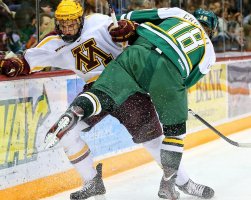
How about this jersey?
1dx and 70-200
3200 iso
3.2
1/800
Attachments
Upvote
0
- Status
- Not open for further replies.
Similar threads


- Replies
- 11
- Views
- 1K

- Replies
- 8
- Views
- 1K