Tony Northrup - D810 vs. 5D Mk3

  • Thread starter Thread starter Lightmaster
  • Start date Start date
The ONLY way you can compare these cameras is on price. That's the biggest lowest common denominator between them. Different tools for different work. Action and Low Light: 5D MKIII. Detail: Nikon. But it's not always so clear. Which would you use to get lots of detail of a bird in flight? At that point, it becomes a preference...

I think Tony Northrup and his wife Chelsea are great. He is one of the few highly-marketed photographers I pay any attention to anymore. Several reasons:

  • Great Gear Reviews. He doesn't pull punches when reviewing gear. But I also think he's fair.
  • Myth Buster. See his video on FF vs APS-C and what it means for focal length and aperture? I've never seen anyone do a video that shows you what the differences is between the two sensor sizes. This is just one example. Why has it been so difficult for anyone else to show the same thing?

I have great respect for Tony and Chelsea. I don't think they are full-time photographers. I believe he has something to do with computer certification programs. He mentioned something briefly about that. I know Chelsea gives private music lessons. And they still make the time to get enough content in for an hour long, quality youtube video every week. Try doing that yourself and see how much time that takes....

And that's another thing about them. They don't oversell themselves or make themselves look like a bigger deal than what they are. They aren't above doing portraits of employees at their local auto dealership. They tell you they don't make that much money on some of their products. They don't follow the common motto: fake it until you make it. They just work hard. Like what these http://ricardogomezphotography.com/successful-photographers-on-making-it-part-ii/ fine photographers have said it takes... Sorry. It's a link to my blog. But it's just easier to find the video because I posted it prominently. Twice ;D This video has gotten me through some difficult times. The interviewees are simply honest. Love it.

And no. I don't know Tony or Chelsea or have ever corresponded with them. Just good peeps working hard to realize their dreams. With integrity. And Chelsea just cracks me up ;D

BTW, Tony and Chelsea aren't switching to Nikon after all. Tony released a video... https://www.youtube.com/watch?v=Jva08HY6uLE Thanks for the video Tony.
 
Upvote 0
RLPhoto said:
+1 He really should RTFM because I tried a d800 for a weekend and it's AF sucked like a vacuum cleaner compared to the 5D3. I don't know about the 810 but it still uses that multicam backbone that was in the d700, which I also used before. Also I remember the G 1.4 primes being a slug compared to my 24L II 50L and 135L.

He probably didn't RTFM and I haven't seen any photos from him either.

Thank you for that very mature and descriptive dialogue; it really added to the conversation. And by that I mean it continues to spread the very misinformation that misleads people into buying into, and then themselves propagating, erroneous myths.

What about the AF? I'm talking about subject tracking in 3D AF vs. Canon's '61-point auto point selection' in AI servo mode.

  • What AF mode were you in?
  • Did the D800 you tested have the completely miscalibrated AF sensor (with the left AF problem?)
  • Were your lenses microadjusted? You don't shoot primes at f/1.4 without 1st checking that they're calibrated to your body properly.

And the D700? The improvements made to that module going to the D800 helped low-light focus significantly, and the dedicated RGB sensor increased 91-fold in resolution going from D700's 1005-pixel sensor to 91,000 pixels.

You think maybe that 100x increase in resolution might, just might, have helped the D800 at subject recognition and tracking?

#facepalm
 
Upvote 0
RGomezPhotos said:
The ONLY way you can compare these cameras is on price. That's the biggest lowest common denominator between them. Different tools for different work. Action and Low Light: 5D MKIII. Detail: Nikon. But it's not always so clear. Which would you use to get lots of detail of a bird in flight? At that point, it becomes a preference...

I think Tony Northrup and his wife Chelsea are great. He is one of the few highly-marketed photographers I pay any attention to anymore. Several reasons:

  • Great Gear Reviews. He doesn't pull punches when reviewing gear. But I also think he's fair.
  • Myth Buster. See his video on FF vs APS-C and what it means for focal length and aperture? I've never seen anyone do a video that shows you what the differences is between the two sensor sizes. This is just one example. Why has it been so difficult for anyone else to show the same thing?

I have great respect for Tony and Chelsea. I don't think they are full-time photographers. I believe he has something to do with computer certification programs. He mentioned something briefly about that. I know Chelsea gives private music lessons. And they still make the time to get enough content in for an hour long, quality youtube video every week. Try doing that yourself and see how much time that takes....

And that's another thing about them. They don't oversell themselves or make themselves look like a bigger deal than what they are. They aren't above doing portraits of employees at their local auto dealership. They tell you they don't make that much money on some of their products. They don't follow the common motto: fake it until you make it. They just work hard. Like what these http://ricardogomezphotography.com/successful-photographers-on-making-it-part-ii/ fine photographers have said it takes... Sorry. It's a link to my blog. But it's just easier to find the video because I posted it prominently. Twice ;D This video has gotten me through some difficult times. The interviewees are simply honest. Love it.

And no. I don't know Tony or Chelsea or have ever corresponded with them. Just good peeps working hard to realize their dreams. With integrity. And Chelsea just cracks me up ;D

BTW, Tony and Chelsea aren't switching to Nikon after all. Tony released a video... https://www.youtube.com/watch?v=Jva08HY6uLE Thanks for the video Tony.

He has some good points. One thing that's misleading is his claim that you can compensate for smaller sensors by using brighter lenses. That's only true up to a certain point, b/c pixels have finite well-capacities. So while this will work in low-light (or light-limited) situations, it won't work for, say, landscapes or scenes with appreciable dynamic range where increasing the exposure indiscriminately will simply blow your pixels.

Here, larger sensors will still fare much better (all else held equal).

These are complicated topics so I'm not blaming him. But it's important to understand some of the intricacies/details.

Btw, here's an in-depth look at equivalence as it relates to focal length, aperture, DOF, and noise/ISO:
http://www.dpreview.com/articles/2666934640/what-is-equivalence-and-why-should-i-care

The take-home is that 'equivalent aperture' is a nice way to get an idea of total light gathering ability of the lens, resulting DOF, and diffraction.
 
Upvote 0
OK. It's totally reasonable and fair to doubt someone claiming something you haven't seen, or that you feel is contrary to your experience and/or some sort of general consensus. That's fine, and I should expect it. Though, remember, I didn't say that Canon was poor at this, I said that Canons without a dedicated RGB sensor (everything but the 1D X) fare worse in this regard. The 1D X is far more capable at this sort of tracking than the 5D3 - in my hands/my tests - and I attribute this to iTR. Though not quite up to speed with the D4s/D810.

All I'd ask of some of the guys here is that you try & refrain from being absolutely certain that you're right, and that I'm totally wrong - until you've verified this yourself by shooting the cameras - in their proper modes properly calibrated - side-by-side to see what exactly these cameras are capable of when it comes to subject tracking in 3 dimensions. And yeah, I know, I can ask all I want... doesn't mean I'll get it. Certainly not here, from past experience.

In the meantime, I thought I'd search for videos demonstrating Nikon's 3D AF tracking vs. Canon's AI servo with automatic point selection, or iTR.

While you can find many examples of Nikon's 3D AF tracking on YouTube, I couldn't find anything similar for Canon, save for marketing videos (which only have simulated demonstrations of how auto AF point selection to track a subject should work).

I suppose, in a sense, this is somewhat indicative of how many people actually use automatic AF point selection for subject tracking on Canons. Like I said, I'll just to take my own videos/pics of comparisons to demonstrate the point, short of quoting Ken Rockwell (who actually happens to be right here re: 3D AF tracking's superiority to the analogues in Canon's 7D and 5D3).

For now, in case this adds anything to the conversation, I'll post a couple links demonstrating Nikon's 3D AF tracking. These tests below don't quite stress the AF system as much as some of the things I've been trying, since these examples don't have the subject changing distance very much. But, this is all I could really find in my brief search. Since you all have used the similar mode on Canons, perhaps from memory you can get a rough idea of how this stacks up against what you've seen on your 5D3, 7D, or what have you.

Here's the Nikon D5200's 3D AF tracking... you know, the Rebel competitor. It uses a 2,016-pixel RGB sensor:
https://www.youtube.com/watch?v=C5J7zALyHic

And here's the D4s' 3D tracking, which uses its 91,000-pixel RGB sensor: Not too much lateral (X-Y plane) movement here, but still gives you an idea of how well the AF system sticks to the initial subject. The 1D X can approach this in my experience, but my 5D3 can't... it often gets confused and the selected AF point(s) hop all over the place. And, yes, I've tried increasing the 'Tracking sensitivity', as well as the 'AF pt auto switching', settings.
https://www.youtube.com/watch?v=daL-4kTaLuU

Is that the sort of AF tracking and AF point moving to stay on the subject you typically experience with your 5D3 and 7D?

Honest question - I'm curious.

P.S. The following video is probably irrelevant b/c no one claims the 6D AF system to very good, but I thought I'd post it anyway. This guy in his 6D vs D600 comparison alludes to the 6D not being able to keep up and track as well across the frame, though things are of course made worse by the severe lack of focus points. And it looks like not too much of a stress test b/c of the DOF. But the D600 clearly outperforms the 6D which, of course, isn't surprising given its 2,016-pixel RGB sensor:

http://youtu.be/Dg_6jSaXGgY?t=4m20s

He says: "[The D600] certain seems to track better... the little dot was traveling with her and staying really close on her... I found it was choosing the skin tone."
 
Upvote 0
sarangiman said:
RLPhoto said:
+1 He really should RTFM because I tried a d800 for a weekend and it's AF sucked like a vacuum cleaner compared to the 5D3. I don't know about the 810 but it still uses that multicam backbone that was in the d700, which I also used before. Also I remember the G 1.4 primes being a slug compared to my 24L II 50L and 135L.

He probably didn't RTFM and I haven't seen any photos from him either.

Thank you for that very mature and descriptive dialogue; it really added to the conversation. And by that I mean it continues to spread the very misinformation that misleads people into buying into, and then themselves propagating, erroneous myths.

What about the AF? I'm talking about subject tracking in 3D AF vs. Canon's '61-point auto point selection' in AI servo mode.

  • What AF mode were you in?
  • Did the D800 you tested have the completely miscalibrated AF sensor (with the left AF problem?)
  • Were your lenses microadjusted? You don't shoot primes at f/1.4 without 1st checking that they're calibrated to your body properly.

And the D700? The improvements made to that module going to the D800 helped low-light focus significantly, and the dedicated RGB sensor increased 91-fold in resolution going from D700's 1005-pixel sensor to 91,000 pixels.

You think maybe that 100x increase in resolution might, just might, have helped the D800 at subject recognition and tracking?

#facepalm
I think your mesuabating to the point where your blaming gear for your shortcomings. Even if the Nikon is better at tracking, of what good is it if real photographers like jrista or the myriad of others here are already getting the results with the superb 61pt system in the situations you described. That just shows you don't know how to get the frames you want.

Now if you want to complain about something legitimate, then point out the lack of AF point metering because that really does suck at times but saying the 5D3s AF is bad at tracking means that you didn't RTFM.

and yes, the nikkor G primes still AF like a slug and that alone shifts AF speed to canons for weddings. (And I've shot a lot of them only with primes.)
 
Upvote 0
sarangiman said:
This shouldn't be difficult to accept. There's a reason it's in the 1D X, and purported to be in the 7D II as well. But if you want to see a great implementation of it - just try a D810. Seriously, just try it. Go to a camera store, and slap some 24/1.4 primes on some bodies. Put a 5D3 in 'auto 65 point selection' mode with AI servo, a 1D X in the same mode but w/ iTR engaged, and a D810 with 3D AF tracking mode engaged. Start on a subject in the center (or whatever focus point you've chosen), then move the camera around wildly (or have the subject dance/run around if you want/can). Be amazed at what how the camera can swiftly move the AF point to stay on the subject. Or not.

Are you saying you can slap on a fast prime, focus dead center, and then rotate ("recompose" generally involves much more rotation than translation, obviously) the camera about its own axis so the initial subject as seen by the AF unit goes from one side of the frame to the other (or at least from the borders of the PDAF sensors) and significantly out of the DOF and it will track it?

If so, that's cool and I do not believe my 5D3 could do such.
 
Upvote 0
sarangiman said:
Here's the Nikon D5200's 3D AF tracking... you know, the Rebel competitor. It uses a 2,016-pixel RGB sensor:
https://www.youtube.com/watch?v=C5J7zALyHic

And here's the D4s' 3D tracking, which uses its 91,000-pixel RGB sensor: Not too much lateral (X-Y plane) movement here, but still gives you an idea of how well the AF system sticks to the initial subject. The 1D X can approach this in my experience, but my 5D3 can't... it often gets confused and the selected AF point(s) hop all over the place. And, yes, I've tried increasing the 'Tracking sensitivity', as well as the 'AF pt auto switching', settings.
https://www.youtube.com/watch?v=daL-4kTaLuU

Is that the sort of AF tracking and AF point moving to stay on the subject you typically experience with your 5D3 and 7D?

Honest question - I'm curious.

P.S. The following video is probably irrelevant b/c no one claims the 6D AF system to very good, but I thought I'd post it anyway. This guy in his 6D vs D600 comparison alludes to the 6D not being able to keep up and track as well across the frame, though things are of course made worse by the severe lack of focus points. And it looks like not too much of a stress test b/c of the DOF. But the D600 clearly outperforms the 6D which, of course, isn't surprising given its 2,016-pixel RGB sensor:

http://youtu.be/Dg_6jSaXGgY?t=4m20s

He says: "[The D600] certain seems to track better... the little dot was traveling with her and staying really close on her... I found it was choosing the skin tone."

My 6D can do what the sample video show, only not so good when the subject too far from centre. I not sure what wrong with the 5D3.
In the 6D vs D600 video, 6D show it was bad when the subject move from far to near.
 
Upvote 0
RLPhoto said:
I think your mesuabating to the point where your blaming gear for your shortcomings. Even if the Nikon is better at tracking, of what good is it if real photographers like jrista or the myriad of others here are already getting the results with the superb 61pt system in the situations you described. That just shows you don't know how to get the frames you want.

No, it means that a system without scene recognition for AF doesn't allow me to get the shots I want for some of my photography. Are you suggesting that 'real photographers like jrista or the myriad of others' represent the entire sample pool of photographers & potential types of photography in the entire world? It really takes some perverse logic to think you understand the needs of every photographer out there so well that you can say 'even if Nikon's AF tracking is better... it doesn't matter.'

Doesn't matter? So the entire focus problem has been completely solved in the industry? Everyone is able to get 100% hit-rate with any prime at f/1.4 under any circumstance?

And - measurebating? Really there's no winning with you. When we're talking about numbers and equations, we're measurebating. When we're talking about real world experience with fast primes and ability of the camera to keep up as a subject moves around erratically, we're still measurebating! I'm saying that a scene recognition system is so good at tracking a subject accurately in 3 dimensions that after you've used it, you just cannot say the 5D III is good at it. Yes it can do it, but it gets confused very easily. And if you just took a minute to think about how the 5DIII is doing it, vs. how the 1D X and 7D II and Nikons are doing it, you wouldn't be at all surprised either. Go back to my thought experiment I posed to jrista in one of my responses, and see if you can understand why an image sensor is much better at tracking than the algorithm the 5D III uses. For your convenience, I've posted it at the end of this post.**

Btw, here's the new Samsung NX1 doing it, with PDAF sensors all over the sensor:
https://www.youtube.com/watch?v=IMYhZ18tKk4

But I suppose that's useless, since the 5DIII is obviously good enough for jrista & a myriad others and therefore every photographer in the entire world.

By the way, did you know that most current Nikon DSLR can focus on faces outside of Live View* (using traditional PDAF and OVF viewing)? Down to the D5200, I believe. And any Sony SLT, of course? Meanwhile, up until the release of the 7D II, only the 1D X could. Because it was the only camera with a separate color sensor for scene analysis. If your face happened to be the closest subject, sure a 5D III would focus on it in 'auto AF area' mode. Have a flower, or any other subject in front of the face, and the 5DIII focuses on that instead. Switch to a 1D X with iTR, and it'll focus on the closest (or biggest, I'm not sure) face, and track it as well. Not a big deal for me, but great when I hand off the camera to a family member to take a photo.

So now with the introduction of the 7D Mark II, do you think the inclusion of iTR with the RGB metering sensor is just a bunch of marketing hype? A 'me too' feature? Or do you think perhaps Canon is including it now b/c its actually of some utility?

Because, at the crux of it, you're essentially arguing that iTR is completely useless. And I completely, radically disagree.

RLPhoto said:
Now if you want to complain about something legitimate, then point out the lack of AF point metering because that really does suck at times but saying the 5D3s AF is bad at tracking means that you didn't RTFM.

I did point that out. Almost every Nikon camera, down to the D5200, has spot-metering linked to the AF point. Because that's yet another thing the RGB metering sensor enables.

Just b/c you don't think the metering sensor 'seeing the scene' and providing face-detection & subject tracking isn't useful, doesn't mean it's not, or that I didn't RTFM.

What's your point of repeating the phrase 'RTFM' other than to incite me? Do you think that phrase is conducive to intelligent discussion?

RLPhoto said:
and yes, the nikkor G primes still AF like a slug and that alone shifts AF speed to canons for weddings. (And I've shot a lot of them only with primes.)

Demonstrably false, and yet another blanket, unsubstantiatad statement. The Nikkor 24/1.4 keeps up no better than the 24/1.4 on a 5DIII in terms of speed of Z-axis tracking in my limited testing of them side by side. Perhaps a very controlled scientific study might demonstrate otherwise, but like a slug? I don't think so.

The Sigma 35mm f/1.4 is even better (and meanwhile retains full 3D focus tracking ability, since it reports distance information).

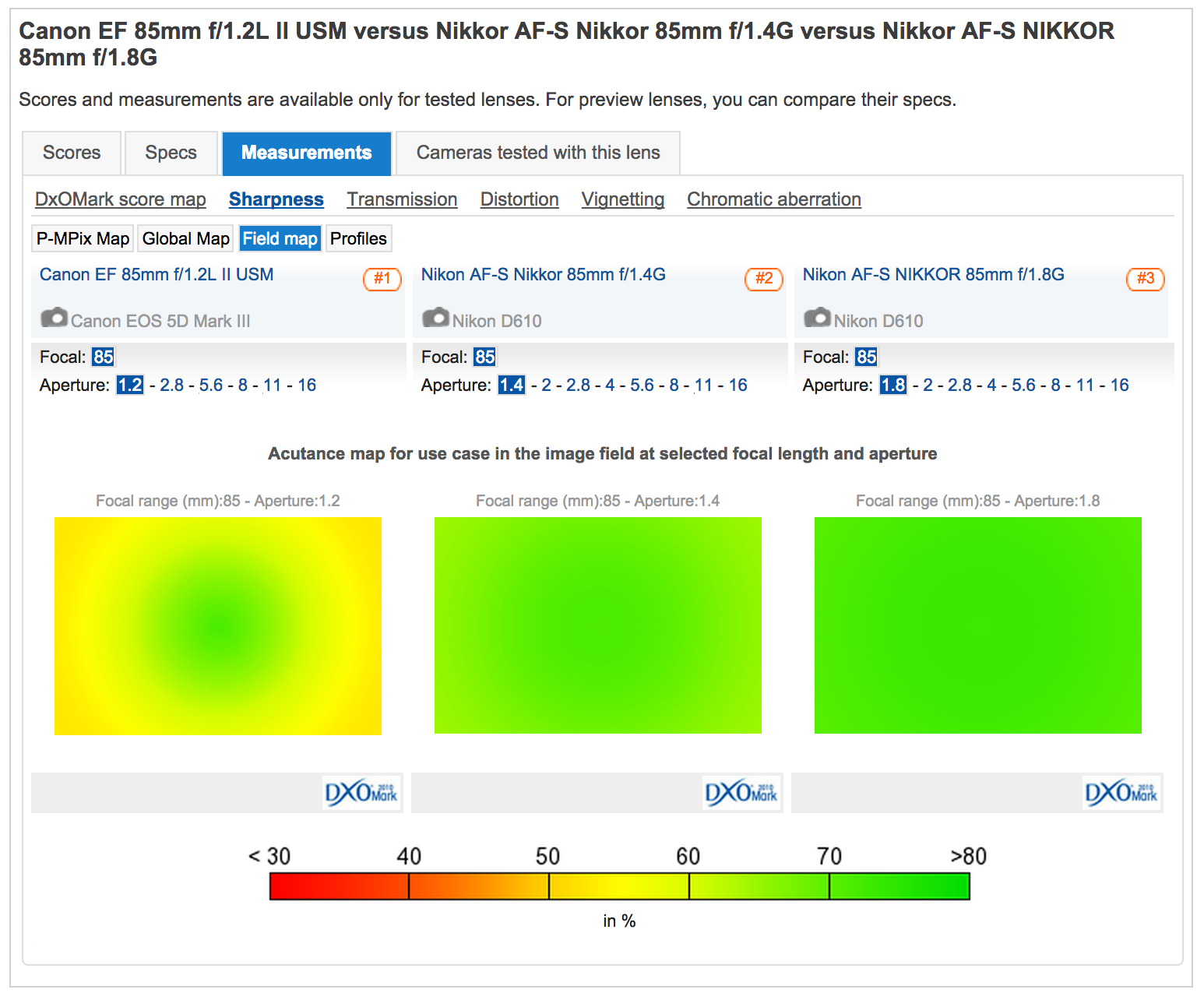
And why don't we talk about 85mm primes now, a workhorse for weddings? The Canon 85/1.2 is so slow to focus that I've missed many shots, finally opting to go with a 85/1.8, only to find its focus precision was quite poor. The Nikkor 85mm primes, OTOH, are great in terms of focus speed. Why would you leave that out of your 'Canon primes are faster for weddings' blanket statement?

Not to mention the 85mm f/1.2's enormous CA on the sides such that it doesn't sharpen up until somewhere between f/2.8 and f/4:

Here's the Canon 85/1.2 vs Nikkor primes wide open:
Canon_vs_Nikon-85mmPrimes-1.png


Here's the 85/1.2 at f/2.8, where it's still not as sharp/uniform as the Nikon 85 primes at f/2 and f/1.8, respectively.
Canon_vs_Nikon-85mmPrimes-2.png


If you want to talk about advantages of the 5D Mark III focus system, talk about its cross-type points all over the frame, and its wider baseline diagonal points in the center of the frame.

*But to be fair, it's doubtful the D5200-D7100, with their 2,016-pixel RGB sensors, do it anywhere near as well the more pro-level bodies with their 91,000-pixel sensors. The higher the resolution of the metering sensor, the better. Then again, I was surprised even the 2,016-pixel metering sensor in the D7000 could aid subject tracking well, but it does a reasonably good job. Certainly much better than my 5D Mark III.

**Here's an example of how the 5D Mark III focus system works. Let's say the center point of the AF system detects a subject 10ft away, then you recompose, then the camera notices a subject 10ft away is now over the left-most AF point, and meanwhile there's now nothing at 10ft away at the center point. Therefore, the camera decides your subject has moved (or you've recomposed such that the subject is now at) the left-most AF point. But what if your subject moved to 9ft away during this time as well? Well, with some clever algorithms you could analyze all the focus points and see if there was some progression of a subject like this (I've assigned letters to specific focus points for ease of discussion):

[list type=decimal]
[*]Subject in center point (C) 10ft away
[*]Center point C no longer detects anything at 10ft, but the point just to its right (D) has a subject at 9.8ft
[*]Point D no longer detects a subject at 9.8ft, but the point to its right (E) detects a subject at 9.5ft.
[*]Point E no longer detects a subject at 9.5ft, but a point 6 points to the left (F) now detects a subject at 9.2ft.
[/list]

... and so on and so forth.

Are you starting to see how incredibly complex this can get, and how prone to failure this might be if the subject is moving like this in 3-axes and/or the movement is convoluted with you recomposing? Or another subject entering the frame at a similar depth?

Are you starting to see how using an image sensor (Sony SLT, or all mirrorless ILCs really), or a color sensor with some finite resolution to recognize color patterns (enough to detect a face, which we know RGB sensors can do given their face-detection ability) that communicates with the PDAF sensor might have the potential to perform significantly better?

Incidentally, many types of bird photography are unlikely to stress this type of system much, since you typically have one subject at a very distinctly different depth from everything else (the background or sky). And when the bird moves, its typically going to move along the depth-axis with measurable acceleration or deceleration - which allows the predictive AF to work quite well (and I've already said Canon does this very well). Also, keep in mind the DOF for extreme telephoto lenses at large subject distances. For example, 300mm at f/4 for a subject 30m away has a DOF of 2.3m, giving the AF system more room for error compared to a subject 1m away shot with a 35/1.4 where the DOF is 6.4cm (and where it's very, very easy for the subject to fall out of that DOF or for the photographer to move more than 6cm).
 
Upvote 0
pbr9 said:
Many thanks for taking your time with this, being in the process of choosing a couple of extra bodies at the moment, this cleared a couple of misconceptions i had, so thanks once again.

You're welcome, and thanks for taking the time to say this.

tat3406 said:
My 6D can do what the sample video show, only not so good when the subject too far from centre. I not sure what wrong with the 5D3.
In the 6D vs D600 video, 6D show it was bad when the subject move from far to near.

I didn't say the 5D3 can't do it, I said it can't do it anywhere near as well as a 1D X with iTR, or any modern Nikon with either a 2,016 or 91k-pixel RGB metering sensor (D7000/7100/5300/5200, D800/810, D4/s, D750, etc.).

And with the 6D's paltry 9 AF points... let's not even go there. The chances of there being an AF point where I actually want the focal point of my subject is vanishingly small.

3kramd5 said:
Are you saying you can slap on a fast prime, focus dead center, and then rotate ("recompose" generally involves much more rotation than translation, obviously) the camera about its own axis so the initial subject as seen by the AF unit goes from one side of the frame to the other (or at least from the borders of the PDAF sensors) and significantly out of the DOF and it will track it?

If so, that's cool and I do not believe my 5D3 could do such.

LOL, thank you for writing this :) And, yes, that's exactly what I'm saying. Again, just watch this video:
https://www.youtube.com/watch?v=C5J7zALyHic

It's literally that good, and even better on the DSLRs with the 91k-pixel RGB sensor.

Importantly, it can still track that well as you're changing distance to the subject, which is exactly where the 5D3 will get confused. That is, the 5D3 will be much more prone to losing the initial subject once you convolute 2D X-Y movement across the frame with distance changes as well. Unless there's only one or two subjects vastly separated from the background moving forward or backward with not too erratic shifts within a small timeframe in the depth/distance axis.

And this should come as no surprise if you follow my thought experiment in my last post in the ** footnote. In fact, once you understand just how the 5D Mark III AF tracking works (by looking at subject distances across all AF points, but never doing any subject/scene analysis to actually understand what your subject is), you'll be able to predict when/where it'll be good, and where a dedicated color/image sensor will be much better.
 
Upvote 0
jrista said:
sarangiman said:
jrista said:
Now, you claim that Canon cameras cannot track in the "Z" axis (which I can only assume means within the depth of the scene, towards or away from the photographer), or track in Z while also tracking in X/Y (vertically and horizontally within the frame).

No no no I don't claim that at all. I would never say the 5D3 isn't good at tracking in the Z-axis; in fact, it's phenomenal at it. You got my statement priorities completely backwards in your statement. I'm talking about the 5D3's ability to automatically move the AF point in the X-Y planes to stick with your initial subject as you recompose or the subject moves quickly & erratically in the X, Y, and Z planes.

I'm just going to nibble your post down to this one part, as I think this point is the clincher. So, first, some clarification is needed. When you do this focus and recompose thing...are you using all of the AF points...or are you in a single-point selection mode? If it is the former...then Canon cameras can do this...maybe not as well, but they can.

If you are doing the latter...using the single center point say, focusing on a subject, then recomposing and the Nikon AF system is then able to maintain the lock using OTHER AF points...then yes. You are correct, Canon cameras DO NOT do that. That is how Sony's new AF system works. I didn't quite get it at first when I first saw some videos explaining what Sony's AF was doing...but once I experimented with the 5D III and couldn't get it to do the same thing, I realized what was "new" about Sony's AF. I think that is a kick-ass feature...and I thought it was only a Sony thing. It would be interesting to me if Nikon has had that for a long time...but I would still like confirmation that that is indeed what your talking about.

jrista: Now please go try it on a Nikon D810, D4s, or D750 or what have you, and you'll be blown away by how 'kick-ass' it is on the Nikon's even without a high-resolution image sensor to do what Sony's doing.

We've essentially reached an impasse where you're not going to understand me any further until you just go and try it.

Now, while you may find Sony's AF 'kick-ass' in this manner (and it really is, especially coming over from Canon), in practice, it's not actually as good as Nikon. The A77 II can't keep up as quickly and accurately as the D810 can. So if you were impressed with the Sony... you're in for a pleasant surprise when you try Nikon's 3D tracking.

If I were to rate this sort of '3D tracking' ability, it'd go something like this:

Nikon D810/D750/D4 > Sony A77 II > Canon 1D X >> Canon 5D Mark III

Since I've tested all of these systems, perhaps you can get some idea of why, in my mind, the 5D Mark III lags so far behind compared to the 3 systems above it in my comparison above that I cannot use any positive descriptor when talking about it.

And - much like you - I want the best of both worlds. So I either want Canon to catch up to Nikon in this regard (b/c it still loses subjects more easily than Nikon and/or Sonly A77 II), or for Nikon to adopt some of Canon's significant benefits: more cross-type AF points, wider baseline sensors, and diagonal sensors, to name a few. So, if the inclusion of the metering sensor* in the 7D II is at all indicative of Canon's intentions to start putting these metering sensors in all their cameras (as Nikon has done for quite some time now), then that's *incredibly* exciting to me. B/c I might actually put up with Canon's sub-par image sensor (in terms of Raw DR) if the 5D Mark III replacement had all cross-type points, those dual cross-type center points, EV -3 focusing, along with a 150,000-pixel RGB metering sensor + iTR. As long as their iTR algorithms caught up to Nikon's 3D focus tracking algorithms, anyway. B/c as much as I love Nikon's huge DR for landscapes, and programmable Auto ISO for more intelligent fast-paced shooting, and EC in M mode with Auto ISO, for that matter, it's focus that remains the largest reason for me having to throw away shots (although, I experienced a huge increase in keepers stepping up from the 5D2 to the 5D3; I just wished I'd gotten either the 1D X or the D800 instead back then... but one was too heavy and the other was plagued by AF sensor miscalibration issues and also didn't really fit in my hand with its poorly designed grip). And therefore I applaud Canon for their focus on focus, if you'll excuse my pun. The 7D Mark II's AF sensor, inclusion of iTR, and dual-pixel AF all indicate Canon cares about AF. And that is, simply put: awesome. Because it's the biggest differentiator between mirrorless ILCs and DSLRs today.

I'm not saying all this matters for every type of photography. I'm just saying it can open up huge doors for certain types of photography. And can even idiot-proof a DSLR once you consider the impact of proper face detection & tracking with a traditional PDAF AF system (which, again, up until the release of the 7D II, only the 1D X had in the Canon line). Or, at the very least, make it easier for pros to focus on more important things, like lighting, composition, capturing the decisive moment, etc. Of course, I won't use face-detection AF for shallow DOF photography b/c you need to nail the eye -- and I'm not yet convinced that Nikon's 3D tracking and/or Canon's iTR are intelligent enough to focus on the eye of the face after detecting the face using the metering sensor.

*Though, I must say, I can't understand why they'd leave out spot-metering linked to the AF point, as it should be easy now that they've got that high-resolution metering sensor in there...
 
Upvote 0
jrista said:
Maybe a D800 would have nailed every shot...I'm a little skeptical of that, given that I still hear pros complaining about Nikon AF, and have read many reviews comparing the 1D X and D4 that clearly indicated Canon AF tracking was superior (although, possibly not your particular close-subject/thin DOF use case.)

Whoa, let's not conflate the 1D X and the 5D3 in this discussion. iTR on the 1D X makes it significantly better than the 5D3 for the type of focus tracking I'm talking about. Furthermore, yes I doubt sports photography stresses the AF system in the manner I'm talking about (remember what I said about DOF of telephoto lenses with large subject distances, and the relative changes in distances to subjects being smaller than for fast wide-angle primes at close subject distances), so there it's possible that the 1D X's diagonal, wider baseline sensors in the center, as well as more cross-type AF points in general, wins.

Also, there was that whole D800 miscalibration fiasco that sunk the collective opinion of Nikon's AF. And I wonder how much of that persists across other cameras - the factories have to individually calibrate every AF point on the sensor! Who does that better? Who knows? I know there are at least a couple of AF points in my 61 point 5D3 sensor that are out of whack compared to the AF points right around it... indicating a miscalibrated point (and not a general skew). This systems are incredibly complex, so I'm not surprised there are a variety of opinions out there.

Also, someone said earlier how Canon's presence is much more significant at the Olympics. That has changed over the years though...

Canon-Nikon-black-lenses.jpg


... and again, I'm not saying one system is better than the other for sports. I am not at all qualified to comment on that, as I haven't tested either system for sports. Actually, my feeling is that you don't strictly need subject recognition and tracking for sports photography, since a lot of the action is happening amongst subjects of similar distances from the camera. So, here, other things might matter more.

I'm only commenting on the type of tracking I've explained previously (and for the sake of my sanity, don't feel like repeating again here!).
 
Upvote 0
Maybe this video released by Sony will help get my point across:
https://www.youtube.com/watch?v=wy8TAGFC95o

Note how at 1:33 they stress how the AF system doesn't get 'distracted' - because it understands its subject from scene analysis of the imaging sensor. Same thing with the RGB metering sensors in the 1D X, and in Nikon cameras (albeit with much less resolution). And that has been my point all along.

Perhaps on-sensor PDAF and/or DPAF will eventually outperform what we see with DSLRs. I'm all for that. But for now, the best subject tracking is available in cameras that *have* a dedicated color sensor for subject tracking. Be it an image sensor, or a dedicated RGB metering sensor. Not a camera like the 5D Mark III that lacks both of these inputs when it comes to subject tracking.
 
Upvote 0
sarangiman said:
RLPhoto said:
I think your mesuabating to the point where your blaming gear for your shortcomings. Even if the Nikon is better at tracking, of what good is it if real photographers like jrista or the myriad of others here are already getting the results with the superb 61pt system in the situations you described. That just shows you don't know how to get the frames you want.

No, it means that a system without scene recognition for AF doesn't allow me to get the shots I want for some of my photography. Are you suggesting that 'real photographers like jrista or the myriad of others' represent the entire sample pool of photographers & potential types of photography in the entire world? It really takes some perverse logic to think you understand the needs of every photographer out there so well that you can say 'even if Nikon's AF tracking is better... it doesn't matter.'

Doesn't matter? So the entire focus problem has been completely solved in the industry? Everyone is able to get 100% hit-rate with any prime at f/1.4 under any circumstance?

And - measurebating? Really there's no winning with you. When we're talking about numbers and equations, we're measurebating. When we're talking about real world experience with fast primes and ability of the camera to keep up as a subject moves around erratically, we're still measurebating! I'm saying that a scene recognition system is so good at tracking a subject accurately in 3 dimensions that after you've used it, you just cannot say the 5D III is good at it. Yes it can do it, but it gets confused very easily. And if you just took a minute to think about how the 5DIII is doing it, vs. how the 1D X and 7D II and Nikons are doing it, you wouldn't be at all surprised either. Go back to my thought experiment I posed to jrista in one of my responses, and see if you can understand why an image sensor is much better at tracking than the algorithm the 5D III uses. For your convenience, I've posted it at the end of this post.**

Btw, here's the new Samsung NX1 doing it, with PDAF sensors all over the sensor:
https://www.youtube.com/watch?v=IMYhZ18tKk4

But I suppose that's useless, since the 5DIII is obviously good enough for jrista & a myriad others and therefore every photographer in the entire world.

By the way, did you know that most current Nikon DSLR can focus on faces outside of Live View* (using traditional PDAF and OVF viewing)? Down to the D5200, I believe. And any Sony SLT, of course? Meanwhile, up until the release of the 7D II, only the 1D X could. Because it was the only camera with a separate color sensor for scene analysis. If your face happened to be the closest subject, sure a 5D III would focus on it in 'auto AF area' mode. Have a flower, or any other subject in front of the face, and the 5DIII focuses on that instead. Switch to a 1D X with iTR, and it'll focus on the closest (or biggest, I'm not sure) face, and track it as well. Not a big deal for me, but great when I hand off the camera to a family member to take a photo.

So now with the introduction of the 7D Mark II, do you think the inclusion of iTR with the RGB metering sensor is just a bunch of marketing hype? A 'me too' feature? Or do you think perhaps Canon is including it now b/c its actually of some utility?

Because, at the crux of it, you're essentially arguing that iTR is completely useless. And I completely, radically disagree.

RLPhoto said:
Now if you want to complain about something legitimate, then point out the lack of AF point metering because that really does suck at times but saying the 5D3s AF is bad at tracking means that you didn't RTFM.

I did point that out. Almost every Nikon camera, down to the D5200, has spot-metering linked to the AF point. Because that's yet another thing the RGB metering sensor enables.

Just b/c you don't think the metering sensor 'seeing the scene' and providing face-detection & subject tracking isn't useful, doesn't mean it's not, or that I didn't RTFM.

What's your point of repeating the phrase 'RTFM' other than to incite me? Do you think that phrase is conducive to intelligent discussion?

RLPhoto said:
and yes, the nikkor G primes still AF like a slug and that alone shifts AF speed to canons for weddings. (And I've shot a lot of them only with primes.)

Demonstrably false, and yet another blanket, unsubstantiatad statement. The Nikkor 24/1.4 keeps up no better than the 24/1.4 on a 5DIII in terms of speed of Z-axis tracking in my limited testing of them side by side. Perhaps a very controlled scientific study might demonstrate otherwise, but like a slug? I don't think so.

The Sigma 35mm f/1.4 is even better (and meanwhile retains full 3D focus tracking ability, since it reports distance information).

And why don't we talk about 85mm primes now, a workhorse for weddings? The Canon 85/1.2 is so slow to focus that I've missed many shots, finally opting to go with a 85/1.8, only to find its focus precision was quite poor. The Nikkor 85mm primes, OTOH, are great in terms of focus speed. Why would you leave that out of your 'Canon primes are faster for weddings' blanket statement?

Not to mention the 85mm f/1.2's enormous CA on the sides such that it doesn't sharpen up until somewhere between f/2.8 and f/4:

Here's the Canon 85/1.2 vs Nikkor primes wide open:
Canon_vs_Nikon-85mmPrimes-1.png


Here's the 85/1.2 at f/2.8, where it's still not as sharp/uniform as the Nikon 85 primes at f/2 and f/1.8, respectively.
Canon_vs_Nikon-85mmPrimes-2.png


If you want to talk about advantages of the 5D Mark III focus system, talk about its cross-type points all over the frame, and its wider baseline diagonal points in the center of the frame.

*But to be fair, it's doubtful the D5200-D7100, with their 2,016-pixel RGB sensors, do it anywhere near as well the more pro-level bodies with their 91,000-pixel sensors. The higher the resolution of the metering sensor, the better. Then again, I was surprised even the 2,016-pixel metering sensor in the D7000 could aid subject tracking well, but it does a reasonably good job. Certainly much better than my 5D Mark III.

**Here's an example of how the 5D Mark III focus system works. Let's say the center point of the AF system detects a subject 10ft away, then you recompose, then the camera notices a subject 10ft away is now over the left-most AF point, and meanwhile there's now nothing at 10ft away at the center point. Therefore, the camera decides your subject has moved (or you've recomposed such that the subject is now at) the left-most AF point. But what if your subject moved to 9ft away during this time as well? Well, with some clever algorithms you could analyze all the focus points and see if there was some progression of a subject like this (I've assigned letters to specific focus points for ease of discussion):

[list type=decimal]
[*]Subject in center point (C) 10ft away
[*]Center point C no longer detects anything at 10ft, but the point just to its right (D) has a subject at 9.8ft
[*]Point D no longer detects a subject at 9.8ft, but the point to its right (E) detects a subject at 9.5ft.
[*]Point E no longer detects a subject at 9.5ft, but a point 6 points to the left (F) now detects a subject at 9.2ft.
[/list]

... and so on and so forth.

Are you starting to see how incredibly complex this can get, and how prone to failure this might be if the subject is moving like this in 3-axes and/or the movement is convoluted with you recomposing? Or another subject entering the frame at a similar depth?

Are you starting to see how using an image sensor (Sony SLT, or all mirrorless ILCs really), or a color sensor with some finite resolution to recognize color patterns (enough to detect a face, which we know RGB sensors can do given their face-detection ability) that communicates with the PDAF sensor might have the potential to perform significantly better?

Incidentally, many types of bird photography are unlikely to stress this type of system much, since you typically have one subject at a very distinctly different depth from everything else (the background or sky). And when the bird moves, its typically going to move along the depth-axis with measurable acceleration or deceleration - which allows the predictive AF to work quite well (and I've already said Canon does this very well). Also, keep in mind the DOF for extreme telephoto lenses at large subject distances. For example, 300mm at f/4 for a subject 30m away has a DOF of 2.3m, giving the AF system more room for error compared to a subject 1m away shot with a 35/1.4 where the DOF is 6.4cm (and where it's very, very easy for the subject to fall out of that DOF or for the photographer to move more than 6cm).
TLDR;

This post in itself proves my point of your measurbating. Please move along.
 
Upvote 0
Bombom said:
Nikons D8xx (Sonys Exmor sensors) are better for landscape shooter.
There is nothing to talk about, it´s a fact.

I can agree with you that when you really can go into the pixel itself. Yes, there is more detail because of the higher resolution. However, in our local photo club and in school, when we all take photo's of the same landscape, we all can immediately see the full frame sensors when we compare photos afterwards, and for sure in combination with good lenses. However, no one can see on the difference between the 5D3 and the Nikon D800, D810. The difference can be found back when we compare in LR into deep detail, but in no other way.

If I would only do landscape, and needed to buy a camera, and not having all the Canon gear, I think I also would choose for the D810. However for action my 5D3 is still very great in combination with my lenses. I would not choose on current situation for Nikon if I was mainly shooting action.
 
Upvote 0
FEBS said:
Bombom said:
Nikons D8xx (Sonys Exmor sensors) are better for landscape shooter.
There is nothing to talk about, it´s a fact.

I can agree with you that when you really can go into the pixel itself. Yes, there is more detail because of the higher resolution. However, in our local photo club and in school, when we all take photo's of the same landscape, we all can immediately see the full frame sensors when we compare photos afterwards, and for sure in combination with good lenses. However, no one can see on the difference between the 5D3 and the Nikon D800, D810. The difference can be found back when we compare in LR into deep detail, but in no other way.

Good to hear from other people who have practical experience between D8xx and 5DIII. This is why so many landscape orientated photographers that use FF ( as opposed to something larger) use Canon.
 
Upvote 0
Bombom said:
Sporgon said:
FEBS said:
Bombom said:
Nikons D8xx (Sonys Exmor sensors) are better for landscape shooter.
There is nothing to talk about, it´s a fact.

I can agree with you that when you really can go into the pixel itself. Yes, there is more detail because of the higher resolution. However, in our local photo club and in school, when we all take photo's of the same landscape, we all can immediately see the full frame sensors when we compare photos afterwards, and for sure in combination with good lenses. However, no one can see on the difference between the 5D3 and the Nikon D800, D810. The difference can be found back when we compare in LR into deep detail, but in no other way.

Good to hear from other people who have practical experience between D8xx and 5DIII. This is why so many landscape orientated photographers that use FF ( as opposed to something larger) use Canon.

Sorry but that´s just blahblah.

How many Landscape shooter use Canon how many Nikon?
How many who would love to have a medium format digital camera choose Canon over Nikon?

Do you have any such statistics?

Not for you.
 
Upvote 0
jrista said:
The D800 resolves quite a lot more detail than the 5D III. That either translates into the ability to enlarge more with the same level of detail as smaller enlargements with the 5D III, or it translates into naturally crisper, sharper images when downsampling for smaller prints or online publication.

Are you saying that the 'naturally crisper, sharper images' from the 36 MP D8x0 can be readily and easily distinguished from images taken with a 24, 22, 20, or 18 MP FF sensor when downsampled for small prints or web-sized images?

Northrup said the 5DIII was ok for Facebook, but you're saying the D810 would be better for Facebook?
 
Upvote 0
sarangiman said:
3kramd5 said:
Are you saying you can slap on a fast prime, focus dead center, and then rotate ("recompose" generally involves much more rotation than translation, obviously) the camera about its own axis so the initial subject as seen by the AF unit goes from one side of the frame to the other (or at least from the borders of the PDAF sensors) and significantly out of the DOF and it will track it?

If so, that's cool and I do not believe my 5D3 could do such.

LOL, thank you for writing this :) And, yes, that's exactly what I'm saying. Again, just watch this video:
https://www.youtube.com/watch?v=C5J7zALyHic

It doesn't look like the camera is rotating much (maybe 5 degrees with a rather wide DOF).

I'll give it a shot this evening with a 5D3 just to satisfy the curiosity.
 
Upvote 0
jrista said:
Sorry, but there is a relatively large difference in detail between the two. That has nothing to do with dynamic range, simply the pixel size. The D800 resolves quite a lot more detail than the 5D III. That either translates into the ability to enlarge more with the same level of detail as smaller enlargements with the 5D III, or it translates into naturally crisper, sharper images when downsampling for smaller prints or online publication.

"Large difference in detail" #1

http://s11.postimg.org/kyh7iwp8j/5d3_d810_1.jpg

"Large difference in detail" #2

http://s16.postimg.org/i7ha1whwl/5d3_d810_2.jpg

"Large difference in detail" #2

http://s24.postimg.org/swj8ybket/5d3_d810_3.jpg

All images: left 5D mark III, right Nikon D810, DPReview studio scene RAW files at ISO 100 / NR0 converted using ACR standard settings. 5D3 file was resized to match (Bicubic Sharper) and then had light sharpening applied. I encourage everyone to download test files such as these and try them for yourself.

At best one can say tiny high contrast details are rendered a little better at pixel peeping sizes, and the D810 will sometimes pick up light, small patterns or textures missed on the 5D3. Shown at 50% on a 96 ppi monitor (i.e. 25x40" print) this stuff would be invisible. In print it would be invisible without a loupe.

We are well into diminishing returns for small format. People talk endlessly about AA filters and 22/24 vs. 36 MP yet they hardly matter at all even when pixel peeping tripod mounted shots made with primes at optimum apertures. Subject lighting, lens, technique, post processing, each 1,000x more important to fine detail and sharpness. I hope when Canon releases a high MP body they A) don't charge 1D prices, and B) shoot past 50 MP even if high ISO suffers. Because at this point I'm wondering if even >50 MP would yield truly significant differences in print without also jumping to a MF sized sensor.

This, btw, is why I'm going with the Sony A7 over the A7R. I see the exact same thing there. I would rather have electronic first curtain shutter, the phase detect points, and the extra cash in my pocket for lenses.

Correction: this is the Imaging Resource studio scene (RAW / ISO 100 / NR0 / converted by me using ACR standard). I had these files on my HD already from when I was comparing 5D3 / A7 / A7R / D8x0. Sorry about that.
 
Upvote 0