TS-E Depth of Field newbie question

LovePhotography

Texas Not Taxes.
Aug 24, 2014
263
13
5,650
I don't have a tilt shift lens. And so, this is a naïve question. I know that...
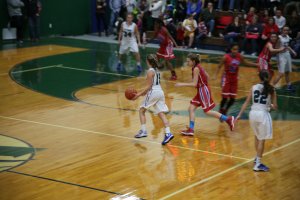
I'd like to get a TS lens, but not just for tripod photographs of landscapes or tall buildings. I'd like the increased depth of field for things like basketball games, when (when you are up in the crow's nest) you can have players quite close and quite far away, and ideally all would be in focus.
I've read where it takes so long to get a TS shot just right. But isn't there, in theory, a lens angle setting that would maximize DOF no matter what direction you point the camera? In other words, once you get what you want as far as exposure, etc., before the game starts, you could shoot quickly and basically everything (give or take) be in focus? (See throw-away shot below that illustrates what I'm talking about. This isn't a great shot or anything, but it would be nice if he girl down by the baseline was also in focus. Or the parents/students in the bleachers even). You never know at a sporting event what interesting stuff is going on away from the main focus of the photo.

(p.s.- in advance of the usual flaming that comes on this website from those for whom photography is not an adequate solution for a deep-seated personality disorder, I understand the problems with this photo regarding needing higher ISO 6400 or more, 1/1000 shutter speed, adding +1 EV for reflections, using an f/2.8 here, post processing, etc. This was a spontaneous off the cuff shot done in "creative sports mode". The main thing I was simultaneously up there to do was video. The point of the question is DOF, not motion blur, etc.)
 

Attachments

  • IMG_7877.JPG
    IMG_7877.JPG
    949 KB · Views: 182
Unfortunately not.

For starters you'd be using a lens with no zoom, a slow aperture and no AF - not exactly a good recipe for sports. Then, throw in all the other manual settings such as the tilt and the rotation of the elements, and you end up with a locked into one position on a tripod solution.

It is a misconception that a TS lens increases DoF. It does not. Like any lens, it has a plane of focus, and the depth of what is acceptably in focus is controlled by the aperture (and subject distance). How it differs is you can angle this plane of focus so it is no longer parallel to the sensor. This means that for two dimensional objects such as a peice of paper, even at an angle, with lots of patience, tweaking, experience, and magnified live view, you could potentially get all of it to lie perfectly within the plane of focus. Move the camera a touch, and you'd need to readjust it all to get it back. And to make matters worse, if that was a three dimensional object, everything above or below the piece of paper would be out of focus.

If you really want an approximation of everything in focus in a three dimensional action scene, try either using very small apertures with very high ISO's, or do the equivalent of such by using a small sensor camera like an iPhone.
 
Upvote 0
The best thing to do is test, test, test. It is possible to hand-hold a T&S lens, it's done more often than you'd think.

What you need to do is learn something about how a T&S lens focuses http://www.trenholm.org/hmmerk/VCFaDOF1.pdf and http://www.trenholm.org/hmmerk/VCFaDOF2.pdf

To test, rent a T&S lens of the proper focal length. Set up a tripod at the location you will shoot from and play-around with ISO, f/stop, shutter speed and focus. If you can get acceptable focus, and a fast enough shutter speed then remove the camera from the tripod and see what you can do hand-held. I often use T&S lenses, and this is exactly what I'd do.
 
Upvote 0
LovePhotography said:
(p.s.- in advance of the usual flaming that comes on this website from those for whom photography is not an adequate solution for a deep-seated personality disorder

Haha, this is brilliant.

I used to own the 24mm ts-e, currently own an arsat 80mm ts and have played with lensbabies for years, including the 'lockable' composer, although I'll confess to never having used a ts-e for sports.

I think the problem would be that whilst you could get the near edge and far edge of the court and everything in between on that plane pin sharp, the players are perpendicular to that plane, the nets are perpendicular to that plane, the foreground and background audience are raked away from that plane, to the risk is that you would end up with all the important game stuff being more off the plane the higher the ball goes the higher the player jumps etc. The effect on the near of far off plane audience could look potentially like the dreaded fake minatures... an effect that can begin to grate quite quickly.

There is maybe something to using a fast prime lens with the right reach for the crop you want from your postion.
The further way you are from the subject the greater your depth of field, so you may find that you don't have to stop down too much to get the desired depth of field at apertures that still let you keep the iso in check and the shutter high.

The other benefit of faster lenses is that they reach their peak when cheaper lenses are still putting their socks on.

A 50mm prime at f5.6 is going to be way sharper than an kit 18-55 set at 50mm wide open (effectively f5.6) especially in the corners, which shall help your application. You would probably find that even at f2.8 the prime would be sharper, if you could live with the reduced depth of field...

Just an alternative approach....
 
Upvote 0
I won't flame as I think this is actually a decent idea, but you would need a tripod for best results. If you got there early and set the camera up for half court+ view, tilted and focused, you could probably get decent results at f/4 with more DOF than you would have shooting f/4 with a normal lens. You could lock it down and have a trigger ready to fire should you need it. That aperture is going to be very slow in anything other than a well-lit gym, but you already know that.

Also, to answer your other question, no T/S isn't a set & forget kind of thing like focus on an ultrawide. As soon as you tilt the lens any direction (up or down) other than where you set the tilt & focus, it all has to be set again. It might be close, but it probably won't be right and it could also be way wrong totally ruining the shot.

Typically, though, the spectacular use for a T/S lens in sports is to blur everything and get that one key player at that one key moment such as (Vincent Laforet's US Open photo). I'm planning a similar shot for a sports event I'm shooting in March, I'm sure it won't be easy...
 
Upvote 0
You are somewhat on the right track, but perhaps hoping for more than what a tilt-shift lens actually provides.

A tilt-shift lens tilts and shifts the plane of focus. But there is still a plane of focus.

A plane is simply a 2D cross-section (i.e. slice) through 3-dimensional space.

So you could set up your tilt-shift lens to capture everything in perfect focus that was in the plane exactly 6 feet above the basketball court. This would probably render everything from 10 feet down to the ground in acceptably sharp focus.

But the other equally important thing to remember is that a plane is, by definition, not curved.

So to continue this example, your plane of focus as described above, would only be able to capture the part of the crowd that is in the plane 6 feet off the ground in perfect focus, and only the part from 10 feet down to the ground in acceptable focus.

Of course, you could then change your TS-E lens so that the plane of focus was at a 45 degree angle and captured 3 feet above the slant of the bleachers in perfect focus. Therefore, the faces of everyone sitting down in the bleachers would be in perfect focus. But someone standing up would be sightly out of focus. You get the idea.

You still have a great idea, but just remember that a plane of focus is like a giant infinite piece of perfectly flat cardboard which can be slanted/tilted/shifted to any angle and placed at any position, except that the piece of cardboard is unable to be curved or bent. Any part of a scene which could be simultaneously in contact with one infinite piece of perfectly flat cardboard could also be brought into perfect focus in a single picture with a tilt-shift lens.
 
Upvote 0
You could do this quite easily, and whilst I don't have the time now I will elaborate later if you are interested. You would need a leveled panning tripod head for best results.

P.S. I use TS-E lenses on a daily basis.
 
Upvote 0
Dear Friend Mr. LovePhotography.
Well, In my Idea, You use the Wrong Lens for the Wrong Purpose.
TS-E Lenses are not the Sport shooting Lenses :
1) Manual focus are very difficult to spot the fast running targets.
2) If you use High Number of F. Stop such as 8.0 and above, Yes- If you use TS-E 90 mm. F/ 2.8 for shoot the Basketball games , For the Light like that, If you use F =2.8, With in 40 feet target , You will have a sharp DOF only from 37 feet to 43.5 feet= Just 6.5 feet from 40 feet target. And You do not have enough time to do manual Focus and get the perfected , sharp pictures.. NOW, If you set F= 8.0 , With 40 feet Target, The Sharpness from 32 feet up to 52 feet---BUT, you need to jack up ISO= very high, and get a lot of NOISE in the photos.
www.dofmaster.com
3) There are So Many Sport shooting Fast Lenses , Such as 135 F/ 2.0 L , 200 mm F/ 2.8 L II, 100 mm. F/ 2.8 L IS MACRO., 70-200 F/ 2.8 L IS MK II + 1.4 X, or + 2X---These Lenses , you can hand held and shoot with SS = 1/ 250 Sec. + , With AI Servo AF and you will get the best/ Sharp Pictures
4) I recommend you to use monopod to shoot Sports Activity..

Yes, My TS-E 24 mm. F/ 3.5 L MK II is the Best of The Best Scenic/ Landscape Lens and with me 95% when I go out side.
Happy New Year, 2015, Sir.
Surapon
 

Attachments

  • SP0179.JPG
    SP0179.JPG
    1.6 MB · Views: 177
  • SP0180.JPG
    SP0180.JPG
    1.6 MB · Views: 156
  • SP0181.JPG
    SP0181.JPG
    918.1 KB · Views: 154
  • SP0188.JPG
    SP0188.JPG
    1.8 MB · Views: 167
Upvote 0
Focus for a Tilt & Shift lens is a Cone. See first page http://www.trenholm.org/hmmerk/VCFaDOF2.pdf
The farther you go along the hinge line the larger the diameter, so it is possible to have the basket in focus.

Shooting this outdoors on a Schoolyard Black Top Basket Ball Court would not be a problem to hand-hold (lots of light).

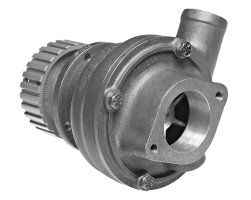
Focus and Acceptable Focus There's a thing called Depth of Field. You don't have to be at the point of Perfect Focus to be in Acceptable Focus. Notice that both the gear teeth (at the back) and the threaded holes (at the front) are in acceptable focus, even though they are at 90° to each other.
 

Attachments

  • Offy Pump on Whitex.51.jpg
    Offy Pump on Whitex.51.jpg
    439.4 KB · Views: 165
Upvote 0
c.d.embrey said:
...... both the gear teeth (at the back) and the threaded holes (at the front) are in acceptable focus, even though they are at 90° to each other.
I think you meant to present a concept differently than you have and I'm clueless about your actual intent.
All the threaded holes visible in the Offenhauser pump pictured are actually very parallel (0°) to the gear teeth.
Can you please re-phrase for clarification?
 
Upvote 0
c.d.embrey said:
Focus for a Tilt & Shift lens is a Cone. See first page http://www.trenholm.org/hmmerk/VCFaDOF2.pdf
The farther you go along the hinge line the larger the diameter, so it is possible to have the basket in focus.

Shooting this outdoors on a Schoolyard Black Top Basket Ball Court would not be a problem to hand-hold (lots of light).

Focus and Acceptable Focus There's a thing called Depth of Field. You don't have to be at the point of Perfect Focus to be in Acceptable Focus. Notice that both the gear teeth (at the back) and the threaded holes (at the front) are in acceptable focus, even though they are at 90° to each other.

No, it isn't a cone, the plane of focus is a plane not a point, so the area of acceptable focus is a wedge shape, like a piece of cheese or cake, on its side for tilt and, in a 'normal' orientation for swing.
 
Upvote 0
privatebydesign said:
No, it isn't a cone, the plane of focus is a plane not a point, so the area of acceptable focus is a wedge shape, like a piece of cheese or cake, on its side for tilt and, in a 'normal' orientation for swing.

Cone ... wedge, whatever. You do see the that the focus widens as you travel farther along the hinge line, which is the point.
 
Upvote 0
tolusina said:
c.d.embrey said:
...... both the gear teeth (at the back) and the threaded holes (at the front) are in acceptable focus, even though they are at 90° to each other.
I think you meant to present a concept differently than you have and I'm clueless about your actual intent.
All the threaded holes visible in the Offenhauser pump pictured are actually very parallel (0°) to the gear teeth.
Can you please re-phrase for clarification?

The removale front of the pump is one leg of an "L." The body of the pump is the other leg of an "L." Where the two legs of the "L" meet is a 90° angle, forming two different planes. Both the side of the body (one plane of the "L"), and the removable front piece (the other plane of the "L") are on two different planes. Both planes are in Acceptable Focus, but how can this be ??? Some posters have said that only one plane can be in focus, therefore I must have made a very large mistake because my photo clearly shows two planes in Acceptable Focus ;)
 
Upvote 0
I might have cane across as one of the one, just for clarity, what I meant, if not exactly what I said, was that the swing lens would let you get the plane of the court perfectly in focus, but the farther perpendicular you are to that axis (nets, jumping, all the activity takes place on unpredictable varying perpendicular axis) the more you risk going outside the sweet zone of acceptable focus.

This would be more prevalent at extreme swings (the court itself is perpendicular to the natural camera position) and wide apertures (which we would be using to keep the iso reasonsble and shutter high)

As I went onto say I think there are better ways to crack this particular nut.

May I suggest some more, rather than trying toncatch all, prefocus on the nets, or in the likely dunk position, or use an aperture with a little more latitude, if you want dribbling try some slow shutter panning.

Tse might be great for shooting a chess board, basketball? not so sure
 
Upvote 0
Appreciate all the thoughtful (and civilized) input. Gonna try to rent one or buy a good deal on ebay. Sometimes you can buy and resell for about the same price as rent. Plus, want one anyway. Any other input still welcomed and appreciated. Anybody else use one for other then static composed tripod shots?
 
Upvote 0
c.d.embrey said:
privatebydesign said:
No, it isn't a cone, the plane of focus is a plane not a point, so the area of acceptable focus is a wedge shape, like a piece of cheese or cake, on its side for tilt and, in a 'normal' orientation for swing.

Cone ... wedge, whatever. You do see the that the focus widens as you travel farther along the hinge line, which is the point.

If you are going to try and explain a subject, it helps greatly if you do it accurately, call me fussy but what is the point of spreading erroneous or incorrect information?

Anyway, there is a major difference from an image point of view between a cone and a wedge, and you don't travel further along the hinge line, the hinge line is always on the same plane as the lens entrance pupil parallel to the sensor plane the key is how far away from the sensor that hinge line is. The much talked about Scheimpflug line is where the plane of the lens intersects the plane of the sensor. The two gif's on this page, made by the seminal author on this stuff, Harold Merklinger, illustrate the core difference between tilt and focus when tilt is applied. http://www.northlight-images.co.uk/article_pages/using_tilt.html

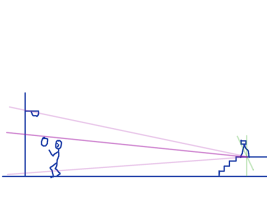
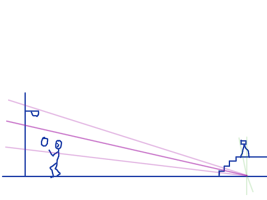
So in the OP's scenario he is in the bleachers, the three (very rough :-) ) diagrams below illustrate the scenario.
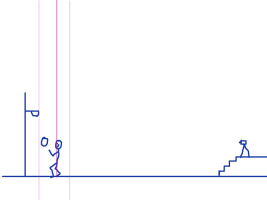
First is normal shot with the camera on a tripod, the darker purple line being the plane of focus and the two lighter purple lines being the planes of acceptable focus (dof).

The second illustrates the lens tilted forwards a little less than 1º, the plane of focus hinges around a line around ten feet below the camera, you can adjust the angle to the ground of the entire wedge of acceptable dof with focus, aperture makes the wedge wider and narrower, but focus swivels the entire wedge about the hinge line.

The third illustrates the lens tilted around 2º to put the hinge line around 4 feet below the camera.

Now I didn't go in to the calculations for actual dof because we don't know the actual height and distance, but that is how it could work.

To refine the shoot I'd put the camera center court and set it up on a level tripod so I could pan to either end for the same result. Also if you are very elevated you could tilt the tripod head forwards a little to help the wedge angle (this is not the same as lens tilt), but an even nicer way to do that would be to use shift, put a little down shift on and you are golden.

This is a very interesting idea and I'd love to see the results when you try it out. To be sure, once the camera is set up in advance there would be no need to touch tilt or focus, just pan for framing.
 

Attachments

  • 1.png
    1.png
    6.3 KB · Views: 571
  • 2.png
    2.png
    14.4 KB · Views: 649
  • 3.png
    3.png
    12.5 KB · Views: 641
Upvote 0
LovePhotography said:
Appreciate all the thoughtful (and civilized) input. Gonna try to rent one or buy a good deal on ebay. Sometimes you can buy and resell for about the same price as rent. Plus, want one anyway. Any other input still welcomed and appreciated. Anybody else use one for other then static composed tripod shots?

Having used a wide TS-E for a while, I think you should do this. I just think it is one of those things we can 'imagine' what it might look like, but it's hard to visualize exactly without actually trying it.

Plus, just because no-one uses a TS-E that way doesn't mean it cant be done.

Exactly what it will look like will depend on your position and FL, and it could look like crap, or it could be OK. I agree it is likely that you will be limited in how much you can move without completely messing up the areas in focus though. But how much - I wouldn't like to speculate.
 
Upvote 0
Private, thank you for the diagrams and detailed explanation. It's much more elegant than the way I tried to word it! I think it's an interesting idea and hope he tries it as well.

Also, LovePhotography, TS-E lenses can be used handheld, even with tilt and shift set, but it's not as easy and leads to less predictable results. If you dial in the settings and pan it (only) on a carefully leveled tripod as we have suggested, it should give you the results you are looking for. If you put it in a video head with a pan bar and add a cable release wrapped or taped to the bar, it could be a pretty cool way to shoot a second camera. Keep in mind that there is a pretty decent learning curve when you first start using a T/S lens so be patient.
 
Upvote 0