tpatana said:If that were completely true, the focal plane is always horizontal no matter what, since that chart covers basically every tilt angle. It'd be just question of how high from ground the plane is, or how much below ground.
So what I'm saying, there's some missing piece on the puzzle that I haven't figured out yet.
I'm not quite sure what you mean by that, I may have misunderstood what exactly it is that you're missing (or I'm missing something myself; also very possible).
I would reformulate what you wrote to say :
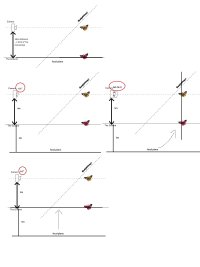
"The focal plane can always be set to a horizontal position (at a certain, specific focus distance), for any tilt angle, it's just a question of how high from the ground the plane is, or how much below ground".
I believe that statement is true (ignoring petty constraints such as limited tilt angles, close focusing ability of the lens or the existence of 100 meter high tripods).
But remember, once your tilt value is set, if you move your focus ring, your plane of focus tilts, and therefore does not remain horizontal. For a given tilt value, the plane of focus can only be horizontal at one specific focus distance. Consequently, at a given tilt value, you can only have a horizontal plane of focus at one specific height above or below ground.
Hence, if you want it to be horizontal AND on the ground (so at a given vertical distance from your camera), you need a specific tilt value, so that once you find the focus distance that gives you a horizontal plane, it happens to fall on the ground. At any other tilt value this wouldn't work. You could still create a horizontal plane of focus, but it would fall above or below ground level.
Hopefully I'm making things a bit clearer, apologies if I'm just confusing things even further

Upvote
0